Is the NISM Series VII book right for you? An honest guide
It is 10:40 at night. The branch closed late, the inspection queries are still in your head, and you have promised yourself that this month you will finally sit down with securities operations. The syllabus looks endless, every guide online claims to be "complete", and you have already bought one thing that is lying unopened.
So before anything else, let us answer one plain question: is the NISM Series VII book right for you? Not everyone needs it. This guide will help you decide, and it will leave you with a usable study method even if you never buy it.
First, what NISM Series VII actually asks of you
Series VII covers securities operations and risk management. In plain words: what happens after you press the buy or sell button. Who clears the trade, how risk is controlled, how settlement happens, what an investor can do when something goes wrong. If you have worked in a branch handling demat or trading accounts, some of this will feel familiar. If you have worked only on the loans or deposits side, much of it will feel like a new language.
That difference matters more than any book. Before you pick any material, be honest about which kind of reader you are. The profiles below are built around the four situations we see most often among working bankers.
For the official exam schedule and registration details, always check the IIBF website and the exam body's notices for the upcoming exam cycle. We do not quote dates or fees here because they change.
What is inside the book, by the numbers
The facts first, without adjectives. The NISM Series VII book is the 2026 edition, with 151 pages, 19 chapters and 285 practice questions. The chapters are grouped into four modules.
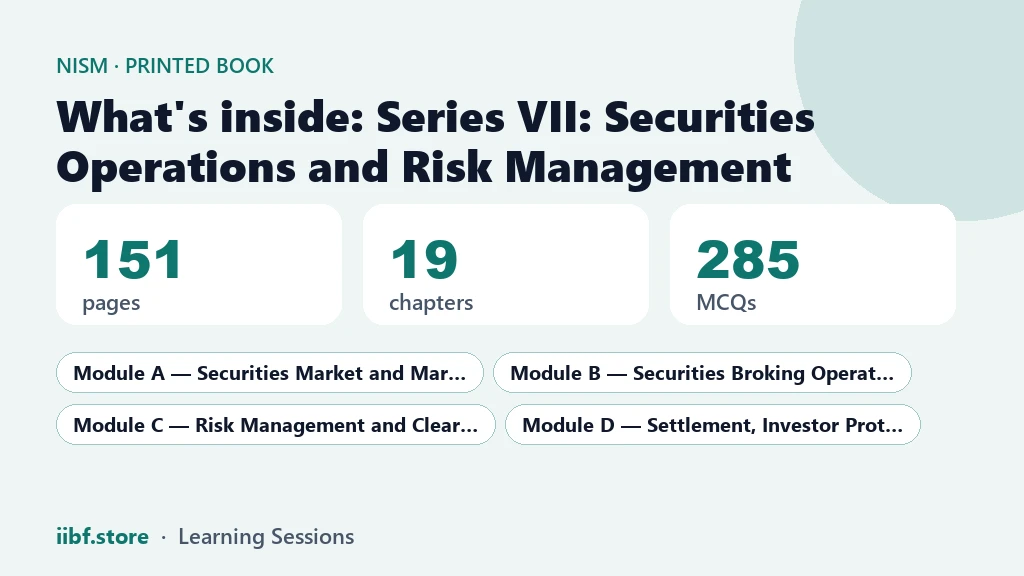
- Module A - Securities Market and Market Participants: 5 chapters on the securities market and who operates in it.
- Module B - Securities Broking Operations: 3 chapters on how broking operations run day to day.
- Module C - Risk Management and Clearing: 5 chapters, four on risk management and one on the clearing process.
- Module D - Settlement, Investor Protection and Other Broker Services: 6 chapters on settlement, investor grievances and arbitration, and other services brokers provide.
The book also lists two extras: 30 case studies (120 questions) and 5 mega tests (500 questions). Notice the shape: Module C has the most weight in chapter count together with Module A, so risk management and clearing deserve real time, not a last-night skim.
The current price on the book page is ₹700 against an MRP of ₹2,398 (71% off). Prices can change, so treat the book page as the final word.
Profile 1: You are attempting for the first time
If this is your first attempt, your biggest risk is not difficulty, it is vagueness. You do not yet know what the exam rewards: definitions, processes, or numerical reasoning.
How to use the book
- Read module by module, in order. Each module builds on the previous one: market and participants, then broking, then risk, then settlement.
- After each chapter, close the book and write three lines from memory. If you cannot, read it again tomorrow.
- Do the end-of-chapter questions the same day, while the material is fresh.
When it is not enough alone
A first-timer who only reads will feel confident and then freeze in the exam hall. Reading is recognition; the exam asks for recall. Add timed practice from the free mock tests as soon as you finish Module B, not after the whole book.
Profile 2: You have attempted before and want a cleaner second run
You do not need to start from page one. Repeat candidates usually fail on two or three weak areas, not on everything. Start with a diagnosis, not a re-read.
- Look at your last result or your memory of the paper. Which module felt worst: risk management, settlement, or the broker-side services?
- Attempt the questions of that module first, cold, before reading. Mark every miss.
- Read only the chapters behind your misses, then re-attempt.
For you, the 30 case studies and 5 mega tests listed in the book matter more than the chapters. They show whether your weak area is knowledge or application. Honest limit: if your last paper went wrong because of time pressure, no book fixes that. Only repeated timed practice does.
Profile 3: You have very little time
You work full time, travel to the branch, and your realistic budget is 45 minutes a day. At 151 pages, the book is short enough to finish without a sabbatical, and that is its real advantage for you. A shorter book you complete beats a thicker one you abandon at chapter six.
A simple way to plan the weeks
Work backwards from your exam date, which you should confirm on the official site. Then divide the 19 chapters into small daily slices. Many of the chapters are labelled Part 1, Part 2, Part 3, which means each slice is already sized for a single evening.
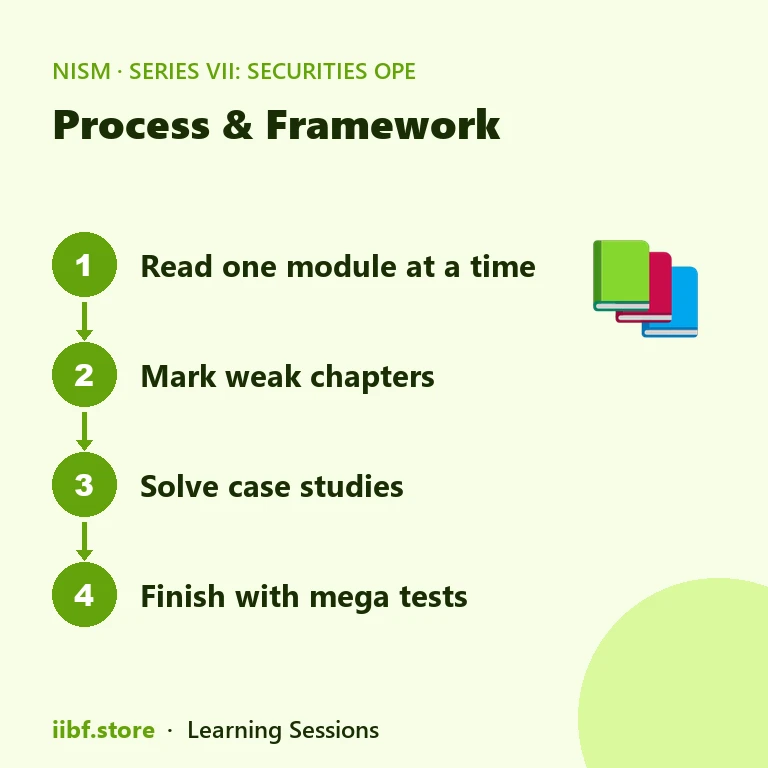
| Phase | What you do | Daily time |
|---|---|---|
| Read | One module, 1 to 2 chapter parts per evening | 40 to 45 min |
| Mark | Tick every chapter where you missed questions | 10 min |
| Apply | Case studies on the marked chapters | 30 min |
| Test | Mega tests on weekends, timed | 60 to 90 min |
Honest limit: if you can only study twice a week, no plan will turn a short book into a guarantee. Be realistic about how many weeks you actually need and book your exam accordingly.
Profile 4: You think better on paper than on a screen
Some people retain more when they hold the page, underline, and scribble in the margin. If that is you, the format matters. A printed book removes the tab-switching and notification problem entirely, which is a real gift when your only free hour is 11 at night and your phone is the enemy.
- Use two colours: one for definitions, one for processes such as the order of steps in clearing and settlement.
- Keep a single page at the back for numbers, limits and terms you keep forgetting.
- Do the questions in pencil first, so you can redo them without seeing your old answers.
The limit here is obvious: paper does not give you a timer or instant scoring. Pair it with the free study material and the online mock tests when you want exam-style pressure. You can browse other titles on the books page as well.
When the NISM Series VII book is the wrong choice
Being honest is cheaper than a refund. This book may not suit you if:
- You want a long, textbook-style treatment with every regulation reproduced. This is a compact 151-page book, not a reference library.
- You never plan to practise under a timer. Reading alone rarely clears a certification.
- You are not preparing for Series VII at all. Check the paper code against the official notice first.
If you are also thinking ahead to JAIIB or CAIIB, see the JAIIB course page and the blog for planning ideas, but do not mix papers in the same month.
Your decision, in one minute
Ask yourself three questions. Can I give 45 focused minutes most days? Will I attempt the case studies and mega tests rather than just read? Do I accept that a book is a tool, not a result? If the answers are yes, the NISM Series VII book is a sensible, affordable companion. If any answer is no, fix that first, with or without this book.
Whichever way you go, read the sample before paying anything. The book page has a free sample so you can judge the writing style and question quality yourself.
Frequently asked questions
Is the NISM Series VII book enough to pass on its own?
It is a solid base, but no book alone gives exam-hall speed. Use its questions, case studies and mega tests, and add timed mocks.
How many pages and chapters does it have?
The 2026 edition has 151 pages and 19 chapters, grouped into four modules, with 285 questions listed.
Can I read a sample before buying?
Yes. The book page offers a free sample. Prices change, so check the page for the current price.
Where do I find the official exam dates?
NISM Series VII is conducted by NISM, so always check the official NISM notices for the upcoming exam cycle. We do not quote dates because they change each cycle.
Prefer revising from a printed book?
Chapter-wise books with MCQs after every chapter — minimal pages, complete coverage, delivered anywhere in India. Every book has a free sample to read first.


















































Practice this topic
Take a free mock test, download chapter PDFs, or watch a video class — all included on iibf.store.