Certificate of Deposit and Commercial Paper: CAIIB BFM Guide
Your treasury head says the bank will raise another Rs 500 crore for ninety days through CDs, while a corporate customer walks in asking you to arrange funds through CP. Both are short-term, both are issued at a discount, both sit in the money market, and both are asked in CAIIB Bank Financial Management as if they were twins. They are not. This guide on certificate of deposit and commercial paper shows you exactly how they differ, what the RBI Directions say, and how the examiner turns the differences into traps.
Read it once for the concepts, then keep the comparison table and the revision points for the last week before the exam.
Why certificate of deposit and commercial paper matter in BFM
Bank Financial Management looks at a bank as a business that has to raise funds, deploy them and manage the gap between the two. The money market is where a bank adjusts its liquidity day to day, and the money market chapters of the BFM syllabus cover call and notice money, repo, treasury bills, certificates of deposit and commercial paper. Among these, the certificate of deposit and commercial paper pair is the favourite for comparison questions because the two look similar on the surface.
Here is the core difference in one line. A certificate of deposit (CD) is a liability of a bank: the bank sells it to raise short-term money. Commercial paper (CP) is a liability of a corporate or other non-bank issuer: the issuer sells it to raise short-term working capital, and the bank is typically an investor or a provider of credit support. Keep that one sentence in mind and half of the exam questions answer themselves.
If you are building the whole BFM paper from scratch, the CAIIB Bank Financial Management course covers the money market module in the same sequence as the IIBF syllabus.
What is a certificate of deposit?
A certificate of deposit is an unsecured, negotiable money market instrument issued by a bank against funds deposited with it for a fixed period. It is issued at a discount to face value (or with a coupon), and the investor gets the face value on maturity. Because it is negotiable, the holder can sell it in the secondary market before maturity instead of waiting.
The governing text is the RBI's Master Direction on Certificate of Deposit Directions, 2021, issued on 4 June 2021 and effective from 7 June 2021. You can read it on the RBI Master Directions page for CDs. The main features are:
- Issuers: scheduled commercial banks, regional rural banks and small finance banks. All India Financial Institutions raise CDs under their own resource-raising norms.
- Investors: CDs may be issued to all persons resident in India.
- Denomination: minimum Rs 5 lakh and in multiples of Rs 5 lakh thereafter.
- Tenor at issuance: not less than seven days and not more than one year.
- Form: only in dematerialised form, held with a SEBI-registered depository.
- Pricing: issued at a discount to face value; fixed or floating rates are allowed, and floating rate CDs reset at agreed periodic rests against a recognised benchmark.
- Buyback: permitted only after seven days from issue, offered to all investors in the issue on identical terms, at the prevailing market price.
- Loans against CDs: banks are not allowed to grant loans against CDs unless the RBI specifically permits.
Why banks issue CDs
A CD lets a bank raise a large, wholesale amount quickly, at a market-determined rate, for exactly the tenor it needs. When deposit growth lags credit growth, treasury often fills the gap with CDs. Because CDs are priced by the market and not fixed by the branch network, they also tell you how tight system liquidity is: when liquidity is tight, CD rates rise.
What the CD does to the bank's balance sheet
A CD is a liability, so it sits among borrowings or deposits on the liability side, and the Directions say that reserve requirements on CDs follow the relevant RBI regulations. Do not quote a CRR or SLR percentage in the exam unless the question gives it; the principle that CD liabilities attract reserve requirements under the prevailing regulations is what matters.
What is commercial paper?
Commercial paper is an unsecured, short-term promissory note issued by a creditworthy borrower to meet working capital needs. It is also issued at a discount and redeemed at face value. The current framework is the RBI Master Direction on Commercial Paper and Non-Convertible Debentures of original or initial maturity up to one year, issued on 3 January 2024 and effective from 1 April 2024. The text is on the RBI Master Directions page for CP and NCDs.
The key provisions you should know are:
- Eligible issuers: companies, NBFCs including housing finance companies, InvITs and REITs, All India Financial Institutions, any other body corporate with a minimum net worth of Rs 100 crore that is statutorily permitted to incur debt, and any entity specifically permitted by the RBI. Co-operative societies and LLPs are also eligible if their net worth is at least Rs 100 crore.
- Asset quality condition: all fund-based facilities the issuer has from banks, AIFIs or NBFCs must be classified as Standard at the time of issue.
- Credit rating: a minimum of A3 from a SEBI-registered credit rating agency.
- Investors: all residents, and non-residents to the extent permitted under FEMA, 1999. Nobody may invest in CP issued by a related party.
- Denomination: minimum Rs 5 lakh and multiples of Rs 5 lakh thereafter.
- Tenor: not less than seven days and not more than one year.
- Form: dematerialised, held with a SEBI-registered depository.
- Credit enhancement: banks and AIFIs may provide stand-by assistance or credit and back-stop facilities, subject to RBI prudential guidelines. Underwriting or co-acceptance of CP issues is not allowed.
Where the bank stands in a CP issue
Notice that scheduled commercial banks are not in the CP issuer list; the bank's own short-term instrument is the CD. A bank meets CP in three roles: as an investor of surplus funds, as a provider of stand-by credit or back-stop support, and as a banker to the issuer. The Directions bar underwriting and co-acceptance, which is a classic one-line exam trap.
Certificate of deposit and commercial paper side by side
This table is the single most useful revision aid for questions on certificate of deposit and commercial paper. Read the rows as if the examiner were drafting one statement per row, and one of the options will always be the twisted version.
| Feature | Certificate of deposit | Commercial paper |
|---|---|---|
| Who raises the money | Scheduled commercial banks, RRBs, SFBs | Companies, NBFCs, InvITs, REITs, AIFIs and other eligible entities |
| Purpose | Short-term funding for the bank | Working capital of the issuer |
| Minimum denomination | Rs 5 lakh, multiples of Rs 5 lakh | Rs 5 lakh, multiples of Rs 5 lakh |
| Tenor at issue | 7 days to 1 year | 7 days to 1 year |
| Form | Demat only | Demat only |
| Credit rating requirement | None prescribed in the CD Directions | Minimum A3 from a SEBI-registered agency |
| Buyback | Allowed after 7 days, at market price | Governed by the CP Directions |
| Loan against the instrument | Banks barred unless RBI permits | Not applicable as a CD-type bar |
| Credit support | Not applicable | Stand-by or back-stop facility from banks and AIFIs |
The similarities (denomination, tenor, demat form, discount pricing) are what make the pair easy to confuse. The differences (issuer type, rating requirement, credit support) are what the examiner tests.
How a discount instrument is priced: a worked example
Both instruments are bought at a price below face value and redeemed at face value. The gain is the difference. For a yield-quoted instrument, the price is:
Price = Face value / (1 + yield x days / 365)
Suppose a bank issues a 91-day CD of face value Rs 10 crore and the market yield is 7.00 per cent.
- Days to maturity: 91.
- Factor: 1 + (0.07 x 91 / 365) = 1.017452.
- Price: Rs 10,00,00,000 / 1.017452 = about Rs 9,82,84,730.
- Discount earned by the investor: about Rs 17,15,270.
Notice that the discount as a percentage of face value, annualised, works out to about 6.88 per cent, which is lower than the 7.00 per cent yield. This is the usual distinction between the discount rate and the yield: the discount rate is computed on the face value, the yield on the amount actually invested. If the question gives a discount rate, apply it on face value; if it gives a yield, use the formula above. The same arithmetic holds for CP.
When the yield rises, the price falls. A rise to 7.25 per cent on the same CD cuts the price to roughly Rs 9,82,24,557. That inverse movement is what makes a negotiable CD carry market risk before maturity, a point that connects to the bond pricing and duration chapters of BFM.
Step by step: issue to redemption
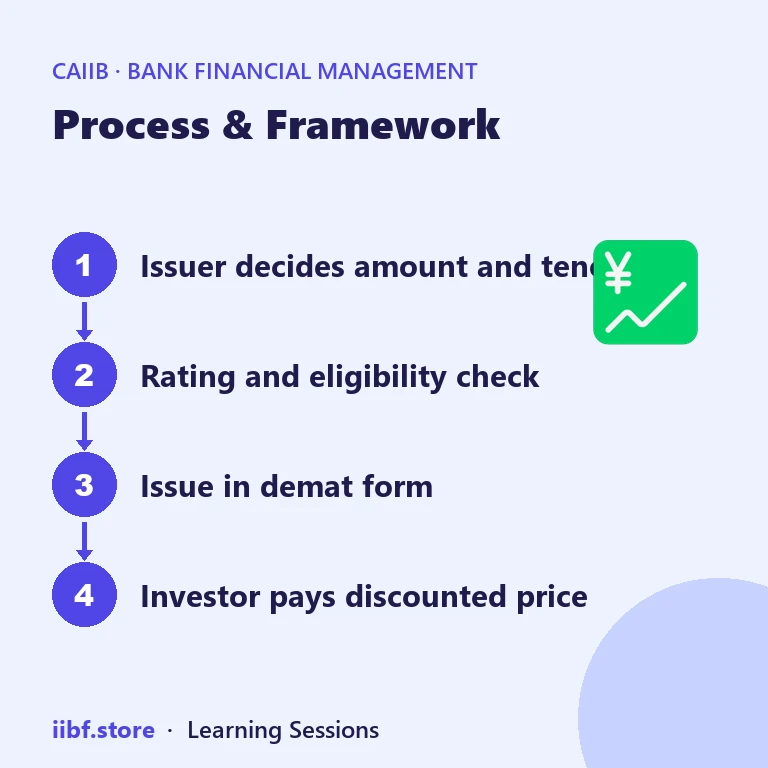
Whether it is a CD or a CP, the life of the instrument follows the same path. Learn this sequence once and you can answer a process question for either.
- Decide size and tenor. The issuer fixes the amount and the tenor within the seven-day to one-year window.
- Check eligibility. For CP, the issuer must satisfy the net worth, Standard-asset and minimum A3 rating tests. For CD, the issuer must be a bank category covered by the Directions.
- Issue in demat form. The instrument is credited to investors' accounts with a SEBI-registered depository.
- Investor pays the discounted price. The amount reaches the issuer on the issue date.
- Redemption at face value. On maturity, the issuer pays the face value. A CD may be bought back by the bank after seven days at the market price, and in that case the bought-back CD is extinguished.
How IIBF tests certificate of deposit and commercial paper
The examiner rarely asks for definitions alone. Questions on certificate of deposit and commercial paper come as statements to be marked true or false, or as odd-one-out options. These are the patterns you will meet.
Common traps
- Swapping the issuer. An option says a bank issues commercial paper to raise working capital. Wrong: the bank's instrument is the CD.
- Wrong tenor. An option says CDs have a minimum maturity of 15 days, or one year to three years. Both are wrong for bank CDs; the tenor at issuance is seven days to one year.
- Wrong denomination. Older books mention Rs 1 lakh. The present Directions say Rs 5 lakh and multiples of Rs 5 lakh, and this is the safe answer.
- Physical form. Both are issued only in demat form, so an option that allows a physical certificate is wrong.
- Underwriting by banks. The CP Directions bar underwriting and co-acceptance, while stand-by credit support is allowed within prudential rules.
- Loans against CDs. Banks cannot lend against CDs unless the RBI specifically permits it.
Three practice questions
Q1. Which one of the following is a feature of a certificate of deposit issued by a scheduled commercial bank?
(a) Minimum denomination Rs 1 lakh (b) Tenor at issuance of seven days to one year (c) Issued only in physical form (d) Banks may grant loans against it freely.
Answer: (b). The tenor at issuance is not less than seven days and not more than one year. Option (a) is the old denomination, (c) is wrong because CDs are demat only, and (d) is wrong because loans against CDs are barred unless the RBI permits.
Q2. A company wants to issue commercial paper. Which condition must it satisfy?
(a) Credit rating of at least A3 from a SEBI-registered agency (b) Bank underwriting of the issue (c) Physical certificates (d) Tenor of three years.
Answer: (a). The CP Directions require a minimum A3 rating. Underwriting and co-acceptance are not allowed, CP is demat only, and the tenor is seven days to one year.
Q3. The price of a 91-day CD with face value Rs 10 crore at a 7 per cent yield is closest to:
(a) Rs 9.83 crore (b) Rs 10.17 crore (c) Rs 9.30 crore (d) Rs 10 crore.
Answer: (a). Price equals face value divided by 1.017452, which is about Rs 9.828 crore. A price above face value is impossible for a discount instrument, so (b) and (d) can be dropped at once.
For more questions of this kind, work through the CAIIB mock tests after finishing the money market chapter, and revise the formulae from the BFM printed book with chapter-wise MCQs.
Connecting the instruments to branch and treasury work
You may never sit on the treasury desk, but the pair still touches your branch. A corporate borrower with a good rating may move part of its cash credit limit into CP, which changes the bank's fund-based exposure and the way you view the account. A mid-office colleague reconciling a CD issue checks the demat credit, the discount amount and the maturity date. Understanding certificate of deposit and commercial paper makes these conversations simpler and also helps you in the liquidity and asset-liability chapters, where short-term wholesale funding is a recurring theme.
The offer page for the CAIIB bundle is at iibf.store/offer/caiib, and the official exam schedule for the upcoming cycle is at iibf.org.in.
Quick revision points
- CD is a bank liability; CP is a non-bank issuer's liability.
- Both: minimum Rs 5 lakh and multiples of Rs 5 lakh; tenor seven days to one year; demat form only; issued at a discount.
- CD issuers: scheduled commercial banks, RRBs and SFBs. CD buyback only after seven days, at market price.
- Banks cannot lend against CDs unless the RBI permits.
- CP needs minimum A3 rating, Standard facilities at issue, and (for body corporates, co-operatives and LLPs) a net worth of at least Rs 100 crore.
- Banks may give CP stand-by or back-stop credit, but cannot underwrite or co-accept the issue.
- Price = Face value / (1 + yield x days / 365). Higher yield means lower price.
Frequently asked questions
Who can issue a certificate of deposit in India?
Under the RBI Certificate of Deposit Directions, 2021, scheduled commercial banks, regional rural banks and small finance banks can issue CDs. All India Financial Institutions raise CDs under their own resource-raising norms.
What is the minimum maturity of a certificate of deposit and of commercial paper?
For both instruments the tenor at issuance must be at least seven days and at most one year, as per the respective RBI Directions.
Can a bank issue commercial paper?
The CP Directions list companies, NBFCs, InvITs, REITs, AIFIs and other eligible entities as issuers. Scheduled commercial banks are not in that list. Banks raise short-term money through CDs instead, and they take part in CP as investors or as providers of stand-by credit support.
Can a bank give a loan against a certificate of deposit?
No, not unless the RBI specifically permits it. The CD Directions bar banks from granting loans against CDs.
What is the minimum credit rating for commercial paper?
The issuer needs a minimum rating of A3 from a SEBI-registered credit rating agency, and all its fund-based facilities from banks, AIFIs and NBFCs must be Standard at the time of issue.
Conclusion
The way to master certificate of deposit and commercial paper for CAIIB BFM is to keep the similarities and the differences in separate boxes. Similar: Rs 5 lakh denomination, seven-day to one-year tenor, demat form, discount pricing. Different: who issues, the rating requirement, buyback and loan restrictions, and the role of banks. Practise the pricing formula until you can do it in under a minute, and re-check the RBI Directions linked above before the exam in case an amendment has been issued.
For free chapter notes, see iibf.store/free-material.
Prefer revising from a printed book?
Chapter-wise books with MCQs after every chapter — minimal pages, complete coverage, delivered anywhere in India. Every book has a free sample to read first.


















































Quick quiz on this topic
5 exam-style questions from our free test bank — check yourself before you move on.
Practice this topic
Take a free mock test, download chapter PDFs, or watch a video class — all included on iibf.store.