Limiting Customer Liability in Fraudulent Banking Transactions
A customer walks into your branch at 11 a.m. and says, "Sir, Rs 40,000 left my account last night and I never approved it." Who bears the loss: the customer, the bank, or nobody? In the IIBF Digital Banking paper this question is tested through one theme, limiting customer liability in fraudulent banking transactions, and in the branch it decides how you speak to an upset customer in the first five minutes.
This guide explains the RBI framework in plain language, shows how the old 2017 rules differ from the 2026 amendment that applies from 1 January 2027, and ends with practice questions in the IIBF style.
What the RBI framework actually covers
RBI first set out a uniform rule on this subject in its circular of 6 July 2017 titled "Customer Protection - Limiting Liability of Customers in Unauthorised Electronic Banking Transactions". That circular told banks that the customer's loss must depend on who was at fault and how quickly the customer reported. You can read the original on the RBI notification page for the 2017 circular.
On 24 June 2026, RBI issued the Reserve Bank of India (Commercial Banks - Responsible Business Conduct) Third Amendment Directions, 2026. It deletes the old section on limiting liability and substitutes a new section on customer protection in fraudulent electronic banking transactions. The new rules apply to electronic banking transactions undertaken by customers on or after 1 January 2027. The full text is on the RBI notification page for the 2026 amendment. The Directions I verified are addressed to commercial banks; for other categories of banks, check the corresponding RBI directions before quoting the rule.
Why RBI cares
Digital payments grew faster than customer awareness. A customer who shares an OTP, clicks a fake link or is cheated through a compromised third party has little power against a bank's systems. The framework therefore fixes three things: the bank must send alerts and keep a 24x7 reporting channel, the customer must report promptly, and the burden of proving the customer's fault lies on the bank, not the customer.
Key terms you must know before the rules make sense
Most exam errors come from mixing up definitions. Learn these first.
- Electronic banking transaction (EBT): an electronic funds transfer as defined in Section 2(c) of the Payment and Settlement Systems Act, 2007. It includes both card-present and card-not-present transactions.
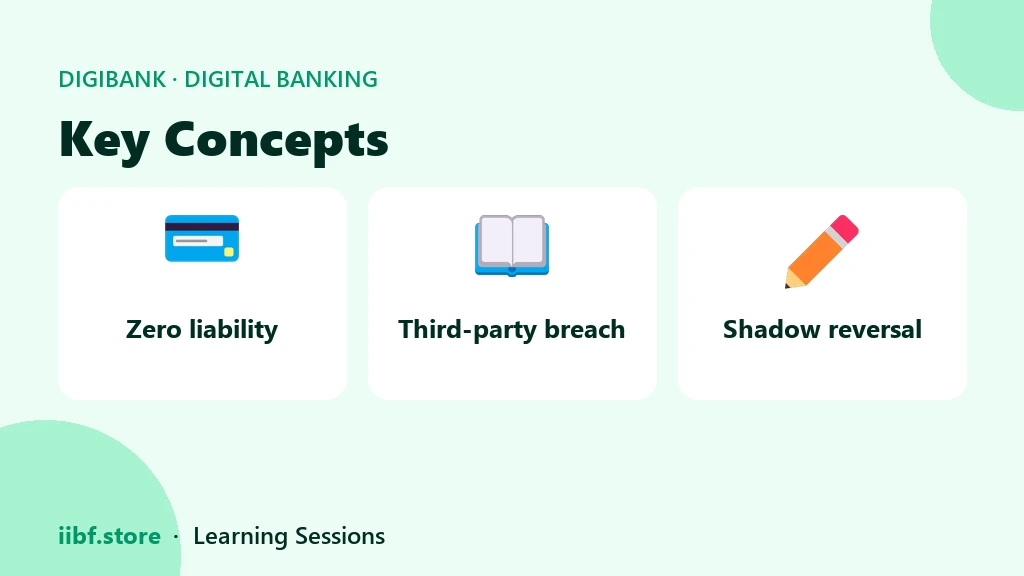
- Unauthorised EBT: a transaction the customer did not authorise, including one caused by bank negligence or a third-party breach.
- Fraudulent EBT: a transaction run by a third party using fraudulently obtained credentials, or one the customer approved under coercion or duress, or an unauthorised EBT.
- Bank negligence: for example failing to maintain mandated security systems, failing to send mandatory alerts, having no 24x7 reporting channel, or not acting diligently on a customer's notification.
- Customer negligence: for example sharing credentials, delaying notification, ignoring specific scam warnings, downloading malicious apps or not updating registered contact details.
- Third-party breach: a deficiency that lies neither with the bank nor with the customer, including at intermediaries such as third-party app providers, payment aggregators, payment gateways and telecom providers.
- Shadow reversal: a provisional credit of the disputed amount given when the customer notifies the bank, before the investigation or any insurance settlement is complete. The customer cannot use the amount, but also bears no extra interest or charges.
Notice that "unauthorised" is wider than "hacked". If the bank's own system failed, or the bank did not send the SMS it was bound to send, the transaction is still unauthorised from the customer's point of view.
Alerts and reporting: the bank's duties come first
A customer cannot report what he or she does not know about. Under the 2026 section, banks must collect and verify the customer's mobile number (and email where available) at onboarding and at set intervals. An instant SMS is mandatory for every EBT above Rs 500. For EBTs up to Rs 500 the SMS is optional under the bank's policy, but if sent it must be free of charge. An email alert is required for all EBTs where the customer has given an email address.
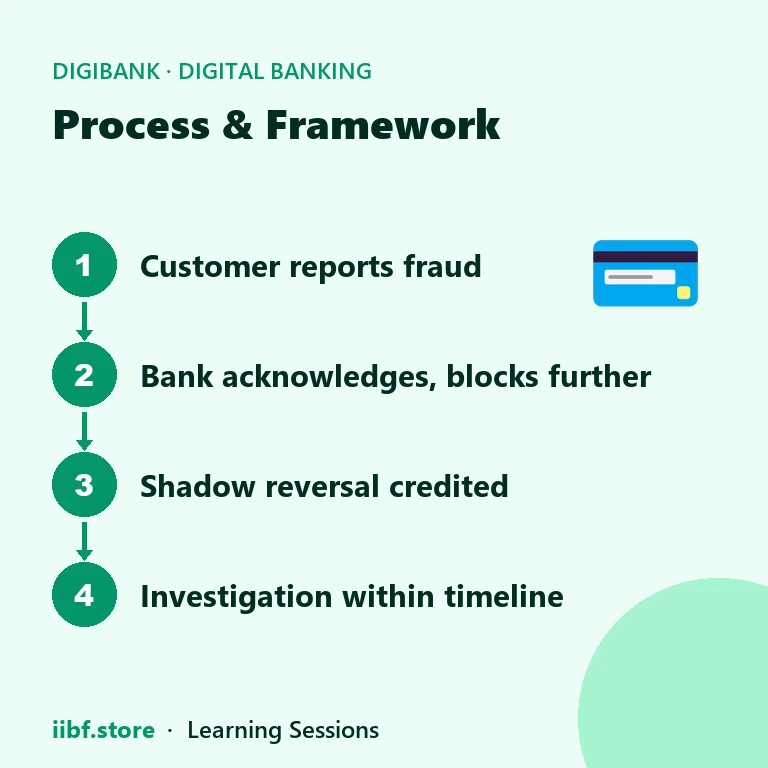
Banks must also provide 24x7 channels for reporting fraud or loss, and should advise customers to report on the National Cyber Crime Reporting Portal or by calling 1930 as well as to the bank. Every complaint must get an immediate acknowledgement carrying a complaint number and the date and time of receipt, and the bank must promptly stop further unauthorised EBTs on that account.
If you are preparing the whole paper, the complete Digital Banking course covers alerts, authentication and payment systems together, which is how the exam links them.
Step by step: what happens after the customer reports fraud
Follow this sequence in your head; IIBF often asks "which of the following should the bank do first?".
- Customer notifies the bank through any 24x7 channel. The bank acknowledges at once with a complaint number and timestamp.
- Bank blocks further EBTs on the affected account or card so that the loss does not grow.
- Shadow reversal is credited. For credit cards, the 2026 section requires the shadow reversal of the disputed amount within five calendar days of notification. The reversal is value-dated to the date of the original transaction, so the customer loses no interest.
- The bank investigates within the timeline set in its Board-approved policy, which cannot exceed 45 calendar days for domestic and 60 calendar days for cross-border fraudulent EBTs, counted from receipt of the complaint.
- The bank communicates the decision. If the claim is rejected, the bank must disclose the reasons and supporting details.
Under the older 2017 circular the corresponding timelines were different: the shadow credit was due within 10 working days of notification, and complaints were to be resolved within the Board-approved policy period and not later than 90 days. Remember which version a question refers to.
Who bears the loss: the liability rules in one table
The rules sort every case into zero liability, customer liability until reporting, or bank liability after reporting. The table below uses the 2026 section.
| Situation | Customer liability | Condition |
|---|---|---|
| Fraud due to bank negligence or deficiency | Zero, with reversal | Applies whether or not the customer reports |
| Third-party breach | Zero, with reversal | Customer reports within five calendar days of occurrence |
| Third-party breach, reported later | As per the bank's policy | Report after five calendar days |
| Customer negligence (for example shared OTP) | Customer bears the loss until the fraud is reported | Any loss after reporting is borne by the bank |
| Any case | Bank may waive liability | Discretion of the bank |
The old 2017 caps, for comparison
Older study material quotes caps on customer liability. Under the 2017 circular, zero liability applied for bank-side fault and for third-party breaches reported within three working days. If a third-party breach was reported in four to seven working days, liability was limited to the transaction value or the amount in a table, whichever was lower: Rs 5,000 for basic savings bank deposit accounts, Rs 10,000 for other savings accounts, prepaid instruments, small current accounts and credit cards up to a Rs 5 lakh limit, and Rs 25,000 for other current accounts and credit cards above Rs 5 lakh. After seven working days, the bank's Board-approved policy decided. The 2026 section replaces this slab approach with a five-calendar-day window and a separate compensation scheme.
New in 2026: compensation for small-value fraud
The 2026 section adds something the 2017 circular did not have. Even where the loss falls on the customer because of customer negligence, a bona fide victim may get partial compensation.
- Who is eligible: an individual, including a sole proprietor, with a gross loss of up to Rs 50,000.
- How much: 85% of the net loss (after recoveries) or Rs 25,000, whichever is less, payable once in a lifetime.
- Conditions: the fraud must be reported both on the National Cyber Crime Reporting Portal or 1930 and to the bank within five calendar days. Joint account holders can claim only once across all accounts.
- Payment: the customer's bank pays within five calendar days of receiving the application and then claims reimbursement from RBI and the beneficiary bank quarterly.
For a domestic loss below Rs 29,412 the cost is shared as RBI 65%, customer's bank 10% and beneficiary bank 10%. For a loss between Rs 29,412 and Rs 50,000, the Rs 25,000 compensation is split as RBI Rs 19,118, customer's bank Rs 2,941 and beneficiary bank Rs 2,941.
Worked example
Meena, a salaried customer, shares an OTP with a caller posing as a bank official. Rs 20,000 is debited. She reports to the bank and calls 1930 on the same day. The loss is due to customer negligence, so she is liable for it, but she meets the small-value conditions. Compensation is the lesser of 85% of Rs 20,000, which is Rs 17,000, and Rs 25,000. She receives Rs 17,000. Had the loss been Rs 40,000, 85% would be Rs 34,000, so the Rs 25,000 cap would apply. The Rs 29,412 threshold in the cost-sharing rule is exactly where 85% of the loss reaches Rs 25,000.
How IIBF tests this topic
Expect statement-type and case-based questions. The common traps are mixing the 2017 and 2026 timelines, forgetting that bank negligence gives zero liability even without reporting, and assuming the customer must prove the bank's fault. The burden of proof lies on the bank. For plenty of practice, attempt the Digital Banking mock tests after finishing this topic, browse the free study material, and keep the Digital Banking printed book handy for chapter-wise MCQs.
Practice question 1
Under the 2026 Directions, a customer suffers a fraudulent EBT caused by a deficiency in the bank's own security system and does not report it for two weeks. What is the customer's liability? The answer is zero, with reversal, because zero liability for bank negligence applies whether or not the customer reports.
Practice question 2
A third-party payment gateway is breached and a customer's card is misused. The customer reports on the seventh calendar day. Under the 2026 Directions the automatic zero-liability protection needed a report within five calendar days, so the case is decided under the bank's policy. Under the 2017 circular the seventh working day would have fallen in the limited-liability slab.
Practice question 3
Who bears the burden of proving that a customer is liable for an unauthorised electronic transaction? The answer is the bank, in both the 2017 circular and the 2026 section.
Quick revision points
- Burden of proof of customer liability lies on the bank.
- Bank negligence means zero liability and reversal, with or without reporting.
- Third-party breach means zero liability if reported within five calendar days (2026); three working days (2017).
- Customer negligence means the customer bears loss only until reporting; the bank bears loss after.
- Shadow reversal is value-dated to the transaction date.
- Resolution timeline: at most 45 calendar days domestic and 60 calendar days cross-border (2026); 90 days (2017).
- Small-value compensation: lesser of 85% of net loss or Rs 25,000, once per lifetime, for losses up to Rs 50,000.
- Mandatory SMS for every EBT above Rs 500; applies from 1 January 2027 for the 2026 section.
Frequently asked questions
What does limiting customer liability in fraudulent banking transactions mean?
It means RBI caps or removes the loss a customer bears in an unauthorised or fraudulent electronic transaction, depending on who was at fault and how fast the customer reported.
From when do the 2026 liability rules apply?
They apply to electronic banking transactions undertaken by customers on or after 1 January 2027, as per the RBI Third Amendment Directions of 24 June 2026.
What is a shadow reversal?
It is a provisional credit of the disputed amount given when the customer reports, before the investigation ends. The customer cannot use it but pays no extra interest or charges.
Does the customer always lose money if he shared an OTP?
Not always. The customer bears the loss until reporting, but a bona fide individual victim may claim small-value compensation of up to Rs 25,000 if the conditions are met, and the bank may also waive liability.
Where should a customer report digital fraud?
To the bank through its 24x7 channel and also on the National Cyber Crime Reporting Portal or by calling 1930, at the earliest.
Conclusion
Limiting customer liability in fraudulent banking transactions is a high-value topic because it joins law, operations and customer service in one question. Learn the definitions, the five-calendar-day window, the shadow reversal and the compensation formula, and keep the 2017 numbers separate in your mind. For the upcoming exam cycle, always check the official schedule and syllabus on the IIBF website, and read the RBI text itself once, because every figure in this article comes from it.
Prefer revising from a printed book?
Chapter-wise books with MCQs after every chapter — minimal pages, complete coverage, delivered anywhere in India. Every book has a free sample to read first.


















































Quick quiz on this topic
5 exam-style questions from our free test bank — check yourself before you move on.
Practice this topic
Take a free mock test, download chapter PDFs, or watch a video class — all included on iibf.store.
Keep reading