Is the NISM Series III-A Book Right for You? An Honest Guide
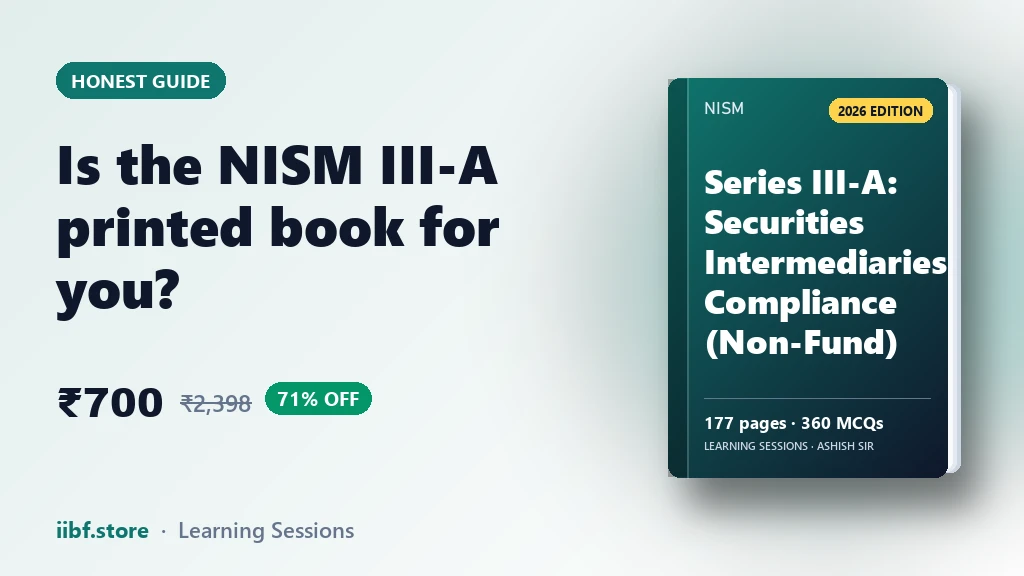
It is 10 pm. The branch closed late, the audit queries are still in your head, and the syllabus of a compliance paper looks like a wall of Acts, Regulations and sub-regulations. If you are preparing for NISM Series III-A while holding a full-time job, you do not need another promise. You need to know whether a particular resource will actually fit your life. That is what this guide does for the NISM Series III-A book: who it suits, how each kind of reader should use it, and where it is simply not enough on its own.
We will go through four reader profiles. If you decide the printed book is not for you, the study method in each section still works with any material.
What this paper actually asks of you
Series III-A (Securities Intermediaries Compliance, Non-Fund) is not a paper you clear by understanding the market in general. It tests whether you know what each intermediary must do, what each regulation prohibits, and how the Acts connect. That means a lot of names, definitions and obligations spread across many regulations.
Two things follow from that. First, the paper rewards structure: if you know which regulation belongs to which kind of intermediary, half of the confusion disappears. Second, it rewards repetition with questions, because compliance rules are easy to read and hard to recall under time pressure.
A quick self-check before you read further
- Can you say, without notes, which regulations apply to stock brokers and which to research analysts?
- Do you know what the Prevention of Money Laundering Act and the KYC Registration Agency rules require of an intermediary?
- Have you ever solved 20 compliance questions in one sitting and reviewed every wrong answer?
If most answers are no, you are in the normal starting position. Nobody learns this paper by osmosis at the counter.
What is inside the book, in plain numbers
Here are the facts, so you can judge for yourself. The NISM Series III-A printed book is the 2026 edition, with 177 pages, 24 chapters and 360 practice questions, organised into four modules.
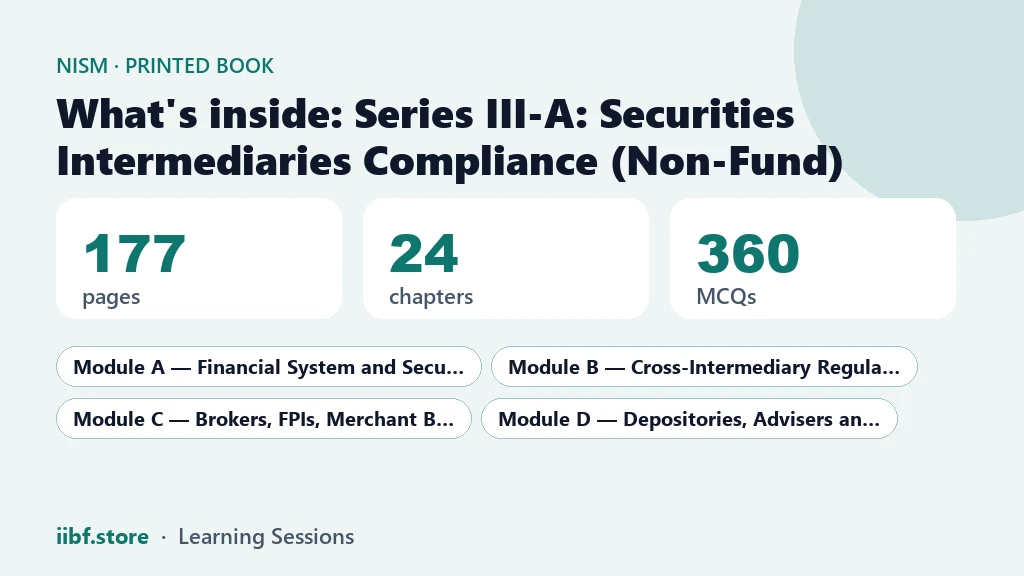
- Module A: the financial system, the regulatory framework, an introduction to compliance, the SEBI Act and the Securities Contracts (Regulation) Act.
- Module B: cross-intermediary regulations: Intermediaries Regulations, insider trading, fraudulent and unfair trade practices, PMLA with AML/CFT guidelines, and KYC Registration Agency rules.
- Module C: foreign portfolio investors, stock brokers (two parts), merchant bankers (two parts) and the ICDR Regulations (two parts).
- Module D: depositories, registrars and share transfer agents, research analysts, investment advisers, debenture trustees, credit rating agencies, and custodians with proxy advisors.
On top of the chapters, the book carries 30 case studies (120 questions) and 5 mega tests (500 questions). A free sample is available on the book page, so you can see the writing style before you decide anything. The price shown is ₹700 against an MRP of ₹2,398 (71% off), but prices may change, so treat the book page as the current word.
Profile 1: You are attempting the paper for the first time
You are the reader who benefits most from a structured, chapter-by-chapter book, because you have no past mistakes to learn from yet. Your job is to build a map first and details second.
How to use the book
- Spend your first week on Module A only. It is the foundation: the financial system, the regulators and what compliance means. Skipping it makes every later chapter feel like trivia.
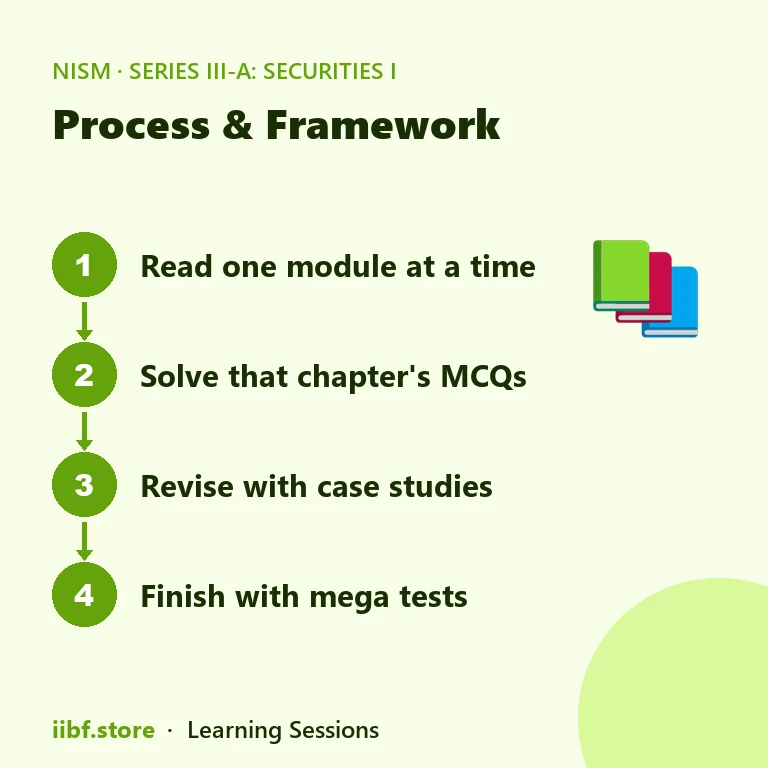
- Read one chapter, then solve that chapter's questions the same day. Do not stack up three chapters and quiz yourself at the end.
- Keep a one-page sheet per module listing each regulation and, in one line, whom it regulates.
When the book is not enough
A first-timer often feels ready after reading and then freezes in the exam. Reading builds recognition, not recall. Once you finish a module, take a free timed quiz from the free mock tests on iibf.store to check that you can answer under a clock.
Profile 2: You have attempted before and want a sharper second round
If you have failed or postponed, please do not conclude that you are not capable. Most repeat candidates did not fail on knowledge; they failed on coverage gaps and exam-hall pace.
How to use the book
The NISM Series III-A book works well as an error-hunting tool here.
- Skip the full read-through. Start with the case studies and mega tests, and mark every question you miss.
- Map each missed question back to its chapter. Within a week you will see two or three chapters that account for most of your errors.
- Re-read only those chapters, then retest. This is faster and far less demoralising than starting from page one.
When the book is not enough
If your earlier attempt came from poor time management rather than weak content, a book cannot fix that. You need timed, full-length practice. Use the five mega tests as full simulations, sit them in one go, and note where you slow down. The book gives you the questions; the discipline of sitting them under exam conditions has to come from you.
Profile 3: You are short on time
Maybe your exam cycle is close, or your branch is in the middle of a heavy quarter. Be honest about what is realistic. The NISM Series III-A book has 24 chapters, which makes it easy to divide, but it cannot create hours you do not have.
A simple compressed plan
- Weeks 1-2: one module per few days. Read, solve that chapter's questions, move on.
- Week 3: go back through the chapters where your question scores were weakest.
- Final stretch: case studies first, then mega tests, reviewing every wrong answer the same evening.
Prioritise by weight of content you find hardest, not by chapter order alone. The Stock Brokers, Merchant Bankers and ICDR chapters sit in Module C and take the most reading time, so start them early.
When the book is not enough
If you have less than a couple of weeks, do not attempt to memorise everything. Focus on questions: they show you what the paper actually asks. Be realistic and check the official schedule on the IIBF website before you plan backwards from a date.
Profile 4: You simply study better on paper
Many bank staff spend the whole day on screens. By evening, a phone or laptop is the last thing they want to read from. If that is you, a printed book is not a luxury; it is how you will actually get the studying done.
How to use the book
- Keep it in your bag. Ten minutes in a queue or a commute is enough for half a chapter.
- Write in the margins. Compliance topics stick better when you note the link between two regulations in your own words.
- Use a pencil to mark questions you got wrong, so you can retry them a week later.
When the book is not enough
Paper cannot tell you your score trend. To see whether you are improving, pair it with online tests and free PDFs from the free material section. Paper builds understanding; test platforms show you whether it is working.
Who should probably not buy it
Being honest means saying this too. The book may not be the right choice if:
- you already hold strong notes you trust and only need practice questions, in which case free mocks may be enough;
- you need live explanations and someone to ask doubts, because a book is a one-way medium;
- you are looking for a shortcut that avoids revising the regulations altogether. No resource offers that.
If you are unsure, read the free sample first and see whether the explanations match how you learn. You can also browse the wider range of titles in the books section or read more preparation guides on the iibf.store blog.
A comparison you can use today
| Reader | Start with | Pair it with |
|---|---|---|
| First attempt | Module A, then chapter by chapter | Free timed quizzes after each module |
| Repeat attempt | Case studies and mega tests | Full-length timed sittings |
| Short on time | Weakest Module C chapters, then questions | Daily 60 to 90 minute slots |
| Prefers paper | Margin notes, pencil marks | Online tests for score tracking |
The honest conclusion
The NISM Series III-A book is a structured, paper-based way to cover the regulations module by module, with questions at the end of each chapter and extra practice in the case studies and mega tests. It suits the first-timer who needs a map, the repeat candidate who needs a sharper plan, and anyone who learns better away from a screen.
Used well, the NISM Series III-A book gives you structure. It does not replace timed practice, and it cannot fix a plan you never follow. Decide which profile sounds most like you, use the matching method above, and add mock tests so exam day feels familiar. Whatever you choose, a calm, consistent hour a day beats a panicked weekend every time.
Frequently asked questions
Can I clear the paper with only this book?
It covers the regulations in 24 chapters with questions, case studies and mega tests, which is a solid base. But you should still practise with timed mock tests, since reading alone does not build exam-hall speed.
Is there a way to preview the book before buying?
Yes, the NISM Series III-A book has a free sample. The book page has a free sample, so you can check the writing style and question format first.
How should I use the case studies and mega tests?
Treat case studies as application practice after you finish a module, and the five mega tests as full simulations near the end. Review every wrong answer and trace it back to its chapter.
Where do I find the official exam schedule?
Check the official website at iibf.org.in for the upcoming exam cycle. Prices on the book page may change, so treat that page as the current reference.
Prefer revising from a printed book?
Chapter-wise books with MCQs after every chapter — minimal pages, complete coverage, delivered anywhere in India. Every book has a free sample to read first.


















































Practice this topic
Take a free mock test, download chapter PDFs, or watch a video class — all included on iibf.store.