Interest Rate Swap in Banks: How It Works for TIRM
Your bank has just booked a large block of fixed-coupon government securities, but a good part of its funding is overnight or floating. The ALCO meeting asks a simple question: what happens to our margin if rates go up by 100 basis points? The treasury head answers with two words: interest rate swap. If you are preparing for the TIRM paper, you need to understand an interest rate swap in banks not as a formula but as a risk-management tool that turns one kind of interest exposure into another.
This article explains the swap from the ground up: what the two legs are, how the net amount is settled, what the Reserve Bank of India permits under its rupee interest rate derivatives framework, a worked rupee example, and the way IIBF frames questions on the topic. Read it once for concepts and once more with the practice MCQs.
What an interest rate swap really is
An interest rate swap is a contract between two parties to exchange interest payments on an agreed notional amount for an agreed period. The notional is never lent or repaid. It is only the base on which interest is calculated. One party pays interest at a fixed rate; the other pays interest at a floating rate linked to a published benchmark. On each settlement date only the difference changes hands.
That last point is what makes an interest rate swap in banks so useful. A bank does not have to sell its bonds or restructure its deposits to change its rate sensitivity. It signs a swap, and the cash flows of its balance sheet effectively change character. A fixed-rate asset funded by floating liabilities becomes, in economic terms, a better matched position.
Pay-fixed and receive-fixed
Every swap has two sides. The payer pays the fixed rate and receives the floating rate. The receiver receives the fixed rate and pays the floating rate. A bank that fears rising rates on floating liabilities usually becomes the fixed-rate payer, because its floating receipts from the swap rise along with its funding cost. A bank sitting on floating-rate assets and fixed-rate deposits usually does the opposite.
Why not just use bonds or loans?
Cash instruments change the balance sheet itself: you must buy or sell securities, which affects classification, liquidity, SLR holdings and trading profit or loss. A swap leaves the underlying asset or liability untouched and adjusts only the interest-rate exposure. That is the heart of why treasuries use it.
The regulatory basis: RBI Rupee Interest Rate Derivatives Directions, 2025
Rupee interest rate derivatives (IRDs) in India are governed by the Reserve Bank of India (Rupee Interest Rate Derivatives) Directions, 2025, issued on 8 December 2025 under sections 45W and 45U of the RBI Act, 1934. They apply from 1 March 2026 and cover both OTC contracts and those on recognised exchanges. Transactions entered into before that date continue under the earlier directions until maturity or cancellation, and the 2019 circulars are among the instruments the new text supersedes.
For a TIRM candidate, these points matter most:
- Hedging is defined broadly. The Directions describe hedging as a derivative transaction undertaken to reduce rupee interest rate risk at the balance sheet level, the portfolio level, or the level of an individual asset or liability (para 2.1).
- Market-makers and users. A market-maker is an entity that provides prices to users and to other market-makers, and it need not have an underlying risk. A user is anyone who deals other than as a market-maker. Scheduled banks, standalone primary dealers, certain NBFCs in the upper layer and some all-India financial institutions are eligible to be market-makers (para 5.1).
- One party must be a market-maker. At least one party to every IRD transaction must be a market-maker or a central counterparty authorised by the RBI.
- Retail and non-retail users. Users are classified as retail or non-retail (para 5.2). The product menu and the purpose restrictions differ for the two groups (paras 5.3 and 5.4).
- Benchmarks. Any floating rate used in an OTC IRD must be a benchmark published by a Financial Benchmark Administrator (para 5.6).
- Reporting. Most OTC IRD trades, including client trades, must be reported to the Trade Repository within 30 minutes, and client trade reports must say whether the deal was for hedging (para 5.7).
Always read the original text before an exam, because the RBI page records later updates. The primary link above is the one to keep bookmarked.
How a swap works: the building blocks
Every interest rate swap in banks is built from the same handful of components. Learn these six terms cold, because exam options are usually built by swapping them around.
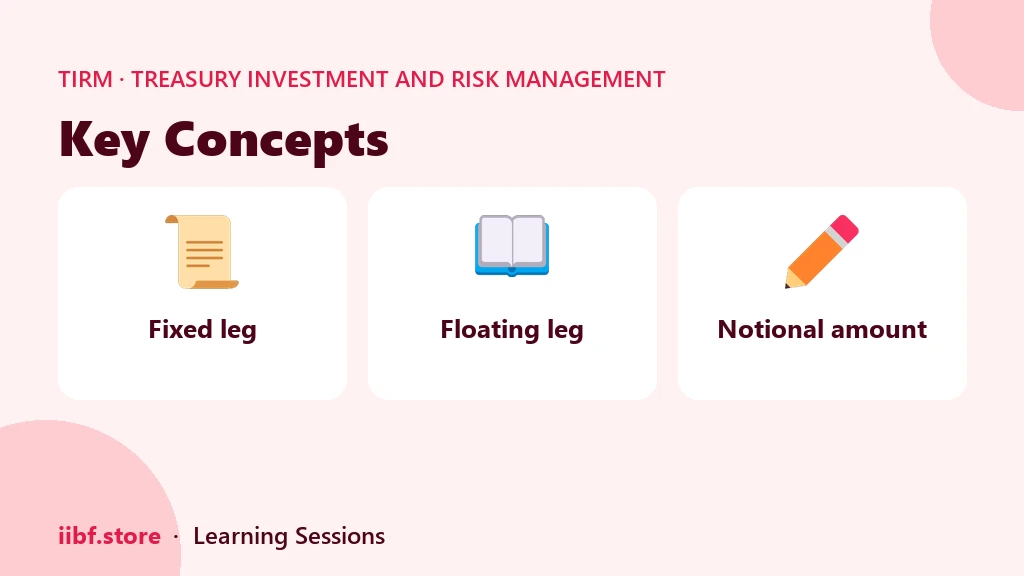
- Notional amount: the reference principal. It is not exchanged.
- Fixed leg: interest at a rate agreed on day one, which stays unchanged for the life of the swap.
- Floating leg: interest linked to a benchmark that resets. In India, the overnight rupee market has traditionally been the base for overnight index swaps, where the floating leg is a compounded overnight rate.
- Tenor and settlement dates: the swap runs for an agreed term, with periodic settlement.
- Net settlement: on each date only the difference between the two legs is paid.
- Benchmark: the published reference rate. The Directions require it to come from a Financial Benchmark Administrator.
Settlement basis and market conventions, such as day count, can be specified by FIMMDA (para 5.6). A swap may be settled bilaterally or through a clearing arrangement approved by the Reserve Bank.
Overnight index swap in one line
In an overnight index swap (OIS), one party pays a fixed rate and the other pays the compounded overnight benchmark over the term. Because the floating leg tracks the overnight money market, OIS rates are widely read as the market's expectation of the policy-rate path. Treasury desks use them to hedge short-term funding costs and to price other instruments.
Step by step: from balance sheet gap to hedge
A treasury does not wake up and decide to trade a swap. It follows a sequence, and the same sequence is a good template for a long answer in the exam.
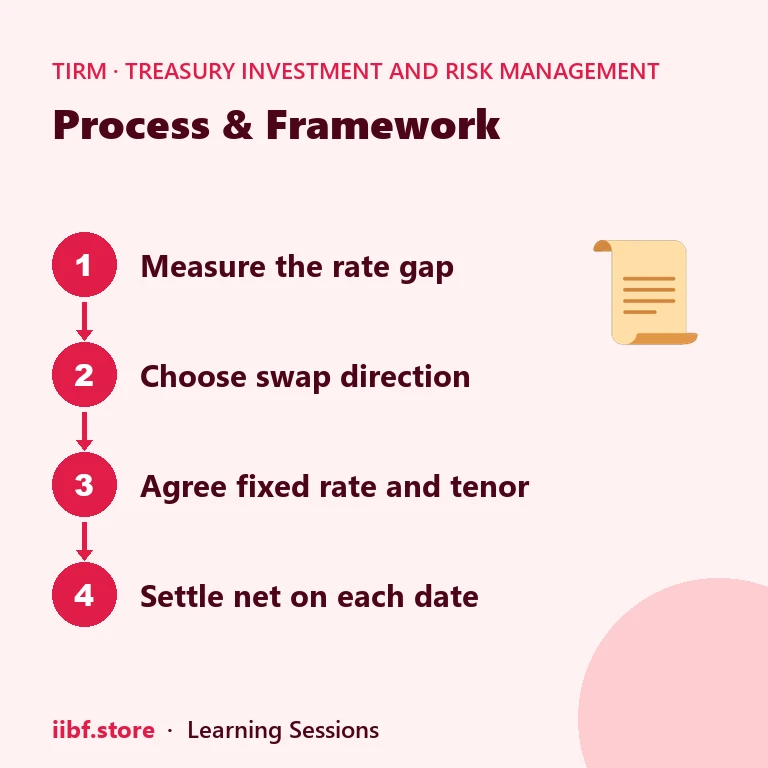
- Measure the rate gap. ALM reports show which assets and liabilities reprice and when. Suppose fixed-rate investments are funded by liabilities that reprice sooner. A rising rate then squeezes net interest income.
- Choose the swap direction. To protect against rising funding cost, the bank pays fixed and receives floating. To protect against falling yields on floating assets, it receives fixed and pays floating.
- Agree the fixed rate, notional and tenor. The market-maker quotes a fixed rate against the chosen benchmark. The notional is sized to the exposure being hedged, not to the bank's appetite for profit.
- Settle net on each date. Only the difference is paid or received. This gain or loss offsets the movement in the underlying funding cost or yield.
- Report and monitor. The trade is reported to the Trade Repository, flagged as a hedge where applicable, and tracked against limits and mark-to-market.
Worked example: hedging a funding-cost risk
The numbers below are illustrative, made up only to show the mechanics. Real quotes depend on the market on the day.
A bank holds Rs 100 crore of fixed-rate securities funded by overnight borrowing. Management enters a swap on a notional of Rs 100 crore in which the bank pays a fixed rate of 6.50 percent and receives the overnight benchmark. Take one settlement period of 182 days, with interest on an actual/365 basis for simplicity.
| Scenario | Average benchmark | Bank receives (floating) | Bank pays (fixed 6.50%) | Net to the bank |
|---|---|---|---|---|
| Rates rise | 7.00% | about Rs 3.49 crore | about Rs 3.24 crore | receives about Rs 24.93 lakh |
| Rates unchanged | 6.50% | about Rs 3.24 crore | about Rs 3.24 crore | nil |
| Rates fall | 6.00% | about Rs 2.99 crore | about Rs 3.24 crore | pays about Rs 24.93 lakh |
Work through the rise scenario. The difference of 0.50 percent on Rs 100 crore for 182 days is 100 crore x 0.50% x 182/365, which is about Rs 24.93 lakh received by the bank. That receipt compensates for the extra interest the bank pays on its overnight borrowing. If rates fall, the bank pays about the same amount on the swap, but it also pays less on its borrowing. The result is a stable spread, which is exactly what hedging aims for.
Notice what the swap does not do. It does not promise a profit. If rates fall, the swap loses money, and that is the price of certainty. Exam questions love this point: a hedge reduces variability, it does not guarantee gain.
Who can do what: market-makers, users and purpose
Under the Directions, the purpose behind a swap matters as much as the product. Retail users may deal in forward rate agreements, interest rate swaps, and buy-side options, caps and floors, while non-retail users get a wider menu that includes swaptions. Para 5.4 then restricts some user categories to hedging only. Non-resident individuals, for instance, may deal only for hedging, and IRDs on government securities with non-residents are hedging-only.
| Role | What it means | Typical example |
|---|---|---|
| Market-maker | Quotes prices to users and other market-makers; need not have an underlying risk | Scheduled bank, standalone primary dealer |
| Non-retail user | Wider product access; classified on eligibility and risk-management capability | Insurer, mutual fund, large corporate |
| Retail user | Narrower product list; buy-side options only | Smaller resident entities not meeting non-retail criteria |
| Hedger | Uses the derivative to reduce rate risk at balance sheet, portfolio or single-item level | Bank hedging fixed-rate bond book |
A useful way to remember it: the market-maker is the shop, the user is the customer, and the hedging definition is the reason the customer is allowed into some shops. For the exact eligibility lists, go to the Directions rather than rely on memory.
Risks a treasury must manage
A swap removes one risk and introduces others. A senior colleague would tell you to keep this list handy for descriptive answers.
- Market (interest rate) risk: the swap itself has a mark-to-market value that moves with rates. Sensitivity is usually expressed as PV01 or DV01, which is the change in value for a one-basis-point move. The Directions use the term PVBP for the non-resident position cap.
- Basis risk: the floating leg of the swap may not move exactly with the bank's actual funding cost, so the hedge is imperfect.
- Counterparty and settlement risk: the other side may default before the swap matures. Clearing arrangements approved by the RBI reduce this.
- Operational and documentation risk: mismatched confirmations, wrong reset dates or incorrect day-count bases lead to disputes. Standard agreements recommended by FIMMDA or a central counterparty are expected for novations.
- Compliance risk: wrongly flagging a trade as a hedge, or missing the reporting window, is a regulatory breach.
On the prudential side, participants follow the capital adequacy, exposure and KYC norms of their own regulators, and accounting follows notified standards and the instructions of the relevant regulator (para 6). The Directions do not themselves fix capital figures, so do not quote any in an answer unless the question supplies them.
If you want the surrounding concepts, revise duration and PV01 and the investment classification rules, which sit alongside swaps in the paper. The free material library has more notes, and the TIRM video course covers derivatives chapter by chapter.
How IIBF tests this topic
The IIBF syllabus for the Diploma in Treasury, Investment and Risk Management lists forward rate agreements, interest rate swaps and pricing of interest rate swaps under its derivatives coverage. You can check the official DTIRM syllabus on iibf.org.in, and the upcoming exam cycle details are on the IIBF website.
Typical question patterns are straightforward once the concepts are clear:
- Direction questions: which side of the swap benefits when rates rise?
- Concept questions: is the notional amount exchanged? (No.)
- Matching questions: pair the term with its meaning, such as fixed leg, floating leg, net settlement.
- Application questions: which swap position hedges floating-rate liabilities against rising rates?
- Regulatory questions: who can be a market-maker, what the hedging definition covers, how soon an OTC trade is reported.
The common traps are mixing up pay-fixed and receive-fixed, assuming the principal moves, and believing that a swap guarantees profit. To practise, attempt chapter-wise questions in the TIRM printed book and then test yourself under time pressure with the TIRM mock tests.
Practice MCQs
Q1. In an interest rate swap, the notional amount is: (a) lent by one party to the other; (b) exchanged at maturity; (c) used only to calculate interest; (d) repaid in instalments. The answer is (c). The notional is a reference amount and is never exchanged, which is why a swap does not need funding of the notional.
Q2. A bank funds fixed-rate bonds with floating-rate borrowing and fears rising rates. Which swap position hedges it? (a) pay fixed, receive floating; (b) receive fixed, pay floating; (c) pay floating, receive floating; (d) none. The answer is (a). If rates rise, the floating amount the bank receives on the swap rises and offsets its higher funding cost.
Q3. Under the RBI Rupee Interest Rate Derivatives Directions, 2025, an entity that provides prices to users and other market-makers is a: (a) retail user; (b) market-maker; (c) benchmark administrator; (d) trade repository. The answer is (b). A market-maker need not have an underlying risk of its own.
Quick revision points
- A swap exchanges fixed and floating interest on a notional; only the net difference is paid.
- Pay-fixed gains when rates rise; receive-fixed gains when rates fall.
- The RBI Directions apply from 1 March 2026; hedging is defined at balance sheet, portfolio or individual asset or liability level.
- At least one party must be a market-maker or an RBI-authorised central counterparty.
- Floating rates must be benchmarks published by a Financial Benchmark Administrator.
- Most OTC trades are reported to the Trade Repository within 30 minutes.
- A hedge reduces variability; it does not guarantee profit.
Frequently asked questions
Is the principal exchanged in an interest rate swap?
No. The notional is only a reference amount for calculating interest. On each settlement date the two interest amounts are netted and only the difference is paid.
Why does a bank use a swap instead of selling its bonds?
Selling bonds changes the balance sheet, classification and profit or loss. A swap adjusts only the interest-rate exposure while the asset or liability stays where it is.
What is the difference between an interest rate swap and an overnight index swap?
An overnight index swap is a type of interest rate swap whose floating leg is linked to a compounded overnight benchmark rate. The general term covers swaps on other benchmarks too.
Who can act as a market-maker in rupee interest rate derivatives?
Under para 5.1 of the RBI Directions, eligible entities include scheduled banks, standalone primary dealers, NBFCs in the upper layer and certain all-India financial institutions. Read the Directions for the full list.
Do I need to remember the RBI paragraph numbers for the exam?
Not usually. Focus on the ideas: the hedging definition, market-maker and user roles, benchmark and reporting requirements. Paragraph numbers are useful for reference, not for memorising.
Conclusion
To summarise, an interest rate swap in banks is a simple idea with a few moving parts: two legs, a notional that never moves, net settlement, and a regulated framework that asks the bank to use it for hedging with proper reporting. Practise the direction of the swap with small numbers, remember that hedging reduces risk rather than creating profit, and keep the RBI Directions page handy for the regulatory details. Combine this article with the TIRM course, the printed book and the mock tests and you will be ready for any swap question the paper throws at you.
Prefer revising from a printed book?
Chapter-wise books with MCQs after every chapter — minimal pages, complete coverage, delivered anywhere in India. Every book has a free sample to read first.


















































Practice this topic
Take a free mock test, download chapter PDFs, or watch a video class — all included on iibf.store.