Is the NISM Series VIII Book Right for You? An Honest Guide
It is 9:40 pm. You have closed the branch, reached home, eaten something quick, and now a certification you need for your career is sitting on the table. Derivatives. Futures, options, Greeks, margins, settlement cycles. None of it appeared in your day job, and your head already feels full. If that is you, this article is for you. We will look at who the NISM Series VIII book actually suits, and just as honestly, who should not rely on it alone.
Nobody needs another pitch. What you need is a decision you can make in five minutes. So we will go profile by profile, and each section gives you something usable even if you never buy anything: a method, a table, a plan.
First, what exactly is this book?
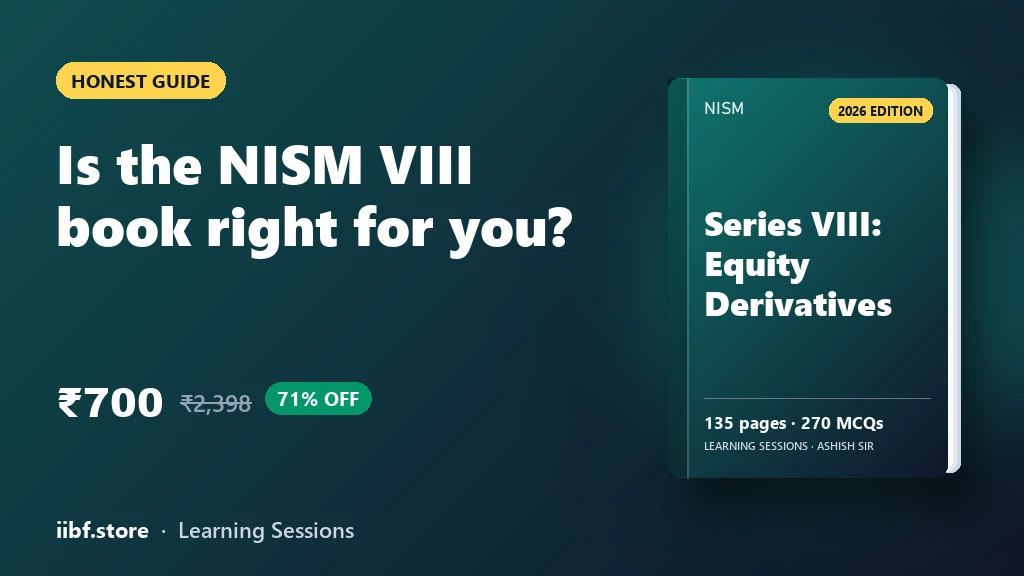
Series VIII is the NISM Equity Derivatives certification. The printed edition we are talking about is a 2026 edition of 135 pages, organised into 18 chapters across four modules, with 270 practice questions. That is a deliberately compact book. It is not a 600-page reference you will never finish.
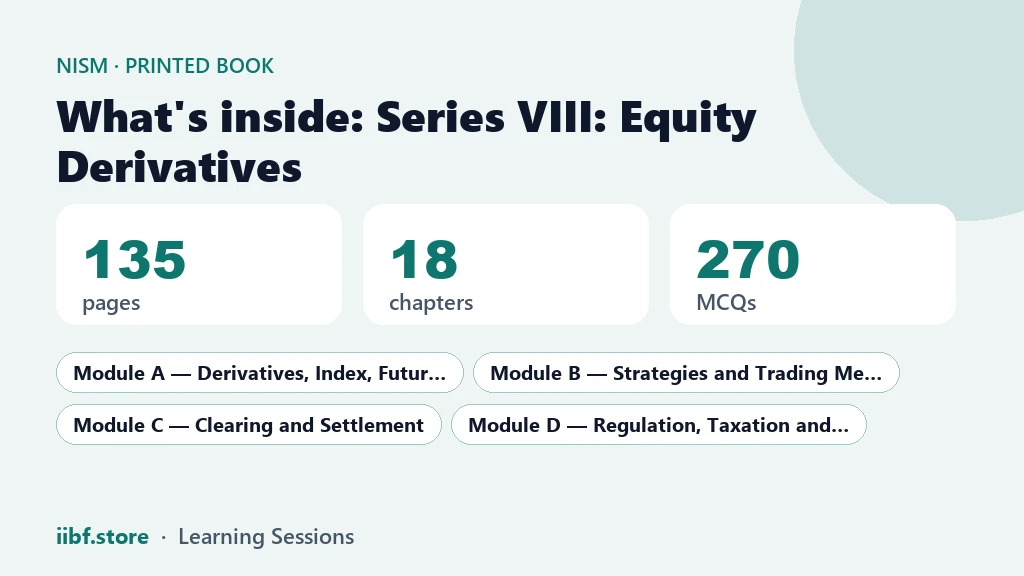
The four modules follow the way the subject builds up:
- Module A: Derivatives, Index, Futures and Options. Six chapters covering the basics of derivatives, how an index works, futures and forwards, and options.
- Module B: Strategies and Trading Mechanism. Five chapters on hedging and speculation strategies, option pricing, put-call parity, Greeks, open interest, order types, corporate actions, charges and STT.
- Module C: Clearing and Settlement. Three chapters on how trades are cleared and settled.
- Module D: Regulation, Taxation and Investor Protection. Four chapters on the legal and regulatory environment, accounting and taxation, and sales practices.
The listing also mentions two extras: 30 case studies (120 questions) and 5 mega tests (500 questions). Check the book page for exactly how these are delivered with your order, so you know what you are getting before you pay.
Which reader are you? Four honest profiles
The same book works very differently depending on your situation. Find yourself in one of these, then read the matching advice.
| Your situation | How the book helps | Not enough on its own for |
|---|---|---|
| First attempt, no derivatives background | One clean path from basics to regulation | Exam-hall speed on calculation questions |
| Repeat attempt | Targeted re-reading of weak modules | Fixing careless errors without timed practice |
| Very short on time | Compact size, chapter-sized sittings | Skipping modules you have never seen |
| Prefers paper to screens | No battery, no notifications, easy to mark up | Timed, on-screen exam simulation |
Profile 1: First attempt, derivatives feel like a foreign language
This is where a compact book does the most good. Your problem is not a lack of intelligence, it is vocabulary. Strike price, premium, lot size, margin, mark-to-market: until these words stop feeling strange, every question looks harder than it is.
Read Module A slowly, even if it takes the first full week. Write each new term on the margin in your own words. Do not move to Module B until you can explain, without looking, the difference between a future and an option. Module B is where most beginners wobble, especially on option pricing and the Greeks, so give it more days than the others.
Where it is not enough: calculation. Reading a payoff diagram is easy; computing a profit in two minutes under exam pressure is a skill built only by repetition. Once you finish the chapters, use the free mock tests at iibf.store/tests to find out how fast you really are.
Profile 2: You have attempted before and it did not work out
First, drop the guilt. A full-time job and a technical subject is a hard mix, and a failed or postponed attempt tells you about your schedule, not your ability. Now be specific about what went wrong. Did you run out of time? Mix up settlement rules? Lose marks in the regulation module because you treated it as "easy reading"?
For you, the NISM Series VIII book is a re-reading tool, not a first-reading tool. Take your old score report or your memory of the paper, list the two weakest modules, and re-read only those, attempting the chapter questions first and the text second. That order matters: attempting questions before reading shows you what you truly do not know.
Where it is not enough: a repeat attempt usually fails on accuracy under time, not on knowledge. A book cannot simulate the clock. Treat full-length timed tests as non-negotiable.
Profile 3: You have only a few weeks, or a few evenings
Be realistic first. With very little time, you cannot do everything, so you must decide what to do first. The book's size helps, because at 135 pages you can plan around chapters instead of vague hours: one chapter an evening, a short revision loop at the weekend.
A workable pattern for a tired evening is 45 minutes: 30 minutes on one chapter, 15 minutes on its questions. If a day is lost to office work, do not try to double up the next day. Simply carry the chapter forward.
Where it is not enough: a short timeline is not a reason to skip a module you have never seen. Every module can appear in the paper. If you are truly out of time, drop re-reading comfortable chapters, not whole unfamiliar modules.
Profile 4: You simply think better on paper
If you spend your whole working day in front of a screen, a printed book is a relief, not a nostalgia trip. You can underline, tear out a page of formulas, stick flags on Greeks and settlement timelines, and read it on a train without a charger or a data pack. For most tired people the biggest hurdle is simply opening the study material at all, and a book lying on the bedside table lowers that hurdle.
Where it is not enough: paper cannot give you the experience of a computer-based test. Pair it with timed practice on screen at least a few times before the exam.
A simple four-step method that works with any of the profiles
Whichever profile you matched, this loop keeps you honest and does not need much time.
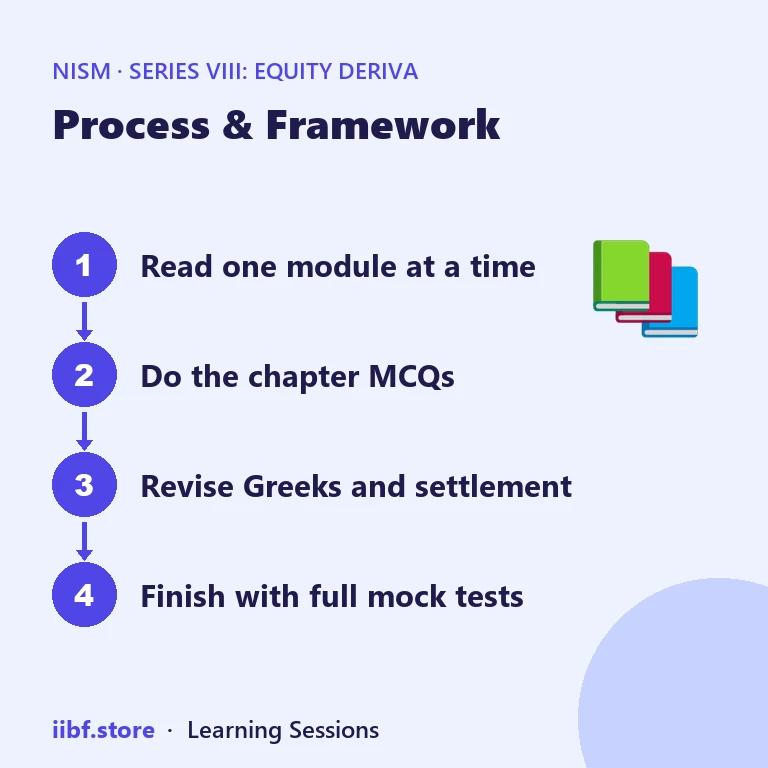
- Read one module at a time. Finish a module before you begin the next. Switching around makes derivatives feel more confusing than it is.
- Do the chapter questions the same day. The book carries 270 questions. Use them as a check, not as a score to be proud of.
- Revise the tricky parts on a fixed day. For most people that means option pricing, the Greeks, and clearing and settlement.
- Finish with full, timed mock tests. This is the step that converts knowledge into marks.
What this book will not do
Honesty is the whole point of this guide, so here is the list of limits. The NISM Series VIII book will not make you exam-fast by itself. It will not replace practice papers. It will not keep itself updated if rules change after the 2026 edition, so for any regulatory or tax detail, check the official sources before the exam, starting with the IIBF website and the exam body's own notices for the upcoming exam cycle.
It also cannot decide whether this certification is the right one for your role. If you are comparing options, look at the other printed titles on the books page and match them to your career plan, not to what a colleague happens to be reading.
Where to start today, even before you buy
Do these three things this week, whether or not you ever buy this book.
- Take one free mock at iibf.store/tests to learn your honest starting score.
- Browse the free study material for derivatives basics, and see whether the style suits you.
- Read the free sample of the book, if you are considering it. Ten minutes of reading tells you more than any review.
If the sample reads clearly to you, the book is priced at ₹700 against an MRP of ₹2,398. Prices can change, so the book page is always the current word. For the wider picture of how certification study fits alongside JAIIB and CAIIB, the blog has more working-banker guides.
The bottom line
The NISM Series VIII book suits you best if you want a compact, module-by-module path through equity derivatives and you are willing to pair it with mock tests. It suits you less if you want a magic shortcut. Match your profile, follow the four steps, and give Module B extra time. That is a better plan than any promise.
Frequently asked questions
Is this book enough to pass NISM Series VIII on its own?
For many readers it covers the syllabus in a compact form, but we would not promise a pass from any single book. Pair it with full-length timed mock tests so you build speed and catch careless errors.
I have never studied derivatives. Can I still start with this book?
Yes. The book begins with the basics of derivatives and builds up through futures, options, strategies and settlement. Give yourself extra time for Module B, where option pricing and the Greeks sit.
Is there a free sample so I can check before buying?
Yes, the book page offers a free sample. Read it before you decide, and check the page for the current price, because prices may change.
Where do I find the official exam schedule and rules?
Please check the official notices for the upcoming exam cycle, and the IIBF website at https://www.iibf.org.in for related certification information. Do not rely on any third party for dates or eligibility.
Prefer revising from a printed book?
Chapter-wise books with MCQs after every chapter — minimal pages, complete coverage, delivered anywhere in India. Every book has a free sample to read first.


















































Practice this topic
Take a free mock test, download chapter PDFs, or watch a video class — all included on iibf.store.