Is the NISM Series XV Book Right for You? An Honest Guide
It is 10:40 at night. The branch closed hours ago, the day's targets are still ringing in your head, and the Research Analyst syllabus on your table looks endless. Valuation, technical analysis, regulations, commodities, financial statements. You want to pass, but you do not want to buy one more thing that ends up gathering dust.
So let us do this the honest way. This guide tells you who the NISM Series XV book suits, who it does not, and what else you must pair it with. If the answer is "this is not for you", that is a perfectly good outcome. You will still walk away with a method you can use today.
Start with your situation, not the book
Before you compare any study material, answer three questions honestly.
- How many hours a week can you really give? Not what you hope to give. What you gave last month.
- Is this your first attempt or a repeat? A repeat attempt needs a different approach, not the same approach with more guilt.
- Where do you actually study? A metro commute, a quiet room at home, or a few minutes between customers?
Your answers matter more than any brand name. A good book used for forty minutes a day beats a perfect book opened twice a month. Keep your answers in mind as you read the profiles below.
One more thing before the profiles. For the official exam schedule, syllabus notices and registration details of the upcoming exam cycle, always check NISM's official website, the body that conducts this exam (for IIBF banking certificates the equivalent source is www.iibf.org.in). Nothing in a study guide, including this one, replaces that.
What the book actually contains
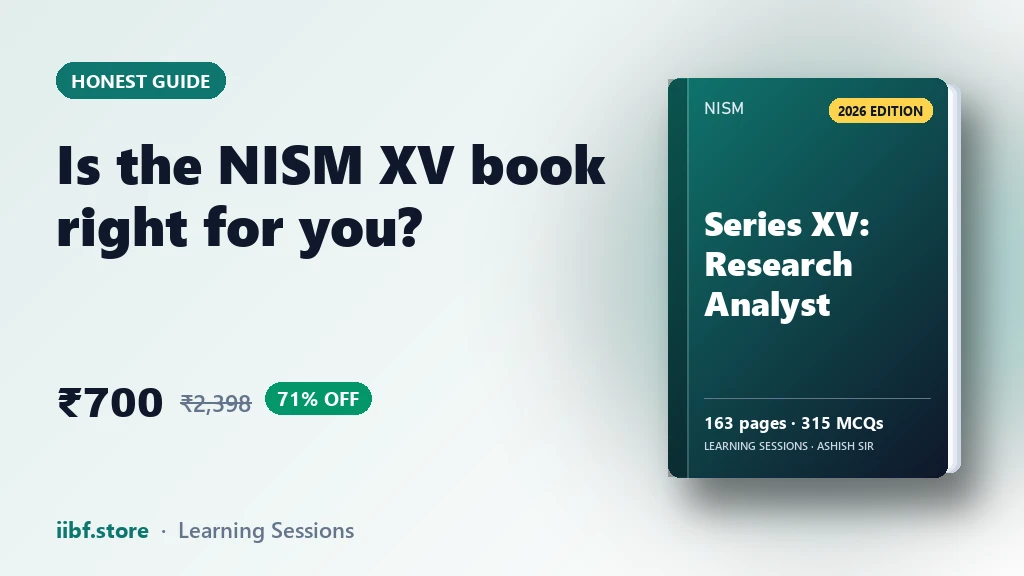
Here are the plain facts about the NISM Series XV: Research Analyst book, 2026 edition. It runs to 163 pages across 21 chapters, with 315 practice questions. The chapters are grouped into four modules.
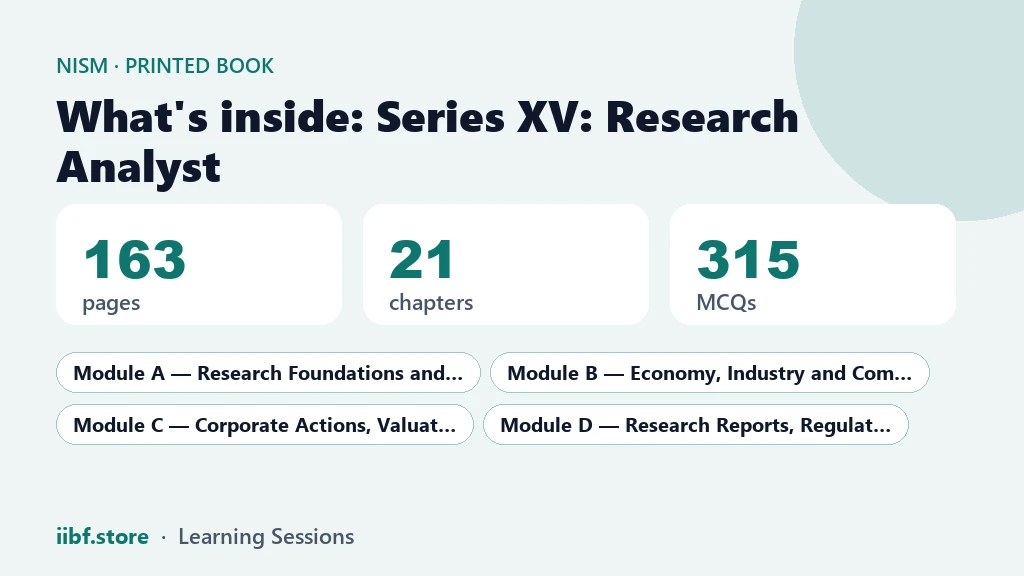
The four modules
- Module A, Research Foundations and Securities Markets: the research analyst profession, the securities market in two parts, equity and debt terminology, and the fundamentals of research.
- Module B, Economy, Industry and Company Analysis: economic analysis, industry analysis in two parts, business and governance, and financial analysis in two parts.
- Module C, Corporate Actions, Valuation, Commodities and Risk: corporate actions, valuation principles in two parts, fundamental analysis of commodities, and risk and return.
- Module D, Research Reports, Regulation and Technical Analysis: the qualities of a good research report, legal and regulatory environment in two parts, and technical analysis in two parts.
The listing also mentions two extras: 30 case studies carrying 120 questions, and 5 mega tests carrying 500 questions. The book page shows exactly how these are delivered, so read it before you decide.
Profile 1: You are attempting for the first time
You do not yet know how this exam feels. That is your biggest risk. First-timers usually either over-read the early chapters and run out of time for the later ones, or skip the reading and jump straight to questions.
How to use the book
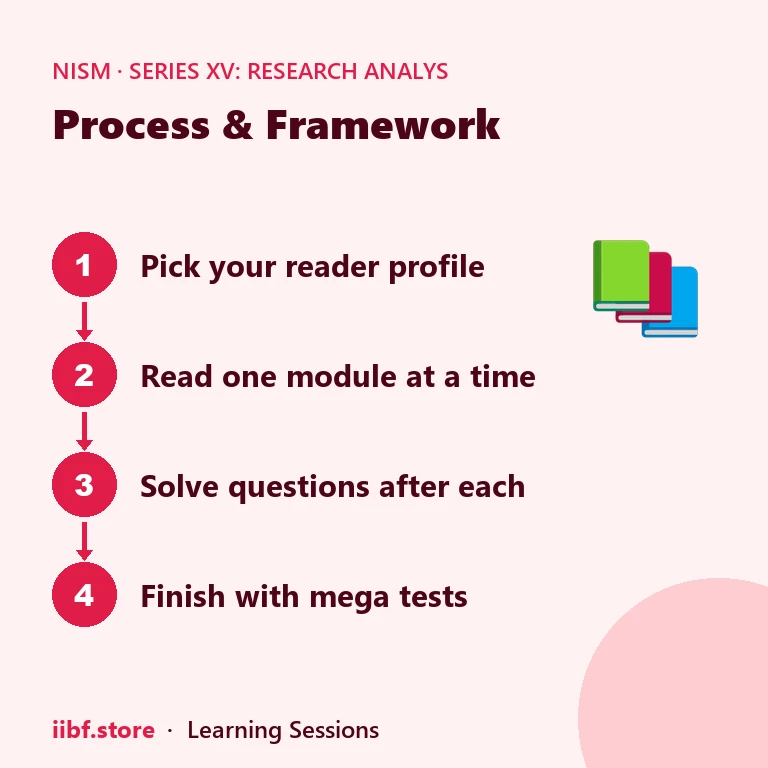
Treat the NISM Series XV book as a map. Read one module at a time, in order, because Module B (company analysis) leans on Module A, and Module C (valuation) leans on Module B. After each chapter, close the book and try its questions from memory of the chapter, not by flipping back.
When it is not enough
Reading builds understanding. It does not build exam-hall speed. In the final stretch you need timed practice. Try the free mock tests at iibf.store/tests to see how you behave under the clock, and use them to discover which module is your weak spot.
Profile 2: You have attempted before and want a cleaner second try
A failed or postponed attempt hurts, and it also gives you something valuable: you know your weak areas. Do not restart from page one. That feels productive but it is mostly a comfort ritual.
How to use the book
List the topics that cost you marks last time. For most candidates in this paper that tends to be numerical or technical-looking areas such as valuation or financial analysis, but your list is the one that counts. Go to those chapters first, work every question at the end, and write the formula or rule you got wrong on a single sheet. Revisit that sheet daily.
When it is not enough
If your earlier attempt failed because of time pressure rather than gaps in knowledge, another read-through will not fix it. You need repeated full-length practice. This is where the mega tests mentioned on the book page and the free tests on the site come in. Practise until a full paper stops feeling like a sprint.
Profile 3: You are short on time
Be realistic here. If you have only a few weeks and a heavy branch workload, a 163-page book is more manageable than a thick reference text, but it will not do the work for you.
How to use the book
Do not read all 21 chapters with equal weight. Read the official syllabus and notices on NISM's website for the upcoming exam cycle, then mark which chapters are heavy for you. Give the longest sessions to the chapters that are both unfamiliar and split into two parts, such as valuation, financial analysis, regulation and technical analysis. Skim the chapters you already know from your job, like securities market basics.
A simple weekly rhythm works for most people with a full-time job:
- Weekdays: one chapter or half a chapter in 40 minutes, then 10 to 15 questions.
- Saturday: revise the week's chapters and attempt a short test.
- Sunday: rest half the day, then one longer practice block.
When it is not enough
Short on time means you cannot afford to learn from your mistakes during the real exam. Take at least a few full mocks before you sit. Also, if a topic simply does not click from the page, a free explainer can help. Browse the free study material section and the blog for supporting notes.
Profile 4: You think better on paper than on a screen
Many working professionals spend their whole day on a screen. By night they want to hold something, underline it, fold a corner, and write in the margin. If that is you, a printed book is not a luxury. It is how your attention works.
How to use the book
Use three colours at most. One for definitions, one for formulas, one for regulatory points. Keep a pencil for questions you got wrong and put a small mark next to them. On your second pass, attempt only the marked ones. A printed book also lets you study during a power cut, on a train, or when your phone battery is gone.
When it is not enough
A printed book cannot tell you your score or your timing. Pair it with a screen-based mock, because the real exam is taken on a computer or per the format announced by the exam body for the upcoming cycle. Check the format on the official site rather than assuming.
A quick comparison table
Here is a summary of how the NISM Series XV book fits each reader, and what you should add beside it.
| Reader profile | Best use of the book | Add alongside it |
|---|---|---|
| First attempt | Module by module, in order, with end-of-chapter questions | Free mock tests to learn exam timing |
| Repeat attempt | Go straight to your weak chapters first | Full-length timed practice |
| Short on time | Prioritise heavy chapters, skim the familiar ones | A few full mocks and free notes |
| Paper over screen | Mark, annotate and revise on a second pass | Screen-based mocks for the real format |
Who should probably not buy it
Honesty matters more than a sale, so here are the cases where this book is the wrong fit:
- You want live teaching and someone to answer doubts as you go. A book cannot do that.
- You are already confident, practise daily and mostly need mock tests. Start with the free tests and see how you score before buying anything.
- You expect a book to guarantee a pass. No book can. Your hours of practice decide that.
If you are unsure, look at the free sample on the book page first. The current price is listed there at ₹700 against an MRP of ₹2,398, but prices may change, so treat the book page as the final word. You can also compare other titles in the books section.
The bottom line for tired, busy candidates
Most candidates do not fail because the material was missing. They fail because the routine broke in week three. Whatever you pick, protect a small daily slot, finish one module before touching the next, and test yourself under the clock before the exam. The NISM Series XV book is a compact, organised tool for that routine. It is best when paired with mock practice and a clear look at the official notices.
Decide your profile, make your plan, and take the first chapter tonight. That is the real start.
Frequently asked questions
Is the NISM Series XV book enough to pass on its own?
For most people, the book is the learning part. You also need timed practice. Pair it with mock tests so that you build exam-hall speed, not only understanding.
How many chapters and questions does it have?
The 2026 edition has 163 pages, 21 chapters in four modules, and 315 practice questions. The listing also mentions 30 case studies with 120 questions and 5 mega tests with 500 questions.
Can I check the book before buying?
Yes. A free sample is available on the book page, so you can judge the writing style and layout before you decide.
Where do I find the official exam dates and rules?
Always use NISM's official website for the schedule and rules of the upcoming exam cycle. Do not rely on any third-party guide for dates.
Prefer revising from a printed book?
Chapter-wise books with MCQs after every chapter — minimal pages, complete coverage, delivered anywhere in India. Every book has a free sample to read first.


















































Practice this topic
Take a free mock test, download chapter PDFs, or watch a video class — all included on iibf.store.