Multi-Factor Authentication in Banking: RBI Rules Explained
A customer calls your branch at 6 pm. Rs 48,000 has left his account through a card-not-present payment, and he swears he never shared his OTP. Your first question as a banker should not be "who is lying?" but "how many independent factors protected that payment, and did they really stay independent?" That question sits at the heart of multi-factor authentication in banking, one of the most practical topics in the IIBF IT Security syllabus.
In this article we walk through what authentication means, the three families of factors, what the Reserve Bank of India's 2025 directions on digital payment authentication require, where exemptions apply, who pays when authentication fails, and how IIBF frames questions on it. Read it once for the concept and once more as a revision sheet before the upcoming exam cycle.
What is authentication, and why one factor is never enough
Authentication is the process of validating the credentials of the person who originates a payment instruction or a login request. It answers the question "are you really who you claim to be?" Authorisation, which is a different step, answers "what are you allowed to do?". IIBF likes to test whether you can separate the two, so keep them apart in your head.
A single factor, usually a password, fails for predictable reasons. Customers reuse passwords, write them down, type them on phishing pages and install keyloggers without knowing it. The moment a second, independent proof is demanded, the attacker has to defeat two different weaknesses at once. That is the whole logic of multi-factor authentication in banking: combine proofs of different kinds so that the loss of one does not open the door.
The three factor families
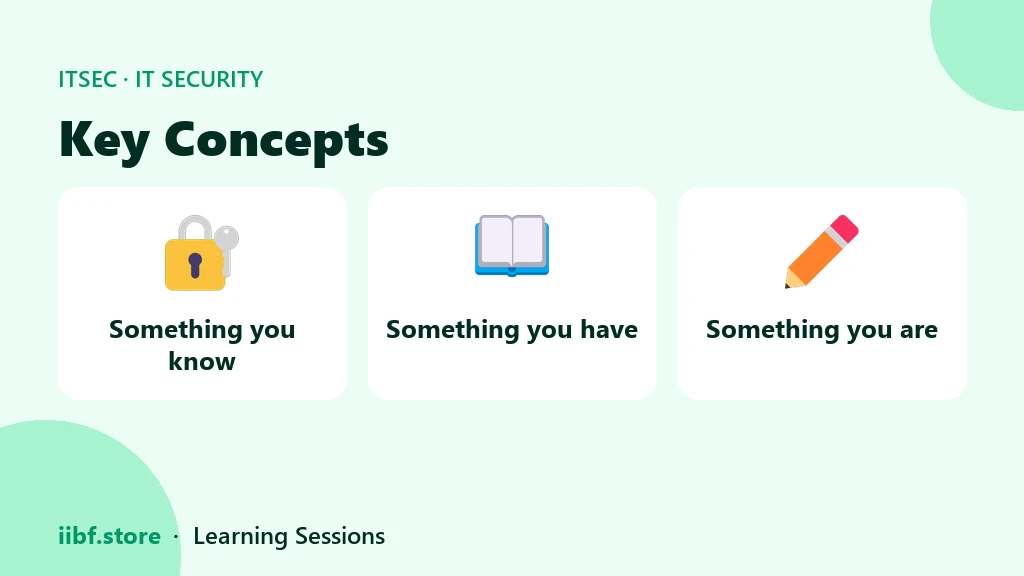
Every credential that a bank uses falls into one of three families. The RBI directions define a factor of authentication in exactly these terms.
- Something the user knows (knowledge): password, PIN, passphrase, security answer.
- Something the user has (possession): card hardware, a registered mobile receiving an SMS OTP, a hardware or software token generating a code.
- Something the user is (inherence): fingerprint, face, iris or other biometrics.
A very common exam trap: a password plus a PIN is not two-factor authentication, because both are knowledge factors. Two distinct families are what count. A debit card plus PIN at an ATM is a possession factor plus a knowledge factor, so it qualifies.
Static versus dynamic factors
A static factor stays the same across transactions, such as a PIN. A dynamic factor is created or proven afresh for each transaction, such as an OTP, a cryptogram from a token or an in-app approval tied to that specific payment. Dynamic factors matter because a stolen copy is useless for the next transaction.
What RBI's 2025 authentication directions require
The Reserve Bank issued the Authentication mechanisms for digital payment transactions Directions, 2025 on 25 September 2025, under Section 18 read with Section 10(2) of the Payment and Settlement Systems Act, 2007. They came into force on 1 April 2026 for payment system providers and participants, banks and non-banks alike, unless a provision says otherwise. You can read the original text on the RBI notification page.
Three principles carry most of the weight:
- Two distinct factors. All digital payment transactions must be authenticated by at least two distinct factors of authentication, except those listed as exempt in the annexure to the directions.
- One dynamic factor. For transactions other than card-present ones, at least one of the factors must be dynamically created or proven, meaning unique to that transaction.
- Independence. The factors must be built so that compromise of one does not affect the reliability of the other.
Notice what is not said. The directions do not make SMS OTP the only acceptable dynamic factor. Banks may use other methods, for example app-based or biometric approaches, as long as the principles above hold. For a student, the safe reading is: the rule is about factor design, not about one named technology.
Authentication and tokenisation must stay interoperable
The directions also require that authentication or tokenisation services be accessible to all applications and token requestors in the operating environment. In plain words, an issuer should not lock its authentication method to one app in a way that shuts out others.
Risk-based checks beyond two factors
The directions allow issuers to add checks on top of the two-factor baseline when a transaction looks risky. Behavioural and contextual signals such as location, device attributes and past transaction patterns can trigger a step-up. The directions treat these as optional enablers, and they mention that issuers may explore DigiLocker to notify and confirm high-risk transactions.
This is why a branch banker should explain to customers that an extra prompt on an unusual payment is a feature, not a fault. It is the risk engine doing its job.
Step by step: how a two-factor digital payment is authenticated
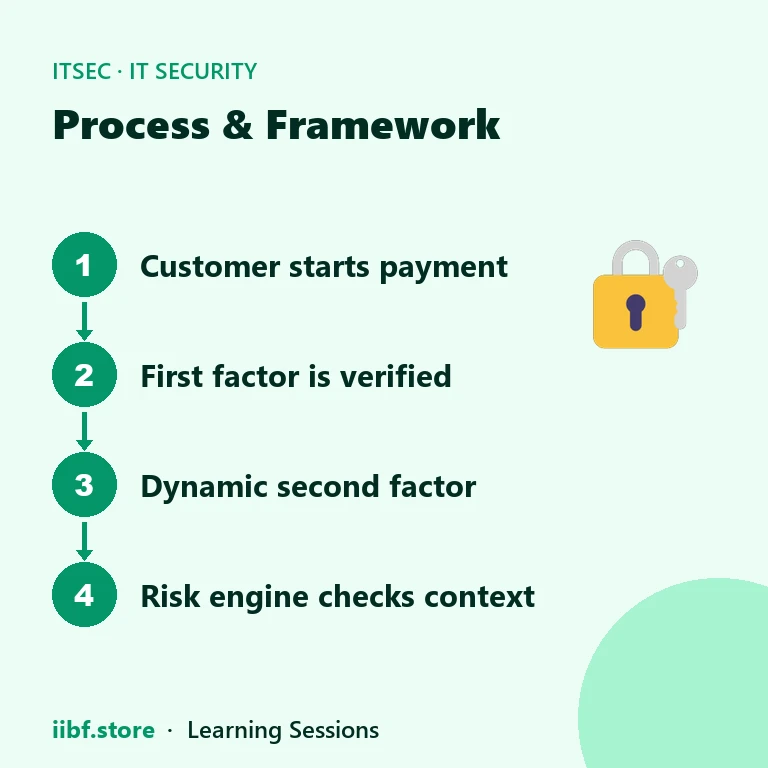
Here is a simplified flow for an online card payment. Your own bank's screens may differ, but the logic is the same.
- The customer enters card details on the merchant page. This identifies the instrument but is not itself a strong proof.
- The issuer's system asks for the first factor, for example a registered-device approval (possession) or a PIN (knowledge).
- A second, dynamic factor is generated for this specific transaction, such as an OTP or a one-time cryptogram.
- The risk engine looks at device, location and amount. If the pattern is unusual, it can demand an extra check.
- Only when the factors verify and the risk checks pass does the issuer approve the payment and send the customer an alert.
Exemptions: where simplified authentication is allowed
The annexure to the directions lists transactions where the two-factor rule does not apply, mainly to protect convenience for small or recurring payments. The listed categories include:
- small-value contactless card transactions;
- recurring transactions, other than the first, under the e-mandate framework;
- certain prepaid instruments such as PPI-MTS and gift PPIs;
- NETC (FASTag) transactions;
- small-value offline digital payments;
- travel bookings made through commercial or corporate cards, including GDS and IATA channels;
- Tap and Pay UPI transactions on NFC-enabled POS machines.
Do not memorise exact rupee limits from guides or social media. If a question mentions a threshold, rely on the current RBI text. For the e-mandate point, remember the detail IIBF can twist: the first payment of an e-mandate is authenticated normally, and only the later recurring debits are exempt.
Cross-border card-not-present payments
The directions do not apply to cross-border digital payments as such. A separate provision deals with cross-border card-not-present transactions on Indian-issued cards used with overseas merchants. By 1 October 2026, card issuers were required to put in place a mechanism to validate non-recurring cross-border card-not-present transactions when the overseas merchant or acquirer requests authentication, which involves registering BINs with the card networks. Issuers were also required to have a risk-based mechanism for all cross-border card-not-present transactions.
Who pays when authentication fails?
This is the part customers care about and exams love. The directions place the responsibility on the issuer, the bank or non-bank that maintains the account, credit line or prepaid instrument. The issuer must ensure the robustness and integrity of its authentication mechanism before deployment. If a customer suffers a loss from transactions that did not comply with the directions, the issuer must compensate the customer in full. The directions also require issuers to comply with the Digital Personal Data Protection Act, 2023, which matters because biometrics and behavioural data are personal data.
Liability for unauthorised electronic transactions where the customer was negligent or where the fault lies elsewhere is governed by the RBI's separate customer-protection framework, so do not mix the two in an answer. Say clearly which instrument you are quoting.
Comparison table: weak versus strong authentication designs
| Design | Factor families used | Dynamic factor? | Meets two-factor principle? |
|---|---|---|---|
| Password only | Knowledge | No | No |
| Password + PIN | Knowledge, Knowledge | No | No (same family) |
| Card PIN at ATM (card present) | Possession, Knowledge | Not required for card-present | Yes |
| Password + SMS OTP | Knowledge, Possession | Yes | Yes |
| Registered-device approval + biometric | Possession, Inherence | Yes, if tied to the transaction | Yes |
| OTP and password typed on one compromised phone | Knowledge, Possession | Yes | Weak in practice, independence is doubtful |
The last row is a good reminder. When a single compromised device receives the OTP and also holds the banking app, the independence principle is under strain. This is exactly why risk-based checks and device binding exist.
How IIBF tests this topic
In the IT Security paper, authentication shows up as definition questions, factor-classification questions, and short scenario questions. Typical patterns are: classify an item as knowledge, possession or inherence; identify which combination qualifies as two-factor; state who bears the loss; and distinguish authentication from authorisation and from identification. Practise these with the topic-wise questions in the IT Security mock tests and revise concepts from the IT Security course. The IT Security printed book gives chapter-wise MCQs to drill after every reading.
Practice MCQ 1
Which of the following combinations is a valid two-factor authentication? (a) Password and PIN (b) Password and security question (c) PIN and OTP sent to the registered mobile (d) Username and password.
Answer: (c). A PIN is knowledge, and an OTP received on the registered mobile is a possession-based dynamic factor. The other options combine two things from the same knowledge family or are a single factor.
Practice MCQ 2
Under the RBI directions, for a non-card-present digital payment, at least one factor must be: (a) a biometric (b) a printed card number (c) dynamically created or proven for that transaction (d) shared with the merchant.
Answer: (c). The directions require one dynamic factor, unique to the transaction, for transactions other than card-present ones. Biometrics are allowed but not mandatory.
Practice MCQ 3
If a customer loses money from a transaction that did not comply with the RBI authentication directions, who must compensate? (a) The customer (b) The merchant only (c) The issuer, in full (d) The payment gateway only.
Answer: (c). The directions make the issuer responsible for compensating the customer for the loss in full when the transaction did not comply with the directions.
Quick revision points
- Authentication verifies identity; authorisation decides permissions.
- Three factor families: knowledge, possession, inherence.
- Two factors must come from two distinct families.
- Non-card-present payments need at least one dynamic factor.
- Factors must be independent: compromise of one must not break the other.
- Risk-based checks (location, device, history) can add extra steps.
- Exempt categories exist for small, recurring or offline use cases.
- The issuer carries the responsibility to compensate where the directions were not followed.
For the exam syllabus and the official schedule of the upcoming cycle, always check the IIBF website. For free reading on related topics, see the free study material library.
Frequently asked questions
Is SMS OTP alone enough as multi-factor authentication?
No. An OTP is one factor, a possession-based dynamic one. It needs to be combined with a factor from another family, such as a PIN, a password or a biometric, to make two-factor authentication.
Does multi-factor authentication in banking mean three factors?
Not necessarily. The term covers two or more factors. The RBI baseline for digital payments is at least two distinct factors, with extra checks added when the risk looks higher.
Are all digital payments covered by the two-factor rule?
No. The annexure to the directions lists exempt categories such as small-value contactless card payments, later recurring e-mandate debits, NETC transactions and small-value offline payments.
Can a bank use biometrics as a factor?
Yes. Biometrics fall under something the user is, and the directions name them as an example of a factor. The bank must still meet the dynamic-factor and independence principles and follow the Digital Personal Data Protection Act, 2023.
Where do I read the official text?
On the RBI website, in the notification titled Authentication mechanisms for digital payment transactions Directions, 2025. Always rely on that text, not on summaries, for exam answers.
Conclusion
Remember the logic and the rest follows: independent proofs of different kinds, one of them fresh for every non-card-present transaction, with the issuer answerable if the system fails. If you can classify factors, state the RBI principles and name the exemption categories, you are ready for most questions on multi-factor authentication in banking. Take a few mock tests, revisit the traps above, and your IT Security preparation will rest on firm ground.
Prefer revising from a printed book?
Chapter-wise books with MCQs after every chapter — minimal pages, complete coverage, delivered anywhere in India. Every book has a free sample to read first.


















































Practice this topic
Take a free mock test, download chapter PDFs, or watch a video class — all included on iibf.store.
Keep reading