Is the NISM X-A Investment Adviser book right for you?
It is 9:40 at night. The branch closed hours ago, the last customer complaint is finally off your desk, and you are looking at a syllabus that covers time value of money, derivatives, portfolio theory and a long list of regulations. You want a credential that moves you toward advisory work, but you have no spare week to read five different sources. If that sounds familiar, this guide is for you.
Before anything else: no single book suits every candidate. This article walks through four common reader profiles and tells you plainly whether the NISM X-A Investment Adviser book fits each one, and where it is not enough on its own. If the answer for you is "no", that is a useful result too, and the free resources linked below will still help.
What the book actually is (and is not)
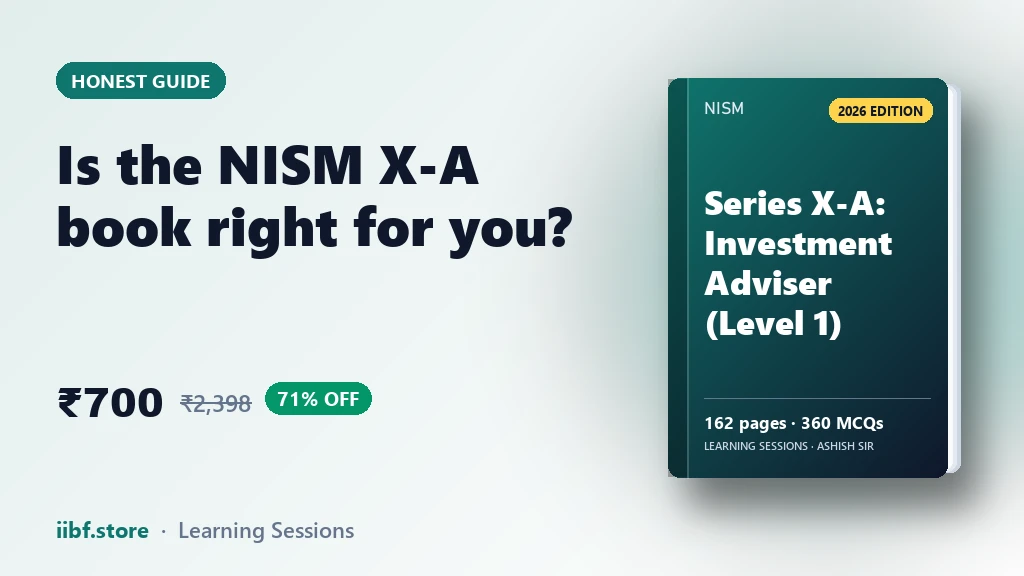
The NISM Series X-A: Investment Adviser (Level 1) printed book is a 2026 edition running to 162 pages and 24 chapters, with 360 practice questions. It is organised into four modules, which makes it easy to ration your time: one module is a sensible unit for one week of tired evenings.
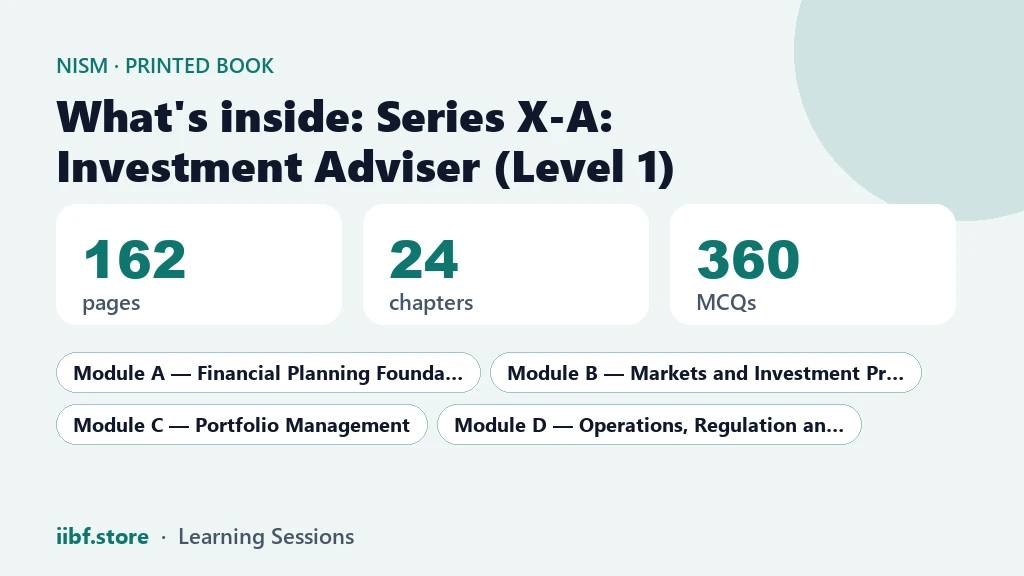
- Module A - Financial Planning Foundations: personal financial planning, time value of money, cash flow and budgeting, and two chapters on debt management and loans.
- Module B - Markets and Investment Products: Indian financial markets, securities market segments, investments, stocks, fixed income (two parts), derivatives, mutual funds, and portfolio managers and AIFs.
- Module C - Portfolio Management: modern portfolio theory, portfolio construction, and performance measurement and evaluation (two parts).
- Module D - Operations, Regulation and Ethics: operational aspects of investment management, key regulations (three parts), and ethics with grievance redress.
Beyond the chapters, it carries 30 case studies (120 questions) and 5 mega tests (500 questions). That is a lot of practice material inside one printed book, and it matters for the profiles below. What the book is not: a live class, a doubt-clearing service, or a guarantee. It is a structured set of notes and questions, and you still have to do the work.
Profile 1: You are attempting for the first time
First attempts usually fail for one reason: the candidate underestimates how wide the paper is. Series X-A mixes calculation-heavy topics (time value of money, debt, performance measurement) with memory-heavy ones (key regulations, operations). A first-timer needs a clear map more than extra material.
How to use the book
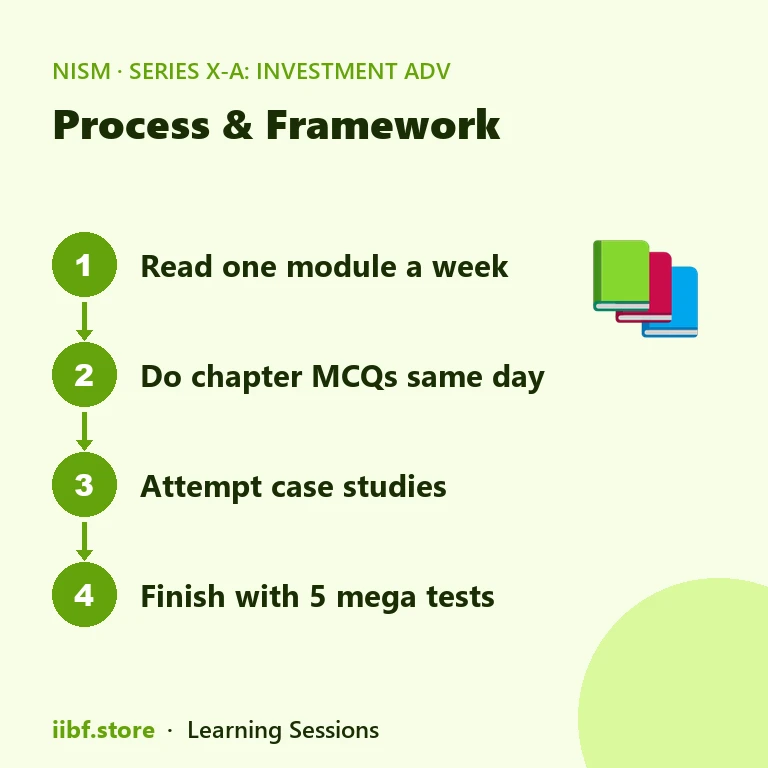
- Read straight through once, module by module, without trying to memorise. Your only goal is to know where each topic lives.
- On the second pass, solve the chapter questions the same day you read the chapter. Do not stack them up for later.
- Mark every calculation you got wrong and redo it two days later with a fresh sheet of paper.
When it is not enough
A book gives you understanding, not exam-hall speed. Once you have finished Module B, start timed practice using the free mock tests at iibf.store/tests. Timed practice is where first-timers discover that they know the material but run out of minutes.
Profile 2: You have attempted before and need a different approach
If you have already failed or postponed once, repeating the same method will repeat the same result. Do not start again from page one. Instead, treat the NISM X-A Investment Adviser book as a diagnostic tool.
Start with the mega tests at the back. Attempt one under exam conditions, then sort every wrong answer into three buckets: did not know the concept, knew it but made a calculation error, or misread the question. Each bucket needs a different fix, and the module structure tells you exactly which chapters to revisit.
Repeaters often find that regulation chapters were the weak spot, because they are easy to skim. Spend an evening on each of the three key regulation chapters and write your own one-page summary from memory. Then compare with the book.
Profile 3: You are short on time
Working a full branch day leaves you perhaps ninety usable minutes on a weeknight and a few hours on Sunday. With 24 chapters in 162 pages, the chapters are compact, which suits this schedule. But compact does not mean skippable.
A realistic plan
| Week | Focus | What to finish |
|---|---|---|
| 1 | Module A | 5 chapters, chapter questions, redo calculations |
| 2 | Module B | 9 chapters in two sittings; stocks, fixed income and derivatives first |
| 3 | Modules C and D | Portfolio chapters, then regulations and ethics |
| 4 | Revision and practice | Case studies, then mega tests under timed conditions |
Be honest with yourself about the limit. If you can only study on a couple of evenings a week, four weeks is optimistic. Stretch the plan rather than skipping the practice stage. A short plan that drops the mega tests is not really a plan.
Profile 4: You think better on paper than on a screen
Many bankers spend eight hours a day looking at a screen and do not want to spend the night doing the same. A printed book lets you underline a formula, fold a page, and study in a train or a quiet corner of the house without notifications pulling you away. That is a genuine advantage, and it is the main reason a printed edition exists.
The trade-off is equally real. Paper cannot time you, cannot shuffle questions, and cannot show you a score trend. If you choose print, pair it with a screen-based mock now and then. You can also pick up free PDFs from iibf.store/free-material for topics where you want a second explanation.
Practical tip: keep a pencil, not a pen, for the case studies. You will redo them.
Who should probably skip it
Trust is worth more than a sale, so here is the other side.
- If you already hold a strong finance background and only need a quick refresher, a full book may be more than you need. Use the free sample and judge.
- If you learn best from a teacher explaining live, a book alone will feel dry. Consider pairing it with classes.
- If you need the very latest regulatory changes, remember that any printed edition is a snapshot. Verify current rules on official sites before the exam. For banking certificates, the schedule and notices are published at iibf.org.in; for this exam, check the conducting body's official site for the upcoming exam cycle.
How to decide in ten minutes
Before buying the NISM X-A Investment Adviser book, open the book page, read the free sample, and ask three questions. Can I follow the explanation without rereading it three times? Does the question style look like something I can practise? Can I commit to one module a week? If all three answers are yes, the book will probably serve you well. If not, spend the evening on the free mock tests first and come back later.
The price at the time of writing is ₹700 against an MRP of ₹2,398, but prices can change, so treat the book page as the current source. You can also browse the full range at iibf.store/books or read more guides on the blog.
Conclusion
The NISM X-A Investment Adviser book is a practical, module-wise tool for a candidate who studies in small, tired slices. It suits first-timers who need a map, repeaters who need a diagnosis, busy bankers who need compact chapters, and readers who simply prefer paper. It does not replace timed mock practice, a teacher if you need one, or your own consistency. Pick your profile, follow the plan, and be honest about what the book cannot do for you.
Frequently asked questions
How many chapters and questions does the book have?
It has 24 chapters across four modules in 162 pages, with 360 practice questions, plus 30 case studies (120 questions) and 5 mega tests (500 questions).
Can I clear the exam with this book alone?
It covers the syllabus structure and gives you plenty of practice, but no book can promise a result. Add timed mock tests and revise your weak chapters. Pass outcomes depend on your preparation.
Is there a sample I can read before buying?
Yes. The book page has a free sample so you can check the writing style and question format first.
Where do I find the official exam schedule?
Check the official website of the conducting body for the upcoming exam cycle. Banking candidates can also follow notices at iibf.org.in.
Prefer revising from a printed book?
Chapter-wise books with MCQs after every chapter — minimal pages, complete coverage, delivered anywhere in India. Every book has a free sample to read first.


















































Practice this topic
Take a free mock test, download chapter PDFs, or watch a video class — all included on iibf.store.