PMJJBY and PMSBY Insurance Schemes: Premium, Cover and Exam Traps
A customer walks up to your counter with a small savings account balance and one worry: "If something happens to me, what will my family get?" You do not need to sell him a big policy. Two government-backed schemes, which you will meet again and again in your branch and in the JAIIB RBWM paper, answer that worry for the price of a cup of tea a month. In this article we explain the PMJJBY and PMSBY insurance schemes the way a senior colleague would: who can join, what the premium and cover are, how the auto-debit works, where candidates lose marks and how to handle the customer at the counter.
All scheme facts below are taken from the Ministry of Finance release published by the Press Information Bureau (PIB release on the three Jan Suraksha schemes) and the scheme portal jansuraksha.gov.in. Government can revise premiums, so before your exam cycle always re-check the current figures with the official portal.
What are PMJJBY and PMSBY?
PMJJBY is the Pradhan Mantri Jeevan Jyoti Bima Yojana. PMSBY is the Pradhan Mantri Suraksha Bima Yojana. Both were launched by the Prime Minister on 9 May 2015, together with the Atal Pension Yojana (APY), and together the three are called the Jan Suraksha schemes. The idea was to extend affordable financial protection to everyone, especially the under-served and vulnerable sections of society.
The two schemes are deliberately simple and complement each other:
- PMJJBY is a one-year renewable life insurance cover. It pays out on death due to any reason.
- PMSBY is a one-year renewable accident insurance cover. It pays out on accidental death or disability.
Both are sold through banks and the post office. PMJJBY is offered and administered through LIC and other life insurance companies that are willing to offer the product on similar terms, while PMSBY is offered through public sector general insurance companies and other general insurers who tie up with banks. A participating bank is free to engage any such insurer for its subscribers, which is why you will see different insurers behind the same scheme at different banks.
Why bankers are the real distribution channel
These are not products customers discover on their own. The enrolment form is collected at the branch, the premium is auto-debited from a savings account you manage, and the nominee later comes to your branch for the claim. That is why the RBWM syllabus treats the PMJJBY and PMSBY insurance schemes as retail banking topics and not only as insurance topics. The release quoted above records that more than 23.6 crore enrolments had been done under PMJJBY and more than 51 crore under PMSBY till April 2025, which shows how large the retail bank's role is.
PMJJBY: life cover in detail
PMJJBY is designed to give life insurance cover for death due to any reason at a premium of less than Rs 2 per day. Here are the features you must know cold.
Eligibility
- Any individual bank or post office account holder of a participating bank or post office, aged 18 to 50 years, who gives consent to join or enables auto-debit.
- If a person holds several accounts in one or different banks, he can join through one account only.
Cover period and enrolment
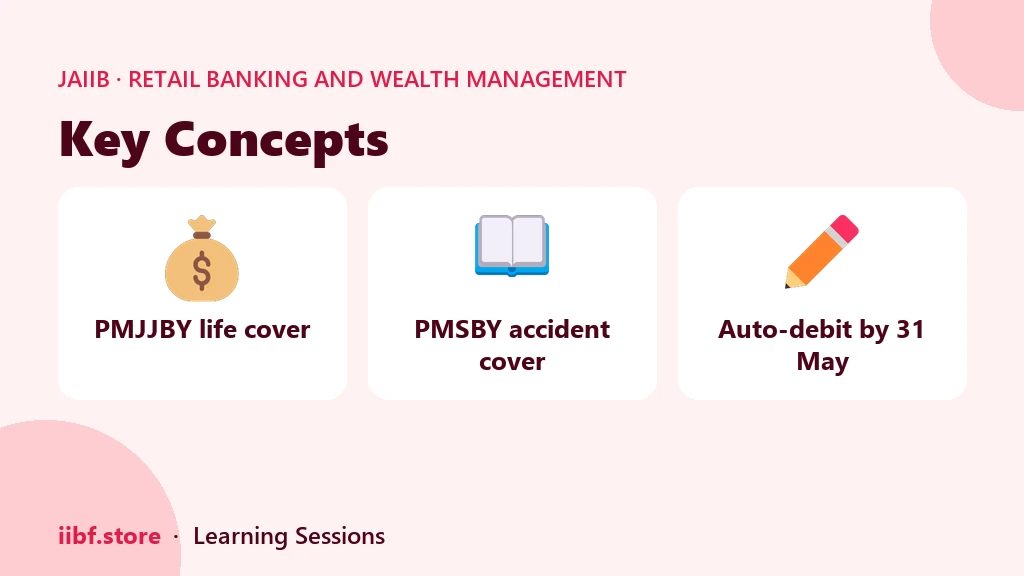
The cover is for one year, from 1 June to 31 May. The option to join, and the auto-debit consent, must be given by 31 May of each year for the next cover year. It is a one-year cover, renewable from year to year; it is not a long-term policy.
Premium and benefit
- Premium: Rs 436 per annum per member, debited in one instalment through auto-debit.
- Benefit: Rs 2 lakh payable on the subscriber's death due to any cause.
- A lien period of 30 days applies from the date of enrolment.
Late joiners pay pro-rata premium
A customer who misses the 31 May window can still join for prospective cover during the year by paying a pro-rata premium. This is a favourite exam point, so memorise the pattern: the premium falls by Rs 94 or Rs 114 with each quarter of the cover year.
| Month of enrolment | Premium payable |
|---|---|
| June, July, August | Rs 436 (full annual premium) |
| September, October, November | Rs 342 |
| December, January, February | Rs 228 |
| March, April, May | Rs 114 |
Notice that the cover still ends on 31 May whatever month the customer joins, so a customer who joins in March pays a small premium for a short cover and must renew from 1 June like everyone else.
PMSBY: accident cover in detail
PMSBY gives accidental death and disability cover of up to Rs 2 lakh to persons aged 18 to 70 years, at a premium of less than Rs 2 per month.
Eligibility
- Individual bank or post office account holders aged 18 to 70 years who give consent to join or enable auto-debit.
- Only one account per person can be used, exactly as in PMJJBY.
Cover period and premium
Like PMJJBY, the cover runs from 1 June to 31 May and the auto-debit option must be given by 31 May of every year. The premium is Rs 20 per annum per member, deducted in one instalment from the account.
Table of benefits
| Event due to accident | Sum insured |
|---|---|
| Death | Rs 2 lakh |
| Total and irrecoverable loss of both eyes, or loss of use of both hands or feet, or loss of sight of one eye and loss of use of one hand or foot | Rs 2 lakh |
| Total and irrecoverable loss of sight of one eye, or loss of use of one hand or foot | Rs 1 lakh |
The exam trap here is the split: full loss (both eyes, both limbs, or one eye plus one limb) earns the full Rs 2 lakh, while a single eye or a single hand or foot earns Rs 1 lakh. Candidates often write Rs 2 lakh for everything.
PMJJBY vs PMSBY: side-by-side comparison
Most RBWM questions are comparisons, so build this table into your memory.
| Feature | PMJJBY | PMSBY |
|---|---|---|
| Type of cover | Life (death due to any cause) | Accidental death and disability |
| Entry age | 18 to 50 years | 18 to 70 years |
| Annual premium | Rs 436 | Rs 20 |
| Maximum benefit | Rs 2 lakh | Rs 2 lakh |
| Cover year | 1 June to 31 May | 1 June to 31 May |
| Offered through | LIC and other life insurers | Public sector general insurers and other general insurers |
| Lien period | 30 days from enrolment | No lien period mentioned in the scheme summary |
| Late enrolment | Pro-rata premium by quarter | Check the scheme rules; do not assume the PMJJBY pattern |
Step-by-step: from enrolment to claim
This is the flow you should be able to describe to a customer and to an examiner.
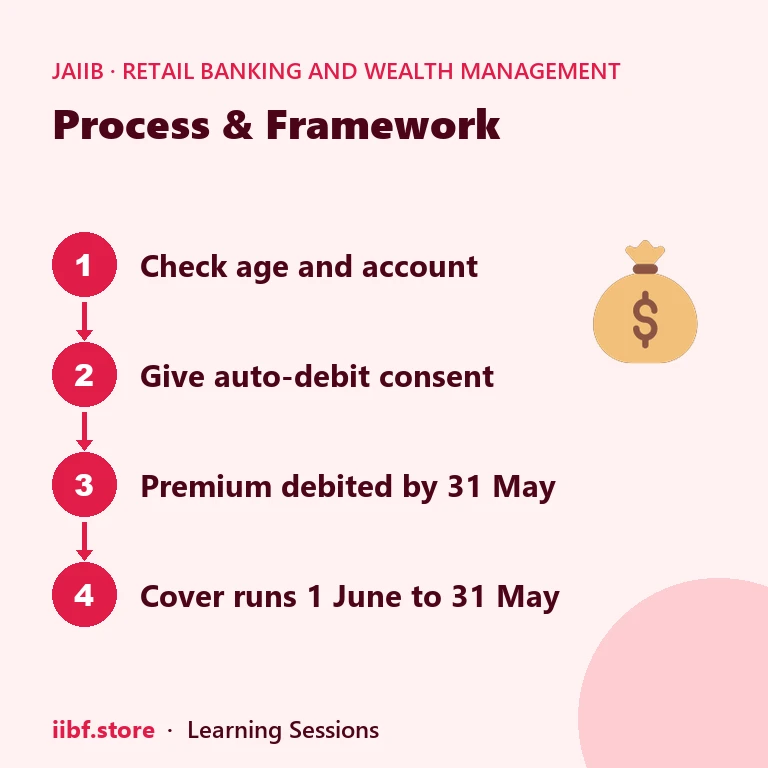
- Check the customer's age and account. The customer must hold an individual savings account with a participating bank or post office, and be within the age limit for the scheme (50 for PMJJBY, 70 for PMSBY).
- Take the auto-debit consent. The customer fills the prescribed enrolment form (or enrols through the online Jan Suraksha portal) and gives consent for annual auto-debit. This consent is the heart of the scheme.
- Keep the balance in the account. The premium is debited in one instalment around the cover renewal on or before 31 May. If the balance is short, the cover can lapse, and you will have an unhappy nominee later.
- The cover year starts on 1 June. From then until the following 31 May the customer is insured.
- The nominee files the claim. The bank branch helps the nominee with the claim form and documents and forwards it to the insurer.
Your single biggest practical role is step 3. A branch that pings customers before 31 May to maintain balance saves families from a nasty surprise. The release also notes that the online Jan Suraksha portal now lets citizens enrol without visiting a branch, and that digitising claims has led to faster settlements.
A worked branch example
Ramesh, aged 46, has a savings account at your branch and joined PMJJBY and PMSBY in June. His combined premium for the year is Rs 436 plus Rs 20, that is Rs 456, and his total cover is up to Rs 2 lakh for death by any cause plus up to Rs 2 lakh for accidental death. If Ramesh dies in a road accident during the cover year, the nominee can claim under both schemes, subject to the scheme conditions and the insurers' claim processes. Suppose instead his wife Sunita, aged 58, wants to join: she cannot join PMJJBY because the entry age ends at 50, but she can join PMSBY because the limit is 70.
Now change the facts: Ramesh forgot to enrol in June and walks in during January. He can still join PMJJBY for prospective cover, and the pro-rata premium for December to February is Rs 228. His 30-day lien period starts from the date of enrolment, so a non-accident death inside those 30 days would not be payable under the scheme rule. That example combines three exam concepts in one case, which is exactly how RBWM likes to frame questions.
Important rules and common mistakes
One account, one cover
If the customer holds several accounts, he can be covered through only one. Multiple premiums do not multiply the cover. This is stated explicitly in the scheme eligibility conditions.
Renewal is annual, not permanent
Both are one-year covers. Candidates sometimes treat them as long-term policies. The auto-debit mandate is what makes renewal automatic, but each cover year stands on its own.
Entry age versus continuation
The limits in the release are the entry eligibility ages: 18 to 50 for PMJJBY and 18 to 70 for PMSBY. Do not confuse these with the age at which a customer must stop; read the scheme rules on the official portal for the renewal and termination conditions before you quote them to a customer.
Lien period
PMJJBY carries a 30-day lien from the date of enrolment. In plain words, it is a short waiting period at the start of the cover.
Do not mix up with APY
The third Jan Suraksha scheme, Atal Pension Yojana, is a pension scheme for account holders aged 18 to 40 who are not income tax payers, administered by PFRDA. It is different from the two insurance schemes covered here, so keep their age limits apart. If you want the pension scheme in depth, read our separate article on Atal Pension Yojana on the site.
How the JAIIB RBWM paper tests these schemes
RBWM questions on the PMJJBY and PMSBY insurance schemes are usually factual and often framed as "which of the following is correct" or as a two-statement question. Expect the examiner to test:
- Entry age (50 versus 70), because the two numbers are easily swapped.
- Premium (Rs 436 versus Rs 20), and which scheme carries which.
- Nature of cover: life versus accident.
- The 1 June to 31 May cover year and the auto-debit consent by 31 May.
- The PMSBY benefit split between Rs 2 lakh and Rs 1 lakh.
- The pro-rata premium slabs for late joiners in PMJJBY.
You can practise this style with chapter-wise questions in the RBWM printed book with MCQs, and test yourself under exam conditions with the JAIIB mock tests. For a structured plan across the whole paper, the JAIIB Retail Banking and Wealth Management course covers insurance and social security schemes along with the rest of the syllabus, and the JAIIB offer page shows the current bundle.
Practice question 1
Question: Which of the following statements about PMJJBY is correct? (a) It covers accidental death only; (b) the entry age is 18 to 70 years; (c) the annual premium is Rs 436 and the cover is Rs 2 lakh for death due to any cause; (d) the cover year is April to March.
Answer: option (c). PMJJBY covers death due to any cause, so (a) is wrong; entry is 18 to 50 years, so (b) is wrong; and the cover year is 1 June to 31 May, so (d) is wrong.
Practice question 2
Question: A customer aged 62 asks which Jan Suraksha insurance scheme he can join through his savings account. Which is the right advice? (a) PMJJBY only; (b) PMSBY only; (c) both; (d) neither.
Answer: option (b). At 62 he is above the PMJJBY entry limit of 50 but within the PMSBY limit of 70.
Practice question 3
Question: Under PMSBY, what is the sum insured for total and irrecoverable loss of sight of one eye? (a) Rs 2 lakh; (b) Rs 1 lakh; (c) Rs 50,000; (d) Nil.
Answer: option (b). Loss of both eyes earns Rs 2 lakh, but loss of sight of one eye earns Rs 1 lakh.
Quick revision points
- Both schemes launched on 9 May 2015 along with APY; all three are Jan Suraksha schemes.
- PMJJBY: life cover, age 18 to 50, Rs 436 a year, Rs 2 lakh, 30-day lien.
- PMSBY: accident cover, age 18 to 70, Rs 20 a year, Rs 2 lakh or Rs 1 lakh as per table.
- Cover year 1 June to 31 May; auto-debit consent due by 31 May.
- One person, one account, one cover.
- PMJJBY late enrolment: Rs 436, Rs 342, Rs 228, Rs 114 by quarter.
- Premium debit is in one instalment through auto-debit.
For more preparation material around insurance and retail products, browse the free resources on our free material page.
Frequently asked questions
What is the difference between PMJJBY and PMSBY?
PMJJBY is a life insurance cover that pays Rs 2 lakh on death due to any cause, for ages 18 to 50, at Rs 436 a year. PMSBY is an accident cover for accidental death and disability, for ages 18 to 70, at Rs 20 a year.
Can one person join both schemes?
Yes. They cover different risks, so a customer within both age limits can enrol in both through his savings account, subject to the rule that only one account can be used for each scheme.
When must the auto-debit consent be given?
For the regular enrolment, the option to join and the auto-debit consent must be given by 31 May every year. The cover then runs from 1 June to 31 May.
Can a customer join PMJJBY after June?
Delayed enrolment for prospective cover is possible with a pro-rata premium: Rs 342 for September to November, Rs 228 for December to February and Rs 114 for March to May. The 30-day lien period applies from enrolment.
Which are the insurers behind these schemes?
PMJJBY is offered through LIC and other life insurers; PMSBY through public sector general insurers and other general insurers. The bank chooses its partner insurer.
Conclusion
The PMJJBY and PMSBY insurance schemes are small in premium but large in exam weight and in everyday branch work. Remember the two ages (50 and 70), the two premiums (Rs 436 and Rs 20), the shared cover year (1 June to 31 May), the auto-debit consent and the one-account rule, and you will pick up easy marks in RBWM while genuinely protecting your customers. Check the official portal for any revision before your exam, and see the IIBF website for the schedule of the upcoming exam cycle.
Prefer revising from a printed book?
Chapter-wise books with MCQs after every chapter — minimal pages, complete coverage, delivered anywhere in India. Every book has a free sample to read first.


















































Quick quiz on this topic
5 exam-style questions from our free test bank — check yourself before you move on.
Practice this topic
Take a free mock test, download chapter PDFs, or watch a video class — all included on iibf.store.
Keep reading