Priority Sector Lending PSL Norms in India 2026
Understanding the PSL norms in India is essential for every candidate preparing for the CAIIB Rural Banking elective, because Priority Sector Lending sits at the heart of how banks channel credit to the productive but under-served segments of the economy. The Reserve Bank of India mandates that a defined share of bank lending must flow to sectors that generate employment, support livelihoods and reduce regional imbalances. This article walks through the PSL categories, the headline 40 percent target, the sub-targets for agriculture, micro enterprises and weaker sections, and the market instruments such as Priority Sector Lending Certificates and the Rural Infrastructure Development Fund that keep the framework working in practice.
What Priority Sector Lending Means and Why It Exists
Priority Sector Lending is a regulatory obligation that requires banks to extend a minimum proportion of their credit to segments that the government and the RBI consider vital for inclusive growth. The idea is simple but powerful: left to pure commercial logic, banks would concentrate lending on large, well-collateralised borrowers in cities, leaving farmers, small entrepreneurs and rural households starved of formal credit. By setting mandatory floors, the framework corrects this market failure and ensures that the benefits of a growing banking system reach the base of the pyramid. This is precisely why the PSL norms in India are treated as a core pillar of financial inclusion rather than a mere accounting rule.
The categories recognised under priority sector are broad. They include agriculture, micro, small and medium enterprises, export credit, education, housing, social infrastructure, renewable energy, and lending to weaker sections. Each category has detailed eligibility rules on loan size and end-use so that credit genuinely reaches the intended beneficiary. For a Rural Banking student, the agriculture and weaker-sections limbs matter most, but you should be able to name every category confidently in the exam. The full master directions are published by the Reserve Bank of India and are updated periodically, so always anchor your revision to the latest circular rather than dated coaching notes.
The 40 Percent Target and the Sub-Targets Within It
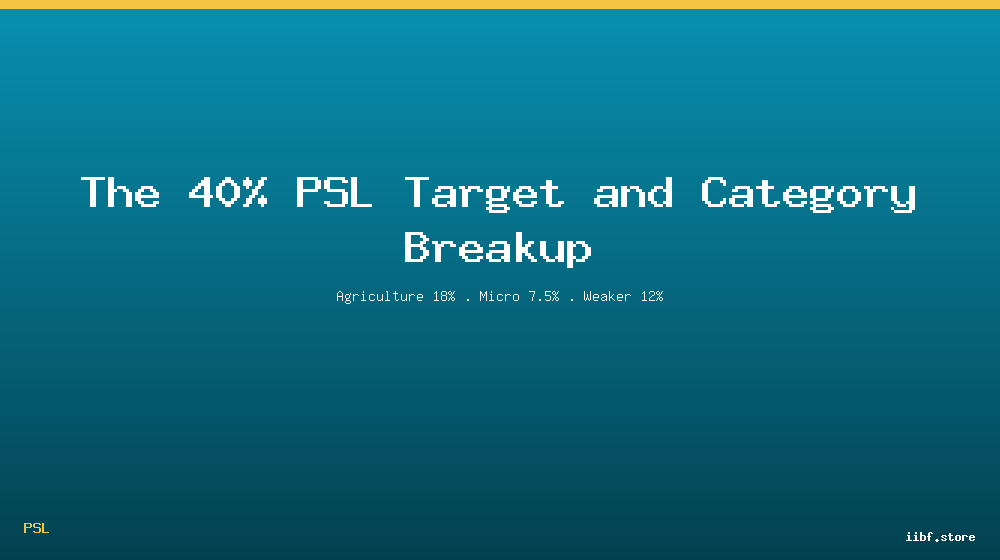
The headline requirement is that scheduled commercial banks must lend 40 percent of their Adjusted Net Bank Credit, or the credit equivalent of off-balance-sheet exposure, whichever is higher, to the priority sector. This 40 percent umbrella is not a single undifferentiated pool; it is carved into sub-targets that force banks to spread credit across specific segments rather than parking it all in one convenient category. Mastering these figures is the single highest-yield part of the PSL norms in India for exam purposes.
Within the 40 percent, 18 percent of ANBC is earmarked for agriculture, and inside that agriculture slice a further 10 percent is reserved for small and marginal farmers, with the figure stepped up in phases. A dedicated 7.5 percent is set aside for micro enterprises, recognising that the smallest units create the most jobs per rupee lent. Advances to weaker sections must reach 12 percent of ANBC. Regional Rural Banks and Small Finance Banks operate under a higher overall target of 75 percent, reflecting their explicit rural and financial-inclusion mandate. Memorising these percentages precisely is worth easy marks, and you can drill them using the practice sets on our mock test hub.
Priority Sector Lending Certificates and Trading of Obligations
Not every bank finds it equally easy to meet each sub-target. A bank with a strong rural footprint may comfortably exceed its agriculture obligation, while an urban-heavy private bank may fall short. To let the system balance itself efficiently, the RBI introduced Priority Sector Lending Certificates, or PSLCs. A PSLC is a tradable instrument that represents priority-sector lending already done by one bank, which another bank can buy to meet its own shortfall, without any transfer of the underlying loan or credit risk.
Four kinds of PSLCs are traded: PSLC Agriculture, PSLC Small and Marginal Farmers, PSLC Micro Enterprises, and PSLC General. Trading happens on the RBI's e-Kuber platform and certificates expire at the end of the financial year on 31 March. The buyer earns priority-sector credit while the seller earns a fee, so the mechanism rewards banks that genuinely over-perform on inclusion and penalises those that under-lend. This market-based approach is a favourite examiner topic because it links regulatory targets to a real financial instrument, and it complements broader themes such as digital banking and microfinance that you will also meet in the CAIIB elective syllabus.
Shortfall Consequences and the Rural Infrastructure Development Fund
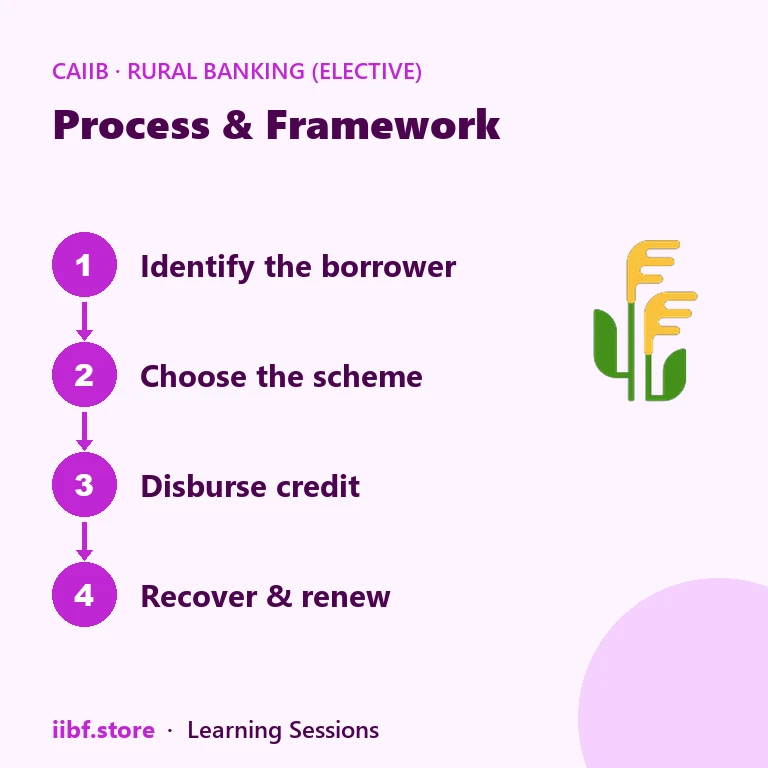
What happens when a bank still misses its priority-sector obligation after using PSLCs? The RBI does not let the shortfall simply disappear. Banks that fail to reach the target are required to contribute the deficit amount to funds maintained with development institutions, the most important of which is the Rural Infrastructure Development Fund, or RIDF, housed at NABARD.
RIDF finances rural infrastructure projects such as irrigation, rural roads, bridges and warehousing undertaken by state governments. In effect, a bank that cannot lend directly to the priority sector still ends up funding rural development indirectly, at a return typically below the market rate, which creates a genuine incentive to meet targets through direct lending instead. Other allocation funds exist for the MSME and short-term cooperative-credit segments on similar logic. For the exam, remember the chain clearly: miss the target, then either buy PSLCs or contribute the shortfall to RIDF and allied funds. This ties the whole framework together with themes like agricultural credit, Jan Dhan financial inclusion and home loans that recur across the paper. You can reinforce the linkages with our spaced-repetition match game and stay current using the RBI rates tracker.
Conclusion: Master PSL Norms and Ace the CAIIB Elective
The PSL norms in India form a tightly interlocking system: broad categories, a 40 percent umbrella target, sharp sub-targets for agriculture, micro enterprises and weaker sections, PSLCs to trade surpluses, and RIDF to absorb shortfalls. Learn the percentages, understand the why behind each rule, and you will handle both direct-recall questions and applied case scenarios with ease. Ready to convert this understanding into marks? Explore structured lessons, full mock tests and quick revision drills on the CAIIB Rural Banking course and start your next practice set on the tests page today.
What is the overall PSL target for scheduled commercial banks?
Scheduled commercial banks must lend 40 percent of their Adjusted Net Bank Credit, or the credit equivalent of off-balance-sheet exposure whichever is higher, to the priority sector. Regional Rural Banks and Small Finance Banks work to a higher 75 percent target.
What are the key sub-targets inside the 40 percent PSL requirement?
Agriculture is 18 percent of ANBC, with a carve-out for small and marginal farmers; micro enterprises get 7.5 percent; and advances to weaker sections must reach 12 percent of ANBC.
What is a Priority Sector Lending Certificate?
A PSLC is a tradable certificate that lets a bank with surplus priority-sector lending sell that achievement to a bank facing a shortfall, without transferring the underlying loan or credit risk. They trade on RBI e-Kuber and expire on 31 March each year.
What happens if a bank fails to meet its PSL target?
After exhausting PSLCs, a bank that still falls short must contribute the deficit to funds such as the Rural Infrastructure Development Fund at NABARD, which finances rural infrastructure at below-market returns.

Quick quiz on this topic
5 exam-style questions from our free test bank — check yourself before you move on.
Practice this topic
Take a free mock test, download chapter PDFs, or watch a video class — all included on iibf.store.
Keep reading