Promissory Note in Banking: NI Act Rules JAIIB PPB Tests
The reel below takes about thirty seconds to say something most of us learned the hard way at a branch counter: a promissory note is the easiest banking document to get wrong. One conditional word, one missing signature, one unstamped sheet — and the paper that was meant to protect the bank becomes something a court will not even look at. JAIIB PPB knows this, which is why this instrument keeps returning in the objective paper attempt after attempt.
Promissory note updates · Watch on YouTube
Let us do what a short cannot. Below is the whole picture — what Section 4 of the Negotiable Instruments Act, 1881 demands, how the instrument differs from a bill of exchange and a cheque, what stamping and limitation quietly do to it, and the exact angles the examiner keeps using.
What Section 4 actually requires
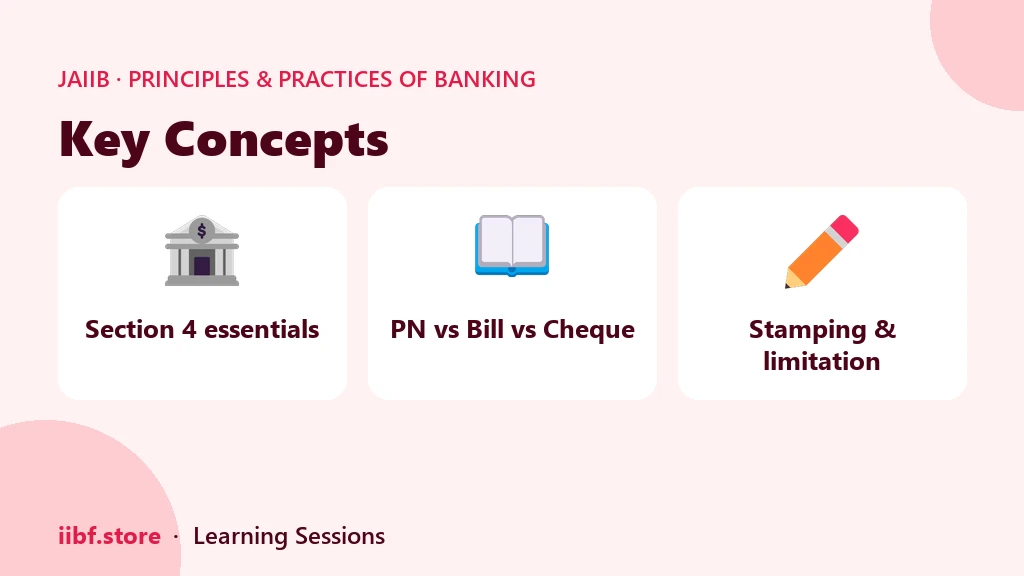
Section 4 defines the instrument as one in writing — not a bank note or currency note — containing an unconditional undertaking, signed by the maker, to pay a certain sum of money only to, or to the order of, a certain person, or to the bearer. Strip out the legal grammar and five tests fall out. Miss any one and the document is not a promissory note at all; it may still be evidence of a debt, but it loses negotiability and every protection the Act attaches to it.
- It must be in writing. An oral promise, however sincere, is nothing here.
- The undertaking must be unconditional. "I promise to pay ₹5,00,000 when my crop is sold" fails. A promise to pay after a fixed period is still unconditional, because the passage of time is certain.
- The maker must sign it. The signature fixes primary liability on the maker — there is no drawee to fall back on.
- The sum must be certain. Interest at a stated rate, or payment by instalments with a default clause, does not destroy certainty. "Pay ₹2,00,000 and all other sums due" does.
- The payee must be a certain person, or the instrument must be payable to bearer. Money, and only money — a promise to deliver 100 grams of gold is not covered.
One restriction trips up almost everyone. Section 4 permits an instrument payable to bearer, but Section 31 of the Reserve Bank of India Act, 1934 says that nobody except the Reserve Bank and the Central Government may draw, accept, make or issue a promissory note payable to bearer on demand. So the moment a private party writes "pay bearer on demand", the document is void. Payable to bearer after a fixed period is fine; payable to bearer on demand is not. That single distinction has carried a full mark in more than one paper.
How it differs from a bill of exchange and a cheque
Examiners rarely ask for a definition in isolation. They ask you to separate three instruments defined in three consecutive sections — Sections 4, 5 and 6 — under time pressure. Keep this table in your head.
| Feature | Promissory note (s.4) | Bill of exchange (s.5) | Cheque (s.6) |
|---|---|---|---|
| Parties at inception | Two — maker and payee | Three — drawer, drawee, payee | Three — drawer, banker, payee |
| Nature of the wording | A promise to pay | An order to pay | An order to pay |
| Drawn on | Nobody; the maker pays | Any drawee | A specified banker only |
| Acceptance needed | No | Yes, for time bills | No |
| Primary liability | Maker, absolutely | Acceptor, after acceptance | Drawer; banker owes duty to customer |
| Payable to bearer on demand | Void unless issued by RBI or Central Govt | Same restriction | Permitted |
| Stamp duty | Chargeable | Chargeable | Exempt |
The liability row is the one worth over-learning. Because the maker is primarily and unconditionally liable, no notice of dishonour is required to hold the maker responsible — a point that separates it cleanly from the drawer of a bill, who must be given notice.
Stamping, limitation and the demand promissory note
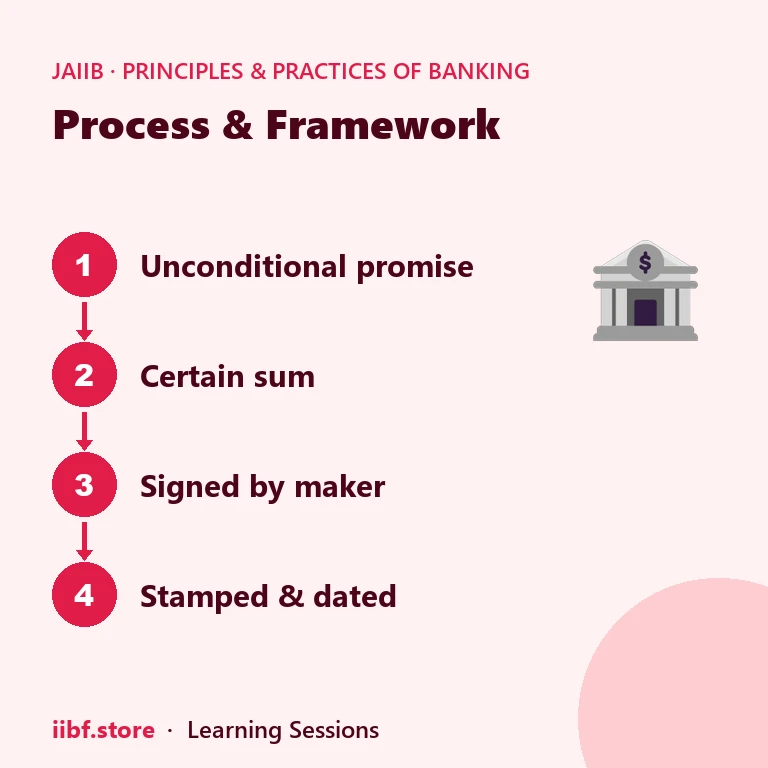
A correctly worded instrument can still be useless. Under the Indian Stamp Act, 1899 a promissory note is chargeable with duty, and under Section 35 an instrument that is not duly stamped is inadmissible in evidence. For most documents the defect can be cured by paying the duty with a penalty. For promissory notes and bills of exchange the proviso does not extend that mercy — an unstamped or insufficiently stamped note cannot be validated later. Duty must be paid before or at the time of execution. When a branch officer forgets the stamp, the security is gone permanently, not temporarily.
Limitation is the second silent killer. A suit on the instrument must be filed within three years under the Limitation Act, 1963 — counted from the date of the note where it is payable on demand, and from the due date where it is payable at a fixed time. This is precisely why banks periodically obtain a balance confirmation or revival letter: an acknowledgement in writing signed before the period expires starts a fresh three-year clock under Section 18 of that Act. Retail and MSME loan files are reviewed on exactly this cycle, which is why the topic overlaps with the documentation portions of the JAIIB syllabus.
In practice, Indian banks take a Demand Promissory Note — a DPN — alongside the loan agreement. It is payable on demand to the bank or its order, never to bearer, and it gives the bank a simple, self-contained cause of action without wading through the full agreement. Two more practical notes: an electronic signature will not work here, because negotiable instruments other than cheques are excluded from the electronic-signature provisions of the Information Technology Act, 2000; and a note made by a company must be executed strictly as its constitutional documents and board resolution permit.
How JAIIB PPB actually frames the question
Take a worked example. A borrower signs: "On demand I promise to pay Mr. A or order ₹3,00,000 with interest at 11% per annum." Is it valid? Yes — the promise is unconditional, the payee is certain, and future interest at a stated rate does not disturb certainty of the sum. Now change one phrase to "…₹3,00,000 out of the sale proceeds of my shop." It collapses. Payment now depends on a sale that may never happen, so the undertaking is conditional and the document is no longer a promissory note.
Change it again to "On demand I promise to pay bearer ₹3,00,000", signed by an individual. It is void under Section 31 of the RBI Act. Three small edits, three different answers — and that is the entire question bank in miniature. Work through variations like these in the practice tests, and pin the topic to a slot in your study planner so it gets a second pass before the exam. The official rules and syllabus are published by IIBF, and more topic breakdowns sit on the blog.
Frequently asked questions
Is a promissory note payable to bearer on demand valid in India?
No. Section 31 of the Reserve Bank of India Act, 1934 reserves that power to the Reserve Bank and the Central Government. A note made by any other person payable to bearer on demand is void, though one payable to bearer after a fixed period is acceptable.
Can an unstamped promissory note be used in court later?
No. Section 35 of the Indian Stamp Act, 1899 makes an instrument that is not duly stamped inadmissible, and the proviso allowing the defect to be cured by paying duty and penalty does not apply to promissory notes or bills of exchange. Duty must be paid at or before execution.
Does charging interest make the sum uncertain?
It does not. Future interest at a stated rate, an indicated rate of exchange, or payment by instalments with a default clause all leave the sum certain. Open-ended wording such as "and all other amounts due" is what destroys certainty.
Why do banks take a DPN when a loan agreement already exists?
The Demand Promissory Note gives the bank a short, independent instrument on which the maker is primarily liable and payable on demand. It simplifies recovery proceedings and is easy to keep alive through periodic acknowledgement letters within the three-year limitation window.
Prefer revising from a printed book?
Chapter-wise books with MCQs after every chapter — minimal pages, complete coverage, delivered anywhere in India. Every book has a free sample to read first.
221 pages · 831 MCQs
Learning Sessions · Ashish Sir
131 pages · 672 MCQs
Learning Sessions · Ashish Sir
128 pages · 524 MCQs
Learning Sessions · Ashish Sir
107 pages · 445 MCQs
Learning Sessions · Ashish Sir
148 pages · 478 MCQs
Learning Sessions · Ashish Sir
151 pages · 465 MCQs
Learning Sessions · Ashish Sir
148 pages · 375 MCQs
Learning Sessions · Ashish Sir
216 pages · 895 MCQs
Learning Sessions · Ashish Sir
109 pages · 300 MCQs
Learning Sessions · Ashish Sir
104 pages · 360 MCQs
Learning Sessions · Ashish Sir
82 pages · 297 MCQs
Learning Sessions · Ashish Sir
151 pages · 600 MCQs
Learning Sessions · Ashish Sir
98 pages · 282 MCQs
Learning Sessions · Ashish Sir
132 pages · 225 MCQs
Learning Sessions · Ashish Sir
188 pages · 435 MCQs
Learning Sessions · Ashish Sir
117 pages · 236 MCQs
Learning Sessions · Ashish Sir
Learning Sessions · Ashish Sir
118 pages · 299 MCQs
Learning Sessions · Ashish Sir
Learning Sessions · Ashish Sir
Learning Sessions · Ashish Sir
Learning Sessions · Ashish Sir
115 pages · 255 MCQs
Learning Sessions · Ashish Sir
Learning Sessions · Ashish Sir
334 pages · 936 MCQs
Learning Sessions · Ashish Sir
Learning Sessions · Ashish Sir
115 pages · 344 MCQs
Learning Sessions · Ashish Sir
107 pages · 240 MCQs
Learning Sessions · Ashish Sir
90 pages · 150 MCQs
Learning Sessions · Ashish Sir
Learning Sessions · Ashish Sir
Quick quiz on this topic
5 exam-style questions from our free test bank — check yourself before you move on.
Practice this topic
Take a free mock test, download chapter PDFs, or watch a video class — all included on iibf.store.