PV01 and DV01 in treasury: Calculation, Limits and Hedging
PV01 and DV01 in treasury reporting answer the one question every dealing room asks before the market opens: if yields move by a single basis point, how many rupees does the bank gain or lose? Every interest rate risk limit, every hedge ratio and every mid-office exception report in a bank treasury is built on that number. For IIBF TIRM candidates, this is high-yield territory — examiners like it because it mixes a simple formula with real portfolio judgement. This article takes you through the definition, the arithmetic, book-wise limits, portfolio aggregation, hedging with swaps and futures, and the limitations you must be able to state in an exam answer.
📉 What PV01 and DV01 Actually Measure
PV01 stands for the price value of a basis point — the change in the market value of a position when the relevant yield moves by 0.01%. DV01, the dollar value of an 01, is the same concept named in the American convention; in an Indian bank treasury the two terms are used interchangeably, and the number is simply reported in rupees. Some desks reserve DV01 for the full-revaluation figure and PV01 for the duration-based approximation, but the examiner will accept them as equivalent unless the question specifically distinguishes them.
The measure is a sensitivity, not a forecast. It says nothing about how likely a one basis point move is; it only tells you the rupee consequence if it happens. That makes it the natural building block for dealer limits, because a limit expressed in PV01 terms is instrument-neutral. A ₹500 crore position in treasury bills and a ₹40 crore position in a 30-year security may carry the same PV01, and the head of treasury cares about the risk, not the face value.
PV01 is signed. A long bond position carries a negative price change when yields rise, so it is normally reported as a loss figure for a one basis point rise. A short position, a pay-fixed swap or a sold interest rate future carries the opposite sign, which is exactly what makes hedging arithmetic possible. The chapter on risk analysis and control in the TIRM syllabus places this sensitivity family at the centre of market risk measurement.
💡 Exam Tip: If a question uses "DV01", "PVBP" or "price value of a basis point", treat all three as the same measure. Marks are lost for arguing they are different concepts.
🧮 The PV01 Formula and a Worked Calculation
The workhorse approximation is:
PV01 ≈ Modified Duration × Dirty Price × 0.0001
Applied to a face value of ₹100, this gives the rupee move per ₹100 of the security. Scale it up by the position size to get the desk-level number. Take a 10-year Government security with a modified duration of 6.8 and a dirty price of ₹101.50. PV01 per ₹100 face = 6.8 × 101.50 × 0.0001 = ₹0.069. On a ₹100 crore holding, that is roughly ₹6.9 lakh for every basis point. Round it for exam work: at a price close to par, PV01 in rupees ≈ face value × modified duration × 0.0001, so ₹100 crore × 6.8 × 0.0001 = ₹6.8 lakh.
The second method is full revaluation. Reprice the instrument at the current yield, then at yield plus one basis point, and take the difference. Better still, shock the yield up and down by one basis point and average the two absolute price changes — that removes part of the convexity bias. Risk systems use full revaluation because it works for options, swaps with amortising notionals and instruments whose cash flows change with rates; the duration formula silently assumes fixed cash flows.
Two practical cautions. First, use the dirty price, not the clean price, because accrued interest is part of the value you actually hold. Second, PV01 depends on the yield level and the shape of the curve on the day you compute it, so it must be recalculated at every valuation — a point worth revising alongside the yield curve and term structure of interest rates.
📊 PV01 Limits for the Trading and AFS Books
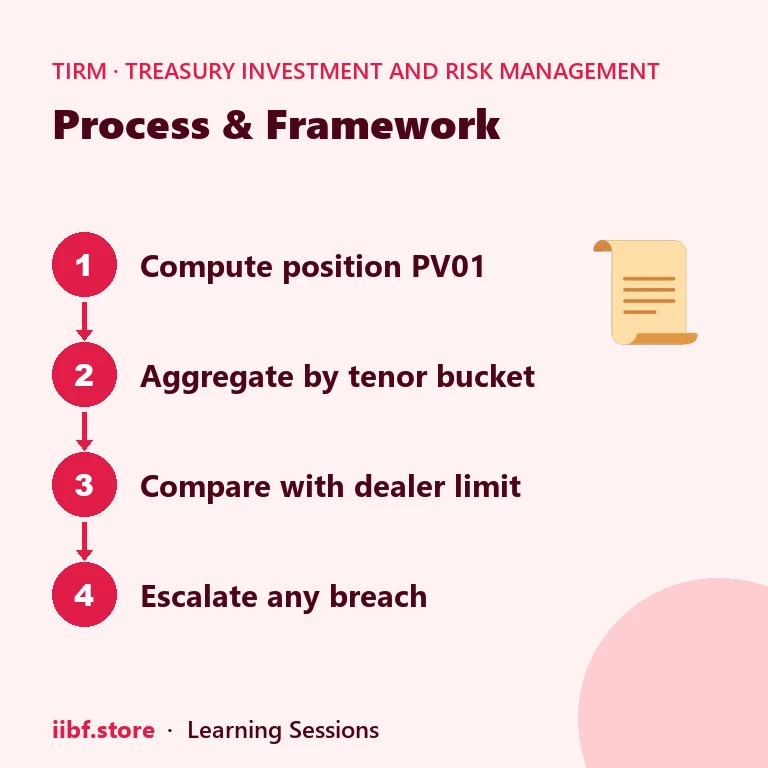
Banks set PV01 limits at several levels: per dealer, per desk, per tenor bucket and for the treasury as a whole. Under the RBI investment classification framework applicable to commercial banks from 1 April 2024, securities sit in Held to Maturity, Available for Sale or Fair Value through Profit and Loss (with Held for Trading as a sub-category of FVTPL). The accounting treatment drives how tight the PV01 limit needs to be: FVTPL moves hit the profit and loss account immediately, AFS moves flow to a reserve in equity, so trading-book PV01 limits are typically far smaller than those on the AFS book even though the economic risk is identical.
Limits are almost always bucket-wise as well as aggregate, because a net figure can hide a large curve position. The table below shows illustrative PV01 figures for ₹100 crore of face value across the curve, and whether a ten-year interest rate futures contract is a reasonable hedging instrument for each.
| Position (₹100 crore face) | Approx. modified duration | Approx. PV01 | Hedgeable with 10-year IRF? |
|---|---|---|---|
| 91-day Treasury bill | 0.24 | ₹0.24 lakh | ❌ (use T-bill futures / MIBOR OIS) |
| 5-year Government security | 4.1 | ₹4.1 lakh | ❌ (large basis risk) |
| 10-year Government security | 6.8 | ₹6.8 lakh | ✅ |
| 14-year Government security | 8.5 | ₹8.5 lakh | ✅ (residual curve risk) |
| 30-year Government security | 12.5 | ₹12.5 lakh | ❌ (hedge with long-tenor IRS) |
Monitoring sits with the mid-office, which is independent of the dealing room — the reporting line and escalation matrix are covered in the chapter on front, mid and back office operations. A PV01 breach is a hard stop: the dealer must either square up or obtain a documented temporary enhancement. Read this together with the broader framework of treasury risk limits and exposure ceilings.
🛡️ Portfolio PV01 and Hedging with IRS and Futures
Portfolio PV01 is simply the algebraic sum of position PV01s, provided every position is shocked by the same one basis point parallel move. That additivity is the great practical virtue of the measure — unlike Value at Risk, you never need a correlation matrix to aggregate it. A desk long ₹6.8 lakh of PV01 in the ten-year segment and short ₹4.0 lakh through pay-fixed swaps carries a net ₹2.8 lakh per basis point.
The hedge ratio follows directly. Number of contracts = Portfolio PV01 ÷ PV01 of one contract. If the book carries ₹6.8 lakh of PV01 and one interest rate futures contract has a PV01 of ₹680, the desk needs roughly 1,000 short contracts to neutralise a parallel shift. With an interest rate swap, the same logic applies to notional: divide the portfolio PV01 by the PV01 per rupee of swap notional at the required tenor, then pay fixed to offset a long bond book.
Two residual risks survive a PV01-neutral hedge. Basis risk arises because the futures or swap curve does not move one-for-one with the underlying security's yield. Curve risk arises because bucket PV01s are not matched even when the total nets to zero — a book long the two-year and short the ten-year has near-zero aggregate PV01 but loses money on any steepening. This is why bucket limits exist. Similar hedge-ratio thinking governs forward positions in currency markets, as seen in the FEDAI rules for forex dealings, and it also drives the valuation of floating rate and inflation indexed bonds, whose PV01 is small because coupons reset.
⚠️ Common Mistake: Adding PV01s across currencies or across unrelated curves. PV01 is additive only within one curve under one common basis point shock.
⚖️ PV01 versus VaR, Convexity and Other Limits
PV01 and Value at Risk answer different questions. PV01 is deterministic: it fixes the size of the shock at one basis point and reports the rupee outcome. VaR is probabilistic: it fixes a confidence level and a holding period, then estimates the loss that will not be exceeded with that probability, using historical or simulated yield volatility. In effect, VaR takes the sensitivity that PV01 measures and multiplies it by an assumed distribution of yield moves. A treasury with a stable PV01 can still see VaR jump when markets turn volatile — which is exactly why both limits are set, not one.
The main technical limitation is convexity. The price-yield relationship of a bond is curved, while PV01 is a straight-line slope measured at today's yield. For a one or two basis point move, the error is negligible. For a 50 or 100 basis point move it is not, and a linear estimate will overstate the loss on a yield rise and understate the gain on a yield fall for a plain vanilla bond. The standard correction is the second-order term: percentage price change ≈ −(modified duration × Δy) + (0.5 × convexity × Δy²). Instruments with embedded options can show negative convexity, where the correction works against the holder.
Three further caveats deserve a line each in any written answer. PV01 assumes a parallel shift, so it misses twists and butterflies. It captures only interest rate risk, not credit spread, liquidity or settlement risk. And it is a point-in-time number that changes as the position ages and yields drift, so a limit checked once a week is no limit at all. Candidates preparing for the CAIIB and certificate examinations should also be able to link the measure to the regulatory reporting requirements set out in the chapter on regulations, supervision and compliance, and to check prevailing benchmark levels on the RBI rates page before attempting numerical practice.
📌 Remember: PV01 tells you the size of the exposure; VaR tells you how likely a painful move is; convexity tells you how wrong PV01 becomes when the move is large.

🎯 Conclusion and Revision Plan
Master three things and this topic is secure: the formula (modified duration × dirty price × 0.0001), the additivity of PV01 across a single curve with its hedge-ratio application, and the honest list of what the measure cannot see — convexity, curve twists and spread risk. Numerical questions in the examination are usually a single multiplication; the marks are actually won on interpretation, so practise explaining what a ₹6.8 lakh PV01 means to a limit setter in one sentence. Work through more chapter-wise material on the treasury investment and risk management tag hub, then test yourself with timed mocks at iibf.store practice tests.
🧠 Practice MCQs: PV01 and DV01 in Treasury
Q1. A ₹100 crore Government security position has a modified duration of 6.8 and trades close to par. Its approximate PV01 is: (a) ₹68,000 (b) ₹6.8 lakh (c) ₹68 lakh (d) ₹6,800
Answer: (b) — ₹100 crore × 6.8 × 0.0001 = ₹6.8 lakh per basis point.
Q2. Which statement about PV01 and DV01 is correct? (a) PV01 measures credit spread risk only (b) DV01 is always ten times PV01 (c) PV01 applies only to floating rate notes (d) Both measure the value change for a one basis point yield move
Answer: (d) — they are the same sensitivity, only the naming convention differs.
Q3. A book's net PV01 is near zero, but the two-year bucket shows +₹9 lakh and the ten-year bucket −₹9 lakh. The residual exposure is best described as: (a) Yield curve risk from a non-parallel shift (b) Credit risk (c) Settlement risk (d) Operational risk
Answer: (a) — offsetting bucket PV01s neutralise a parallel move but not a steepening or flattening.
Q4. Why does a PV01-based estimate overstate the loss on a large upward yield move for a plain vanilla bond? (a) It double counts accrued interest (b) It assumes a non-parallel shift (c) It ignores convexity, since the price-yield curve is not a straight line (d) It uses the clean price instead of the dirty price
Answer: (c) — the positive convexity of a plain vanilla bond cushions the actual price fall.
Q5. The key difference between PV01 and VaR is that: (a) VaR is expressed in basis points and PV01 in rupees (b) PV01 is a deterministic sensitivity to a one basis point move, while VaR attaches a probability and a holding period (c) PV01 can be computed only for derivatives (d) VaR ignores position size
Answer: (b) — VaR adds a confidence level and horizon to the sensitivity that PV01 measures.
Want chapter-wise mock tests with 100+ MCQs? Start practising free →
❓ Frequently Asked Questions
Is PV01 the same as DV01?
In practice yes. PV01 is the price value of a basis point and DV01 is the dollar value of an 01; both measure the change in value of a position for a one basis point move in yield. Some risk systems use DV01 for the full-revaluation number and PV01 for the modified-duration approximation, but the underlying concept is identical.
How do I calculate PV01 from modified duration?
Multiply modified duration by the dirty price and by 0.0001. For a bond priced near par, the shortcut is face value × modified duration × 0.0001. So ₹100 crore of a security with modified duration 6.8 has a PV01 of about ₹6.8 lakh.
Why do banks set separate PV01 limits for each tenor bucket?
Because the aggregate figure can net to almost zero while the book holds a large curve position — long the short end and short the long end. Bucket-wise PV01 limits capture that steepening or flattening risk, which an aggregate limit would completely miss.
Does PV01 replace Value at Risk in treasury risk reporting?
No. PV01 is a sensitivity with no probability attached, while VaR estimates a loss at a stated confidence level over a stated holding period. Banks run both: PV01 for dealer-level control and hedge construction, VaR for capital and portfolio-level risk appetite.
Source and further reading: Reserve Bank of India and the Indian Institute of Banking & Finance.
Practice this topic
Take a free mock test, download chapter PDFs, or watch a video class — all included on iibf.store.