Investment Fluctuation Reserve for Banks: RBI Norms 2026
Every bank that runs an investment book knows the pain of a bond rally that turns into a bond rout inside one quarter. The investment fluctuation reserve for banks exists precisely for that swing — a capital-like cushion built out of trading gains so that a sudden spike in G-Sec yields does not blow a hole in the profit and loss account. For CAIIB and JAIIB-TIRM candidates, this is one of the most exam-friendly topics in the entire investment portfolio syllabus because the mechanism is rule-based, numeric, and easy to test with a single MCQ line.
In this article we stay strictly on the investment-portfolio side of treasury — how a bank classifies, values, and cushions its AFS and HFT holdings — rather than the interest-rate-risk metrics (duration, convexity, PV01) that get their own dedicated coverage elsewhere on this blog. Keep a notepad handy; the numbers below come up almost every exam cycle.
🏦 What the Investment Fluctuation Reserve Actually Is
The Investment Fluctuation Reserve (IFR) is a reserve created out of realised trading profits and appropriated net profit, meant to absorb mark-to-market depreciation on a bank's Available for Sale (AFS) and Held for Trading (HFT) portfolios. Unlike a provision, which is charged against a specific loss already identified, the IFR is a forward-looking buffer built when times are good so that it can be drawn upon when yields rise and bond prices fall.
The logic is simple: G-Sec and SDL prices move inversely with interest rates. A 100-basis-point rise in yields can knock several percentage points off the market value of a long-dated security sitting in the AFS book. Since AFS and HFT holdings are marked to market — with depreciation hitting the P&L or reserves depending on category — a bank without a cushion can see a single rate cycle dent its reported profits sharply.
The IFR sits on the liabilities side of the balance sheet as a specific reserve, distinct from the statutory reserve and from general provisions. It cannot be used for dividend distribution and is meant purely as a shock absorber for the treasury's investment portfolio, reinforcing the bank's resilience during periods of rising yields.
📊 IFR vs IRA: Two Buffers, Two Different Jobs
Students frequently mix up the Investment Fluctuation Reserve with the older Investment Reserve Account (IRA), even though the two solve different problems. The IRA mechanism deals with the accounting mismatch created when a security is shifted between the HTM, AFS and HFT categories — for example, when a security moves out of AFS at a value below its book cost is booked as a loss, but any resulting notional gain is not taken to profit; instead it is parked in the IRA and can only be used to meet a future loss on the sale of investments, not distributed as dividend.
The IFR, in contrast, is built continuously from trading gains on sale of investments and year-end profit appropriation, independent of any specific category-shift transaction. It is a standing floor, expressed as a percentage of the AFS-plus-HFT book, that a bank is expected to maintain at all times once achieved.
| Feature | Investment Fluctuation Reserve (IFR) | Investment Reserve Account (IRA) |
|---|---|---|
| Purpose | General cushion against AFS/HFT price depreciation | Buffer for category-transfer valuation gaps |
| Source of funds | Profit on sale of investments + appropriated net profit | Notional gain on inter-category security transfer |
| Trigger event | Ongoing, built over successive years to reach a floor | Specific transfer of a security between categories |
| Available for dividend | ✗ No | ✗ No |
| Minimum level prescribed by RBI | ✓ Yes, expressed as % of AFS+HFT | ✗ No fixed floor, transaction-linked |
| Common exam trap | Confused with statutory reserve | Confused with IFR |
💡 Exam Tip: If the question mentions a fixed percentage of the AFS+HFT book to be maintained over time, the answer is IFR. If it mentions a security moving between HTM/AFS/HFT categories, the answer is IRA.
⚖️ How AFS and HFT Depreciation Feeds the Reserve
Under the classification, valuation and operation norms for a bank's investment portfolio, securities are grouped into Held to Maturity (HTM), Available for Sale (AFS) and Held for Trading (HFT). HTM securities are carried at acquisition cost (subject to amortisation of premium) and are not marked to market, so they never feed the IFR. AFS and HFT securities, however, are revalued at market prices at defined intervals — HFT typically far more frequently than AFS given its short trading horizon.
Net depreciation within a classification (say, across all AFS securities in a bucket) is charged to the profit and loss account, while net appreciation within the same bucket is usually ignored for prudence rather than credited to income. This asymmetric treatment is exactly why the reserve idea matters: a bank cannot net off gains in one year against losses in another unless it has proactively parked profit into the IFR when the going was good.
Treasury's front office typically flags which portfolio buckets are carrying unrealised depreciation each quarter, and risk/mid-office tracks this against the IFR balance to confirm the bank retains adequate cover. A shrinking IFR relative to a growing AFS/HFT book is an early warning signal examiners and internal auditors both watch closely.
⚠️ Common Mistake: Students often assume HTM securities also require an IFR cushion. They do not — HTM is carried at cost, not marked to market, so it sits outside the entire IFR/IRA framework except in the rare case of a downgrade forcing a shift out of HTM.
🛡️ The Regulatory Floor and Why It Exists
RBI's long-standing investment portfolio guidelines direct banks to build the IFR up to a minimum of a prescribed percentage of the AFS-plus-HFT investment book, achieved progressively over a defined multi-year glide path rather than in a single year. Banks are expected to appropriate a portion of profit on sale of investments in these categories — and, if that alone is insufficient, a share of overall net profit — into the IFR each year until the floor is reached, and to maintain it thereafter as the book grows.
This is deliberately conservative regulation: it forces a bank to save during good years (falling-yield, rising-price cycles when trading gains are large) precisely so that it has resources during bad years (rising-yield, falling-price cycles). Boards and Asset-Liability Committees track the IFR ratio as part of the investment policy oversight that flows from the bank's regulations, supervision and compliance framework for treasury.
Auditors and RBI inspection teams verify the IFR computation during annual financial inspections, checking that the appropriation methodology, the AFS+HFT denominator, and the utilisation history (if the reserve was ever drawn down to absorb a loss) are all correctly disclosed in the notes to accounts.
📌 Remember: IFR is built from below the line (appropriation of profit), never charged as an expense above the line — that is the single fact examiners like to flip into a "true or false" question.
📈 Building and Utilising the IFR — Treasury's Playbook
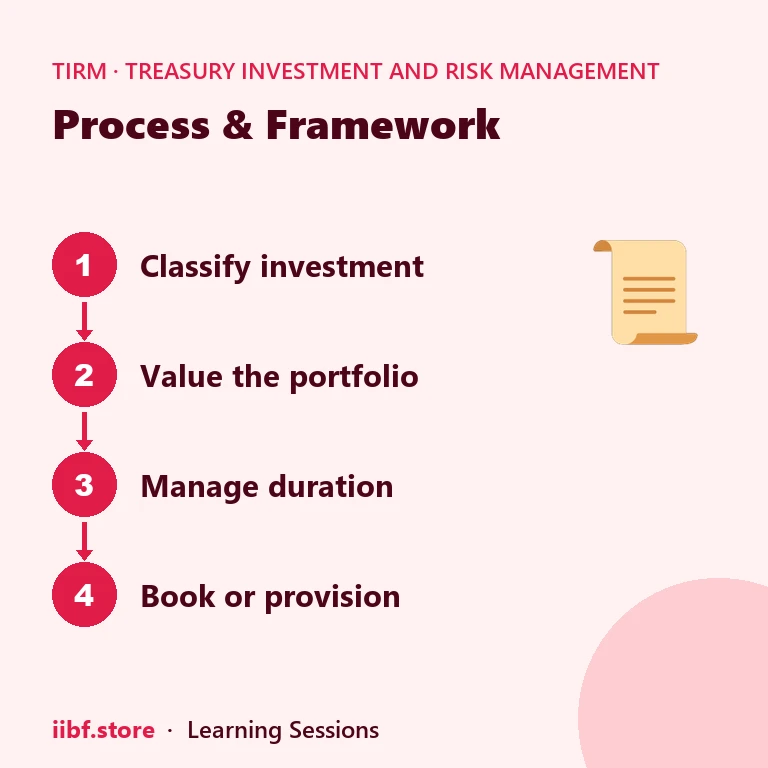
In practice, the treasury middle office proposes the annual IFR appropriation as part of the year-end profit allocation exercise, alongside statutory reserve and other appropriations approved by the board. The front office contributes by realising trading gains on the AFS/HFT book during favourable rate cycles, giving the bank a pool of profit on sale of investments from which to fund the reserve.
Utilisation works the other way: if net depreciation in a given year genuinely threatens reported profitability, a bank may draw down the IFR (subject to board approval and regulatory guidance) to smooth the P&L impact rather than let a single bad quarter distort results. This is not automatic — it is a disciplined, documented decision that back-office and compliance teams record carefully, since regulators scrutinise any drawdown for signs of profit-smoothing abuse.
For students preparing case-study questions, the pattern to remember is: gains build the reserve, losses may draw it down, and the reserve must be rebuilt to the prescribed floor once conditions normalise. This cyclical discipline is central to how a bank's investment portfolio survives a full interest-rate cycle without erratic swings in disclosed earnings.
🧠 Practice MCQs: Investment Fluctuation Reserve for Banks
Q1. The Investment Fluctuation Reserve is primarily built to cushion depreciation in which categories of a bank's investment portfolio? (a) HTM only (b) AFS and HFT (c) HTM and AFS (d) All categories including subsidiaries
Answer: (b) — HTM is carried at cost and not marked to market, so only AFS and HFT depreciation is relevant to the IFR.
Q2. Which of the following best distinguishes the IRA from the IFR? (a) IRA is funded from dividend income (b) IRA arises specifically from inter-category security transfers, IFR is a general ongoing reserve (c) IRA is compulsory for HTM securities (d) There is no difference between the two
Answer: (b) — IRA is transaction-linked to category shifts; IFR is built continuously as a standing cushion.
Q3. Net appreciation within an AFS bucket, in the standard prudential treatment, is generally: (a) Credited fully to profit and loss (b) Ignored for income recognition on grounds of prudence (c) Transferred compulsorily to the IFR (d) Distributed as dividend
Answer: (b) — Prudence norms mean unrealised gains within a bucket are typically not credited to income, while net depreciation is charged to P&L.
Q4. The IFR appropriation is best described as: (a) An expense charged above the line before arriving at net profit (b) An appropriation of profit made below the line (c) A statutory reserve mandated under company law only (d) A liability payable to depositors
Answer: (b) — The IFR is funded through appropriation of profit on sale of investments and net profit, not as a P&L expense.
Q5. Which committee typically oversees the bank's IFR policy and its linkage to the investment portfolio? (a) Human Resources Committee (b) Asset-Liability Committee / Board (c) Customer Service Committee (d) Branch Credit Committee
Answer: (b) — The ALCO and the Board, as part of investment policy oversight, monitor IFR adequacy against the AFS/HFT book.
Want chapter-wise mock tests with 100+ MCQs? Start practising free
Is the Investment Fluctuation Reserve the same as a general provision?
No. A provision is charged for an identified loss already recognised, while the IFR is a proactive reserve built from profit to cushion future, not-yet-realised depreciation on the AFS and HFT book.
Do Held to Maturity securities require an Investment Fluctuation Reserve cushion?
No. HTM securities are carried at acquisition cost and are not marked to market in the ordinary course, so they fall outside the IFR framework unless a security is shifted out of HTM.
Can a bank use the Investment Fluctuation Reserve to pay dividends?
No. The IFR is a specific reserve meant solely to absorb investment depreciation and cannot be used for dividend distribution or any other general purpose.
Why do banks need both an IFR and an IRA if they seem similar?
They cover different situations — the IFR is an ongoing cushion for AFS/HFT mark-to-market swings, while the IRA specifically absorbs valuation gaps created when a security is transferred between HTM, AFS and HFT categories.
🎯 Conclusion: Master This Before Exam Day
The investment fluctuation reserve for banks is one of those topics that rewards precision over memorisation — know the difference between IFR and IRA, understand why HTM sits outside the cushion, and remember that the reserve is built from profit appropriation, not P&L expense. Pair this with a solid grasp of AFS/HFT valuation mechanics from your Regulations, Supervision and Compliance chapter and the broader control framework in Risk Analysis and Control, and you will have this scoring segment locked down.
For the instrument side of the portfolio, revisit how the government securities auction process determines the paper that ultimately sits in the AFS/HFT book, and how STRIPS in government securities creates zero-coupon instruments with their own valuation quirks. If you want the rate-side context that drives these depreciation swings in the first place, our piece on the yield curve and term structure of interest rates is a natural next read, and it is worth comparing how a very different, tech-first balance sheet handles funding and reserves in our explainer on neo banks in India.
Browse more treasury topics on the Treasury Investment and Risk Management tag hub, check the latest repo and reverse repo rate settings on RBI rates, and for the primary source on classification and valuation norms see the RBI Notifications page. When you are ready to test yourself under exam conditions, head to a full CAIIB course plan and attempt a timed mock today.
Practice this topic
Take a free mock test, download chapter PDFs, or watch a video class — all included on iibf.store.