RBI monetary policy tools: Repo, CRR & SLR Guide

The Reserve Bank of India's monetary policy tools are the levers through which the central bank controls the price and quantity of money in the economy. For CAIIB Central Banking candidates, mastering how the repo rate, Cash Reserve Ratio (CRR) and Statutory Liquidity Ratio (SLR) interact with the Liquidity Adjustment Facility, inflation targeting and the Monetary Policy Committee is non-negotiable. These instruments decide whether credit is cheap or dear, whether banks lend freely or hoard cash, and ultimately whether retail inflation stays inside the mandated band. This guide walks through each tool the way it appears in the CAIIB syllabus and in real RBI practice, so you can answer both conceptual and numerical questions with confidence. For structured preparation, pair this with our CAIIB course and keep the latest numbers handy from the RBI rates tracker.
The Policy Repo Rate and the LAF Corridor
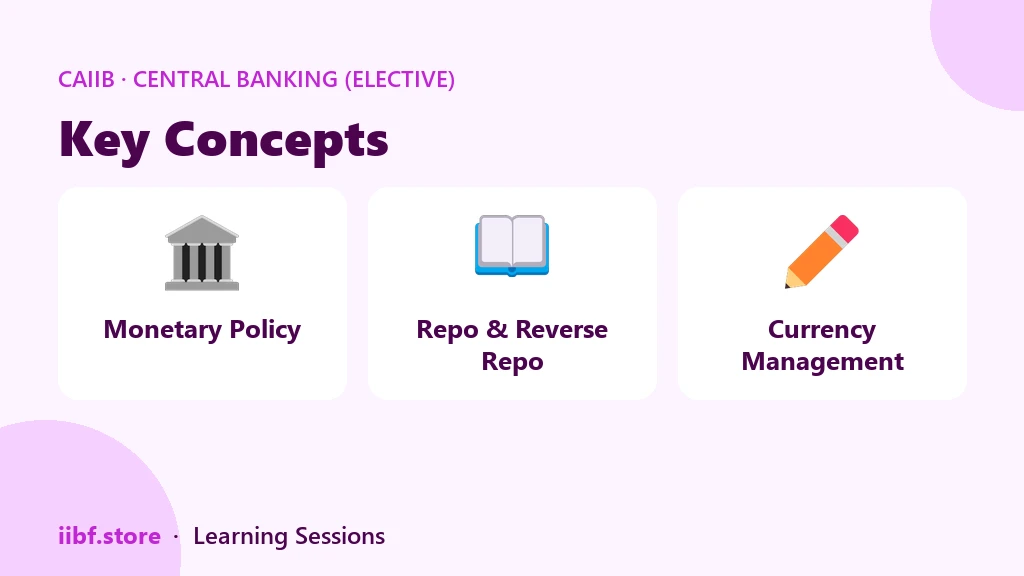
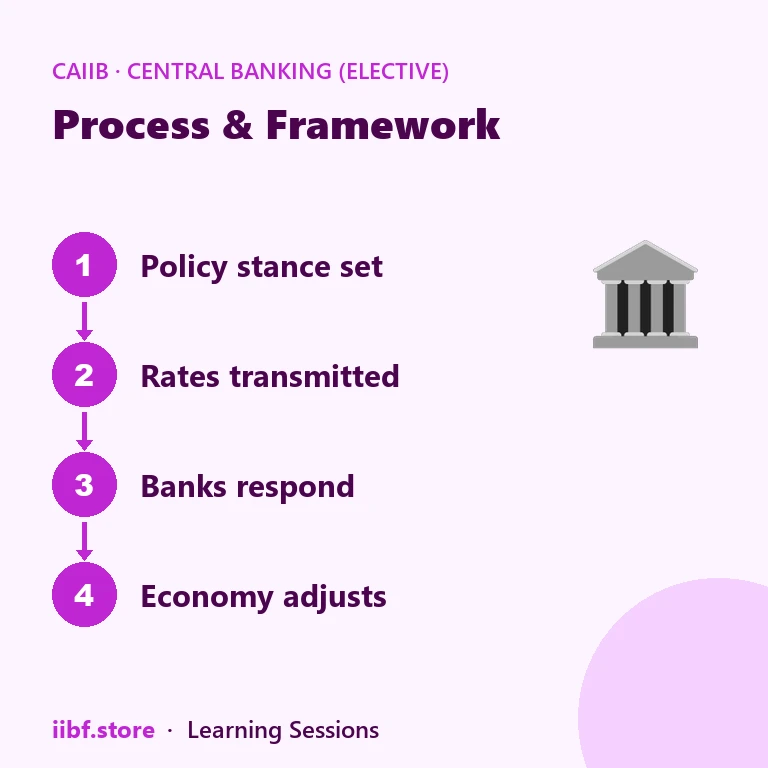
The repo rate is the single most watched of the RBI's monetary policy tools. It is the rate at which the RBI lends overnight funds to commercial banks against government securities under the Liquidity Adjustment Facility (LAF). When the RBI raises the repo rate, borrowing from the central bank becomes costlier, banks pass this on through higher lending rates, credit growth slows and inflationary pressure eases. When it cuts the repo rate, the opposite chain of effects stimulates demand. Because most floating-rate retail loans are now linked to an external benchmark - typically the repo rate under the External Benchmark Lending Rate (EBLR) regime - repo changes transmit to home and MSME loan EMIs almost immediately.
The repo rate does not act alone. It sits at the centre of the LAF corridor. The reverse repo rate (and more importantly the Standing Deposit Facility, or SDF) forms the floor at which banks park surplus funds with the RBI, while the Marginal Standing Facility (MSF) forms the ceiling at which banks can borrow beyond their LAF limit against SLR securities. The SDF, introduced in April 2022, lets the RBI absorb liquidity without giving collateral, making it a cleaner floor. The width between the floor and the ceiling is the policy corridor, and the RBI steers the weighted average call rate to stay close to the repo rate at the centre. The Bank Rate is aligned with the MSF rate. Understanding this corridor is essential for CAIIB numerical questions on liquidity operations.
CRR and SLR: Reserve Requirements That Shape Liquidity
While the repo rate works on the price of money, the Cash Reserve Ratio and Statutory Liquidity Ratio work on its quantity. The CRR is the percentage of a bank's Net Demand and Time Liabilities (NDTL) that must be kept as cash reserves with the RBI. Crucially, no interest is paid on CRR balances, so a higher CRR directly squeezes the funds banks have available to lend and dents their profitability. A cut in CRR releases primary liquidity into the banking system instantly. Because of this blunt, powerful effect, the RBI changes the CRR sparingly and often uses it as a signalling or structural liquidity tool rather than a day-to-day instrument.
The SLR is the minimum percentage of NDTL that a bank must maintain in specified liquid assets - primarily government securities (G-Sec), cash and gold - before it can extend credit. Unlike the CRR, SLR assets earn a return because they are largely invested in interest-bearing government bonds. The SLR serves a dual purpose: it ensures banks hold a buffer of safe, liquid assets for solvency, and it creates a captive demand for government securities, helping the government finance its fiscal deficit. SLR securities also become the collateral banks pledge to borrow under the MSF. For exam purposes, remember the key contrasts: CRR is cash with the RBI earning nothing; SLR is liquid assets held by the bank itself earning a return. Both are set as a percentage of NDTL and are governed under the Banking Regulation Act and RBI Act. You can drill these distinctions in our CAIIB mock tests and reinforce the terms through the concept match game. The official framework is detailed on the Reserve Bank of India website.
Inflation Targeting and the Monetary Policy Committee
Since 2016, India has operated a formal flexible inflation targeting (FIT) framework, anchored in an amendment to the RBI Act. Under this framework, the Government of India, in consultation with the RBI, sets a Consumer Price Index (CPI) inflation target of 4 percent with a tolerance band of plus or minus 2 percent - meaning the RBI aims to keep headline retail inflation between 2 and 6 percent. If inflation stays outside this band for three consecutive quarters, the RBI is deemed to have failed its mandate and must submit a report to the government explaining the reasons, the remedial actions and the expected time to return to target. This accountability mechanism is a frequent CAIIB exam favourite.
Decisions on the policy repo rate are not taken unilaterally by the Governor. They are made by the six-member Monetary Policy Committee (MPC): three members from the RBI (including the Governor as chairperson and a Deputy Governor) and three external members appointed by the central government. Each member has one vote, and in the event of a tie the Governor holds a casting vote. The MPC meets at least four times a year - in practice roughly bi-monthly - and its resolution, along with the vote breakdown and minutes, is published for transparency. The committee weighs growth and inflation trade-offs, global spillovers, the monsoon, fiscal stance and financial stability before deciding whether to hike, hold or cut. Candidates should be able to explain the MPC's composition, quorum, voting rule and the statutory basis for inflation targeting. Keep up with each bi-monthly outcome via our IIBF news feed.
Liquidity Management, OMOs, G-Sec and the Digital Rupee
Beyond the headline rates, the RBI runs an active liquidity management framework to keep money market rates aligned with the repo rate. Its toolkit includes Open Market Operations (OMOs) - the outright purchase or sale of government securities to inject or absorb durable liquidity - along with variable rate repo and reverse repo auctions of different tenors to manage transient frictions. Operation Twist, where the RBI simultaneously buys long-dated and sells short-dated G-Sec, has been used to influence the shape of the yield curve. Foreign exchange operations also affect rupee liquidity, since dollar purchases release rupees into the system. The overarching aim of the revised liquidity framework is to keep the weighted average call rate close to the repo rate, making the policy signal effective.
Government securities sit at the heart of all this: they are the collateral for repo and MSF, the assets that satisfy SLR, and the instruments traded in OMOs. A newer addition to the RBI's toolkit is the Central Bank Digital Currency (CBDC), branded the e-Rupee (e-INR). Launched in pilot form - the wholesale segment (CBDC-W) from November 2022 and the retail segment (CBDC-R) from December 2022 - the digital rupee is legal tender issued directly by the RBI, distinct from private cryptocurrencies and from UPI, which merely moves existing bank deposits. Over time, CBDC could sharpen monetary transmission and improve payment efficiency. For CAIIB Central Banking, be ready to distinguish CBDC from crypto and from UPI, and to explain how each conventional and modern tool fits into the transmission mechanism. Reinforce the whole framework with our Central Banking blog and the foundational JAIIB course for prerequisite concepts.
Frequently Asked Questions
What is the difference between CRR and SLR?
CRR is the portion of a bank's NDTL kept as cash with the RBI, earning no interest. SLR is the minimum share of NDTL held by the bank itself in liquid assets like government securities, cash and gold, which generally earn a return. CRR affects primary liquidity directly; SLR ensures solvency and creates captive demand for G-Sec.
How does the repo rate affect my loan EMI?
Under the External Benchmark Lending Rate regime, most floating-rate retail loans are linked to the repo rate. When the RBI raises the repo rate, banks reset EBLR-linked loans upward and EMIs rise; a cut lowers them. This makes repo changes transmit to borrowers faster than under older regimes.
Who decides the repo rate in India?
The six-member Monetary Policy Committee decides the policy repo rate - three RBI members including the Governor and three external members appointed by the government. Each has one vote, with the Governor holding a casting vote in a tie. The MPC meets at least four times a year, publishing its resolution and minutes.
What is India's inflation target under the framework?
India follows flexible inflation targeting with a CPI target of 4 percent and a tolerance band of plus or minus 2 percent, so inflation is meant to stay between 2 and 6 percent. If it breaches the band for three consecutive quarters, the RBI must report to the government explaining the reasons and remedial steps.
Conclusion
The RBI's monetary policy tools - repo rate within the LAF corridor, CRR and SLR on reserves, inflation targeting steered by the MPC, and liquidity operations through OMOs, G-Sec and the e-Rupee CBDC - together form the machinery of Indian monetary policy. For CAIIB Central Banking, focus on how each tool works, how they interact, and the exact statutory numbers and definitions. Put this knowledge to the test with our CAIIB practice tests and structured lessons in the CAIIB course to walk into the exam hall fully prepared.
Quick quiz on this topic
5 exam-style questions from our free test bank — check yourself before you move on.
Practice this topic
Take a free mock test, download chapter PDFs, or watch a video class — all included on iibf.store.
Keep reading