Inflation Targeting Framework — CAIIB Central Banking 2026

The inflation targeting framework is the constitutional heart of how the Reserve Bank of India runs monetary policy, and it is a guaranteed area in the CAIIB Central Banking paper. Since 2016, India has run a formal flexible inflation targeting (FIT) regime, anchored in law, with a specific numerical target and an accountable committee to hit it. In 2026, with the framework reviewed and re-affirmed, examiners want you to explain not just the target number but the institutional machinery, the transmission channels, and what happens when the target is missed. This guide lays it out clearly.
The Legal Anchor and the Target
India's inflation targeting framework rests on the amended Reserve Bank of India Act, which for the first time gave the RBI a statutory mandate for price stability while keeping in mind the objective of growth. The Central Government, in consultation with the RBI, sets the target once every five years. The target is Consumer Price Index (CPI) inflation of 4%, with a tolerance band of +/- 2%, i.e. an upper limit of 6% and a lower limit of 2%.
Two features make this "flexible" rather than rigid:
- A band, not a point — the 2% tolerance on either side lets policy accommodate supply shocks without mechanically over-reacting.
- Dual mandate framing — price stability is primary, but growth is explicitly acknowledged, so the RBI weighs the output cost of disinflation.
Headline CPI, not core or WPI, is the target measure — a point examiners love to test. Candidates preparing via the CAIIB course should be able to state the target, band and measure from memory, because these anchor almost every Central Banking question on monetary policy.
The Monetary Policy Committee
The framework is operationalised by the Monetary Policy Committee (MPC), a six-member body created by the RBI Act. Three members are from the RBI — the Governor (who chairs it), a Deputy Governor in charge of monetary policy, and an officer nominated by the central board — and three are external experts appointed by the Central Government for a fixed term.
Key procedural facts frequently examined:
- Decision rule — each member has one vote; decisions are by majority, and the Governor has a casting vote in case of a tie.
- Meeting frequency — the MPC meets at least four times a year (in practice bi-monthly), and the resolution is published immediately.
- Transparency — minutes are released after 14 days, and each member gives reasons for their vote, sharpening accountability.
The MPC sets the policy repo rate to steer inflation toward target. This committee-based, transparent approach replaced the earlier system where the Governor decided rates in consultation with an advisory panel. Test your recall of these facts on our CAIIB Central Banking mock tests, where MPC composition is a recurring question.
Transmission and Policy Tools
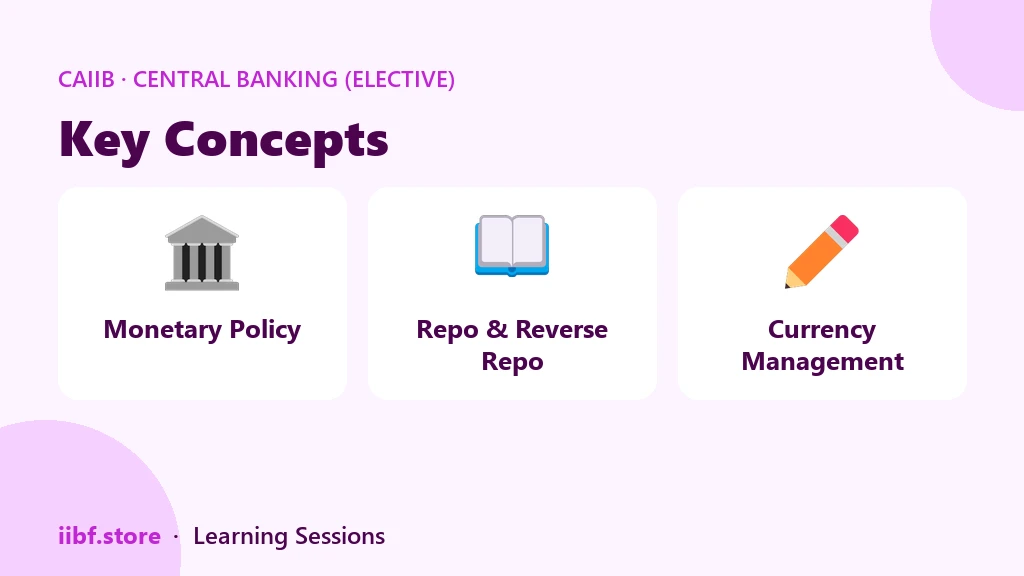
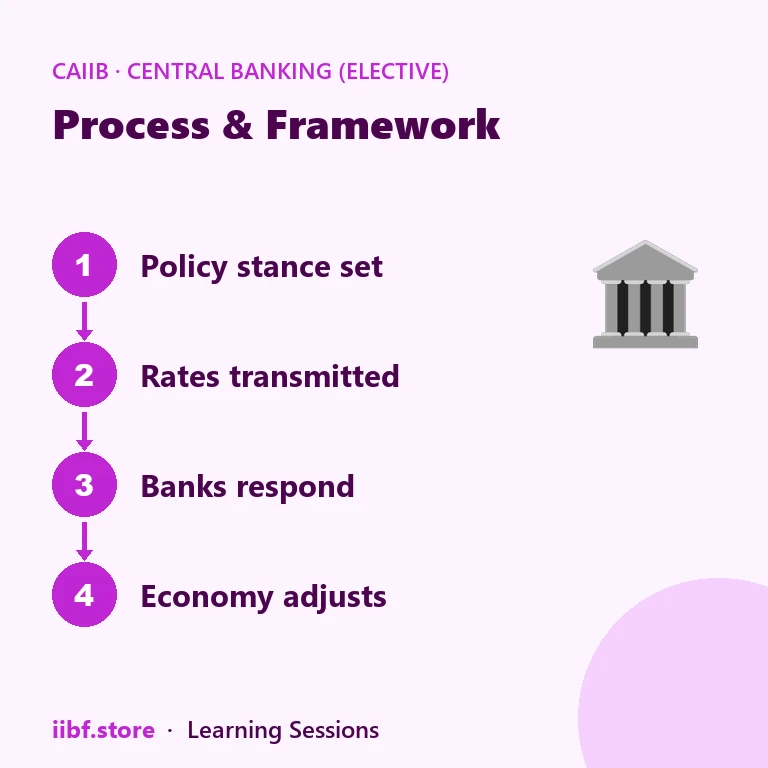
Setting a rate is pointless unless it reaches the real economy — this is monetary policy transmission. The MPC changes the repo rate; the operating target is to keep the weighted average call money rate close to the repo rate. From there, changes flow through banks' cost of funds to lending and deposit rates, and onward to consumption, investment and ultimately inflation.
The RBI supports transmission with a corridor: the Standing Deposit Facility rate forms the floor and the Marginal Standing Facility rate the ceiling, with the repo rate in between, all managed through the Liquidity Adjustment Facility. The introduction of external benchmark lending rates has sharpened transmission on the lending side. You can follow the latest repo, SDF and MSF settings directly from the Reserve Bank of India and track them on our RBI rates page, which is invaluable for framing 2026-current answers.
Accountability When the Target Is Missed
What makes India's inflation targeting framework genuinely binding is the failure clause. The RBI is deemed to have failed if average inflation breaches the tolerance band — above 6% or below 2% — for three consecutive quarters. On failure, the RBI must send a report to the Central Government explaining the reasons, the remedial actions proposed, and the estimated time to return inflation to target.
This accountability mechanism was actually invoked when inflation stayed above 6% through the post-pandemic and commodity-shock period, and the RBI submitted its explanatory report — a real-world event examiners may reference. The clause disciplines policy without removing flexibility, because it targets a sustained breach rather than a single spike.
Understanding this closes the loop: a legal target, an accountable committee, transmission tools, and a consequence for failure. To lock it in, alternate reading with active recall on our concept match game and review solved policy questions on the exam blog. Linking the mechanism to recent events is exactly how top scorers add depth to Central Banking answers.
Frequently Asked Questions
Related study material
Go deeper with the full chapter notes and the complete article hub for this subject:
What is India's inflation target and tolerance band?
CPI inflation of 4%, with a tolerance band of +/- 2%, giving an upper limit of 6% and a lower limit of 2%. The target is set every five years by the government in consultation with the RBI.
Which price index is targeted — CPI or WPI?
Headline Consumer Price Index (CPI) inflation is the target measure, not the Wholesale Price Index or core inflation. This distinction is a common exam trap.
How is the Monetary Policy Committee composed?
Six members: three from the RBI (Governor as chair, a Deputy Governor, and a board-nominated officer) and three external experts appointed by the government. Decisions are by majority, with the Governor holding a casting vote.
When is the RBI considered to have failed its mandate?
When average inflation stays outside the 2–6% band for three consecutive quarters. The RBI must then report to the government explaining the breach, remedial steps and the time to restore the target.
Conclusion and Next Step
The inflation targeting framework is best understood as a full system — a statutory 4% target, the MPC, transmission through the repo corridor, and a real accountability clause for sustained breaches. Command this and you command a large slice of the CAIIB Central Banking paper. Put it to the test now with a full-length CAIIB Central Banking mock test and confirm you can recall every figure under exam pressure.
Quick quiz on this topic
5 exam-style questions from our free test bank — check yourself before you move on.
Practice this topic
Take a free mock test, download chapter PDFs, or watch a video class — all included on iibf.store.
Keep reading