RBI Rate Change Jun 2026: CAIIB Central Banking Guide
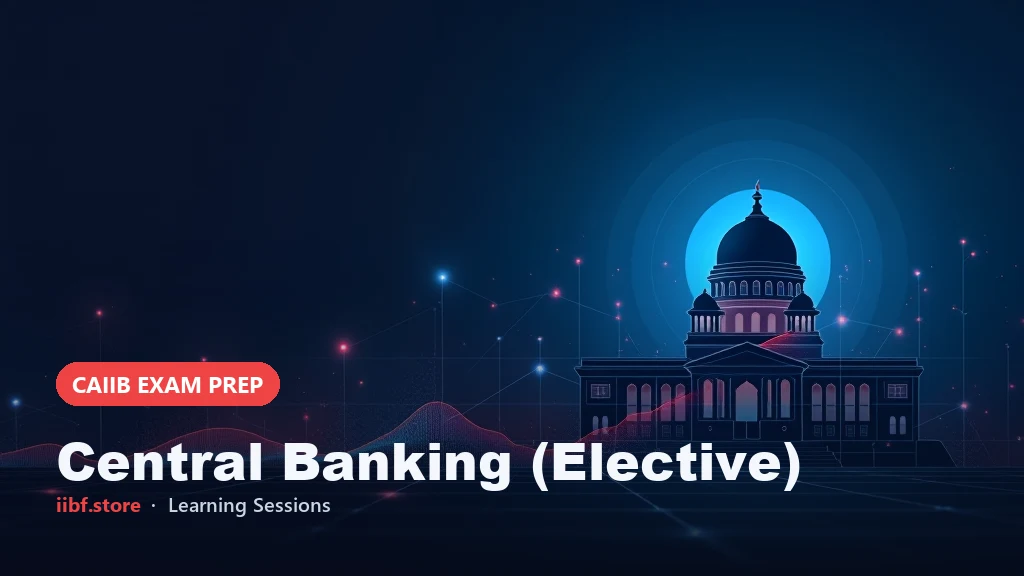
RBI rate change central banking — this guide gives you the latest 2026 information, key dates, eligibility, fees and study tips for the CAIIB exam.
The RBI's rate decisions in June 2026 matter more than you think. As a CAIIB aspirant pursuing the Central Banking (CB) elective, understanding how an RBI rate change ripples through the monetary policy framework is non-negotiable. These decisions touch every syllabus chapter—from repo and reverse repo mechanics to inflation targeting, LAF corridors, and payment system stability.
Today. We'll map the June 2026 RBI rate landscape directly to your CB exam prep, showing you exactly which syllabus concepts you must master and how to connect theory to the real world your banking organisation lives in every day.
Why June 2026's RBI Rate Change Matters for Your CAIIB Exam
Every RBI monetary policy announcement carries signals. In June 2026. As we approach the mid-year financial cycle, the central bank's stance on repo rates, reverse repo rates, CRR, and SLR shapes how ₹ millions flow through India's banking system.
For you, the CAIIB CB aspirant, this is where theory meets practice. Your exam will test your ability to explain why the RBI tweaks rates, not just what the numbers are. The syllabus expects you to link rate changes to:
- Inflation targeting mandates under the RBI Act
- Liquidity management via the Liquidity Adjustment Facility (LAF)
- Credit growth in the wider economy
- Financial stability concerns
- Forex reserve strategy
When you sit for your exam, you'll face scenario-based questions. For instance: "If the RBI raises the repo rate in June. How does it affect bank lending rates, deposit rates, and ultimately, rural credit flow?" You need to trace this chain confidently.
The June 2026 cycle is no exception. Understanding the rationale—whether it's combating inflation, managing rupee depreciation, or supporting growth—is your edge. Let's explore each tool.
Repo, Reverse Repo, and the RBI Rate Change Framework
The repo rate is the rate at which the RBI lends short-term funds to banks. The reverse repo is the rate at which banks park surplus cash with the RBI. Together, they form the LAF corridor—your Central Banking syllabus's backbone.
In June 2026, as the RBI reviews its stance, these rates either stay put or shift. Even a 25 basis point move sends clear signals. When the repo rate rises, banks face higher borrowing costs, which they pass on to customers. Lending slows. Deposits become more attractive.
Your exam questions often test whether you can:
- Explain why the RBI uses repo as its primary policy tool
- Describe how changes in repo affect the transmission chain
- Compare repo-based liquidity injection with OMO (Open Market Operations) in different market conditions
- Relate repo corridor width to financial stability
A narrower LAF corridor (smaller gap between repo and reverse repo) tightens the range within which overnight rates can fluctuate, reducing volatility. A wider corridor allows more flexibility. In June 2026, the RBI's choice reflects its confidence—or caution—about the financial system's stability.
To deepen your understanding, explore RBI Monetary Policy Tools Explained: CAIIB Central Banking and Repo Rate, CRR and SLR: RBI Policy Tools Decoded 2026.
CRR and SLR: How the RBI Rate Change Amplifies System-Wide Impact
Cash Reserve Ratio (CRR) and Statutory Liquidity Ratio (SLR) are older tools, but they remain central to your CAIIB CB syllabus. Unlike repo, which is a short-term lending facility, CRR and SLR are structural requirements. When the RBI changes CRR, it instantly alters how much capital banks must hold as reserves, freeing up—or tightening—money supply.
In June 2026, if the RBI adjusts CRR alongside rate changes, the effect compounds. A 0.5% cut in CRR releases substantial liquidity—equivalent to injecting thousands of crores into the system without printing new currency. Banks can lend more, fuelling credit growth.
Similarly, SLR (currently around 18%) mandates that banks hold a portion of deposits in government securities and approved assets. A lower SLR requirement means more funds for lending; a higher requirement supports G-Sec markets and fiscal stability.
Your exam will test whether you understand:
- The difference between CRR (a tool for short-term liquidity) and SLR (a structural, longer-term tool)
- How CRR changes propagate through the credit multiplier effect
- The role of SLR in anchoring the G-Sec market and supporting government borrowing
- Why the RBI uses CRR and SLR judiciously—too many changes create uncertainty
In mid-2026, the RBI likely balances inflation concerns with growth support. If CRR/SLR moves accompany a repo rate pause or hike, they send a nuanced message about the central bank's confidence in the economy's direction.
Dive deeper with Repo, CRR, SLR: how the RBI manages liquidity in banking.
Inflation Targeting, OMO, and the Broader Monetary Policy Stance
The RBI operates under a flexible inflation-targeting framework mandated by the RBI Act amendments. The target is 4% Consumer Price Index (CPI) inflation, with a band of ±2%. In June 2026. If headline inflation is rising or projections worsen, the RBI may tighten policy—signalling an eventual repo rate hike or maintaining a restrictive stance.
Your CAIIB syllabus covers inflation targeting in detail. You'll encounter questions about:
- How inflation forecasts drive policy decisions
- The transmission lag (typically 6–9 months) between a rate change and its impact on inflation
- Trade-offs between inflation control and growth support
- The role of expectations—if the RBI signals commitment, inflation expectations anchor, easing the inflation problem
Open Market Operations (OMO)—the RBI's purchase or sale of government securities—is another key tool. When the RBI wants to inject liquidity without changing rates, it buys G-Secs from banks (liquidity injection). To absorb liquidity, it sells G-Secs.
In June 2026, the RBI's OMO schedule reveals its stance. If the RBI is buying aggressively, liquidity concerns dominate. If it's selling, the system likely has surplus cash.
The beauty of OMO is that it works alongside repo and CRR/SLR to fine-tune the money supply. Your exam expects you to compare these tools and explain why the RBI might choose OMO over a CRR cut in certain scenarios. For example, a CRR cut is broad—it loosens capital across all banks. OMO is targeted: it influences specific segments (G-Sec holders, money market participants).
Learn more about monetary policy transmission in RBI Monetary Policy Transmission Explained for CAIIB 2026.
Financial Stability, Forex Reserves, and the Bigger Picture of RBI Rate Change
An RBI rate change doesn't occur in isolation. In June 2026, the central bank also considers forex reserve management, rupee stability, and systemic financial stability. These are advanced topics in your CB syllabus, but they're crucial.
When the RBI raises rates, it makes rupee-denominated assets (bank deposits, bonds) more attractive, supporting the rupee's value. Conversely, rate cuts can weaken the rupee if foreign investors move capital out. In a world of floating exchange rates and open capital accounts, this matters. The RBI holds nearly $650 billion in forex reserves (as per recent data). And managing these reserves while maintaining monetary policy independence is a delicate balance your exam will probe.
Financial stability—covered in depth in your CB syllabus—is the RBI's third mandate (alongside price stability and growth). A rate hike that curbs inflation but triggers a credit crisis is counterproductive. So, the RBI monitors:
- Bank profitability and capital adequacy (under Basel III standards)
- Credit quality (Non-Performing Assets)
- Shadow banking and non-bank financial institutions (NBFIs) leverage
- Payment system resilience and cyber security
- Stress in government securities (G-Sec) markets
In June 2026, if the RBI pauses rate hikes or maintains status quo, it may signal concern about financial stability. Banks' net interest margins (the spread between lending and deposit rates) are sensitive to policy. A prolonged high-rate environment can strain weaker banks. Conversely, if the RBI raises rates aggressively despite stability concerns, it signals inflation is the top priority.
Watch FINANCIAL STABILITY and review the detailed PDF notes on 5b Cb Central Banking Indian Specific Issues to master how financial stability shapes policy decisions. Also, study 11d Cb Management of Foreign Exchange Reserves to understand how forex strategy intertwines with rate policy.
The RBI Act itself—a core exam topic—gives the RBI the flexibility to balance these three mandates. Your job as a CAIIB aspirant is to recognise when the RBI prioritises one over others and to articulate the trade-offs clearly in your answers.
Related Video Classes
PDF Study Notes & Cheat Sheets
Practice Tests & Mock Exams
Frequently Asked Questions
Why is understanding the RBI rate change in June 2026 important for CAIIB Central Banking?
What's the difference between repo, CRR, and SLR in the context of an RBI rate change?
How does an RBI rate change affect inflation targeting?
What role does financial stability play in the RBI's rate decisions?
How should I prepare for CAIIB CB questions on RBI rate decisions?
Final Word
The June 2026 RBI rate change is far more than a headline figure. It's a window into how central banking works—a blend of inflation control. Growth support, financial stability, and forex management under the framework of the RBI Act. As you prepare for your CAIIB Central Banking exam. Anchoring your learning to real policy decisions makes theory stick and gives you the confidence to tackle unseen scenario questions in the exam hall.
Start by watching Central Banking Syllabus Priority 2024 to map out the big picture, then deepen your understanding with Liquidity Adjustment Facility Explained for CAIIB Central Banking and LAF Corridor Explained: CAIIB Central Banking Guide 2026. Download the PDF notes on monetary policy and fiscal-monetary relations to see how it all connects. You're closer to mastery than you think—keep building, keep questioning, and you'll excel.
For more on “RBI rate change central banking”, explore our free mock tests and chapter notes on iibf.store.
Bookmark this page — we keep our “RBI rate change central banking” guidance current as IIBF revises its rules.
Still researching “RBI rate change central banking”? Always confirm the latest position on the official IIBF site first.
Practise exam-style questions on “RBI rate change central banking” free on iibf.store to lock in the concept.
Save this “RBI rate change central banking” guide and revisit it during your revision week.
Our free notes cover “RBI rate change central banking” alongside the wider syllabus in one place on iibf.store.
Source: Indian Institute of Banking & Finance — iibf.org.in
Quick quiz on this topic
5 exam-style questions from our free test bank — check yourself before you move on.
Practice this topic
Take a free mock test, download chapter PDFs, or watch a video class — all included on iibf.store.
Keep reading