Risk Appetite Framework: A Complete CAIIB RFS Exam Guide (2026)
Every CAIIB Risk in Financial Services candidate eventually meets a question that looks simple but trips up half the class: what exactly is a risk appetite framework, and how is it different from risk tolerance or risk capacity? Banks don't avoid risk — they price it, limit it, and govern it, and the risk appetite framework is the board-approved document that turns "how much risk can we take" into numbers, limits, and escalation triggers. This article breaks the concept down the way IIBF actually tests it, with a comparison table, real governance mechanics, and five practice MCQs at exam difficulty.
🎯 What Is a Risk Appetite Framework?
A risk appetite framework (RAF) is the overarching approach — including policies, processes, controls, and systems — through which a bank establishes, communicates, and monitors its risk appetite. It is not a single number; it is a structure that links the board's stated risk appetite to the risk limits used by every business line, from treasury to retail lending. The RAF typically has three linked components: a risk appetite statement (qualitative and quantitative expression of the risk the bank is willing to accept), risk limits (the operational boundaries derived from that statement), and a governance process that monitors breaches and escalates them.
The RAF sits above day-to-day risk management. Where a credit policy tells a branch manager the maximum loan-to-value ratio for a mortgage, the risk appetite framework tells the whole bank how much aggregate credit concentration, capital erosion, or liquidity stress it will tolerate before the board intervenes. This top-down design is why RBI supervisors treat a well-articulated RAF as evidence of mature risk culture, and why it recurs across RFS case-study questions on governance.
💡 Exam Tip: If a question asks "who approves the risk appetite statement," the answer is always the Board of Directors — not the Risk Management Committee, which only recommends and monitors it.
📊 Risk Appetite vs Risk Tolerance vs Risk Capacity
IIBF loves testing whether candidates can separate three terms that sound almost identical. Risk capacity is the maximum risk a bank can absorb given its capital, liquidity, and regulatory constraints — it is a hard ceiling set by reality, not choice. Risk appetite is the amount of risk the board chooses to take in pursuit of its strategy, and it must always sit below risk capacity. Risk tolerance is the acceptable variation around risk appetite for a specific risk category or business line — the operational-level band that trading desks and credit teams actually work within day to day.
| Term | Who Sets It | Can Exceed Capacity? | Typical Horizon |
|---|---|---|---|
| Risk Capacity | Determined by capital/regulation | ❌ No — it is the ceiling | Structural |
| Risk Appetite | Board of Directors | ❌ No — must stay within capacity | Strategic (annual) |
| Risk Tolerance | Risk Management Committee / business heads | ✅ Can flex within appetite bands | Operational (ongoing) |
Notice the hierarchy in the table: capacity constrains appetite, and appetite constrains tolerance. A common exam trap is reversing this order, so it's worth memorizing capacity → appetite → tolerance as a one-way funnel, never the other direction.
🏛️ Board and Governance Role in Setting Risk Appetite
The Board of Directors owns the risk appetite statement, but it does not write it in isolation. The Chief Risk Officer (CRO) and the Risk Management Committee of the Board (RMCB) draft the statement using stress-test outputs, capital adequacy projections, and business strategy inputs, then present it for board approval, typically annually or whenever strategy shifts materially. Once approved, the CRO's team cascades the appetite into limits for credit, market, operational, and liquidity risk, which line managers then monitor against dashboards and key risk indicators (KRIs).
Good governance also means the RAF is a living document. Breaches of tolerance bands trigger an escalation ladder — first to business heads, then risk committees, and ultimately the board if the breach threatens the stated appetite itself. This escalation discipline is exactly what separates a real risk appetite framework from a static policy PDF that nobody revisits. Readers building a full picture of why this discipline matters should also study why banks are special, since the fiduciary and systemic role of banking is the reason regulators insist on this rigor.
⚠️ Common Mistake: Candidates often assume the CRO "approves" the risk appetite statement. The CRO facilitates and recommends; only the board approves it.
📈 Risk Appetite Statements and Key Risk Indicators
A risk appetite statement (RAS) combines qualitative narrative ("we will not compromise depositor safety for growth") with quantitative metrics — capital adequacy ratio floors, NPA ceilings, single-borrower concentration limits, liquidity coverage ratio minimums, and earnings-at-risk thresholds. Each metric needs a matching KRI so the bank can track drift before a limit is actually breached. For example, if the appetite statement caps gross NPA at 4%, the KRI dashboard might flag an amber alert at 3.2% so corrective action starts early rather than after the ceiling is crossed.
This is where the RAF connects directly to other RFS topics candidates already know: credit rating systems feed the probability-of-default inputs that size credit-risk appetite limits, while the collection of loss data underpins the operational-risk component of the same framework. Treating the RAF as an isolated topic is a mistake — exam scenarios usually ask you to trace how a breach in one KRI cascades through governance layers.
📌 Remember: Every quantitative limit in a risk appetite statement should have a named owner and an escalation trigger — appetite without accountability is just a wish list.
🔄 Linking Risk Appetite to Stress Testing and ICAAP
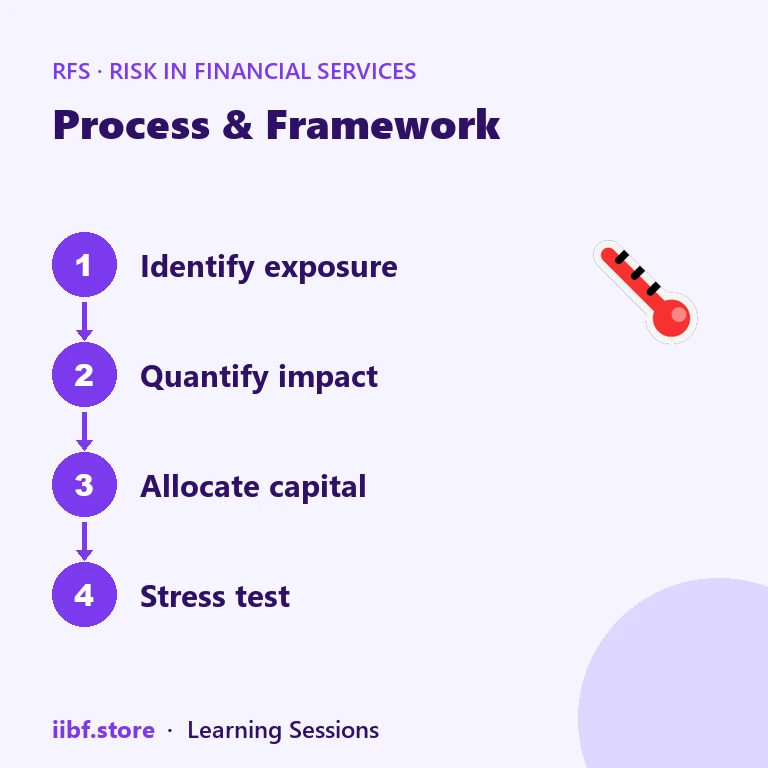
Risk appetite is not set in a vacuum — it is calibrated using stress testing and validated through the Internal Capital Adequacy Assessment Process (ICAAP). Stress scenarios reveal how much capital erosion a severe-but-plausible shock would cause, and the board uses that output to decide whether the current appetite leaves an adequate buffer above regulatory minimums. Candidates preparing this topic should cross-read stress testing and the PCA framework directly, since PCA thresholds are effectively the regulator's own external risk appetite for a bank's soundness.
RBI's supervisory guidance similarly expects boards to demonstrate that their risk appetite framework is stress-tested and forward-looking rather than a backward-looking average of past losses — see RBI's guidance on risk governance and ICAAP at rbi.org.in for the primary regulatory framing. This is also where derivatives and risk management enters the picture, since hedging positions change the risk profile that the appetite framework is meant to bound, and any RAF review must account for derivative exposures alongside on-balance-sheet risk.
🔗 Related Reading
Deepen your RFS preparation with these related guides: conduct risk in banking, credit rating systems, and credit risk models.
🧠 Practice MCQs: Risk Appetite Framework
Q1. Who has final approval authority for a bank's risk appetite statement? (a) Chief Risk Officer (b) Board of Directors (c) Statutory Auditor (d) Branch Credit Committee
Answer: (b) — The board owns and approves the risk appetite statement; the CRO only drafts and recommends it.
Q2. Which of the following correctly orders the risk hierarchy from broadest ceiling to narrowest operational band? (a) Tolerance → Appetite → Capacity (b) Appetite → Capacity → Tolerance (c) Capacity → Appetite → Tolerance (d) Tolerance → Capacity → Appetite
Answer: (c) — Capacity is the structural ceiling, appetite is the board's chosen level within that ceiling, and tolerance is the operational band around appetite.
Q3. A gross NPA ceiling of 4% with an amber alert set at 3.2% is best described as an example of: (a) Risk capacity (b) A key risk indicator tied to the risk appetite statement (c) A regulatory capital buffer (d) A stress-test scenario
Answer: (b) — Early-warning thresholds set below the hard limit are classic KRIs used to operationalise a risk appetite statement.
Q4. Why must a risk appetite framework be reviewed alongside stress-test outputs? (a) Stress tests set the accounting depreciation schedule (b) Stress tests reveal whether the current appetite leaves an adequate capital buffer under adverse conditions (c) Stress tests replace the need for a board-approved RAF (d) Stress tests are only relevant to market risk, not the RAF
Answer: (b) — Stress testing validates that the chosen appetite level does not erode capital below safe thresholds in a severe scenario.
Q5. Which statement about risk tolerance is correct? (a) It can exceed the board-approved risk appetite (b) It is set independently of the risk appetite statement (c) It represents acceptable variation within the boundaries set by risk appetite (d) It is identical to risk capacity
Answer: (c) — Risk tolerance is the operational flex band that must stay inside the appetite the board has already approved.
Want chapter-wise mock tests with 100+ MCQs? Start practising free →
❓ Frequently Asked Questions
What is the difference between risk appetite and risk tolerance?
Risk appetite is the board-approved overall level of risk a bank chooses to accept in pursuit of its strategy, while risk tolerance is the narrower operational band of acceptable variation around that appetite for a specific risk category or business line.
Who is responsible for approving the risk appetite framework in a bank?
The Board of Directors holds final approval authority. The Chief Risk Officer and the Risk Management Committee of the Board draft and recommend the framework, but only the full board can approve it.
How does risk appetite relate to ICAAP and stress testing?
ICAAP and stress testing quantify how much capital a bank would lose under adverse scenarios, and the board uses that analysis to confirm the chosen risk appetite still leaves a safe capital buffer above regulatory minimums.
Is risk appetite tested as a standalone topic in CAIIB RFS?
Yes, but it is usually combined with governance, KRIs, and stress testing in scenario-based questions, so candidates should study it alongside the board's role and the PCA framework rather than in isolation.
A risk appetite framework is where governance meets numbers — get the hierarchy of capacity, appetite, and tolerance right, and most CAIIB RFS questions on this theme fall into place. For deeper coverage of related governance and risk-management concepts, browse the Risk in Financial Services article hub, revisit the Risk Management chapter, and when you're ready to test yourself, take a full CAIIB mock exam at iibf.store/tests.
Prefer revising from a printed book?
Chapter-wise books with MCQs after every chapter — minimal pages, complete coverage, delivered anywhere in India. Every book has a free sample to read first.
Learning Sessions · Ashish Sir
132 pages · 225 MCQs
Learning Sessions · Ashish Sir
188 pages · 435 MCQs
Learning Sessions · Ashish Sir
117 pages · 236 MCQs
Learning Sessions · Ashish Sir
Learning Sessions · Ashish Sir
118 pages · 299 MCQs
Learning Sessions · Ashish Sir
Learning Sessions · Ashish Sir
Learning Sessions · Ashish Sir
115 pages · 255 MCQs
Learning Sessions · Ashish Sir
Learning Sessions · Ashish Sir
334 pages · 936 MCQs
Learning Sessions · Ashish Sir
Learning Sessions · Ashish Sir
115 pages · 344 MCQs
Learning Sessions · Ashish Sir
107 pages · 240 MCQs
Learning Sessions · Ashish Sir
90 pages · 150 MCQs
Learning Sessions · Ashish Sir
Learning Sessions · Ashish Sir
131 pages · 672 MCQs
Learning Sessions · Ashish Sir
221 pages · 831 MCQs
Learning Sessions · Ashish Sir
128 pages · 524 MCQs
Learning Sessions · Ashish Sir
107 pages · 445 MCQs
Learning Sessions · Ashish Sir
148 pages · 478 MCQs
Learning Sessions · Ashish Sir
151 pages · 465 MCQs
Learning Sessions · Ashish Sir
148 pages · 375 MCQs
Learning Sessions · Ashish Sir
216 pages · 895 MCQs
Learning Sessions · Ashish Sir
109 pages · 300 MCQs
Learning Sessions · Ashish Sir
104 pages · 360 MCQs
Learning Sessions · Ashish Sir
82 pages · 297 MCQs
Learning Sessions · Ashish Sir
151 pages · 600 MCQs
Learning Sessions · Ashish Sir
98 pages · 282 MCQs
Learning Sessions · Ashish Sir
Practice this topic
Take a free mock test, download chapter PDFs, or watch a video class — all included on iibf.store.
Keep reading