ESG risk management in banks: A Complete CAIIB RFS Guide (2026)
ESG risk management in banks has moved from a boardroom buzzword to a core CAIIB Risk in Financial Services (RFS) exam topic, because environmental, social and governance failures now translate directly into credit losses, regulatory penalties and reputational damage for lenders. A textile exporter losing an EU order over labour violations, a thermal power project stranded by a carbon transition, or a bank fined for greenwashing its "green" bonds — all of these sit squarely inside the ESG risk universe that examiners expect CAIIB candidates to map, measure and mitigate. This article builds a working framework for the topic, links it to the credit and market risk chapters you have already studied, and closes with practice MCQs and FAQs pitched at exam level.
🌱 What ESG Risk Actually Covers
ESG risk is not one risk but three interlinked risk families that a bank must underwrite alongside traditional credit and market risk. Environmental risk includes physical risk (floods, cyclones, heat stress damaging collateral and borrower operations) and transition risk (carbon pricing, stranded fossil-fuel assets, and the cost of moving to cleaner technology). Social risk covers labour practices, community relations, data privacy and product-responsibility failures across a borrower's supply chain. Governance risk covers board independence, related-party transactions, disclosure quality and executive accountability — weak governance is often the earliest warning sign of the other two failing later. For a bank, ESG risk is best understood as a risk multiplier: it rarely destroys value on its own but amplifies existing credit, market, operational and reputational exposures. A borrower with poor governance and high carbon intensity is not just an ESG concern — it is a higher-probability default two or three years out. That is why RBI's regulatory guidance increasingly treats climate and ESG factors as inputs into existing prudential frameworks rather than a stand-alone silo, a distinction examiners like to test directly.
💡 Exam Tip: When a question asks you to "classify" an ESG event, first decide whether it is E, S or G, then map it to the traditional risk category (credit, market, operational, reputational) it will eventually hit. Two-step classification questions are a favourite CAIIB pattern.
🏦 Why Banks Must Manage ESG Risk
Banks sit at the centre of the ESG transmission chain because they finance the assets — power plants, factories, real estate, vehicle fleets — whose environmental and social footprint determines transition outcomes for the whole economy. If a bank underprices ESG risk today, it inherits three costs later: elevated credit risk as high-carbon or poorly-governed borrowers default or face stranded assets, reputational risk when regulators, investors or the media flag financed emissions or lending to controversial sectors, and regulatory risk as disclosure norms tighten. This connects directly to the Credit Risk Management Framework chapter, where ESG factors are now expected as an explicit input into borrower risk-rating models rather than a qualitative afterthought. Investors and rating agencies increasingly price ESG-laggard banks at a discount, and large corporate borrowers now demand ESG-linked loan pricing, so treasury and market risk desks must also account for ESG spreads — a theme covered in the Market Risk chapter. Boards are also expected to own ESG risk appetite explicitly, tying this topic back to enterprise risk governance more broadly. Rating agencies now publish ESG-adjusted issuer ratings, and institutional investors screen bank balance sheets for exposure to high-carbon or governance-weak sectors before committing capital, which means a bank's own cost of funds is increasingly a function of how well it manages ESG risk in its loan book, not just its own operations. Supervisors globally, and RBI domestically, have signalled that climate and ESG risk will feature in future stress-testing cycles and supervisory review, so banks that build the capability early avoid a costly scramble later. For CAIIB candidates, the practical exam angle is simple: know that ESG risk management protects the bank from cost of funds, credit-loss, regulatory, and reputational costs, in that order of immediacy, and be ready to give one concrete example of each.
📊 Frameworks Banks Use to Manage ESG Risk
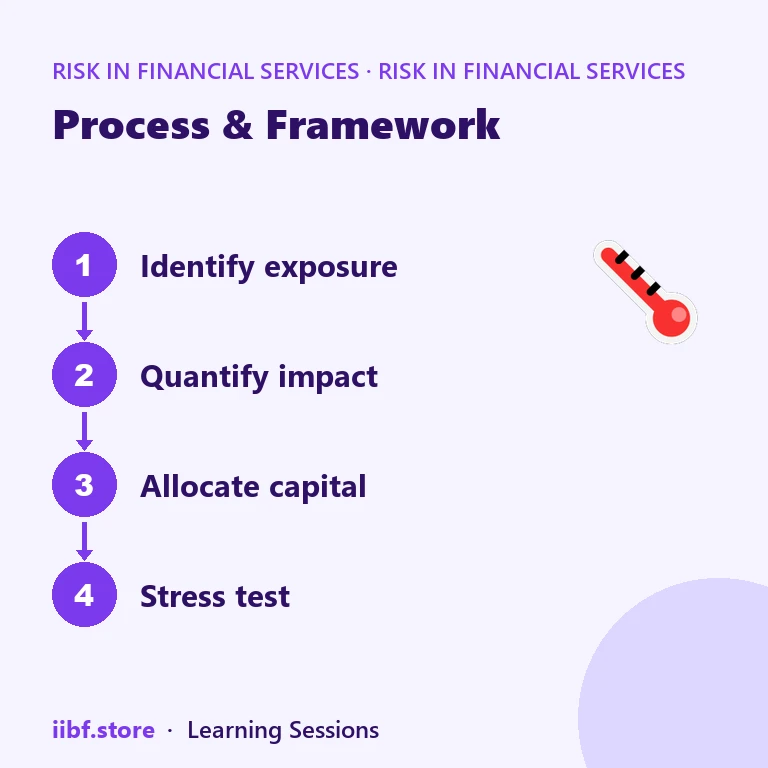
Indian and global banks lean on a handful of recurring frameworks. ESG due diligence at loan origination screens borrowers against exclusion lists (child labour, banned pesticides, certain fossil-fuel categories) and assigns an ESG score alongside the usual credit score. Climate scenario analysis and stress testing — increasingly referenced by RBI — model how physical and transition shocks flow through a loan book over 5, 10 and 30-year horizons. Task Force on Climate-related Financial Disclosures (TCFD)-style reporting structures disclosure around governance, strategy, risk management and metrics/targets, and RBI's own disclosure framework for climate-related financial risks draws heavily on this structure. Portfolio-level tools such as financed-emissions accounting (aligned to the Partnership for Carbon Accounting Financials methodology) let banks track and cap exposure to high-carbon sectors the way they already cap sectoral concentration. None of this replaces the existing credit risk toolkit; it layers on top of it, which is why RFS treats ESG risk as an extension chapter rather than a parallel syllabus.
⚠️ Common Mistake: Candidates often write that ESG risk "replaces" credit or market risk analysis. It does not — ESG factors are additional inputs into the same credit-rating, provisioning and pricing models you already know.
| Practice | ESG-Integrated Approach | Legacy Approach |
|---|---|---|
| Loan origination screening | ✅ ESG score + exclusion list applied | ❌ Financials only, ESG ignored |
| Credit rating inputs | ✅ Climate & governance factors weighted in | ❌ Purely historical financial ratios |
| Stress testing | ✅ Climate scenario analysis included | ❌ Interest-rate/market shocks only |
| Disclosure | ✅ TCFD-aligned reporting to regulator | ❌ Annual report boilerplate only |
🔍 Measuring and Monitoring ESG Risk in Practice
Measurement is the weakest link in ESG risk management today, and examiners know it — expect at least one question on data limitations. Banks typically build a composite ESG score per borrower using third-party ratings, self-disclosed questionnaires and sector-average proxies where borrower-specific data is missing, which is itself a data-quality risk worth naming in an answer. This score feeds three places: the internal credit rating (as one more risk factor), portfolio heat-maps that flag concentration in high-ESG-risk sectors, and covenant design, where lenders increasingly attach sustainability-linked pricing step-ups or step-downs. This overlaps with techniques from the Measurement Of Credit Risk chapter, since ESG scores are ultimately just another risk factor feeding the same probability-of-default and loss-given-default engines. Ongoing monitoring uses satellite data for environmental compliance, news and social-media sentiment tracking for social/governance red flags, and periodic re-scoring at each credit review cycle — not just at origination. A bank that only checks ESG risk once, at disbursement, is not actually managing it; RFS examiners frequently test this "point-in-time versus continuous monitoring" distinction.
📌 Remember: ESG risk overlaps heavily with reputational risk — a lending decision that is technically compliant can still trigger reputational damage if it is perceived as ESG-negligent. Revisit the reputational risk chapter to connect the two topics for exam answers.
🌐 ESG Risk and Regulatory Direction in India
RBI has steadily formalised expectations around climate and ESG risk for regulated entities, moving the topic from voluntary best-practice to supervisory expectation. Banks are expected to build governance structures — typically a board-level committee or sub-committee — that owns climate and ESG risk oversight, define risk appetite statements that explicitly reference sectoral exposure limits to high-transition-risk industries, and progressively align disclosures with international frameworks. For CAIIB purposes, the key takeaway is that ESG risk management is no longer optional good practice; it is being woven into the same supervisory and disclosure architecture that already governs capital adequacy and credit risk reporting. Candidates should be able to name the three pillars (environmental, social, governance), map each to a traditional risk category, and describe at least one measurement tool and one governance mechanism banks use to manage the exposure. Review the official RBI Notifications page for the latest circulars on climate risk and sustainable finance disclosure requirements before your exam, since this is an area regulators actively update.
Related reading to strengthen your RFS preparation: the risk appetite framework guide shows how ESG limits fit inside a bank's broader appetite statement, the conduct risk in banking guide covers the social/governance overlap in more depth, and the reputational risk in banking guide is essential since ESG failures are the fastest-growing source of reputational loss for lenders today. For a wider view of how RFS topics connect across the CAIIB syllabus, browse the iibf.store blog, and see every RFS post tagged together on the Risk in Financial Services tag hub.
🧠 Practice MCQs: ESG Risk Management in Banks
Q1. Which of the following best describes "transition risk" within environmental risk? (a) Risk of a borrower relocating its factory (b) Risk arising from the shift to a low-carbon economy, such as carbon pricing and stranded assets (c) Risk of currency transition during cross-border loans (d) Risk of a borrower changing management
Answer: (b) — Transition risk specifically covers financial impact from the economy-wide shift away from carbon-intensive activity, including policy, technology and market shifts.
Q2. ESG risk is best understood by a bank as: (a) A replacement for credit risk analysis (b) A stand-alone risk unrelated to existing frameworks (c) A risk multiplier that amplifies credit, market, operational and reputational risk (d) Relevant only to overseas branches
Answer: (c) — ESG factors rarely cause loss independently; they amplify the probability or severity of traditional risk categories already tracked by the bank.
Q3. Which international reporting structure has most influenced RBI's climate-related disclosure expectations for banks? (a) GAAP (b) TCFD (Task Force on Climate-related Financial Disclosures) (c) Basel I (d) IFRS 9 only
Answer: (b) — RBI's disclosure framework for climate-related financial risks draws structurally on TCFD's four pillars: governance, strategy, risk management, and metrics/targets.
Q4. A key weakness examiners expect candidates to identify in ESG risk measurement is: (a) Excess borrower data (b) Data quality and availability gaps, forcing reliance on proxies and third-party ratings (c) Too many regulators involved (d) Absence of any scoring methodology
Answer: (b) — Borrower-level ESG data is often incomplete, pushing banks toward sector proxies and third-party ratings, which introduces measurement inconsistency.
Q5. Sustainability-linked loan pricing, where interest rates step up or down based on ESG performance, is typically embedded through: (a) Regulatory capital charges (b) Loan covenants (c) Deposit insurance premiums (d) Statutory liquidity ratio adjustments
Answer: (b) — Banks attach ESG performance triggers directly into loan covenants, adjusting pricing as borrowers meet or miss agreed sustainability targets.
Want chapter-wise mock tests with 100+ MCQs? Start practising free →
Frequently Asked Questions
Is ESG risk a separate chapter or part of credit risk in the CAIIB RFS syllabus?
ESG risk is typically tested as an extension of existing credit, market and reputational risk chapters rather than a fully separate silo, since ESG factors feed into the same rating and provisioning models.
What are the three components of ESG risk?
Environmental risk (physical and transition risk), social risk (labour, community, data privacy, product responsibility) and governance risk (board independence, disclosure quality, related-party dealings).
How do banks measure ESG risk in the absence of complete borrower data?
Banks combine third-party ESG ratings, self-disclosed borrower questionnaires and sector-average proxies to build a composite score, which is then fed into credit rating and portfolio monitoring tools.
How does ESG risk connect to reputational risk for a bank?
A lending decision can be technically compliant yet still trigger public backlash if perceived as environmentally or socially negligent, so ESG failures are one of the fastest-growing sources of reputational loss for lenders.
ESG risk management in banks is now a permanent fixture of both regulatory expectation and the CAIIB RFS syllabus, sitting at the intersection of credit, market and reputational risk rather than beside them. Lock in the framework, practice the scenario-based questions above, and take a full chapter-wise mock on the CAIIB course page to see how ESG-linked questions are actually framed under exam conditions.
Prefer revising from a printed book?
Chapter-wise books with MCQs after every chapter — minimal pages, complete coverage, delivered anywhere in India. Every book has a free sample to read first.
Learning Sessions · Ashish Sir
132 pages · 225 MCQs
Learning Sessions · Ashish Sir
188 pages · 435 MCQs
Learning Sessions · Ashish Sir
117 pages · 236 MCQs
Learning Sessions · Ashish Sir
Learning Sessions · Ashish Sir
118 pages · 299 MCQs
Learning Sessions · Ashish Sir
Learning Sessions · Ashish Sir
Learning Sessions · Ashish Sir
115 pages · 255 MCQs
Learning Sessions · Ashish Sir
Learning Sessions · Ashish Sir
334 pages · 936 MCQs
Learning Sessions · Ashish Sir
Learning Sessions · Ashish Sir
115 pages · 344 MCQs
Learning Sessions · Ashish Sir
107 pages · 240 MCQs
Learning Sessions · Ashish Sir
90 pages · 150 MCQs
Learning Sessions · Ashish Sir
Learning Sessions · Ashish Sir
131 pages · 672 MCQs
Learning Sessions · Ashish Sir
221 pages · 831 MCQs
Learning Sessions · Ashish Sir
128 pages · 524 MCQs
Learning Sessions · Ashish Sir
107 pages · 445 MCQs
Learning Sessions · Ashish Sir
148 pages · 478 MCQs
Learning Sessions · Ashish Sir
151 pages · 465 MCQs
Learning Sessions · Ashish Sir
148 pages · 375 MCQs
Learning Sessions · Ashish Sir
216 pages · 895 MCQs
Learning Sessions · Ashish Sir
109 pages · 300 MCQs
Learning Sessions · Ashish Sir
104 pages · 360 MCQs
Learning Sessions · Ashish Sir
82 pages · 297 MCQs
Learning Sessions · Ashish Sir
151 pages · 600 MCQs
Learning Sessions · Ashish Sir
98 pages · 282 MCQs
Learning Sessions · Ashish Sir
Practice this topic
Take a free mock test, download chapter PDFs, or watch a video class — all included on iibf.store.
Keep reading