Risk Control Self Assessment in Banks: CAIIB RM Guide 2026
Risk control self assessment in banks is the first-line-of-defence exercise that turns operational risk from an abstract Basel category into a line-by-line audit of what can actually go wrong in a branch, a treasury desk, or a data centre. For CAIIB Risk Management candidates, RCSA is a favourite examiner topic because it sits at the intersection of governance, process design and capital calculation. This article walks through the RCSA process, how it compares with loss data collection and key risk indicators, who owns it, and where banks typically get it wrong.
🔍 What Is Risk Control Self Assessment (RCSA) in Banks?
RCSA is a structured, business-line-driven exercise in which process owners identify the risks inherent in their activities, evaluate the controls meant to mitigate those risks, and rate the residual exposure that remains after controls are applied. Unlike loss data collection, which is backward-looking and records what has already gone wrong, RCSA is forward-looking — it asks "what could go wrong here, and how strong is our control?" before an incident occurs. This makes it one of the three core pillars of the Advanced Measurement Approach and the Standardised Measurement Approach frameworks for operational risk capital under Basel norms.
Banking is unusually exposed to this kind of granular self-review because, as the CAIIB module on why banks are special explains, a single control failure — a wrong SWIFT instruction, a mis-configured core banking parameter, an unpatched server — can cascade into losses far larger than the transaction that triggered it. RCSA is how banks convert that structural fragility into a manageable inventory. A large share of RCSA findings today relate to IT and cyber exposure, which is why the chapter on technology risk is now examined alongside classical operational risk topics rather than as a separate silo.
💡 Exam Tip: RCSA is a first-line (business unit) self-assessment; the second line (risk management function) reviews, challenges and consolidates it. Do not confuse "self" with "unsupervised."
🧩 The RCSA Process: Step by Step
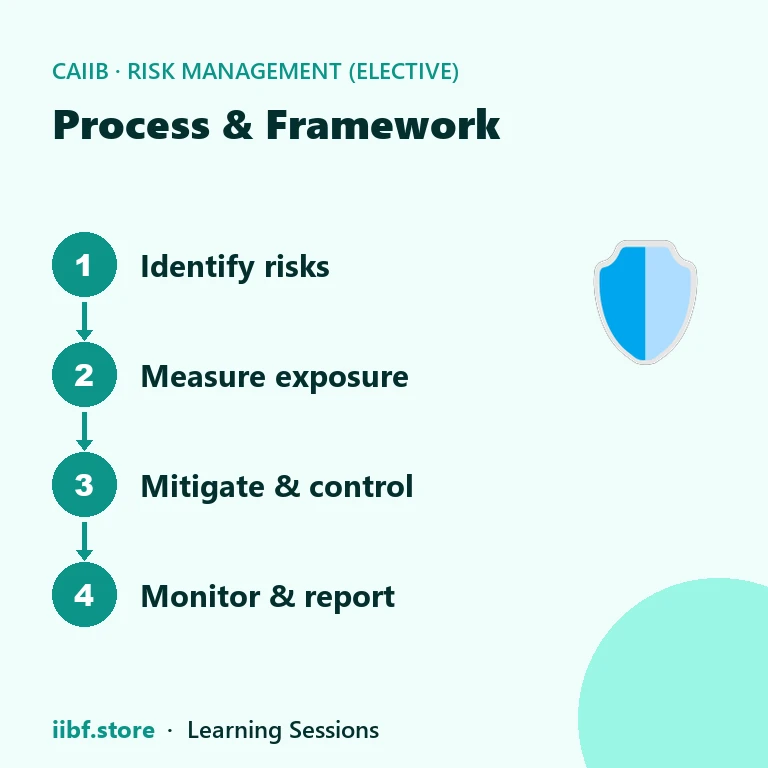
A typical RCSA cycle runs through five stages. First, risk identification: the business unit lists the risks relevant to each process, mapped against a standard risk taxonomy (internal fraud, external fraud, employment practices, clients and products, damage to physical assets, business disruption and system failures, and execution/delivery/process management). Second, inherent risk rating: each risk is scored on likelihood and impact before considering any control, usually on a low/medium/high or 1-5 scale.
Third, control identification and effectiveness testing: existing controls — maker-checker, system validations, reconciliation, access restrictions — are listed and rated as effective, partially effective, or ineffective, often with sample testing rather than a self-declared tick. Fourth, residual risk rating: inherent risk is combined with control effectiveness to arrive at the exposure that remains after mitigation. Fifth, action planning: any residual risk above the bank's risk appetite triggers a remediation plan with an owner and a target date, which feeds into the capital charge computation described in the chapter on capital change for operational risk.
The outputs of this cycle do not sit in isolation. High residual-risk processes are prioritised for internal audit coverage, and unresolved action items are reported to the Operational Risk Management Committee and, in aggregate, to the board risk committee — closing the loop between a branch-level control gap and enterprise governance.
📊 RCSA vs Loss Data Collection vs KRI Monitoring
Operational risk management leans on three complementary tools, and examiners frequently test whether candidates can tell them apart. RCSA is a periodic, judgment-based, forward-looking self-review; Loss Data Collection (LDC) is a continuous, backward-looking record of actual incidents and near-misses; Key Risk Indicators (KRIs) are ongoing, metric-driven early-warning signals such as staff attrition, system downtime, or the number of overdue reconciliations. Together they triangulate the bank's true risk profile — RCSA tells you where the exposure could be, LDC confirms where it actually was, and KRIs flag when it is about to get worse.
| Dimension | RCSA | Loss Data Collection | KRI Monitoring |
|---|---|---|---|
| Time orientation | Forward-looking | Backward-looking | Real-time / near-term |
| Basis | Expert judgment | Actual incident data | Quantitative metrics |
| Typical frequency | Annual / half-yearly | Continuous | Monthly / quarterly |
| Predictive of emerging risk? | ✅ Yes | ❌ No (confirms past events) | ✅ Yes |
| Feeds capital charge? | Directly | Directly | Indirectly only |
Banks that run these three processes as disconnected silos routinely under-report risk. Good practice links every RCSA action item to a monitorable KRI and cross-checks residual ratings against actual loss experience during the next assessment cycle — a discipline the CAIIB syllabus expects candidates to be able to describe end to end.
🏦 Governance, Ownership and Reporting of RCSA
Ownership of RCSA sits squarely with the first line — branch managers, product heads, and process owners — because they understand the day-to-day mechanics of their operations better than any central risk team. The second line, typically the Operational Risk Management department, sets the methodology, facilitates workshops, challenges optimistic self-ratings, and consolidates results for the Risk Management Committee of the Board. Internal audit, as the third line, independently tests a sample of RCSA outputs and reports gaps directly to the audit committee. This layered structure mirrors the broader risk-governance model covered in the sibling article on three lines of defence in banks, and CAIIB questions often blend RCSA specifics with that broader governance framework in the same case study.
RCSA outputs also matter well beyond operational risk. Where a bank lends under joint or multiple-banker arrangements, weak process controls at the lead bank can propagate risk to participating lenders, which is one reason the topic of consortium and multiple banking arrangements increasingly references operational control quality alongside credit appraisal. Similarly, residual operational risk findings on loan-processing controls can influence provisioning judgment under the expected credit loss framework, since a control breakdown that delays recovery action effectively worsens the loss-given-default assumption. RCSA is therefore not a stand-alone compliance ritual — it is an input into capital, provisioning and credit decisions across the bank. As per RBI's guidance on operational risk management frameworks, banks are expected to embed such self-assessments into their overall risk management and internal capital adequacy processes rather than treat them as an annual paperwork exercise.
⚠️ Common Pitfalls in RCSA Implementation
The most frequent failure is rating inflation: business units, aware that a "high residual risk" tag invites scrutiny and action-item ownership, systematically under-rate exposure or over-rate control effectiveness. Independent challenge from the second line, backed by sample testing rather than self-certification, is the main defence against this. A second common gap is stale assessments — RCSAs completed once a year and never revisited even after a process, system, or product change, leaving the register disconnected from current reality.
A third pitfall is treating RCSA as disconnected from credit risk controls. Operational failures in loan documentation, collateral perfection, or covenant monitoring are sometimes assessed purely as "process risk" without linking them to the credit risk mitigation techniques that depend on those very controls working correctly — an unperfected charge or an unmonitored covenant is as much an operational risk failure as a credit risk one. Finally, many banks under-invest in follow-up: action items are logged but not tracked to closure, so the same "high" residual rating reappears cycle after cycle with no improvement trend to show examiners, auditors, or the RBI.
Getting RCSA right also depends on granular understanding of exposure at the counterparty level, which is why the broader chapter on obligor borrower risk is worth revisiting alongside operational risk material — many "process" failures in banking ultimately surface as borrower-level losses.
📌 Remember: RCSA residual rating = Inherent risk rating adjusted for control effectiveness. A "high inherent, strong control" process can land at "low residual" — examiners test whether you understand this adjustment, not just the raw risk list.
🧠 Practice MCQs: Risk Control Self Assessment in Banks
Q1. Risk Control Self Assessment (RCSA) in banks is best described as: (a) A backward-looking record of actual operational losses (b) A first-line, forward-looking self-review of risks and control effectiveness (c) A capital adequacy ratio computation (d) A credit rating exercise for borrowers
Answer: (b) — RCSA is a forward-looking, business-unit-led assessment of inherent risk and control strength, distinct from loss data collection.
Q2. In the RCSA methodology, "residual risk" refers to: (a) Risk remaining after adjusting inherent risk for control effectiveness (b) The total loss recorded in a financial year (c) Risk transferred entirely to an insurer (d) The risk-weighted assets of the bank
Answer: (a) — Residual risk is inherent risk moderated by how effective the identified controls actually are.
Q3. Which of the following is a Key Risk Indicator (KRI) rather than an RCSA output? (a) A risk register entry rating a process as "high residual risk" (b) The number of overdue account reconciliations tracked monthly (c) An action plan to strengthen maker-checker controls (d) A control effectiveness rating of "partially effective"
Answer: (b) — KRIs are ongoing quantitative metrics (like overdue reconciliations) used for early warning, unlike RCSA's periodic judgment-based ratings.
Q4. Who is primarily responsible for conducting the RCSA exercise in a bank? (a) The external auditor (b) The business unit / process owner (first line) (c) The board of directors (d) The regulator
Answer: (b) — RCSA ownership rests with the first line, since they best understand day-to-day process risk; the second line challenges and consolidates.
Q5. A major pitfall in RCSA implementation is: (a) Excessive independent challenge from internal audit (b) Rating inflation, where units under-state residual risk to avoid scrutiny (c) Too frequent updates to the risk register (d) Over-reporting of minor risks to the board
Answer: (b) — Self-assessed ratings are prone to optimism bias; independent second-line challenge and sample testing counter this.
Want chapter-wise mock tests with 100+ MCQs? Start practising free →
Frequently Asked Questions
What is the difference between RCSA and loss data collection?
RCSA is a forward-looking, judgment-based self-assessment of risks and control effectiveness performed before losses occur, while loss data collection is a backward-looking record of incidents and near-misses that have already happened. Both feed into the operational risk capital calculation but from opposite time directions.
Who reviews and challenges RCSA ratings in a bank?
The second-line Operational Risk Management function reviews, challenges and consolidates RCSA ratings submitted by first-line business units, and internal audit, as the third line, independently tests a sample of the outputs for accuracy.
How often should banks conduct RCSA exercises?
Most banks run RCSA annually or half-yearly, but good practice requires a fresh review whenever a process, product, or system changes materially, rather than relying solely on the fixed calendar cycle.
Does RCSA affect a bank's capital requirement?
Yes. RCSA outputs, together with loss data, are a direct input into the operational risk capital charge under both the legacy Basel approaches and the current Standardised Measurement Approach, making accurate self-assessment a capital-relevant exercise, not just a compliance formality.
Key Takeaways for CAIIB Risk Management
Risk control self assessment in banks is one of the more testable, process-heavy topics in the CAIIB Risk Management elective precisely because it links governance, operational risk capital, and day-to-day banking practice in one framework. Candidates should be comfortable distinguishing RCSA from loss data collection and KRI monitoring, describing the five-stage RCSA cycle, and explaining how first-, second- and third-line roles interact around it. For structured chapter notes, practice sets and mock tests covering this and the rest of the risk management elective syllabus, explore the full CAIIB course on iibf.store.
Prefer revising from a printed book?
Chapter-wise books with MCQs after every chapter — minimal pages, complete coverage, delivered anywhere in India. Every book has a free sample to read first.















Quick quiz on this topic
5 exam-style questions from our free test bank — check yourself before you move on.
Practice this topic
Take a free mock test, download chapter PDFs, or watch a video class — all included on iibf.store.