IIBF Risk Management Study Plan for Working Bankers: 24 Days
It is 9:40 pm. The branch closed hours ago, the last reconciliation is finally done, and you are looking at a syllabus with words like ICAAP, IRRBB, Value at Risk and swaps. You want to start, but your head says tomorrow. If that sounds familiar, you are exactly who this IIBF Risk Management study plan is written for.
You do not need a free month. You need a fixed order, a small daily target and a way to check that something has stuck. Below is a 24-day plan that fits around a full-time job. You can use it with any material you trust, and later I will show how the printed book fits into it.
Why Risk Management feels harder than it is
Most bankers find this paper heavy for one reason: it mixes three different kinds of thinking. There is regulation (Basel, capital, supervision), there is numbers (duration, VaR, option payoffs) and there is plain banking sense (liquidity, ALM, why banks are special). When you jump between them randomly, everything feels like jargon.
The fix is sequence. Start with the big picture, then regulation, then market risk, then derivatives. Each block gives you the vocabulary for the next one. That is the whole idea behind this IIBF Risk Management study plan.
Three habits that matter more than hours
- Same slot daily. Forty-five minutes at the same time beats a four-hour Sunday that you skip half the weeks.
- Read, then test the same day. A few questions on what you read tonight will show you what you actually retained.
- Keep an error list. One notebook page for formulas and facts you got wrong. You will revise only this page in the last week.
The four modules and how to approach each
The Risk Management book is organised in four modules and 26 chapters. Here is how to think about each.
Module A: Risk Management, an overview (5 chapters)
This covers why banks are special, the basics of risk management, the risk management framework, asset liability management with IRRBB, and liquidity risk. It is mostly conceptual, so it is the right place to start on a tired evening. Do not rush it: ALM and liquidity ideas come back in later modules.
Module B: Basel framework and risk regulation (12 chapters)
This is the largest module and the one most people dread. It runs from why banks need regulation and the global financial crisis, through regulatory capital and capital charges for credit, market and operational risk, to supervisory review and ICAAP, stress testing and PCA, market discipline, buffers, liquidity and leverage ratios, risk based supervision and risk based internal audit. Treat it as a story: crisis, then rules, then capital, then supervision.
Module C: Market risk (4 chapters)
Market risk, fixed income, interest rate measurement and Value at Risk. Numbers appear here, so keep a calculator and your error list handy.
Module D: Derivatives (5 chapters)
Derivatives in general, forwards, futures, options and swaps. Learn the one-line definition and a worked example for each instrument before you attempt questions.
What is inside the book, in plain numbers
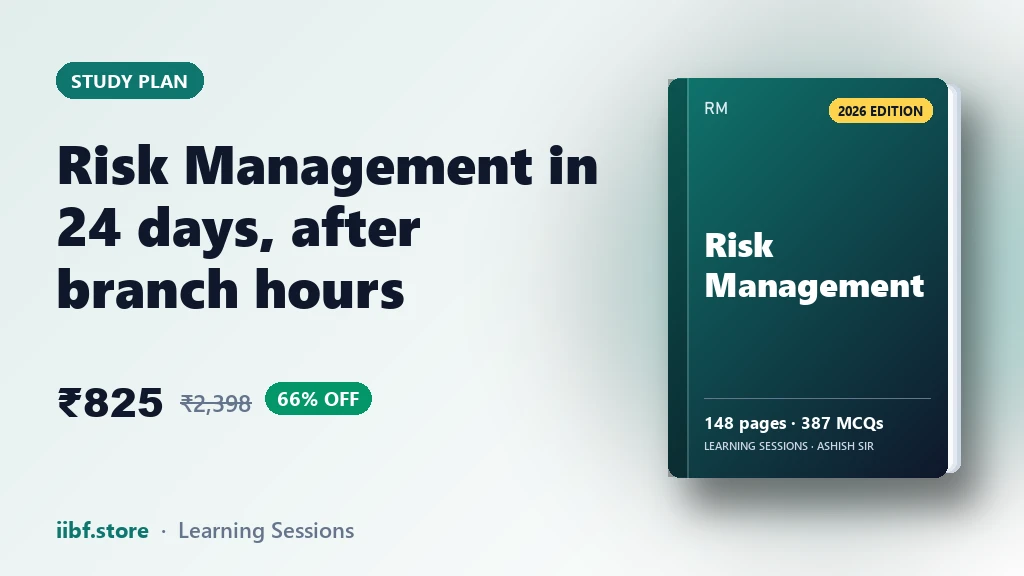
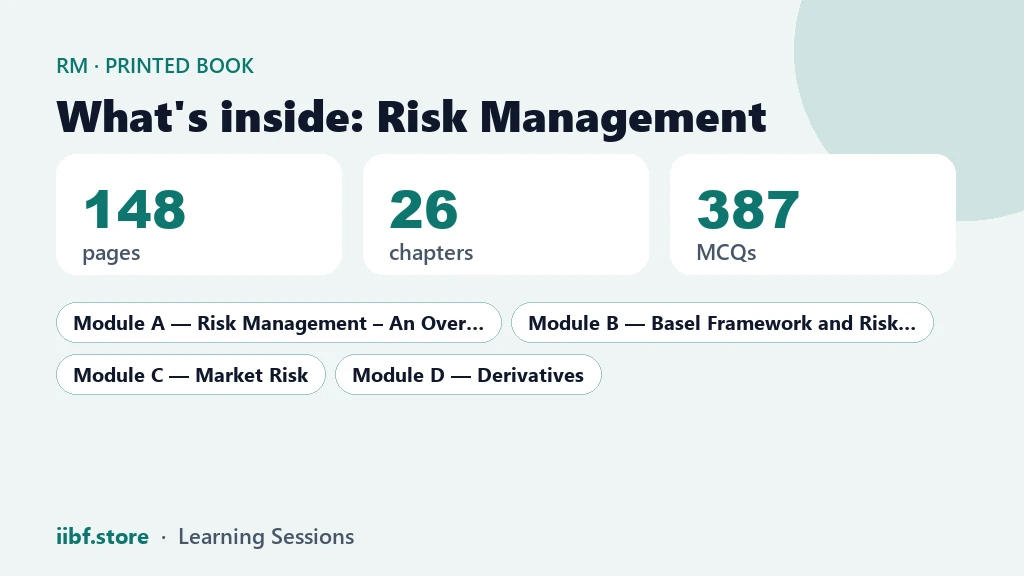
Since your time is limited, here are the facts you can plan around. The 2026 edition of the Risk Management book is 148 pages across 26 chapters, with 387 questions. On top of that it lists 36 case studies (144 questions) and 5 mega tests (500 questions). It is a compact book, which is the point: you can carry it in your bag and read a chapter on the metro or between customers.
Prices can change, so check the Risk Management book page for the current figure. At the time of writing it is listed at ₹825 against an MRP of ₹2,398. There is also a free sample you can read before deciding anything.
The 24-day IIBF Risk Management study plan
This plan assumes about 45 to 60 minutes on weekdays and a little more on weekends. It follows the book's chapter order. Shift days freely, but keep the sequence.
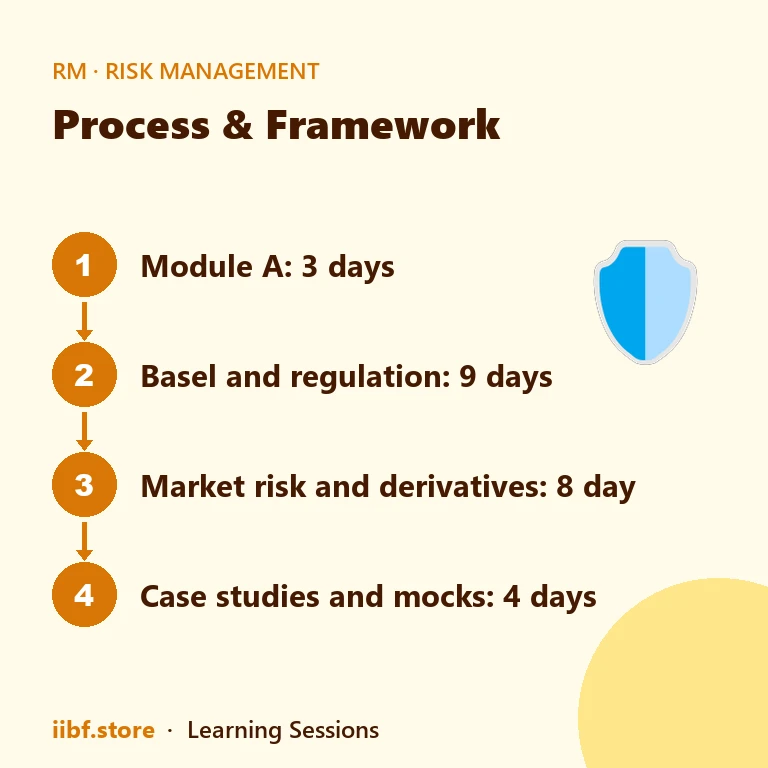
| Days | What to read | Practice |
|---|---|---|
| 1 to 3 | Module A: why banks are special, risk management basics, framework, ALM and IRRBB, liquidity risk | Chapter questions after each chapter |
| 4 to 6 | Module B: need for regulation, global financial crisis and Basel III, regulatory capital | Chapter questions, start the error list |
| 7 to 9 | Module B: capital charge for credit risk, market risk capital, operational risk capital | Chapter questions, redo wrong ones |
| 10 to 12 | Module B: SREP and ICAAP, stress testing and PCA, market discipline | Chapter questions |
| 13 to 14 | Module B: buffers, liquidity and leverage ratios, risk based supervision, risk based internal audit | Chapter questions, one-page Basel summary |
| 15 to 18 | Module C: market risk, fixed income, interest rate measurement, Value at Risk | Chapter questions, work every numerical twice |
| 19 to 21 | Module D: derivatives, forwards, futures, options, swaps | Chapter questions, one example per instrument |
| 22 | Revise your error list only | Re-attempt every question you got wrong |
| 23 to 24 | Case studies and a full mock | Timed attempt, then review mistakes |
How to run a single evening
- First 25 minutes: read the day's chapter once, pencil in hand, underlining only definitions and numbers.
- Next 10 minutes: close the book and write the three key points from memory.
- Last 15 minutes: attempt the chapter questions and note every miss in your error list.
If you miss a day, do not double up the next evening. Just slide the plan by one day. A plan that survives a bad week is better than a perfect one you abandon.
Using MCQs the right way
Questions are not only for the end. Attempt them right after reading, while the chapter is fresh, and treat a wrong answer as information. Ask yourself: did I not know the fact, or did I misread the question? The first needs more reading, the second needs slower reading.
For extra practice beyond the book, the free mock tests on iibf.store/tests and the PDFs in the free material library cost nothing. Use them for timed practice in the last week.
An honest note on limits
A book alone will not give you exam-hall speed. Reading builds understanding, but speed comes from timed mocks. So even if you buy nothing, make sure the final three or four days of this IIBF Risk Management study plan are timed practice, not more reading.
Where the book fits, and where it does not
If you like a printed copy you can annotate and revise from without a screen after a long day, the Risk Management printed book is built for that: short chapters in exam order, with questions to test yourself. If you prefer screens, the other options on iibf.store/books and the blog may suit you better. Either way, the plan above works.
Always confirm the exam schedule and any rule changes for the upcoming exam cycle on the official site, www.iibf.org.in, before you fix your own dates.
Final word
You do not have to be a risk specialist to clear this paper. You have to show up for 24 modest evenings in the right order. Pick your start date tonight, write the table on a sticky note, and begin with Module A tomorrow. This IIBF Risk Management study plan is only useful if it leaves your screen and enters your routine.
Frequently asked questions
Can I finish Risk Management in less than 24 days?
You can compress it if you have more hours, but keep the module order and the timed practice at the end. Skipping practice is the usual mistake, not skipping reading.
Which module should I give the most time?
Module B has 12 of the 26 chapters, so it takes the most days in the plan above. Give it steady time rather than one long weekend.
Is the free sample enough to start?
The free sample lets you judge the style of the book before you decide. For a complete preparation you will still need all chapters and timed mocks, from whichever source you prefer.
Where do I check the exam date?
Only on the official IIBF website at www.iibf.org.in. We do not quote dates here because they change from cycle to cycle.
Prefer revising from a printed book?
Chapter-wise books with MCQs after every chapter — minimal pages, complete coverage, delivered anywhere in India. Every book has a free sample to read first.


















Practice this topic
Take a free mock test, download chapter PDFs, or watch a video class — all included on iibf.store.
Keep reading