Scale of Finance and Crop Loan Assessment: DLTC Norms (CAIIB Rural Banking)
Every rejected crop loan and every mismatched Kisan Credit Card limit usually traces back to one thing: the branch got the scale of finance and crop loan assessment wrong. This is not a minor operational detail — it is the arithmetic backbone of agricultural lending in India, and CAIIB Rural Banking examiners test it precisely because loan officers routinely get it wrong in the field.
In this guide, you will learn how the District Level Technical Committee (DLTC) fixes Scale of Finance (SoF), how cost of cultivation feeds into crop-wise limits, and how post-harvest and consumption components get layered on top before a final crop loan or KCC limit is sanctioned.
📊 What Is Scale of Finance and Why DLTC Fixes It
Scale of Finance is the per-acre (or per-hectare) benchmark credit limit that a bank uses to assess a crop loan for a given crop, season and location. It answers a simple question: for one acre of paddy grown under irrigated conditions in this district, how much working capital does a farmer genuinely need? Without this benchmark, every branch would set crop loan limits arbitrarily, and both under-financing and over-financing would be rampant — the former starves genuine cultivation, the latter risks diversion of funds.
The Scale of Finance is fixed by the District Level Technical Committee (DLTC), an inter-agency body operating under the Lead Bank Scheme. The DLTC is typically convened by the Lead District Manager along with the District Development Manager of NABARD, representatives of the state agriculture and horticulture departments, and lead bankers in the district. This committee reviews crop-wise cultivation data before the start of each cropping season and notifies the SoF for that district, which is then adopted through the District Consultative Committee for uniform application by all banks operating there.
Understanding this institutional mechanism connects directly to the broader agriculture economy chapter, where cropping patterns, input costs and seasonal cash flows are covered in depth — SoF fixation is simply the credit-delivery translation of that economic reality.
🌾 Cost of Cultivation and Crop-Wise Limits
The starting point for any Scale of Finance figure is the cost of cultivation for that specific crop, season and agro-climatic zone. This includes seeds, fertilisers, pesticides, hired labour, irrigation charges, land preparation, and machinery or bullock-power costs where relevant. State agriculture departments and cost-of-cultivation surveys feed this data to the DLTC, which then arrives at a per-acre or per-hectare figure for each major crop grown in the district.
Crop-wise limits vary sharply. A rainfed cotton crop and an irrigated sugarcane crop in the same district will carry very different Scale of Finance figures because input intensity, duration and risk profile differ. Similarly, the same crop grown under irrigated conditions typically commands a higher SoF than the rainfed version, since irrigated cultivation uses more inputs and targets higher yields. This is exactly why the Kisan Credit Card limit for a farmer is never a flat number — it is built up crop by crop, season by season, using the applicable DLTC-notified rate. For a full walkthrough of how these limits translate into an actual KCC sanction, see our guide on the Kisan Credit Card scheme.
Because cost of cultivation is dynamic — input prices, wage rates and diesel costs move every year — SoF figures are never treated as static. Banks that continue to apply a stale, un-revised rate risk under-financing farmers in an inflationary input environment, which is one of the most commonly tested exam scenarios under this topic.
📦 Post-Harvest and Consumption Components
Scale of Finance is not limited to pre-harvest input costs. Two additional layers are typically added on top of the base cultivation cost.
The post-harvest component covers expenses incurred after the crop is standing in the field but before it is sold — harvesting labour, transport to the mandi or storage point, primary processing, drying, and short-term storage. Crops with higher spoilage risk or longer marketing chains, such as vegetables, fruits and cash crops, generally carry a meaningful post-harvest add-on, since a farmer who cannot move or store the produce quickly loses value fast. This is closely tied to the state of rural marketing and storage infrastructure — a theme also covered in the infrastructure chapter and in our detailed piece on rural infrastructure development in India.
The consumption component recognises that a farming household has living expenses that do not stop between sowing and harvest. As per extant guidelines applicable to Kisan Credit Card limits, banks may add a consumption support allowance — commonly cited at up to around 10 percent of the crop-loan component of the SoF — to help the household bridge day-to-day expenses without diverting crop input funds. Always verify the current applicable percentage against the latest circular before applying it, since these allowances are administratively revised from time to time.
💡 Exam Tip: Remember the build-up sequence — base cost of cultivation, plus post-harvest component (where applicable), plus consumption component (mainly under KCC) — equals the final crop loan or KCC limit. Examiners love testing this sequencing.
🏦 How Banks Apply Scale of Finance in Practice
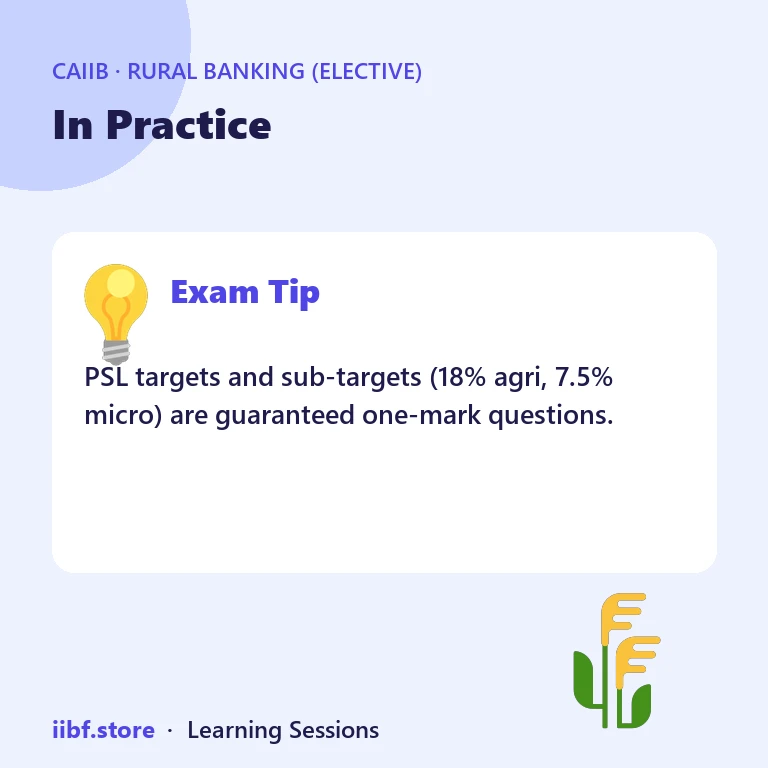
At the branch level, crop loan assessment is a structured, not a discretionary, exercise once SoF is notified. The credit officer identifies the crop, the season (kharif, rabi or annual/perennial), the irrigation source (irrigated vs rainfed), and the area under cultivation as per land records or self-declaration for KCC. The applicable DLTC rate for that crop-season combination is applied to the area to arrive at the base crop loan component, and post-harvest or consumption add-ons are layered in where the guidelines permit.
The most common assessment error is applying last season's rate, or applying the irrigated rate to a rainfed holding (or vice versa), which either starves the farmer of adequate working capital or creates an inflated, diversion-prone limit. Sound judgement here is a credit-appraisal skill, and how banks formally evaluate that judgement in their staff is covered in our CAIIB HRM piece on the performance appraisal system in banks.
⚠️ Common Mistake: Using a district's flat, single SoF figure for all crops instead of the crop-and-irrigation-specific rate notified by the DLTC — this is the single most tested error pattern in this topic.
The table below illustrates how these components typically stack up across different crops. Treat every figure as illustrative only — actual DLTC-notified Scale of Finance varies by district, soil type, irrigation source and year, so always check your district's current circular.
| Crop (Season) | Illustrative SoF per acre (Rs)* | Post-Harvest Component | Consumption Component (KCC) |
|---|---|---|---|
| Paddy (Kharif, irrigated) | 28,000 | ✅ Yes | ✅ Yes |
| Wheat (Rabi, irrigated) | 24,000 | ❌ No | ✅ Yes |
| Cotton (Kharif, rainfed) | 32,000 | ✅ Yes | ✅ Yes |
| Sugarcane (annual) | 55,000 | ✅ Yes | ✅ Yes |
| Vegetables (short duration) | 40,000 | ✅ Yes | ❌ No |
*Illustrative figures for reference only — not to be treated as the actual notified rate for any district. Refer to the Reserve Bank of India's priority sector lending framework and your district's current DLTC circular for authoritative figures.
This crop-wise, component-by-component build-up is also the reason Scale of Finance interacts closely with allied-activity financing decisions on the same holding — a farmer with dairy or poultry alongside cropping needs both assessed separately, as explained in our guide on financing allied agricultural activities. It also connects to the broader policy push covered under rural development policies, since accurate crop loan assessment is central to the larger agricultural credit delivery objective.
📌 Remember: DLTC fixes the rate; the branch applies it correctly, crop by crop, season by season, irrigation type by irrigation type. Getting either step wrong breaks the entire assessment.
🧠 Practice MCQs: Scale of Finance and Crop Loan Assessment
Q1. Who fixes the Scale of Finance for crops in a district? (a) RBI head office (b) State government alone (c) District Level Technical Committee (DLTC) (d) NABARD head office alone
Answer: (c) — The DLTC, an inter-agency body under the Lead Bank Scheme, notifies district-wise Scale of Finance for each crop and season.
Q2. The Scale of Finance for a crop is primarily based on: (a) The farmer's landholding size only (b) Cost of cultivation of the crop (c) Market price of the crop at harvest (d) The farmer's credit score
Answer: (b) — SoF is derived from the actual cost of cultivating that crop under given season and irrigation conditions.
Q3. Which additional component may be added to Scale of Finance mainly under Kisan Credit Card limits to support household needs? (a) Insurance premium (b) Consumption component (c) Marketing cess (d) Processing fee
Answer: (b) — A consumption component is added to help meet household expenses between sowing and harvest, as permitted under extant KCC guidelines.
Q4. The post-harvest component in Scale of Finance typically covers: (a) Cost of seeds and fertilisers (b) Transport, storage and primary processing costs (c) Land revenue payments (d) Crop insurance premium
Answer: (b) — Post-harvest costs arise after the crop is ready — harvesting labour, transport, drying and short-term storage before sale.
Q5. Scale of Finance for a crop is normally reviewed and notified: (a) Once every five years (b) Annually, before the start of the cropping season (c) Only when a farmer applies for a loan (d) Only after crop failure is reported
Answer: (b) — DLTC reviews and notifies SoF ahead of each cropping season so branches apply a current, not stale, rate.
Want chapter-wise mock tests with 100+ MCQs? Start practising free →
What is Scale of Finance in agricultural lending?
Scale of Finance is the district-notified, per-acre credit benchmark used by banks to assess crop loan and KCC limits for a specific crop, season and irrigation type, based on the actual cost of cultivation.
What is DLTC and who is part of it?
DLTC stands for District Level Technical Committee, an inter-agency body under the Lead Bank Scheme comprising the Lead District Manager, NABARD's District Development Manager, agriculture department officials and lead bankers, who jointly fix the Scale of Finance for the district.
Does Scale of Finance include consumption expenses?
Yes, mainly under Kisan Credit Card limits, a consumption component may be added on top of the crop loan component to support household expenses, as per prevailing guidelines applicable at the time of sanction.
How often is Scale of Finance revised?
The DLTC typically reviews and notifies Scale of Finance annually, ahead of the relevant cropping season, so that input cost inflation and changed cultivation practices are reflected in the limits banks apply.
✅ Conclusion: Get the Assessment Right, Every Season
Scale of Finance and crop loan assessment is not a one-time formula — it is a live, DLTC-governed process that every rural banker must re-check every season, crop and irrigation type. Master the build-up of cost of cultivation, post-harvest component and consumption component, and both your loan appraisals and your CAIIB Rural Banking score will improve together.
Explore more chapter notes in Rural Banking (Elective), or strengthen your preparation with full-length papers on the CAIIB course page.
Quick quiz on this topic
5 exam-style questions from our free test bank — check yourself before you move on.
Practice this topic
Take a free mock test, download chapter PDFs, or watch a video class — all included on iibf.store.
Keep reading