Sensitivity Analysis in Credit Appraisal: A CAIIB ABM Guide
A borrower's projections always look fine on the base case — that is precisely why banks cannot sanction on the base case alone. Sensitivity analysis in credit appraisal is the discipline of deliberately flexing a project's key assumptions to see how much stress the account can absorb before debt servicing starts to break down. CAIIB ABM tests this as a layer on top of the loan-appraisal exercise: not "what is the projected cash flow" but "what happens to that cash flow, and to the borrower's ability to repay, when reality is worse than projected." This article covers which variables to flex, how to build the three standard cases, and where credit officers commonly get the exercise wrong.
🎯 What Is Sensitivity Analysis in Credit Appraisal
Every loan proposal starts with a base case: management's best estimate of sales, costs, and margins over the loan tenor. Sensitivity analysis asks a different question — if one or more of those assumptions turns out to be optimistic, does the project still generate enough cash to service the debt?
The technique works by changing one input at a time (or a defined combination of inputs), recalculating the project's cash flows and debt-servicing capacity, and comparing the result against the base case. A project that stays comfortably above its lending covenants even under a reasonably adverse scenario is a stronger credit than one that only works if every assumption holds exactly as projected.
Banks use this both at the sanctioning stage, to decide whether to lend and on what terms, and afterwards, to identify which projects in the existing portfolio are most exposed if a specific input — say raw-material cost or the exchange rate — moves against the borrower.
💡 Exam Tip: CAIIB case studies usually give you a base-case cash flow and then ask you to recompute one ratio (often the DSCR) after a stated percentage change in one or two variables — the arithmetic matters more than the theory.
🔧 Which Variables Banks Flex — and Why
Not every input deserves equal attention. Appraisal teams focus on the handful of assumptions the project is genuinely sensitive to, typically:
- Sales volume — a demand shortfall directly cuts revenue and, below a point, tips the project below break-even.
- Selling price — competitive pressure or commoditised output can compress realisations even if volumes hold up.
- Raw-material cost — for manufacturing borrowers, input cost swings often move faster than the borrower can pass through in price.
- Interest rate — a rate increase raises debt-servicing obligations directly, independent of how the underlying business performs.
- Capacity utilisation — new projects that assume high utilisation from year one are especially exposed if ramp-up is slower than planned.
- Forex rate — relevant wherever the borrower has import content in costs or export content in revenue, or where the loan itself carries a foreign-currency component.
The point of flexing these specific variables is that they are the ones most likely to move in the real world and most likely to matter to the outcome — flexing an input the project is genuinely insensitive to wastes appraisal effort without adding insight.
📊 Building the Best, Base and Worst Case
A complete sensitivity exercise usually produces three scenarios: a best case (assumptions modestly better than projected), the base case (management's projection as submitted), and a worst case (a defined, reasoned adverse shift in the key variables). The table below illustrates how a single project's numbers might move across the three.
| Scenario | Key Assumption Shift | Illustrative DSCR | Within Covenant (min. 1.25)? |
|---|---|---|---|
| Best case | Sales volume +5%, costs as projected | 1.85 | ✅ Yes |
| Base case | Management's submitted projection | 1.60 | ✅ Yes |
| Worst case | Sales volume −10%, raw-material cost +8% | 1.10 | ❌ No — breaches covenant |
A worst case that breaches the covenant is not automatically a rejection — it is a signal to restructure the proposal: a higher promoter margin, a shorter repayment tenor, additional collateral, or a covenant requiring the borrower to notify the bank early if actuals track toward the stressed scenario. The value of the exercise is in surfacing that conversation before disbursement, not after.
📉 Break-Even, Margin of Safety and the DSCR Read-Across
Sensitivity analysis connects directly to two other appraisal tools. The break-even point — the sales level at which total revenue exactly covers total cost — tells you how far current or projected sales sit above the point where the project stops covering its costs. The gap between projected sales and the break-even level, expressed as a percentage, is the margin of safety: a thin margin of safety means a relatively small sales shortfall is enough to push the project into loss.
That read-across matters because a project can show a healthy base-case Debt Service Coverage Ratio (DSCR) while still sitting close to its break-even point — the DSCR captures debt-servicing capacity, while margin of safety captures how much cushion there is before the underlying business itself turns unprofitable. Appraisal notes that quote DSCR without also checking the margin of safety are only telling half the story.
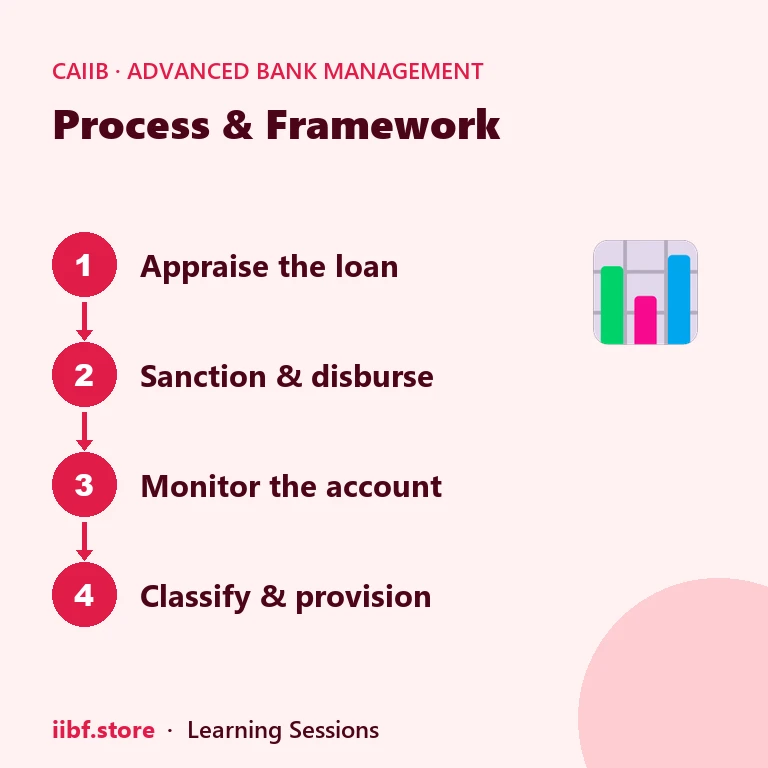
Practically, once the worst-case variables are flexed, the resulting stressed DSCR is what actually drives the lending decision and the terms attached to it — repayment schedule, moratorium, security cover, and any additional covenants are all set with the stressed case in mind, not just the base case.
⚠️ Common Mistake: Sanctioning purely on a base-case DSCR that comfortably exceeds the covenant, without asking what the DSCR looks like once the key variables are stressed, is the single most common appraisal shortcut that comes back to bite the bank later.

⚠️ Common Mistakes in Sensitivity Analysis
A few recurring errors show up both in real credit files and in CAIIB case studies:
Flexing one variable at a time only. Changing sales volume in isolation, then raw-material cost in isolation, understates real-world risk — adverse conditions rarely arrive one variable at a time. A combined worst case, where two or three correlated variables move together, gives a far more realistic stress picture.
Ignoring correlated variables. Sales volume and selling price often move together (a demand slowdown depresses both), and raw-material cost and forex rate can move together for import-dependent inputs. Treating these as independent when building the worst case overstates the project's resilience.
An over-optimistic base case. If the base case itself already embeds unrealistic capacity-utilisation or margin assumptions, every downstream sensitivity calculation inherits that optimism. Cross-checking the base case against industry benchmarks and the borrower's own historical performance — using proper estimation discipline — is a necessary first step before any scenario is flexed.
Reviewing the spread of outcomes across scenarios also benefits from the same measures of central tendency and dispersion covered elsewhere in the ABM syllabus — a wide spread between best and worst case DSCR is itself a risk signal, independent of where the base case sits. Proposals showing a wide spread should route through the bank's credit committee under its corporate governance in banks framework rather than being cleared at branch level, and the scenario workings should be recorded through consistent classification and tabulation of banking data so they can be reviewed at renewal. This stress-testing approach is distinct from working-capital sizing, which typically uses the maximum permissible bank finance method rather than scenario DSCR analysis. Where interest-rate stress is a key flexed variable, it should also be checked against the bank's own rate positioning, which treasury tracks through gap analysis in banks under the BFM syllabus. For the RBI's broader prudential lending framework, refer to the RBI's official guidelines directly rather than a secondhand summary.
🧠 Practice MCQs: Sensitivity Analysis in Credit Appraisal
Q1. What is the primary purpose of sensitivity analysis in credit appraisal? (a) To calculate the borrower's credit score (b) To test how changes in key assumptions affect project viability and debt-servicing capacity (c) To classify the account as standard or NPA (d) To determine the loan's interest rate
Answer: (b) — Sensitivity analysis flexes key assumptions to see how project cash flows and debt-servicing capacity hold up under adverse conditions.
Q2. Which of the following is NOT typically a variable flexed in a project's sensitivity analysis? (a) Selling price (b) Raw-material cost (c) Interest rate (d) The borrower's registered office address
Answer: (d) — Sensitivity analysis flexes financial and operating assumptions like price, cost, volume, interest rate and forex; the registered office address has no bearing on project cash flows.
Q3. What does the margin of safety measure in relation to the break-even point? (a) The bank's capital adequacy buffer (b) How far projected sales sit above the break-even sales level (c) The borrower's credit rating buffer (d) The gap between IRR and the hurdle rate
Answer: (b) — Margin of safety expresses how much sales can fall before the project reaches its break-even point, indicating the cushion against loss.
Q4. Why should lending terms be based on the stressed (worst-case) DSCR rather than only the base-case DSCR? (a) Regulations require using the lowest possible number (b) The stressed DSCR shows debt-servicing capacity under realistic adverse conditions, which the base case does not capture (c) The base-case DSCR is always inaccurate (d) Worst-case DSCR is easier to calculate
Answer: (b) — A comfortable base-case DSCR can mask real risk; the stressed DSCR shows whether the project can still service debt if key assumptions turn adverse.
Q5. What is the main problem with flexing sensitivity-analysis variables one at a time only? (a) It takes too much computing time (b) It understates risk because it ignores the effect of correlated variables moving together (c) It always overstates the DSCR (d) It is not permitted under CAIIB guidelines
Answer: (b) — Flexing variables individually misses the combined effect of correlated variables (such as sales volume and price) moving adversely together, giving an overly optimistic worst case.
Want chapter-wise mock tests with 100+ MCQs? Start practising free →
Frequently Asked Questions
What is sensitivity analysis in credit appraisal?
It is the process of deliberately changing key project assumptions — such as sales volume, selling price, or interest rate — to test how a project's cash flows and debt-servicing capacity hold up under adverse conditions, before a loan is sanctioned.
Which variables do banks typically flex in a sensitivity analysis?
Common variables include sales volume, selling price, raw-material cost, interest rate, capacity utilisation, and the forex rate where the project has import or export exposure.
How does sensitivity analysis feed into the actual lending decision?
The stressed, worst-case DSCR — not just the base-case DSCR — typically drives decisions on loan structure, tenor, security cover, and any additional covenants attached to the sanction.
What is the most common mistake banks make when running sensitivity analysis?
Flexing only one variable at a time and ignoring how correlated variables, such as sales volume and selling price, tend to move together in an actual downturn, which understates real project risk.
For CAIIB ABM, sensitivity analysis questions reward candidates who can move from a base-case number to a stressed number quickly and correctly, and who understand why the stressed case — not the base case — should drive the final lending terms. Practise the worst-case DSCR recalculation until it is automatic, then attempt a full-length CAIIB mock test to see how these questions are actually framed. For more CAIIB ABM coverage, browse the Advanced Bank Management tag page.
Quick quiz on this topic
5 exam-style questions from our free test bank — check yourself before you move on.
Practice this topic
Take a free mock test, download chapter PDFs, or watch a video class — all included on iibf.store.
Keep reading