Stamp Duty and Registration of Bank Documents: Rules (CAIIB BRBL)
For a CAIIB BRBL candidate, stamp duty and registration of bank documents is one of those topics that looks procedural on the surface but decides the fate of a recovery suit years later. A loan agreement, a mortgage deed, or a guarantee that is inadequately stamped can be thrown out as evidence in court, no matter how sound the underlying credit decision was. This article walks through the Indian Stamp Act 1899, the Registration Act 1908, the adjudication route under Section 31/32, and the consequences of unstamped or under-stamped documents — exactly the way examiners frame this chapter.
Banks execute dozens of instruments per loan file: term loan agreements, hypothecation deeds, mortgage documents, guarantees, letters of continuity, and powers of attorney. Each of these is an "instrument" for the purpose of the Indian Stamp Act, and each attracts duty the moment it is executed — not when it is presented in court. Getting the stamping and registration right at origination is cheaper, faster, and far less risky than trying to cure a defect after a default has already occurred.
📜 Indian Stamp Act 1899 and Bank Documents
The Indian Stamp Act 1899 is a fiscal statute — it does not decide whether a contract is valid, but it decides whether that contract can be used as evidence and whether it is admitted for registration. Every document listed in Schedule I (or the corresponding State schedule) is chargeable with duty, either ad valorem (as a percentage of the loan or security value) or at a fixed amount depending on the class of instrument.
For bank documents this typically covers term loan agreements, deeds of hypothecation, mortgage deeds, deeds of guarantee, and powers of attorney executed in favour of the bank or its recovery agents. The duty must be paid before or at the time of execution; stamping after the fact through adjudication is permitted but attracts penalty in most States.
Stamp duty is levied and collected by the State in whose territory the instrument is executed or the property is situated — it is a State subject under the Constitution, so rates and exemptions genuinely differ from State to State and change frequently through State Finance Acts. A CAIIB candidate should never memorise a single "national" percentage; the exam expects you to know the concept, the classification of instruments, and the consequences, not a specific State's rate.
💡 Exam Tip: Stamp duty is a State subject — questions that quote a specific percentage rate as universal are testing whether you know this is wrong. Answer on principle, not on a memorised figure.
🏛️ Registration Act 1908 and Compulsory Registration
The Registration Act 1908 governs a separate question: which documents must be formally registered with the Sub-Registrar to be legally effective against third parties. Section 17 of the Act makes registration compulsory for instruments that create, declare, assign, limit, or extinguish any right, title, or interest of the value of Rs 100 or more in immovable property — which brings most registered mortgage deeds squarely within its scope.
An equitable mortgage created purely by deposit of title deeds is a notable exception among the various types of mortgages under Transfer of Property Act: it does not require a written, registered instrument because the deposit itself, coupled with intent, creates the charge. But the moment banks reduce that arrangement to a written memorandum of deposit that itself creates or records the transaction, the document can attract registration and stamping requirements depending on how it is worded — a nuance frequently tested in this chapter.
Documents that are compulsorily registrable but are not registered are treated, for most purposes, as if they do not affect the immovable property described in them; they cannot be received as evidence of the transaction affecting that property, though they can sometimes be used for a collateral purpose. This is distinct from, and additional to, the stamping requirement — a document can be perfectly stamped and yet fail for want of registration, or vice versa. Candidates preparing this alongside the regulation of banking business important questions chapter will notice how often the two statutes are tested together.
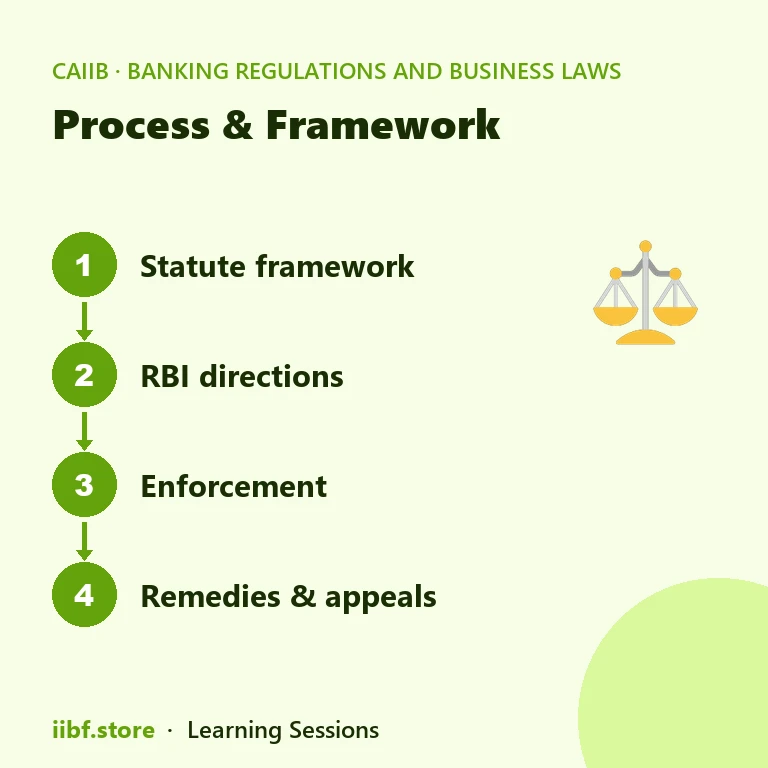
⚖️ Adjudication of Stamp Duty: Sections 31 and 32
Where a bank or its customer is unsure of the correct duty payable on an instrument, the Indian Stamp Act provides a safety valve: adjudication. Under Section 31, any person can bring an executed instrument to the Collector and ask for an opinion on the duty with which it is chargeable, on payment of the prescribed fee. Under Section 32, once the Collector is satisfied that the full duty has been paid, the instrument is certified by an endorsement — and that certificate is conclusive evidence that the instrument has been duly stamped.
Adjudication is particularly useful for banks in two situations: first, when a large-value or unusually structured instrument (a consortium deed, a complex hypothecation-cum-mortgage, or an instrument combining several distinct transactions) makes the applicable duty genuinely unclear; second, when a document has been executed outside India or in another State and the bank wants certainty before relying on it locally. Getting an instrument adjudicated before a dispute arises removes any later argument that it was under-stamped, which is a common defence raised by defaulting borrowers to delay recovery proceedings.
It is worth linking adjudication back to the broader supervisory architecture: RBI's oversight of documentation standards sits within the same legal framework of regulation of banks that CAIIB BRBL tests elsewhere, even though stamp duty itself is administered by State Revenue authorities rather than the banking regulator. This is a different track from RBI's control over management of banking companies, which deals with governance, not documentation.
⚠️ Common Mistake: Candidates often assume registration cures a stamping defect, or that stamping cures a registration defect. They are two independent requirements under two different Acts, and a document can fail on either ground separately.
🚫 Consequences of Unstamped or Under-Stamped Documents
Section 35 of the Indian Stamp Act is the provision that gives the whole topic its teeth. An instrument that is not duly stamped cannot be acted upon, registered, or admitted in evidence by any court or authority for any purpose — with limited exceptions such as use in criminal proceedings. If a bank sues to recover on a hypothecation deed or guarantee that was never stamped, or under-stamped, the court can refuse to even look at it until the deficiency and penalty are made good.
The court (or authority before which the document is produced) impounds the instrument and, under Section 35's proviso, may allow the party to pay the deficient duty along with a penalty — commonly up to ten times the deficient duty, though the exact penalty regime is set by the applicable State Stamp Act and can vary. Once the deficiency and penalty are paid, the instrument becomes admissible, but the delay, cost, and litigation risk this creates in a recovery suit is entirely avoidable by getting the stamping right at disbursement stage.
This is also why credit and legal teams are trained never to treat stamping as a back-office formality. A single under-stamped guarantee can stall an entire recovery action under the SARFAESI Act or before the Debt Recovery Tribunal while the bank scrambles to cure the defect — precisely the kind of operational risk covered under regulation of banking business in this subject.
📌 Remember: Section 35 makes an unstamped instrument inadmissible as evidence, not automatically void. Paying the duty and penalty at the adjudication stage can still cure it — but only after the deficiency is made good.
| Bank Document | Stamp Duty Required | Registration Compulsory | Key Provision |
|---|---|---|---|
| Registered mortgage deed | ✅ Yes | Yes (if value ≥ Rs 100) | Indian Stamp Act Schedule I; Registration Act S.17 |
| Equitable mortgage (deposit of title deeds only) | ❌ No, on the deposit itself | No | Common law charge; no written instrument created |
| Memorandum recording an equitable mortgage | ✅ Yes, if it creates/records the transaction | Depends on wording | Indian Stamp Act; case-specific |
| Deed of hypothecation | ✅ Yes | Usually not (movable property) | Indian Stamp Act Schedule I |
| Deed of guarantee | ✅ Yes | No | Indian Stamp Act Schedule I |
| Power of attorney to bank/recovery agent | ✅ Yes | Usually no, unless it affects immovable property | Indian Stamp Act; Registration Act S.17/18 |
🧭 How Banks Manage Stamping and Registration Risk
Operationally, most banks build stamping into the loan documentation checklist itself: the sanctioning branch verifies the class of instrument, the duty payable under the relevant State Stamp Act, and whether registration at the Sub-Registrar's office is required before the deed is treated as perfected security. For high-value or cross-State transactions, legal teams often route the instrument through adjudication proactively rather than wait for a dispute to surface the defect.
Franking and e-stamping have largely replaced physical judicial stamp paper in most States, and banks increasingly rely on empanelled advocates to confirm the correct State-specific duty before disbursement — because a duty calculated for the wrong State, or on the wrong instrument classification, creates exactly the same Section 35 exposure as skipping stamping altogether. This is also where corporate-facing instruments intersect with the topic: share certificates and allotment-related instruments executed during an initial public offering process in India attract their own stamp duty treatment under the same Act, which is a useful cross-subject link when you are revising BRBL alongside ABFM.
Bankers should also keep the register-of-documents discipline tight — noting execution date, stamping date, and registration date against each security document — because this same record becomes the first exhibit relied upon if a dispute over admissibility ever reaches the Bankers Books Evidence Act certified-copy route in litigation. Getting the paperwork right once, at the branch counter, is always cheaper than defending it later before a Tribunal. Read the full control over organisation of banks chapter alongside this one — examiners like to combine a documentation-law question with a regulatory-control question in the same case study.
🧠 Practice MCQs: Stamp Duty and Registration of Bank Documents
Q1. Under which Act is stamp duty on bank loan documents primarily governed? (a) Registration Act 1908 (b) Indian Stamp Act 1899 (c) Transfer of Property Act 1882 (d) Companies Act 2013
Answer: (b) — The Indian Stamp Act 1899 (along with applicable State Stamp Acts) governs stamp duty on instruments including bank loan documents.
Q2. Stamp duty on instruments executed within a State is: (a) Fixed uniformly by the Central Government (b) A State subject, so rates vary by State (c) Not applicable to banking instruments (d) Decided solely by RBI
Answer: (b) — Stamp duty is a State subject; rates and exemptions are set and revised by individual State Finance Acts.
Q3. Which section of the Registration Act 1908 makes registration compulsory for instruments creating an interest of Rs 100 or more in immovable property? (a) Section 17 (b) Section 35 (c) Section 32 (d) Section 138
Answer: (a) — Section 17 of the Registration Act 1908 lists the categories of documents for which registration is compulsory.
Q4. What is the effect of Section 35 of the Indian Stamp Act on an unstamped instrument produced before a court? (a) It is automatically void (b) It cannot be acted upon or admitted in evidence until duty and penalty are paid (c) It is admissible without restriction (d) It must be destroyed
Answer: (b) — Section 35 bars an unstamped instrument from being acted upon or admitted in evidence until the deficient duty and penalty are made good.
Q5. Adjudication of stamp duty under Sections 31 and 32 of the Indian Stamp Act is done by: (a) The Sub-Registrar (b) The Collector (c) The Reserve Bank of India (d) The Debt Recovery Tribunal
Answer: (b) — The Collector adjudicates the proper stamp duty on an instrument under Sections 31 and 32 and certifies it once the duty is paid.
Want chapter-wise mock tests with 100+ MCQs? Start practising free →
Is stamp duty on bank documents the same across all Indian States?
No. Stamp duty is a State subject under the Constitution, so the rate and exemptions on instruments like mortgage deeds, hypothecation deeds, and guarantees vary from State to State and change periodically through State Finance Acts. Always verify the current State-specific rate before disbursement rather than relying on a memorised figure.
What happens if a bank loan document is not registered when registration was compulsory?
Under the Registration Act 1908, a document that required compulsory registration under Section 17 but was not registered generally cannot be used as evidence of the transaction affecting the immovable property it describes, and it does not effectively create or transfer the right, title, or interest in that property against third parties.
Can an under-stamped bank document be cured after execution?
Yes, in most cases. Under the Indian Stamp Act, an under-stamped instrument can be impounded and the deficient duty paid along with a penalty prescribed under the applicable State Stamp Act. Once the deficiency is made good, the instrument becomes admissible in evidence.
Does an equitable mortgage created by deposit of title deeds need registration?
The deposit of title deeds itself, made with the intent to create security, generally does not require a written or registered instrument. However, if the parties execute a memorandum that itself records or creates the mortgage transaction (rather than merely recording facts), stamping and possibly registration requirements can apply depending on how the document is drafted.
✅ Conclusion: Get the Paperwork Right, Every Time
Stamp duty and registration of bank documents is not a side topic in CAIIB BRBL — it is where contract law, evidence law, and everyday credit operations meet. Know the difference between the Indian Stamp Act 1899 and the Registration Act 1908, understand the adjudication route under Sections 31 and 32, and be exam-ready on the Section 35 consequences of unstamped instruments. Revisit the NBFC chapter too, since similar documentation-compliance questions recur across BRBL case studies.
For more topic-wise coverage of this subject, browse the Banking Regulations and Business Laws tag on the blog, and when you are ready to test yourself, take a free chapter-wise mock at iibf.store/course/caiib. For the statutory text itself, always cross-check the latest position on rbi.org.in and your State's Stamp Act before applying any specific rate in practice.
Quick quiz on this topic
5 exam-style questions from our free test bank — check yourself before you move on.
Practice this topic
Take a free mock test, download chapter PDFs, or watch a video class — all included on iibf.store.
Keep reading