RBI Control Over Management of Banking Companies: CAIIB BRBL Guide
The Reserve Bank of India holds sweeping powers over how banking companies are run in India, and CAIIB BRBL candidates are tested on this every attempt. Control over management of banking companies is not a vague policy idea — it is a set of specific legal powers that let RBI approve directors, remove executives, impose a moratorium, or force a merger when a bank is in trouble. This article walks through those powers in plain language, ties them to the chapters you need for CAIIB Banking Regulations and Business Laws, and gives you five exam-style MCQs to test yourself before you move on.
🏛️ Why RBI Controls Bank Management
Banks run on other people's money. A depositor hands over savings expecting the bank to stay solvent, honest, and well run — and that trust is exactly what collapses first when a bank is mismanaged. Because of this, the law does not treat a banking company like an ordinary business. It gives RBI direct, statutory control over who can run a bank, how the board must be composed, and what happens when management fails.
This authority sits inside the same chapter of law that CAIIB candidates study as the legal framework of regulation of banks. It covers four broad powers: licensing a bank before it can open its doors, approving and, if needed, removing directors and key managerial personnel, imposing a moratorium or restructuring a weak bank, and sanctioning amalgamation when standalone survival is no longer realistic. Each power has its own section number, its own trigger conditions, and its own exam angle, and examiners like to test the difference between them precisely because candidates often blur the lines.
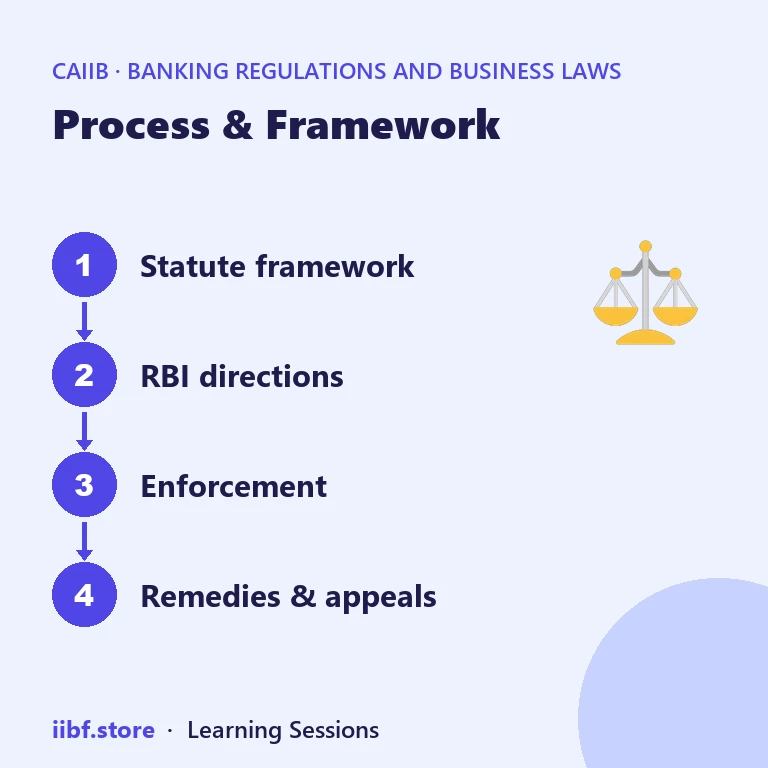
It helps to think of these powers as a ladder of intervention. Licensing and board-composition rules operate every single day, quietly, in the background. Removal and supersession powers activate only when something has already gone wrong at the top. Moratorium and amalgamation are the last resort, used when a bank's own management can no longer be trusted to fix the problem. Understanding that sequence — routine oversight, corrective action, and last-resort restructuring — is more useful for the exam than memorising section numbers in isolation, though you will need both.
📋 Licensing, Directors and Board Powers
No company can call itself a bank and take public deposits in India without a licence from RBI. This licensing requirement is the entry gate: RBI examines capital adequacy, the soundness of the promoters, and whether the proposed business is in the public interest before granting or refusing a licence, and it can attach conditions or cancel a licence later if those conditions are breached. This chapter overlaps closely with the material tested under control over organisation of banks, so read the two together.
Once a bank is licensed, the law does not leave board composition to chance. A defined share of the board must consist of people with real, demonstrable expertise — accountancy, agriculture, banking, cooperation, economics, law, or small-scale industry — rather than being filled entirely with nominees or relatives of large shareholders. If a board falls short of this requirement, RBI can direct the bank to reconstitute it within a set period, and can co-opt or nominate directors itself if the bank does not comply.
RBI also has a say in the appointment of the chairman and managing director of a banking company, particularly in the private sector, and can withhold approval if it is not satisfied with a candidate's fitness or propriety. This is a preventive check, not a punitive one — the goal is to keep unsuitable individuals out of the top seat before any damage is done, rather than cleaning up after the fact.
💡 Exam Tip: Licensing and board-composition powers are preventive and continuous. Removal and supersession powers are corrective and triggered by a specific failure. Questions often ask you to classify a scenario into one of these two buckets.
⚖️ Removal, Supersession and Moratorium
When a director, chairman, or other managerial person is already in place but is acting against depositors' interests, RBI does not have to wait for the next licensing cycle. It can remove that individual directly, in the public interest, to prevent the affairs of the bank being conducted in a manner detrimental to depositors, or to secure the proper management of the bank. The removed person has a right to make representations, but the order can take immediate effect if the situation demands it.
A step further along the same ladder is supersession — the power to replace an entire board, not just one person, when the whole leadership has lost the confidence of the regulator. This is rare and reserved for serious governance failures, typically alongside the appointment of an administrator to run the bank in the interim while a permanent solution is worked out.
Moratorium is a different, blunter tool. Rather than replacing people, it freezes the bank's normal operations — withdrawals are capped, and business is restricted — for a limited period while RBI and the government work out a rescue plan. A moratorium buys time; it does not itself fix governance. It is almost always paired with a reconstruction or amalgamation scheme so that, once the freeze lifts, depositors have a solvent bank to deal with rather than the same troubled one.
⚠️ Common Mistake: Candidates often assume moratorium and amalgamation are the same event. Moratorium is a temporary freeze; amalgamation or reconstruction is the permanent fix that usually follows it.
🤝 Amalgamation, NBFCs and the Wider Regulatory Net
Amalgamation can happen two ways. Banks can voluntarily merge on their own initiative, with shareholder approval and RBI's sanction, when the boards on both sides see a sound business case. Or RBI can compel a merger, usually alongside or right after a moratorium, when a bank cannot be revived on its own and depositor protection demands a stronger partner take it over. The compulsory route is faster, gives RBI more discretion over terms, and is the one exam questions focus on most, because it sits at the intersection of moratorium and reconstruction law covered under regulation of banking business.
The same underlying logic — protect depositors, keep unsuitable management out, step in before failure spreads — extends beyond commercial banks. NBFCs operate under a parallel, though lighter, supervisory regime, and public sector and cooperative banks carry their own variations on board-approval and removal powers, shaped by additional statutes that apply to them. Cooperative banks in particular sit under a dual-control arrangement, sharing oversight between RBI and the Registrar of Cooperative Societies.
At a system level, all of this sits inside a coordinating structure. The Financial Sector Legislative Reforms and Financial Stability and Development Council chapter covers how multiple regulators — RBI, SEBI, IRDAI and others — coordinate on systemic risk so that a management failure in one bank does not spill over into the wider financial system unchecked.

📌 Remember: Voluntary amalgamation is bank-led and shareholder-driven. Compulsory amalgamation is RBI-led and depositor-protection-driven. The trigger and the driving party are what the exam usually asks you to identify.
| Entity Type | Governing Framework | Compulsory Amalgamation Possible | RBI Direct Removal Power |
|---|---|---|---|
| Public sector banks | Banking Regulation Act | Yes | ✅ |
| Private sector banks | Banking Regulation Act | Yes | ✅ |
| Cooperative banks | Banking Regulation Act + State Acts | Yes | ✅ |
| NBFCs | RBI Act, 1934 | No | ❌ |
For related ground, see the guide on creation and registration of charges, which shares exam weight with this topic, and the guide on Payment and Settlement Systems Act 2007, which covers a parallel piece of RBI's statutory oversight. If your syllabus also touches agency law, the article on contract of agency for bankers is worth a read too.
🧠 Practice MCQs: Control Over Management of Banking Companies
Q1. Under the Banking Regulation Act, which power lets RBI remove a chairman, director, or other managerial person of a banking company in the public interest? (a) Licensing power under Section 22 (b) Removal power under Section 36AA (c) Voluntary amalgamation under Section 44A (d) Winding-up power
Answer: (b) — Section 36AA gives RBI the power to remove managerial and other persons from office in the public interest or to protect depositors.
Q2. A moratorium on a banking company's operations is imposed under which provision? (a) Section 45 (b) Section 36AB (c) Section 10A (d) Section 22
Answer: (a) — Section 45 empowers RBI, with government sanction, to impose a moratorium and work out reconstruction or compulsory amalgamation for a failing bank.
Q3. Which section requires a banking company to hold a valid RBI licence before commencing business in India? (a) Section 10A (b) Section 22 (c) Section 45 (d) Section 36AA
Answer: (b) — Section 22 makes an RBI licence mandatory before any company can carry on banking business in India.
Q4. Under the board-composition rule for banking companies, what minimum proportion of directors must have special knowledge or practical experience in relevant fields? (a) At least one-third (b) Not less than 51 percent (c) At least two-thirds (d) The entire board
Answer: (b) — The law requires not less than 51 percent of the board to consist of persons with special knowledge or practical experience in areas such as banking, law, accountancy or agriculture.
Q5. Compulsory reconstruction or amalgamation of a failing banking company, initiated by RBI rather than the bank's own shareholders, falls under which provision? (a) Section 44A (b) Section 45 (c) Section 36AB (d) Section 22
Answer: (b) — Section 45 is the RBI-led route, distinct from Section 44A, which covers amalgamation proposed voluntarily by the banks themselves.
Want chapter-wise mock tests with 100+ MCQs? Start practising free →
What is Section 36AA of the Banking Regulation Act?
It is the provision that lets RBI remove a chairman, director, or other managerial person of a banking company in the public interest or to prevent conduct detrimental to depositors, after giving the person a chance to respond.
What is the difference between voluntary and compulsory amalgamation of banks?
Voluntary amalgamation is proposed by the banks' own boards and shareholders and then sanctioned by RBI, while compulsory amalgamation is initiated by RBI itself, usually alongside a moratorium, when a bank cannot be revived on its own.
Does RBI's control over management extend to cooperative banks and NBFCs?
Yes, with variations. Cooperative banks operate under dual control shared between RBI and the Registrar of Cooperative Societies, while NBFCs follow a separate, somewhat lighter registration and supervision regime under RBI.
Why does CAIIB BRBL test this topic so often?
Because governance failure and depositor protection sit at the core of banking regulation, and examiners repeatedly test whether candidates can correctly match a scenario to the specific power — licensing, removal, moratorium, or amalgamation — that applies to it.
Control over management of banking companies is one of those CAIIB BRBL topics that rewards a structured approach far more than rote memorisation. Once you can place licensing, director approval, removal, moratorium, and amalgamation on a single mental ladder, most exam questions become an exercise in matching a scenario to the right rung rather than recalling a section number from scratch. If your preparation also covers rural lending, the guide on financing allied agricultural activities is a useful cross-subject companion. For more chapters on this subject, browse the banking regulations and business laws tag hub, and when you are ready to test yourself properly, head over to iibf.store/tests for full-length mock papers.
Quick quiz on this topic
5 exam-style questions from our free test bank — check yourself before you move on.
Practice this topic
Take a free mock test, download chapter PDFs, or watch a video class — all included on iibf.store.