Kirkpatrick Model of Training Evaluation for CAIIB HRM
The Kirkpatrick Model of Training Evaluation answers one question a bank's HR department must answer every year: did the money spent on training actually change anything at the branch counter? It grades a programme on four ascending levels — Reaction, Learning, Behaviour and Results — and CAIIB HRM examiners test whether you can place a given piece of evidence on the correct level.
🎯 What the Kirkpatrick Model of Training Evaluation Measures
Donald L. Kirkpatrick set out the four-level framework in 1959, and it remains the default vocabulary of the training function in banks, insurers and regulators alike. Each level asks a harder question than the one below it, and each costs more to answer.
- Level 1 — Reaction: did participants find the programme relevant, engaging and well delivered?
- Level 2 — Learning: did knowledge, skill, attitude, confidence or commitment actually increase?
- Level 3 — Behaviour: is the learning being applied back on the job, weeks after the classroom closed?
- Level 4 — Results: did the intended business outcome move — fewer deficiencies, faster turnaround, better recovery?
The logic is a chain of inference, not four independent surveys. A good Level 1 score does not guarantee Level 2 learning; strong Level 2 test marks do not guarantee Level 3 transfer. Most training functions collect the two cheap levels and quietly abandon the two expensive ones, which is exactly the weakness examiners like to probe.
Kirkpatrick also insisted on reading the model backwards when you design a programme. Start from the business result the bank wants, work down to the behaviour that produces it, then to the learning that enables the behaviour, and only last to the delivery format. If you have already worked through the fundamentals of HRM chapter, you will recognise this as the same means-ends discipline that underlies manpower planning and appraisal design. The New World Kirkpatrick Model, developed later by Jim and Wendy Kirkpatrick, keeps the four levels but adds required drivers — coaching, reinforcement and accountability — that make Level 3 transfer happen instead of hoping for it.
📊 The Four Levels Side by Side
The table below is the single most exam-useful summary of the framework. Note the last column: the two lower levels are captured while the programme is still running, which is precisely why they are over-reported.
| Level | What it measures | Typical evidence in a bank | Captured during the programme? |
|---|---|---|---|
| 1. Reaction | Satisfaction, relevance, engagement | End-of-session feedback form after a credit appraisal workshop | ✅ |
| 2. Learning | Knowledge, skill, attitude, confidence, commitment | Pre-test and post-test on KYC and AML rules; role-play scoring | ✅ |
| 3. Behaviour | On-the-job application and transfer | Branch head observation and audit sampling 60–90 days later | ❌ |
| 4. Results | Business and compliance outcomes | Fall in documentation deficiencies, faster loan turnaround, higher cross-sell ratio | ❌ |
Read each row as a claim that must be evidenced separately. A pre-test and post-test is Level 2 even if it is administered a month later; a supervisor's observation is Level 3 even if it is informal. The level is fixed by what is being measured, never by when or by how rigorous the instrument is.
💡 Exam Tip: When a question describes a measurement, ignore the timing and ask what is being observed. Satisfaction is Level 1, capability is Level 2, application is Level 3, and an organisational outcome is Level 4.
🏦 Applying the Four Levels to Bank Training
Indian banks run three broad streams of training: mandatory compliance inputs such as KYC, AML and cyber hygiene; role-based skilling for credit, forex, treasury and branch operations; and leadership development for officers moving into scale-based roles. Each stream sits differently on the four levels.
Compliance training is the easiest to evaluate at Level 4 because the outcome is countable — audit observations, customer complaints and process exceptions all fall or they do not. Role-based skilling usually stops at Level 2 unless the bank builds an observation checklist for the reporting authority. Leadership programmes are the hardest, because the results surface over quarters, not weeks.
Certification-linked learning gives the training function a ready-made Level 2 instrument. When a bank sponsors staff for the professional and certificate examinations conducted by the Indian Institute of Banking and Finance, the pass result is an independent, externally validated measure of learning that no internal quiz can match. The remaining work is to design the Level 3 evidence — what should a certified officer now do differently at the desk?
Delivery structures matter as well. Staff training colleges, regional training centres, e-learning modules and on-the-job coaching all feed the same four levels, but only blended designs with post-programme reinforcement reliably reach Level 3. The chapter on HRM in banks sets out how these establishments fit the wider HR architecture. Transfer is also a cultural question: where line managers treat training as a break from work, Level 3 collapses regardless of content quality, which is why employee engagement in banks is treated as a precondition for training effectiveness rather than a separate initiative.
💰 Level 5: Phillips ROI and the Cost of Training
Jack J. Phillips extended the framework with a fifth level that converts Level 4 results into money and compares them with the fully loaded cost of the programme. The formula every CAIIB candidate should be able to reproduce is:
ROI (%) = (Net Programme Benefits ÷ Programme Costs) × 100, where Net Programme Benefits = Monetary Benefits - Programme Costs.
A benefit-cost ratio, by contrast, is simply Monetary Benefits ÷ Programme Costs — the same inputs, no subtraction, and a ratio that is always one point higher in effect than the ROI decimal. Confusing the two is the single most common arithmetic slip in this topic.
Programme costs must be fully loaded: faculty and content development, venue and travel, learning technology, administration, and the opportunity cost of the participant's time away from the desk. Understating the last item flatters the ROI of every residential programme a bank runs.
Phillips also insists on isolating the effect of training before claiming any benefit. If recoveries in a circle improve after a recovery workshop, some of the gain may be due to a new incentive scheme, a legal amendment or a seasonal effect. Control groups, trend-line analysis and expert estimation with confidence adjustment are the accepted isolation techniques.
This discipline is the same one used elsewhere in the CAIIB syllabus — when a treasury team is trained on the net stable funding ratio, the improvement in the ratio cannot be credited to the training alone, because balance-sheet composition changes for many reasons at once.
⚠️ Common Mistake: Candidates calculate ROI on gross benefits. ROI subtracts programme costs from benefits first; skipping that subtraction gives you the benefit-cost ratio, which is a different answer to a different question.
🔗 Where Training Evaluation Fits the Bank HR Cycle
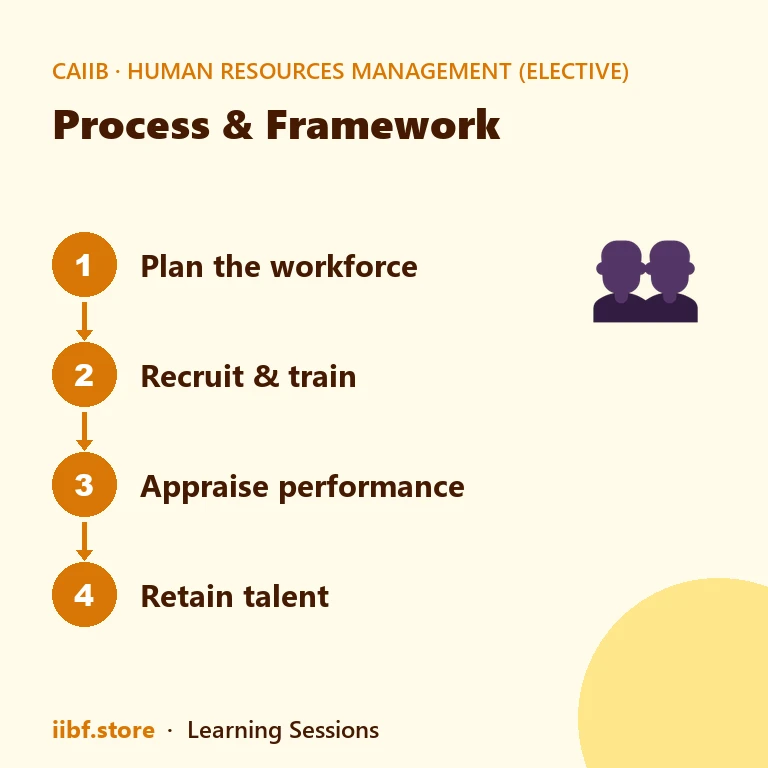
Training evaluation is not a standalone ritual at the end of a programme. It closes a loop that begins with a needs analysis and ends with a decision to repeat, redesign or scrap the intervention.
- Needs analysis at organisational, task and person level, drawn from appraisal gaps, audit findings and business strategy.
- Design and delivery, with the target Level 4 result written into the objectives before the content is built.
- Evaluation across all four levels, with required drivers scheduled in advance for Level 3.
- Feedback into HR decisions — placement, job rotation, promotion eligibility and the next cycle's training calendar.
The outputs feed directly into the bank's knowledge base. Capturing what worked, which faculty delivered transfer and which job aids survived contact with the branch is a knowledge management activity as much as a training one; otherwise every redesign starts from zero.
Evaluation data also has an industrial-relations dimension. Where training is linked to promotion eligibility or to redeployment after a process change, unions have a legitimate interest in how the assessment is conducted, and the process must sit comfortably inside the industrial relations framework in banks. Assessment records used in disciplinary or transfer decisions must also respect the labour laws applicable to banks, particularly on natural justice and documentation.
For a broader revision sweep of this elective, the CAIIB HRM elective tag hub collects the related study guides in one place, and the RBI rates reference is the safer source for any policy number a case-study question throws at you.
🧠 Practice MCQs: Kirkpatrick Model of Training Evaluation
Q1. Which level of the Kirkpatrick model measures whether learners apply the training on the job? (a) Level 1 — Reaction (b) Level 2 — Learning (c) Level 3 — Behaviour (d) Level 4 — Results
Answer: (c) — Level 3 Behaviour assesses transfer of learning to actual job performance, typically 60–90 days after the programme.
Q2. Who extended the four-level framework by adding a fifth level dealing with return on investment? (a) Donald Kirkpatrick (b) Jack Phillips (c) Peter Senge (d) Dave Ulrich
Answer: (b) — Jack J. Phillips added Level 5, converting Level 4 results into monetary terms and comparing them with fully loaded programme costs.
Q3. A bank records a fall in KYC documentation deficiencies six months after a compliance workshop. This evidence belongs to: (a) Level 4 — Results (b) Level 3 — Behaviour (c) Level 2 — Learning (d) Level 1 — Reaction
Answer: (a) — A change in an organisational outcome such as deficiency count is a Level 4 result, not merely individual behaviour.
Q4. The feedback form filled in immediately at the close of a branch operations programme captures: (a) Level 2 — Learning (b) Level 3 — Behaviour (c) Level 4 — Results (d) Level 1 — Reaction
Answer: (d) — Satisfaction and perceived relevance are Level 1 Reaction data, often called a smile sheet.
Q5. Under the Phillips approach, ROI (%) is computed as: (a) Monetary benefits ÷ programme costs × 100 (b) Programme costs ÷ monetary benefits × 100 (c) (Monetary benefits - programme costs) ÷ programme costs × 100 (d) Monetary benefits - programme costs
Answer: (c) — ROI uses net benefits in the numerator; option (a) is the benefit-cost ratio expressed as a percentage.
Want chapter-wise mock tests with 100+ MCQs? Start practising free →
❓ Frequently Asked Questions
Is the Kirkpatrick model still relevant when most bank training is online?
Yes. The delivery channel changes the instruments, not the levels. An e-learning module still generates Level 1 ratings and Level 2 assessment scores, and still needs supervisor observation for Level 3 and business data for Level 4.
Which level do banks most often skip, and why?
Level 3. Behaviour measurement needs a follow-up 60–90 days later, cooperation from line managers and an agreed observation checklist, so it is dropped when the training calendar is crowded.
What is the difference between ROI and the benefit-cost ratio?
ROI uses net benefits — monetary benefits minus programme costs — divided by programme costs. The benefit-cost ratio divides gross monetary benefits by programme costs without subtracting them first.
How does the New World Kirkpatrick Model differ from the original?
It keeps the four levels but front-loads required drivers such as coaching, reinforcement and accountability, and adds leading indicators so that Level 3 transfer is planned during design rather than measured after the fact.
🚀 Revise This the Exam Way
Learn the four levels as a chain of evidence, memorise the ROI formula with its subtraction intact, and practise placing sample measurements on the correct level until it is automatic. Then test yourself under time pressure with the CAIIB question bank and mock tests.
Prefer revising from a printed book?
Chapter-wise books with MCQs after every chapter — minimal pages, complete coverage, delivered anywhere in India. Every book has a free sample to read first.
104 pages · 360 MCQs
Learning Sessions · Ashish Sir
148 pages · 478 MCQs
Learning Sessions · Ashish Sir
151 pages · 465 MCQs
Learning Sessions · Ashish Sir
148 pages · 375 MCQs
Learning Sessions · Ashish Sir
216 pages · 895 MCQs
Learning Sessions · Ashish Sir
109 pages · 300 MCQs
Learning Sessions · Ashish Sir
82 pages · 297 MCQs
Learning Sessions · Ashish Sir
151 pages · 600 MCQs
Learning Sessions · Ashish Sir
98 pages · 282 MCQs
Learning Sessions · Ashish Sir
131 pages · 672 MCQs
Learning Sessions · Ashish Sir
221 pages · 831 MCQs
Learning Sessions · Ashish Sir
128 pages · 524 MCQs
Learning Sessions · Ashish Sir
107 pages · 445 MCQs
Learning Sessions · Ashish Sir
132 pages · 225 MCQs
Learning Sessions · Ashish Sir
188 pages · 435 MCQs
Learning Sessions · Ashish Sir
117 pages · 236 MCQs
Learning Sessions · Ashish Sir
Learning Sessions · Ashish Sir
118 pages · 299 MCQs
Learning Sessions · Ashish Sir
Learning Sessions · Ashish Sir
Learning Sessions · Ashish Sir
Learning Sessions · Ashish Sir
115 pages · 255 MCQs
Learning Sessions · Ashish Sir
Learning Sessions · Ashish Sir
334 pages · 936 MCQs
Learning Sessions · Ashish Sir
Learning Sessions · Ashish Sir
115 pages · 344 MCQs
Learning Sessions · Ashish Sir
107 pages · 240 MCQs
Learning Sessions · Ashish Sir
90 pages · 150 MCQs
Learning Sessions · Ashish Sir
Learning Sessions · Ashish Sir
Quick quiz on this topic
5 exam-style questions from our free test bank — check yourself before you move on.
Practice this topic
Take a free mock test, download chapter PDFs, or watch a video class — all included on iibf.store.