Succession Planning in Banks: Talent Pipelines and Board Oversight (CAIIB HRM)
Succession planning in banks is no longer a back-office HR exercise. It is now a board-level priority under RBI's tightened governance expectations. Banks must identify critical roles, build ready talent pipelines, and prove they can replace a Managing Director or CEO without disruption. For CAIIB HRM candidates, this topic blends HR theory with real regulatory stakes. You will see it tested through case-based questions on the nine-box grid, board oversight, and knowledge transfer. This article walks through succession planning in banks step by step, from critical-role mapping to the failure modes examiners love to probe.
🎯 Identifying Critical Roles and Building the Talent Pipeline
Not every vacancy needs a succession plan. Banks start by mapping "critical roles" — positions where a sudden exit would hurt operations, compliance, or customer trust. These typically include the MD and CEO, whole-time directors, the Chief Risk Officer, the Chief Financial Officer, and heads of large business verticals.
Once critical roles are listed, HR builds a bench for each one. A good pipeline has three layers. "Ready now" candidates can step in within weeks. "Ready in 1-2 years" candidates need one more stretch assignment. "Long-term potential" candidates need broader exposure across functions.
This bench-strength exercise links directly to core HR theory. The fundamentals of HRM chapter explains how job analysis and competency mapping feed this process. The HRM in banks chapter then shows how these generic HR tools get adapted for a regulated, hierarchy-heavy sector.
💡 Exam Tip: Succession planning is proactive and long-term. Replacement planning is reactive and short-term. Examiners often test this distinction directly.
Banks also grade roles by "single point of failure" risk. A role with no trained backup anywhere in the bank scores highest priority for pipeline building. Public sector banks additionally track transfer-linked vacancies, since promotions often force geographic moves.
📊 The Nine-Box Grid and the Succession-Planning Toolkit
The nine-box grid is the most common tool banks use to rank talent. One axis measures current performance. The other axis measures future potential. Each employee lands in one of nine cells, from "low performance, low potential" to "high performance, high potential."
Employees in the top-right cell are usually called "stars" or "top talent." They get accelerated development, cross-functional postings, and closer NRC visibility. Employees in the middle cells get targeted training. Employees in low cells may need a performance improvement plan instead of a development plan.
The grid works best when paired with clear documentation. A one-page nine-box review is not a succession plan by itself. It becomes one only when linked to named backups, target dates, and a development budget for each critical role.
The table below separates true succession planning from ad-hoc emergency replacement, since CAIIB questions frequently test this comparison.
| Aspect | Succession Planning | Emergency Replacement |
|---|---|---|
| Time horizon | Multi-year, planned | Immediate, reactive |
| Board involvement | NRC reviews annually | Ad hoc, after the vacancy |
| Talent pipeline | ✅ Built in advance | ❌ Not maintained |
| Knowledge transfer | ✅ Structured handover | ❌ Minimal or none |
| Regulatory expectation | ✅ Expected for MD and CEO roles | ❌ Falls short of governance norms |
Grid-based ranking also feeds into promotion decisions. The performance appraisal system in banks supplies the performance-axis data, while career-track reviews supply the potential-axis judgment. Weak appraisal data anywhere in this chain distorts the whole grid.
🏛️ RBI Expectations on MD and CEO Succession and the Board's Role
Boards, not HR departments, own succession planning for the top job. RBI's corporate governance expectations for banks require the board to satisfy itself that a credible succession plan exists for the Managing Director and CEO, and for other whole-time directors.
The Nomination and Remuneration Committee, or NRC, does the detailed work. It reviews candidate readiness, checks "fit and proper" criteria, and recommends timelines to the full board. For private banks, this becomes especially visible around CEO tenure renewals, where the board must show RBI it has planned ahead rather than scrambling at the last moment.
📌 Remember: The NRC recommends. The full board approves. RBI supervises the outcome, not the internal HR paperwork.
Public sector banks follow a parallel but distinct route. Top management appointments run through government and Banks Board Bureau processes, so succession planning there focuses more on empanelment readiness and grooming officers for board-level roles well before vacancy notices go out.
This governance layer is exactly why succession planning sits inside HRM in Indian banks as both an HR and a compliance topic. The HRM in Indian banks chapter covers how public and private sector rules diverge on this point. For the primary regulatory framing, see the Reserve Bank of India's corporate governance guidelines for banks.
📚 Knowledge Transfer Before Retirement
A named successor is only half the job. The outgoing officer's tacit knowledge, client relationships, and informal workarounds also need to move. Without this, a technically qualified successor can still stumble for months.
Effective banks build a formal overlap period, often three to six months, where the incoming officer shadows the outgoing one. Structured handover notes, documented decision logs, and joint client meetings capture knowledge that never made it into any manual.
Exit interviews add another layer. They surface undocumented risks, pending escalations, and relationship history that a resume never shows. Some banks also run "reverse mentoring," where the retiring officer briefly reports to the successor to transfer real decision authority before the actual handover date.
This entire practice sits inside the broader discipline covered in the knowledge management chapter, which treats tacit-to-explicit knowledge conversion as a core HR system, not a retirement-week formality.
Poorly staffed transitions often trace back to weak manpower forecasting earlier in the cycle. Reviewing the manpower planning in banks process alongside succession planning helps candidates see how the two topics connect in exam case studies.
⚠️ Common Failure Modes in Succession Planning
Most succession plans fail quietly, long before a vacancy exposes them. Five patterns repeat across banks of every size.
First, banks treat succession planning as a one-time annual form, not a living process. Second, pipelines exist only for the top one or two roles, leaving middle management exposed. Third, informal favouritism overrides the NRC's documented criteria, damaging both morale and governance credibility.
⚠️ Common Mistake: Assuming a nine-box grid completed once a year, with no follow-up development action, counts as an active succession plan.
Fourth, poor documentation means a sudden exit leaves no handover trail at all. Fifth, banks ignore how promotion timing interacts with existing rules. Weak alignment with the transfer and promotion policy in banks often stalls a ready successor at the wrong moment, forcing an external hire instead.
Modern HR teams are also starting to use predictive analytics for pipeline risk-scoring. This overlaps with how generative AI in banking is reshaping HR decision support, though banks must still keep a human board layer in the final call for regulated roles.
✅ Building an Exam-Ready Succession Planning Strategy
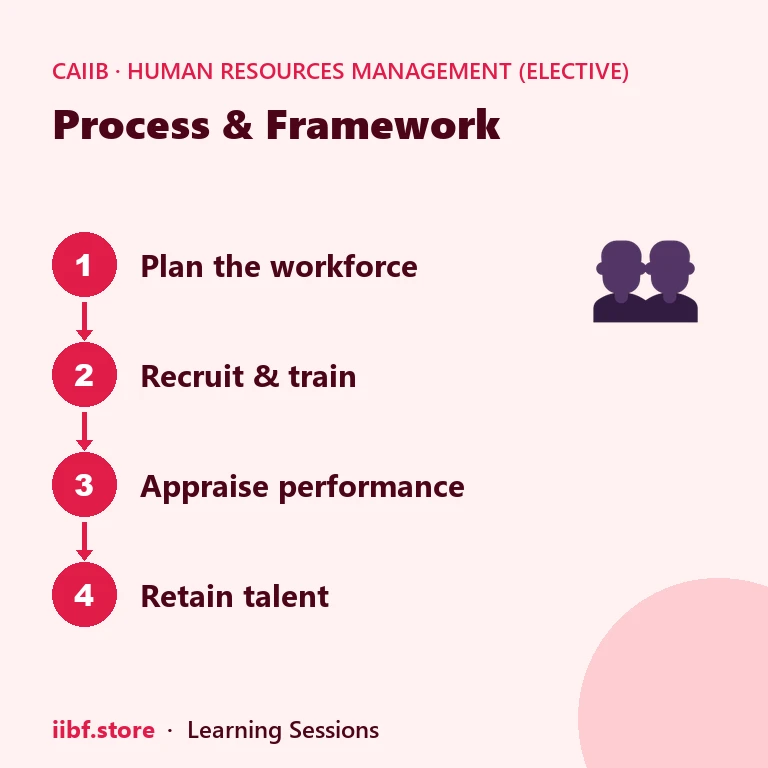
For CAIIB HRM, remember the sequence: identify critical roles, grade talent on the nine-box grid, route approval through the NRC and board, then execute a structured knowledge handover. Each stage has its own failure points, and examiners test all four.
Keep the succession-versus-replacement distinction sharp, and know that RBI expects boards, not HR alone, to own MD and CEO continuity. Practise applying this framework to short bank case studies before your exam.
Ready to test yourself? Explore more Human Resources Management topic articles or try a full CAIIB HRM mock test to check your readiness.
🧠 Practice MCQs: Succession Planning in Banks
Q1. Which board committee typically reviews candidate readiness and recommends succession timelines for the MD and CEO? (a) Audit Committee (b) Nomination and Remuneration Committee (c) Risk Management Committee (d) IT Strategy Committee
Answer: (b) — The NRC evaluates fit-and-proper criteria and readiness before recommending succession decisions to the board.
Q2. In the nine-box grid, an employee rated high on both current performance and future potential is generally classified as: (a) A flight risk (b) A star or top-talent performer (c) A training gap case (d) A retention concern only
Answer: (b) — High performance combined with high potential places the employee in the top talent cell, prioritised for accelerated development.
Q3. What best distinguishes succession planning from emergency replacement planning? (a) Succession planning is reactive and short-term (b) Succession planning is proactive and multi-year (c) Replacement planning always involves the board (d) There is no real difference
Answer: (b) — Succession planning builds pipelines years in advance, while replacement planning reacts only after a vacancy occurs.
Q4. Which practice is LEAST likely to support effective knowledge transfer before retirement? (a) A structured overlap period with the successor (b) Documented decision logs from the outgoing officer (c) Skipping the exit interview to save time (d) Joint client meetings before handover
Answer: (c) — Skipping exit interviews discards valuable undocumented knowledge about risks and relationships.
Q5. Which of the following is a common failure mode in bank succession planning? (a) Reviewing the nine-box grid every year with follow-up actions (b) Building pipelines only for the top one or two roles (c) Aligning succession timing with transfer and promotion policy (d) Documenting every handover in writing
Answer: (b) — Limiting pipeline-building to the very top roles leaves middle management exposed and is a frequent, quietly damaging gap.
Want chapter-wise mock tests with 100+ MCQs? Start practising free →
What is succession planning in banks?
It is the structured process of identifying critical roles, building a ready talent pipeline, and preparing named backups so a bank can replace key leaders, especially the MD and CEO, without operational disruption.
How does the nine-box grid help in succession planning?
It maps each employee's current performance against future potential across nine cells, letting HR prioritise development spend and identify top-talent successors for critical roles.
Who approves succession plans for a bank's MD and CEO?
The Nomination and Remuneration Committee reviews readiness and criteria, then recommends the plan to the full board, which retains final ownership under RBI's governance expectations.
Why does knowledge transfer matter as much as naming a successor?
A successor without the outgoing officer's tacit knowledge, client history, and informal workarounds can still struggle for months, so structured handover periods and exit interviews are essential.
Quick quiz on this topic
5 exam-style questions from our free test bank — check yourself before you move on.
Practice this topic
Take a free mock test, download chapter PDFs, or watch a video class — all included on iibf.store.
Keep reading