Manpower Planning in Banks: Process and CAIIB HRM Focus
Every bank branch that opens on time, every loan desk that is staffed, and every rural outlet that meets its priority-sector targets depends on one quiet HR discipline working correctly in the background: manpower planning in banks. Unlike recruitment drives or training calendars that react to a vacancy, manpower planning is the forward-looking exercise that tells a bank how many people it will need, with what skills, at which location, and by when. For CAIIB HRM Elective candidates, this topic sits at the intersection of HR strategy and day-to-day branch operations, and examiners routinely test the process steps, the difference between manpower planning and related HR activities, and the practical constraints Indian banks face while executing it. This article walks through the concept, the process, the tools, and the common exam traps around manpower planning in banks.
📋 What Is Manpower Planning in Banks?
Manpower planning in banks is the systematic process of forecasting an organisation's future human resource requirements and matching them against the existing workforce, so that gaps can be closed proactively rather than through emergency hiring. It flows directly out of the fundamentals of HRM, where human resources are treated as a planned input to be forecast, budgeted and deployed like any other scarce resource — capital, technology or premises.
In a banking context, manpower planning has to account for factors unique to the industry: branch expansion or rationalisation, digitisation reducing teller-counter headcount while increasing demand for relationship and risk roles, superannuation waves in public sector banks, and regulatory requirements around specialist cadres (credit, treasury, IT, compliance). A good manpower plan therefore covers three linked activities — demand forecasting (how many and what kind of employees will be needed), supply analysis (who is already available internally, including promotable staff and expected attrition), and gap identification (the net shortfall or surplus by cadre, scale and location). This is different from job evaluation, which grades roles for pay purposes, and from workforce engagement metrics, which measure how people feel about their jobs rather than how many are required.
💡 Exam Tip: If a CAIIB question asks you to sequence "forecasting demand → auditing existing supply → gap analysis → action plan," that four-step logic is manpower planning, not recruitment planning — recruitment is only the action step once a gap is confirmed.
🏦 The Manpower Planning Process in Indian Banks
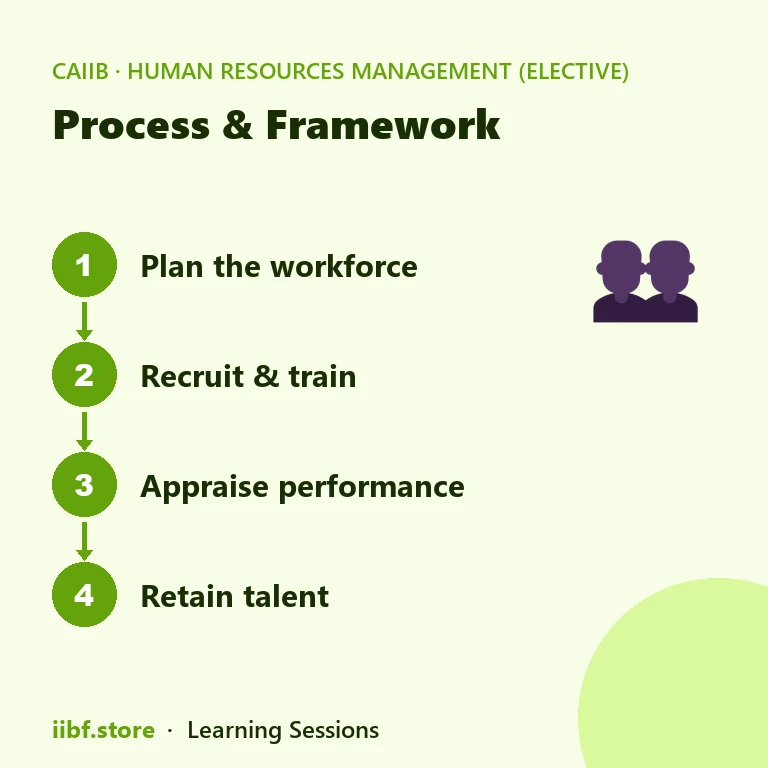
The manpower planning process typically begins with corporate and business plan inputs — branch expansion targets, new digital channels, planned mergers or restructuring — translated into a demand forecast using techniques such as ratio-trend analysis, workload analysis, and managerial judgement. Public sector banks have historically relied on norms-based staffing (a fixed employee-to-business or employee-to-branch ratio) while private banks lean more on productivity-linked, workload-driven models. Both approaches are discussed extensively under HRM in banks and, with sector-specific nuance, under HRM in Indian banks.
Once demand is forecast, the bank audits its existing supply through a skills inventory or HRIS — capturing age profile, scale of officer, specialisation, mobility, and expected retirements over the plan period. The gap between demand and supply is then closed through an action programme that may include fresh recruitment, promotions, lateral transfers, retraining, or in some cases, planned redundancy through voluntary retirement schemes. A distinguishing feature of Indian public sector banking is that a large share of this action programme runs through bipartite-settlement-governed transfer and promotion rules rather than open-market hiring alone, which is why manpower planning outcomes are closely tied to internal mobility policy — the mechanics of which are covered in detail in our piece on transfer and promotion policy in banks.
📌 Remember: Manpower planning is a continuous cycle, not a one-time exercise — banks typically review the plan annually alongside the business plan, with interim course-correction if attrition or business volumes diverge sharply from assumptions.
🧮 Job Analysis, Manpower Budgeting and HR Development Linkage
Manpower planning cannot be done in isolation from job analysis — the systematic study of what a role actually requires in terms of tasks, skills, and reporting relationships. Job analysis feeds both the job description (used in recruitment and appraisal) and the manpower norms used to size a branch or department. This linkage between planning tools and the broader HR development architecture is explored in the chapter on human resource development strategies and systems, which frames manpower planning as one pillar of a wider HRD system alongside training, career planning and performance management.
Manpower budgeting translates the approved manpower plan into a cost figure — projected wage bill, provisioning for retirement benefits, and recruitment cost — which the finance function uses for annual budgeting. In IIBF's CAIIB curriculum, this is where HR strategy visibly meets balance-sheet planning: a bank that under-forecasts attrition in a high-growth year will show both a staff shortage and a wage-bill variance in the same reporting cycle. As per IIBF's published CAIIB HRM Elective syllabus (iibf.org.in), candidates are expected to connect manpower planning outputs to these downstream HR and financial processes rather than treat it as a standalone forecasting exercise.
⚖️ Manpower Planning vs Recruitment, Succession and Training
Exam-setters frequently test whether candidates can distinguish manpower planning from adjacent HR functions that use similar inputs but serve different purposes. Manpower planning answers "how many, of what kind, where and when"; recruitment and selection answers "how do we source and choose the right individual for an already-identified vacancy"; succession-style continuity planning is concerned with readiness for specific leadership and critical roles rather than aggregate headcount; and training programmes build capability in an existing workforce rather than determine its size. The table below summarises the distinction.
| HR Function | Primary Question | Time Horizon | Aggregate Headcount Focus? |
|---|---|---|---|
| Manpower Planning | How many staff, of what type, are needed? | Medium to long term (1-5 years) | ✅ Yes |
| Recruitment & Selection | Who is the right person for this vacancy? | Immediate to short term | ❌ No |
| Career/Continuity Planning | Who is ready for critical future roles? | Long term | ❌ No |
| Training Programmes | How do we build required skills in staff? | Short to medium term | ❌ No |
This distinction also has behavioural roots — how staff perceive redeployment or role changes flowing from a manpower plan is very much a function of workplace attitudes and group dynamics, a theme developed further under organisational behaviour in banks. Similarly, once a manpower gap triggers a promotion round, the fairness of the outcome is judged against documented ratings, a process examined in our article on the performance appraisal system in banks.
⚠️ Common Mistake: Candidates often equate manpower planning with recruitment forecasting alone. Manpower planning also covers redeployment, retraining and even planned reduction — it is a headcount-and-skills balancing exercise, not merely a hiring pipeline.
🧭 Challenges and Best Practices in Indian Banking
Manpower planning in Indian banks faces some structural challenges that examiners like to probe. First, business volumes and staffing needs can shift faster than the annual planning cycle, particularly when a bank scales a specialised lending vertical — for instance, a sudden push into agricultural and rural credit requires officers trained in scheme-based lending, a workforce need closely tied to how scale of finance and crop loan assessment norms are applied at the branch level under DLTC guidance. Second, geographic mismatch is common: metro branches may be overstaffed while rural or semi-urban branches face chronic shortages, especially in specialist cadres. Third, technology-led role redesign means the manpower plan must be revisited whenever a new digital channel materially changes counter-transaction volumes.
Best practice responses include maintaining a live HRIS-based skills inventory rather than a static annual headcount sheet, running scenario-based forecasts (business-as-usual versus aggressive-growth versus consolidation), and building flexibility through cross-training so that staff can be redeployed across cadres without a fresh recruitment cycle. Boards and HR committees in well-run banks review manpower planning MIS quarterly, not just at the start of the financial year, and tie the plan explicitly to the bank's three-year business strategy rather than treating it as a purely administrative HR filing exercise.

🧠 Practice MCQs: Manpower Planning in Banks
Q1. The primary purpose of manpower planning in a bank is to (a) grade jobs for pay fixation (b) forecast future human resource needs and match them against available supply (c) measure employee satisfaction (d) design incentive schemes
Answer: (b) — Manpower planning forecasts demand and audits supply to identify staffing gaps; it is not a pay-grading, engagement, or incentive-design exercise.
Q2. Which of the following is NOT a typical step in the manpower planning process? (a) Demand forecasting (b) Supply analysis through a skills inventory (c) Gap identification (d) Fixing the annual increment percentage
Answer: (d) — Increment fixation is a compensation decision, separate from the demand-supply-gap sequence that defines manpower planning.
Q3. A bank staffing a new agricultural lending vertical needs officers trained in scheme-based crop lending. This illustrates which aspect of manpower planning? (a) Succession readiness (b) Demand forecasting driven by business strategy (c) Wage bill budgeting (d) Grievance redressal
Answer: (b) — A new business vertical changes the skills and headcount required, which manpower planning must forecast ahead of the launch.
Q4. Job analysis primarily supports manpower planning by (a) fixing union wage settlements (b) defining what a role actually requires in tasks and skills, feeding manpower norms (c) scheduling training calendars (d) conducting domestic enquiries
Answer: (b) — Job analysis documents role content, which is the input used to set manpower norms and staffing ratios.
Q5. Which statement about manpower planning is correct? (a) It is a one-time exercise done only at bank incorporation (b) It focuses solely on external recruitment (c) It is a continuous cycle reviewed alongside the business plan (d) It excludes redeployment and retraining as options
Answer: (c) — Manpower planning is reviewed on a recurring basis, typically annually alongside business planning, and includes redeployment and retraining as valid gap-closing actions.
Want chapter-wise mock tests with 100+ MCQs? Start practising free →
Is manpower planning the same as recruitment planning?
No. Manpower planning is the broader exercise of forecasting how many staff of what type are needed and comparing that against existing supply; recruitment is only one of several actions — alongside redeployment, retraining or promotion — used to close a confirmed gap.
What techniques are used for demand forecasting in bank manpower planning?
Common techniques include ratio-trend analysis linking staff numbers to business volumes, workload analysis based on transaction or account counts per employee, and managerial judgement informed by branch expansion or digitisation plans.
How does manpower planning differ across public and private sector banks?
Public sector banks have traditionally used norms-based, ratio-driven staffing tied to bipartite settlements and cadre structures, while private banks tend to use more flexible, productivity- and workload-linked staffing models with faster review cycles.
Why is manpower planning important for CAIIB HRM Elective candidates?
It links several exam themes — HRD systems, job analysis, transfer and promotion policy, and organisational behaviour — into one process, and is frequently tested through sequencing questions and function-comparison questions.
Manpower planning in banks is ultimately the discipline that keeps every other HR process honest: recruitment, promotions, training and even performance appraisal all execute against gaps that a sound manpower plan identifies well in advance. For CAIIB HRM Elective candidates, mastering the demand-supply-gap logic, knowing how it differs from recruitment and succession-style continuity planning, and understanding the Indian banking constraints around it will cover a reliable share of exam questions on this theme. Browse more HRM Elective coverage on the HRM Elective tag hub, and when you are ready to test your recall under exam conditions, work through topic-wise mocks on the CAIIB course page to consolidate this chapter alongside the rest of the elective.
Quick quiz on this topic
5 exam-style questions from our free test bank — check yourself before you move on.
Practice this topic
Take a free mock test, download chapter PDFs, or watch a video class — all included on iibf.store.
Keep reading