Third Party Product Distribution in Banks: Compliance and Controls (BCP)
Every branch manager knows the pressure: a customer walks in for a loan, and the cross-sell target for the quarter is still short. This is exactly where third party product distribution in banks turns from a revenue line into a compliance minefield. Selling insurance, mutual funds and pension products as a corporate agent or distributor is fully permitted business for banks in India — but only inside a tightly fenced set of rules on disclosure, staff qualification, remuneration and non-coercion. For the BCP exam, and for your desk in real life, you need to know exactly where that fence sits and how examiners test whether it has been breached.
Banks do not sell insurance, mutual fund units or National Pension System (NPS) accounts as their own products. They act as an intermediary — a corporate agent for insurance under IRDAI's corporate agency framework, a mutual fund distributor empanelled with AMCs and registered with AMFI, and a Point of Presence (POP) for NPS under PFRDA. That three-regulator reality is the first thing a compliance officer must internalise: the bank is regulated by the RBI as a bank, and simultaneously bound by IRDAI, SEBI/AMFI and PFRDA rules for each product line it distributes.
📋 Board-Approved Policy and the Corporate Agency Structure
No bank can start distributing insurance, mutual funds or pension products on a branch manager's initiative. RBI requires a board-approved policy before a bank undertakes any such third party distribution business. The policy has to spell out which products the bank will distribute, the empanelment and due-diligence process for insurers, AMCs and other product manufacturers, the training and certification requirements for front-line staff, the remuneration structure the bank will disclose to customers, and the grievance-redress mechanism specific to third party sales.
This board oversight is not a one-time formality. The audit committee and the compliance function are expected to periodically review the policy against actual sales practice — target-setting for branches, incentive structures for staff, and the volume of complaints. Because third party distribution is essentially an agency arrangement layered onto the bank's own customer relationships, many compliance teams map it against the same due-diligence discipline used for other outsourced or agency arrangements; if you are revising that broader framework, the piece on outsourcing governance in banks is a useful companion read since several due-diligence and exit-clause principles overlap.
🏷️ Disclosure and the No-Linkage Rule
Two customer-facing obligations sit at the heart of this topic, and both are exam favourites. First, the customer must be told, clearly and in writing wherever possible, that the insurance policy, mutual fund unit or pension account is a third party product — not a bank deposit, not guaranteed by the bank, and not covered by deposit insurance. Verbal assurances that blur this line ("it's basically like an FD, sir") are precisely the kind of mis-selling that regulatory inspections and internal audits are trained to catch.
Second is the prohibition on linking a third party product to a loan or a locker. A bank cannot make the sanction or disbursement of a loan, or the allotment of a safe deposit locker, conditional on the customer buying an insurance policy, mutual fund or any other third party product. This is a forced-selling practice and it is explicitly barred under RBI's customer service directions. The restriction sits close to the broader universe of conditions banks may attach to credit facilities, which is why revisiting Loans and Advances Regulatory Restrictions alongside this topic helps you see the full picture of what a bank may and may not condition a credit sanction on.
⚠️ Common Mistake: Candidates often assume the no-linkage rule only bars an explicit written condition. In practice, examiners and internal auditors also flag disguised linkage — where a loan file shows unusually fast processing right after a policy purchase, or where locker allotment waiting lists mysteriously shorten for insurance buyers.
🎓 Staff Qualification and Remuneration Disclosure
A bank employee cannot sell an insurance policy or a mutual fund purely because they sit at the counter. Staff who solicit or sell insurance on behalf of the bank as a "specified person" must hold the certification prescribed under IRDAI's regulations for corporate agents, renewed periodically through continuing education. Staff distributing mutual funds must be associated with a valid AMFI Registration Number (ARN) and, where they interact directly with investors, an Employee Unique Identification Number (EUIN) issued through the NISM-certified distributor framework. NPS distribution similarly requires POP-registered and trained staff.
Remuneration disclosure is the other limb. Banks earn commission, brokerage or fee income from the insurers, AMCs and pension entities whose products they distribute, and this must be disclosed to the customer — both because it is a regulatory requirement and because commission-linked incentive structures are the single biggest driver of mis-selling risk that internal compliance testing looks for. A staff member pushing a single insurer's high-commission product over a lower-commission but more suitable option is a textbook conflict-of-interest pattern that examiners specifically probe for during branch visits and file reviews.
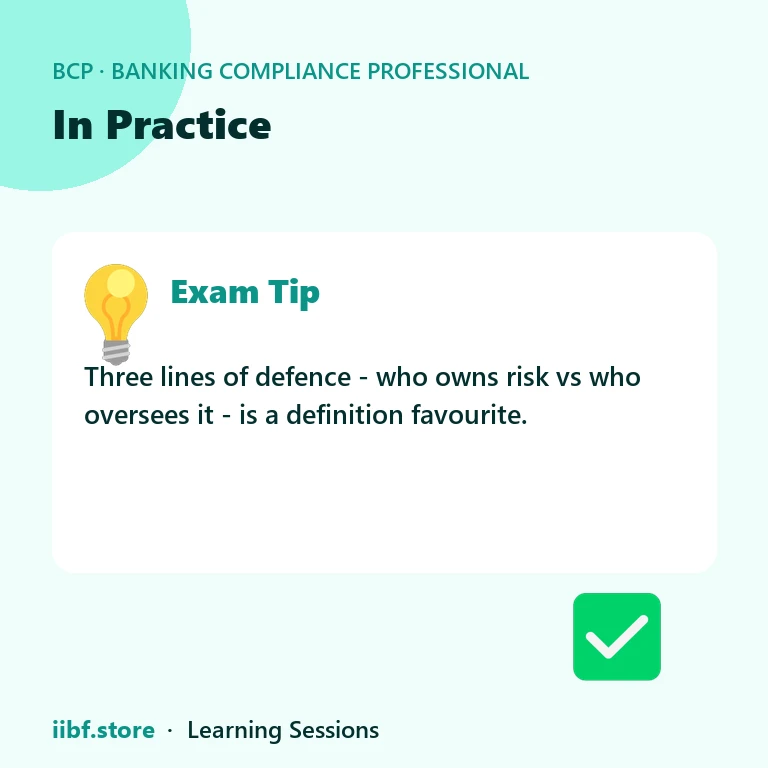
💡 Exam Tip: If a BCP question gives you a scenario with an unusually high commission payout tied to a single insurer, treat it as a conflict-of-interest red flag for compliance testing, not just a sales-performance detail.
🔍 Complaint Handling and Compliance Tests for Mis-selling
Every bank distributing third party products must run a dedicated grievance-redress channel for complaints arising from such sales — separate tracking from ordinary banking complaints, because the root cause and the regulator involved can differ by product. Complaints alleging mis-selling, non-disclosure of the third party nature of a product, or forced linkage to a loan must be escalated through the bank's grievance mechanism and, where unresolved, can reach the bank's internal ombudsman before any external forum. If you need a refresher on how that internal escalation ladder is structured, see internal ombudsman in banks.
Compliance testing for mis-selling typically combines several methods: mystery shopping visits to branches, sample call-back verification to customers who recently bought a third party product (confirming they understood the product was not a deposit and was not linked to any loan), scrutiny of the free-look/cooling-off period cancellation rate, and analysis of complaint trends by branch and by relationship manager. A spike in policy cancellations within the free-look window, or a cluster of complaints from customers who also had a loan sanctioned around the same date, is treated as a strong mis-selling signal requiring root-cause review. Ultimately, none of these controls work without the tone set at the top — a compliance culture where branch leadership visibly discourages forced cross-selling is what the piece on ethical leadership in banks discusses in more depth, and it is directly relevant to why some branches show chronically higher mis-selling complaint ratios than others despite identical written policies.
Priority sector borrowers and first-time bank customers are a particularly sensitive segment for this kind of testing, since they are less likely to push back on a bundled sale at the counter. Compliance teams reviewing distribution practices in rural and semi-urban branches often cross-check this against lending patterns covered under Priority Sector, MSME and Microfinance lending, since forced-selling complaints cluster disproportionately in exactly these loan categories.
| Product Line | Regulator / Registration | Bank's Role | May Be Linked to Loan/Locker? |
|---|---|---|---|
| Life & General Insurance | IRDAI (Corporate Agency Regulations) | Corporate Agent | ❌ No |
| Mutual Funds | SEBI / AMFI (ARN, EUIN) | Distributor | ❌ No |
| National Pension System | PFRDA | Point of Presence (POP) | ❌ No |
| Bank's Own Deposit/Loan Product | RBI | Principal | ✅ N/A — own product, not third party |
📌 Remember: The word "third party" itself is the compliance trigger — the moment the product is manufactured by an insurer, AMC or pension entity rather than the bank, disclosure and no-linkage rules apply automatically, regardless of how the sale is bundled.
✅ Getting the Distribution Model Exam-Ready
For the BCP exam, keep three anchors firm: which regulator governs which product line, what exactly must be disclosed to the customer, and what a compliance test looks for when it hunts mis-selling. In practice, the same three anchors are what protects a bank from enforcement action and reputational damage — a board-approved policy that is followed on the ground, staff who are certified and whose incentives are visible to the customer, and a complaint channel that actually surfaces problems instead of burying them. Revisit the KYC angle too, since customer verification and product suitability checks overlap at the point of sale — see KYC compliance framework for banks for that connection. For the regulatory text itself, the Reserve Bank of India's guidelines on banks acting as corporate agents and distributors are available at rbi.org.in and are worth reading in full before your exam. You can browse more BCP-focused explainers on the Banking Compliance Professional tag hub, and once you've read through this, test your recall with a timed chapter-wise mock at iibf.store/tests.
🧠 Practice MCQs: Third Party Product Distribution in Banks
Q1. A bank distributing insurance policies to customers is acting in which capacity? (a) Underwriter (b) Corporate Agent (c) Reinsurer (d) Trustee
Answer: (b) — Banks distribute insurance under IRDAI's corporate agency framework; they do not underwrite or reinsure the risk themselves.
Q2. Which of the following is required before a bank starts distributing third party mutual fund products? (a) RBI trading license (b) Board-approved policy (c) SEBI merchant banker license (d) No approval needed if AMC agrees
Answer: (b) — RBI requires a board-approved policy covering product selection, staff training, remuneration disclosure and grievance handling before a bank undertakes third party distribution.
Q3. Linking the sanction of a housing loan to compulsory purchase of an insurance policy from the bank's empanelled insurer is: (a) Permitted if disclosed in the loan agreement (b) Permitted only for amounts above Rs 10 lakh (c) Not permitted, as it amounts to forced selling (d) Permitted if the customer signs a consent form
Answer: (c) — Making a loan sanction conditional on buying a third party product is a prohibited forced-selling practice regardless of disclosure or consent documentation.
Q4. A bank employee selling mutual fund units to retail investors and interacting with them directly must hold: (a) Only a bank employee ID (b) An AMFI ARN and, where applicable, an EUIN (c) A stockbroker license (d) A PFRDA POP certificate
Answer: (b) — Mutual fund distribution requires AMFI registration (ARN), and staff directly advising investors need an Employee Unique Identification Number (EUIN).
Q5. Which of the following is a compliance test commonly used to detect mis-selling of third party products? (a) Reviewing the bank's capital adequacy ratio (b) Mystery shopping and post-sale call-back verification (c) Checking the bank's foreign exchange position (d) Reviewing the bank's provisioning coverage ratio
Answer: (b) — Mystery shopping visits and call-back verification with recent buyers are standard techniques compliance teams use to detect forced or mis-sold third party products.
Want chapter-wise mock tests with 100+ MCQs? Start practising free →
❓ Frequently Asked Questions
Can a bank refuse to disburse a sanctioned loan if the customer declines to buy an insurance policy?
No. Once a loan is sanctioned on its own merits, disbursement cannot be made conditional on the customer purchasing a third party insurance or investment product; doing so is a forced-selling violation.
Does the bank guarantee the returns on a third party mutual fund or pension product it distributes?
No. The bank acts only as a distributor or Point of Presence; investment returns, market risk and product performance are entirely the responsibility of the manufacturing insurer, AMC or pension fund, and this must be disclosed to the customer.
Who certifies bank staff who sell insurance products as specified persons?
Staff must complete the certification prescribed under IRDAI's regulations for corporate agents and renew it through periodic continuing education as required by the regulator.
What should a customer do if they believe they were mis-sold a third party product?
They should first raise a complaint through the bank's designated grievance-redress channel for third party products; if unresolved, the matter can be escalated to the bank's internal ombudsman and, subsequently, to the sector regulator concerned.
Practice this topic
Take a free mock test, download chapter PDFs, or watch a video class — all included on iibf.store.
Keep reading