Unhedged Foreign Currency Exposure: RBI Provisioning Rules
A rupee that slides eight per cent in a bad year does not hurt every borrower equally — it wrecks the ones who borrowed in dollars and hedged nothing. That is exactly why the Reserve Bank treats unhedged foreign currency exposure as a credit risk problem sitting on the lending bank's books, and not merely a market risk problem sitting on the borrower's. For the CAIIB Risk Management elective, this is one of the few topics where a single ratio drives both a provisioning slab and a risk-weight add-on, so the numbers are worth memorising cold.
🌐 What Counts as Unhedged Foreign Currency Exposure
The starting point is Foreign Currency Exposure (FCE) — the gross sum of all items on a borrower's balance sheet whose profit and loss impact changes when exchange rates move. External commercial borrowings, foreign currency term loans raised domestically, foreign currency convertible bonds, import payables, export receivables and foreign currency derivative positions all belong here.
UFCE is simply FCE minus the portion covered by an effective hedge. Only two kinds of cover qualify. A financial hedge is a derivative contract booked with a financial institution, properly documented, with hedge effectiveness assessed by the bank. A natural hedge exists only where the borrower has offsetting foreign currency cash flows from its own operations falling within the same accounting year — an exporter's dollar receivables against dollar interest obligations in that year, for instance.
The Directions apply to all commercial banks other than Payments Banks and Regional Rural Banks, and extend to overseas branches and subsidiaries of Indian banks. Certain exposures are carved out: exposures to sovereigns, to other banks and to individuals, exposures already classified as non-performing, hedged intra-group exposures of multinationals incorporated outside India, and derivative or factoring transactions with entities that have no other exposure to the Indian banking system. Everything else — essentially the corporate book — must be assessed. Students revising the wider syllabus should read this alongside the Credit risk chapter, because the entire construct is a credit-quality overlay rather than a treasury control.
💡 Exam Tip: An anticipated export order for next financial year is not a natural hedge. The offsetting cash flow must fall within the same accounting year as the exposure it is claimed against.
📐 Measuring Likely Loss Against EBID
Once UFCE is known, the bank converts it into a rupee number called the likely loss — an estimate of what a severe currency move would cost the borrower. The calculation is deliberately mechanical: likely loss equals UFCE multiplied by the largest annual adverse movement in the USD/INR rate observed over the preceding ten years, using volatility data published by FEDAI. Banks do not get to model their own scenario; the regulator fixed the stress so that comparisons across banks stay meaningful.
That loss is then measured against the borrower's capacity to absorb it. The denominator is EBID, defined as profit after tax plus depreciation plus interest on debt plus lease rentals. The resulting likely loss to EBID ratio, expressed as a percentage, is the single number that decides the regulatory treatment.
Take a mid-sized importer with UFCE of ₹100 crore and EBID of ₹40 crore. If the worst annual USD/INR move in the last decade was 20 per cent, the likely loss is ₹20 crore, and the ratio is 50 per cent. Push EBID down to ₹25 crore and the same exposure yields 80 per cent — the top band. The lesson is that leverage and thin earnings, not exposure size alone, drive the outcome. This deterministic stress sits alongside the probabilistic tools covered in our guide to value at risk models, and the governance scaffolding is set out in the Risk Management Framework chapter.
📊 The Incremental Provisioning and Capital Slabs
The ratio maps onto a five-band grid. Provisioning here is incremental — it is charged over and above the normal standard-asset provision, and it applies to the bank's total credit exposure to that entity, not just the foreign currency portion. Only the top band attracts an additional capital charge.
| Likely Loss / EBID | Incremental provisioning | Extra risk weight? | Add-on |
|---|---|---|---|
| Up to 15% | Nil | ❌ | — |
| Above 15% and up to 30% | 20 bps | ❌ | — |
| Above 30% and up to 50% | 40 bps | ❌ | — |
| Above 50% and up to 75% | 60 bps | ❌ | — |
| Above 75% | 80 bps | ✅ | +25 percentage points on risk weight |
Note how the capital cliff works. A borrower at 74 per cent carries 60 basis points of extra provisioning and nothing more; a borrower at 76 per cent jumps to 80 basis points and a 25 percentage point increase in the risk weight otherwise applicable. If the exposure would normally carry a 100 per cent risk weight, it now carries 125 per cent, inflating risk-weighted assets and depressing the capital ratio.
Because the add-on is expressed in percentage points on top of the applicable weight, you must first know what that base weight is — which is why this topic pairs naturally with the standardised approach for credit risk.
⚠️ Common Mistake: Candidates apply the incremental provision only to the foreign currency loan. It applies to the bank's entire credit exposure to that borrower, rupee facilities included.
🏦 Small Entities, Missing Data and the Punitive Default
Real portfolios contain hundreds of small borrowers who cannot produce audited hedge data. The Directions therefore allow a simplified route: where the total exposure of the banking system to an entity is ₹50 crore or less and that entity is unable to furnish UFCE information, the bank may skip the likely-loss computation entirely and instead apply a flat 10 basis points incremental provision over and above the extant standard-asset provision. No capital add-on arises under this route.
The concession stops there. For any entity above that ₹50 crore threshold, silence is expensive. If the bank cannot obtain UFCE information, it must place the exposure in the harshest band — 80 basis points of incremental provisioning plus the 25 percentage point risk-weight increase — as though the borrower had already breached 75 per cent. That default is designed to make data collection cheaper than non-compliance, and in practice it turns UFCE disclosure into a standing covenant in sanction letters.
This behavioural design mirrors other prudential nudges you will meet across the elective, where the cost of an information gap is deliberately set above the cost of closing it. Keep an eye on the current RBI rates and prudential updates page, since the underlying volatility inputs and standard-asset provisioning rates both shift over time.
🛡️ Building UFCE Into the Bank's Risk Architecture
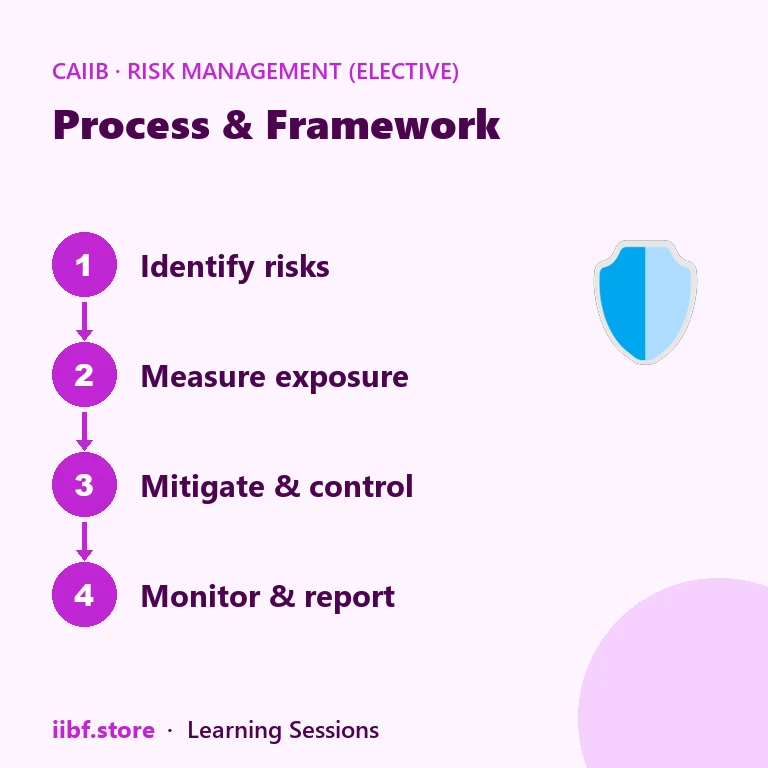
Compliance is a process, not a year-end calculation. Banks must compute incremental provisioning and capital requirements at least quarterly, drawing on UFCE information obtained from borrowers, with the data supported by audited annual accounts and, at least annually, certified by the entity's statutory auditors. Internal audit is expected to test both the collection and the computation.
The requirement bites at three points in the credit cycle. At appraisal, the projected likely loss to EBID ratio should feed pricing and structuring, since a borrower sitting near the 75 per cent cliff is materially more expensive to carry. At documentation, hedging covenants and periodic UFCE reporting obligations are the practical remedy. At monitoring, a slide in EBID can push a previously clean account into a provisioning band without any change in the loan itself.
There is a small offset on the capital side: incremental provisions made for unhedged foreign currency exposures qualify for inclusion in Tier 2 capital, along with other general provisions, subject to the overall ceiling of 1.25 per cent of credit risk-weighted assets under the standardised approach. Board and ALCO reporting should show the portfolio distribution across the five bands, not just the aggregate charge — a discipline parallel to the balance-sheet work in our note on asset liability management in banks, and to the resilience planning covered in business continuity planning in banks. The hedging instruments themselves are dealt with in the DERIVATIVES AND RISK MANAGEMENT chapter, and the full primary text sits among the RBI Master Directions.
📌 Remember: Small entity relief needs two conditions together — banking system exposure of ₹50 crore or less and inability to furnish UFCE data. Above that threshold, missing data means the top band.
🧠 Practice MCQs: Unhedged Foreign Currency Exposure
Q1. A borrower's likely loss works out to 62% of EBID. What incremental provisioning must the bank make on its total credit exposure to that borrower? (a) 20 bps (b) 40 bps (c) 60 bps (d) 80 bps
Answer: (c) — The band "above 50% and up to 75%" attracts 60 basis points of incremental provisioning.
Q2. The additional risk weight of 25 percentage points is triggered when the likely loss to EBID ratio exceeds: (a) 30% (b) 50% (c) 75% (d) 100%
Answer: (c) — Only the top band, above 75%, carries both 80 bps provisioning and the 25 percentage point risk-weight add-on.
Q3. Which of the following qualifies as a natural hedge? (a) A forward contract booked with a bank (b) Offsetting foreign currency cash flows from operations within the same accounting year (c) An expected export order in the next financial year (d) Foreign currency deposits held personally by the promoter
Answer: (b) — A natural hedge requires operational cash flows that offset within the same accounting year; option (a) is a financial hedge.
Q4. The simplified 10 bps incremental provisioning route is available for entities whose total exposure to the banking system is: (a) ₹5 crore or less (b) ₹25 crore or less (c) ₹50 crore or less (d) ₹100 crore or less
Answer: (c) — Entities with banking system exposure of ₹50 crore or less that cannot furnish UFCE data may be charged a flat 10 bps instead.
Q5. EBID for this computation is defined as: (a) Profit after tax plus depreciation plus interest on debt plus lease rentals (b) Profit before tax plus interest only (c) EBITDA less current tax (d) Operating profit plus provisions written back
Answer: (a) — EBID adds back depreciation, interest on debt and lease rentals to profit after tax.
Want chapter-wise mock tests with 100+ MCQs? Start practising free →
❓ Frequently Asked Questions
Which banks and which exposures are covered by the UFCE norms?
All commercial banks except Payments Banks and Regional Rural Banks are covered, including their overseas branches and subsidiaries. Exposures to sovereigns, banks and individuals are excluded, as are non-performing assets, appropriately hedged intra-group exposures of multinationals incorporated outside India, and derivative or factoring transactions with entities having no other Indian banking system exposure.
How often must a bank compute the provisioning and capital requirement?
Incremental provisioning and capital requirements must be computed at least on a quarterly basis. The underlying UFCE information should be obtained from the borrower and supported by audited annual accounts, with statutory auditor certification at least once a year.
Does the incremental provision give any capital benefit?
Yes. Incremental provisions on unhedged exposures are treated like other general provisions and qualify for inclusion in Tier 2 capital. The inclusion is capped, together with other eligible general provisions, at 1.25 per cent of total credit risk-weighted assets under the standardised approach.
What happens if a large borrower simply refuses to share UFCE data?
Where banking system exposure exceeds ₹50 crore and UFCE information is unavailable, the bank must apply the harshest treatment — 80 basis points of incremental provisioning and a 25 percentage point increase in the applicable risk weight. This is why hedging and disclosure covenants are now standard in sanction terms.
Take this into your CAIIB preparation
Learn the five bands, the two hedge definitions and the ₹50 crore threshold, and this topic becomes free marks in the elective paper. Reinforce it with the full chapter set and mock papers on the CAIIB course page, and browse more revision notes under the Risk Management elective tag hub.
Practice this topic
Take a free mock test, download chapter PDFs, or watch a video class — all included on iibf.store.
Keep reading