UPI Payment System Explained: NPCI Architecture, PSPs and Security for CAIIB
The UPI payment system has become the single most important topic in the Information Technology & Digital Banking (ITDB) paper of CAIIB, and for good reason: it now processes the overwhelming majority of retail digital transactions in India and touches every part of modern banking operations. When you sit down to answer questions in the exam, you are not merely reciting definitions — you are demonstrating that you understand how money moves in real time across banks without any physical clearing, how the National Payments Corporation of India (NPCI) governs the rails, and how each participant in the ecosystem is bound by rules issued by the regulator. This article walks you through the architecture, the settlement mechanics, the security layers and the newer flavours such as UPI AutoPay and UPI Lite, all framed in the way ITDB examiners expect a competent banker to explain them. 📌 Keep a notebook of the abbreviations as you read, because ITDB rewards precision more than any other CAIIB paper.
🏦 How the UPI architecture actually works
At its heart, the Unified Payments Interface is an application programming interface layer that sits on top of the Immediate Payment Service (IMPS) rails and lets any participating bank talk to any other participating bank instantly. When a customer opens a UPI application, the app is technically a Third Party Application Provider, or TPAP, and it must ride on the licence of a sponsor bank known as the Payment Service Provider, or PSP. This distinction matters enormously in the exam: the TPAP is the consumer-facing brand you recognise, but the PSP bank is the regulated entity that holds the relationship with NPCI and carries the compliance burden. A customer's identity in this system is expressed as a Virtual Payment Address, or VPA — the human-friendly handle such as name@bankhandle — which deliberately hides the underlying account number and IFSC so that no sensitive credential is ever shared during a payment.
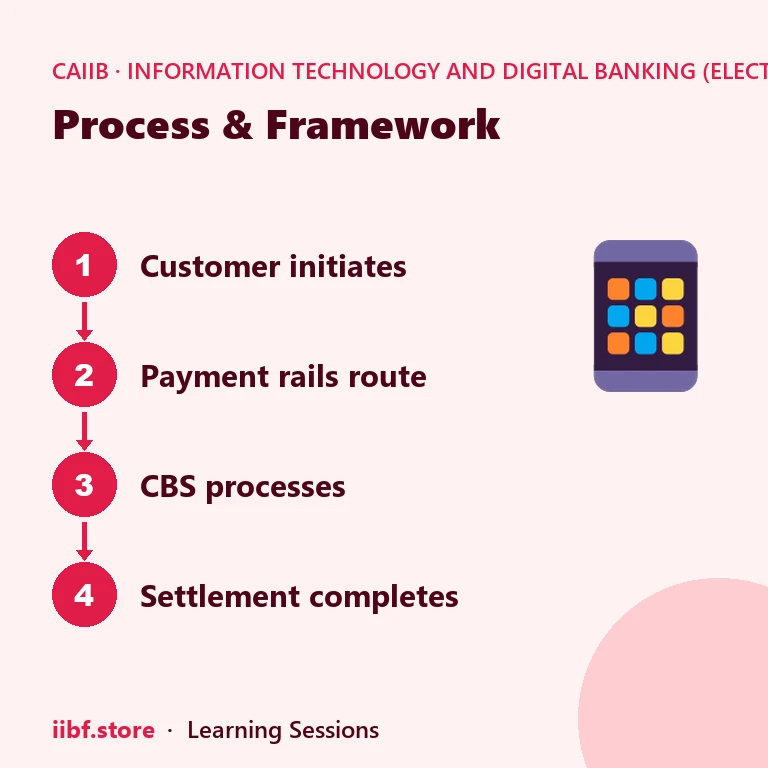
The flow of a single transaction is elegant once you internalise it. The payer initiates a request through the app, the request travels to the payer's PSP, then to the NPCI switch, which routes it to the beneficiary's PSP and finally to the beneficiary bank for crediting. Behind the scenes, the actual inter-bank obligation is netted and settled through the Reserve Bank of India's settlement systems, which is why UPI is considered a deferred net settlement overlay on top of instant messaging. ✅ Understanding that the messaging is instant while the settlement is netted is exactly the kind of nuance that separates a pass from a distinction. NPCI operates the central switch, defines the message formats, sets transaction limits, and arbitrates disputes, so treat NPCI as the operating heart of the whole design whenever a question asks who is responsible for a particular function.
⚖️ The players: NPCI, PSP, TPAP and the VPA
To answer ITDB questions confidently you must be able to describe each participant's role without hesitation. NPCI is the umbrella organisation that owns and operates the UPI platform along with RuPay, IMPS, AePS and the National Automated Clearing House; it is a not-for-profit company promoted by a consortium of banks under the guidance of the RBI and the Indian Banks' Association. The PSP bank is any bank that has been permitted by NPCI to offer UPI, and it is the entity that generates and validates the VPA, applies the two-factor authentication, and settles funds. The TPAP is the technology company whose slick interface most customers actually use, but crucially it cannot settle money on its own — it is always tethered to one or more PSP banks. ⚠️ A very common trap in the exam is to conflate the TPAP with the PSP; remember that the app you tap is rarely the bank that settles the money.
The Virtual Payment Address deserves special attention because it is the privacy cornerstone of the design. By replacing the account number and IFSC with a simple alias, UPI ensures that even if you send your handle to a stranger, they cannot derive your account details, cannot pull money without your explicit approval, and cannot see your balance. This tokenisation of identity, combined with the collect-versus-pay distinction — where a pay request pushes money out and a collect request asks someone to authorise a debit — is a favourite examiner theme. If you can explain why collect requests carry higher fraud risk than pay requests, and why NPCI has therefore tightened limits on collect calls from unverified entities, you will be demonstrating exactly the applied judgement the paper is testing. To reinforce this, work through a few scenario questions from a caiib mock test free set so the roles become second nature under time pressure.
🔑 Security, 2FA, and the newer variants
Security in UPI rests on a mandatory two-factor authentication model that the RBI insists upon for every debit. The first factor is possession of the registered mobile device, verified through a device-binding SMS at registration, and the second factor is the UPI PIN that the customer sets and that never leaves the secure element of the phone. Because the PIN is required for every payment and because the device is cryptographically bound to the account, a fraudster who merely knows your VPA still cannot move a single rupee. This is why examiners stress that UPI's security is procedural as much as technological: the customer must be educated never to enter a PIN to receive money, since receiving never requires authentication. 💡 A large share of UPI fraud is social engineering that tricks users into approving collect requests, not any breakdown of the cryptography itself.
The platform has also grown new capabilities that ITDB now examines directly. UPI AutoPay lets a customer set up a recurring electronic mandate for subscriptions, utility bills, insurance premiums and SIP investments, with the bank auto-debiting up to a defined cap on a schedule while still requiring authentication for amounts above the threshold. UPI Lite, by contrast, tackles the problem of small-value transaction congestion on core banking systems by creating an on-device wallet that settles tiny payments without hitting the bank's core in real time, dramatically reducing the load and speeding up low-value spends. Understanding the trade-off — that UPI Lite sacrifices a real-time core-banking record for speed and does not send an SMS for each micro-payment — shows the graders you grasp why the feature exists. For deeper structured revision, pair your reading with downloadable caiib pdf notes and rehearse the settlement flow until you can draw it from memory.
| Feature | What it does | Exam angle |
|---|---|---|
| VPA | Alias hiding account number/IFSC ✅ | Privacy & tokenisation |
| PSP bank | Regulated settling entity | Compliance owner |
| TPAP | Consumer-facing app on PSP licence | Cannot settle alone ⚠️ |
| UPI AutoPay | Recurring e-mandate debits | Subscriptions, SIPs |
| UPI Lite | On-device small-value wallet | Reduces core-banking load |
📈 Why UPI dominates the exam and how to score it
UPI keeps growing in exam weight because it keeps growing in real life, and the ITDB syllabus is deliberately kept current with the payments landscape. Every year the RBI and NPCI announce fresh limits, new use cases such as UPI on credit lines, cross-border UPI corridors, and interoperability rules, and the exam quietly folds these into fresh questions. The practical way to stay ahead is to treat the payments news cycle as part of your syllabus rather than a distraction, noting each change in a running revision sheet. When you write your answers, anchor every claim to a governing body: if a limit changed, it changed because NPCI issued a circular; if a security norm applies, it applies because the RBI mandated it. This habit of attributing rules to their source is precisely the professional reflex that distinguishes a banker's answer from a layperson's.
From a preparation standpoint, the highest-yield strategy is repetition against realistic questions, because the concepts here are simple individually but easy to confuse under time pressure. Rotate between reading the architecture, drawing the transaction flow, and then testing yourself, and you will find recall becomes automatic. Build the digital-banking module into your wider CAIIB plan by enrolling through the CAIIB course, then stress-test your knowledge on the practice tests, browse related explainers on the blog, and even take a lighter revision break with a quick round on match games. If you are choosing a study companion, many aspirants rate the best app for jaiib caiib preparation precisely because it turns this dense ITDB material into short, testable chunks you can revise on the move.
- ✅ NPCI operates the UPI switch; the PSP bank settles; the TPAP is only the front-end app.
- ✅ The VPA hides account number and IFSC — tokenised identity is the privacy core.
- ✅ Every debit needs 2FA (device binding + UPI PIN); receiving money never needs a PIN.
- ✅ UPI AutoPay enables recurring mandates; UPI Lite offloads small-value payments from the core.
- ✅ Attribute every rule to NPCI or the RBI when you write exam answers.
Is UPI the same as IMPS?
No. IMPS provides the underlying instant inter-bank transfer rails, while UPI is an API layer on top that adds the VPA, a single unified interface across banks, and 2FA authentication through a mobile app. UPI makes IMPS-style instant transfers vastly simpler for the end user.
Can a TPAP hold or settle my money?
No. A Third Party Application Provider is only the consumer-facing app. It must operate on the licence of a sponsor Payment Service Provider bank, and it is that PSP bank — not the app — that actually validates the VPA, applies authentication and settles funds through NPCI.
Why does UPI Lite not send an SMS for every payment?
UPI Lite creates a small on-device wallet so that low-value transactions settle without hitting the bank's core banking system in real time. This reduces load and speeds up micro-payments, but the trade-off is that individual Lite transactions do not generate a per-payment bank SMS.
How does UPI AutoPay stay secure for recurring debits?
The customer authorises an electronic mandate once, defining a cap and frequency. Debits within the cap are auto-processed, but any amount above the pre-set threshold still requires explicit 2FA approval, so the recurring facility never becomes an open-ended authority to drain the account.
🎯 Conclusion
Master the UPI payment system by learning the roles cold, drawing the flow from memory, and attributing every rule to NPCI or the RBI, and the ITDB paper becomes one of your strongest scoring areas rather than a source of anxiety. Put the theory to work now: attempt a full set on the CAIIB practice tests and structure your revision through the CAIIB course so every concept here is reinforced with realistic questions.
Quick quiz on this topic
5 exam-style questions from our free test bank — check yourself before you move on.
Practice this topic
Take a free mock test, download chapter PDFs, or watch a video class — all included on iibf.store.
Keep reading