AI in Banking: CAIIB ITDB Guide to Digital Banking
AI in banking is now a core theme of the CAIIB elective paper Information Technology and Digital Banking (ITDB), and understanding it is essential for anyone appearing in 2026. Indian banks have moved far beyond branch computerisation: they run cloud-hosted core banking systems, process billions of UPI transactions a month, expose services through open APIs, and deploy artificial intelligence and machine learning for fraud detection, credit scoring, and customer service. This guide walks through the technology stack an ITDB candidate must know, links each concept to the regulatory framework laid down by the Reserve Bank of India, and shows how AI and ML sit on top of core banking, UPI, API banking, and cloud infrastructure while staying compliant with the Digital Personal Data Protection (DPDP) Act, 2023.
Core Banking Systems: The Foundation of Digital Banking
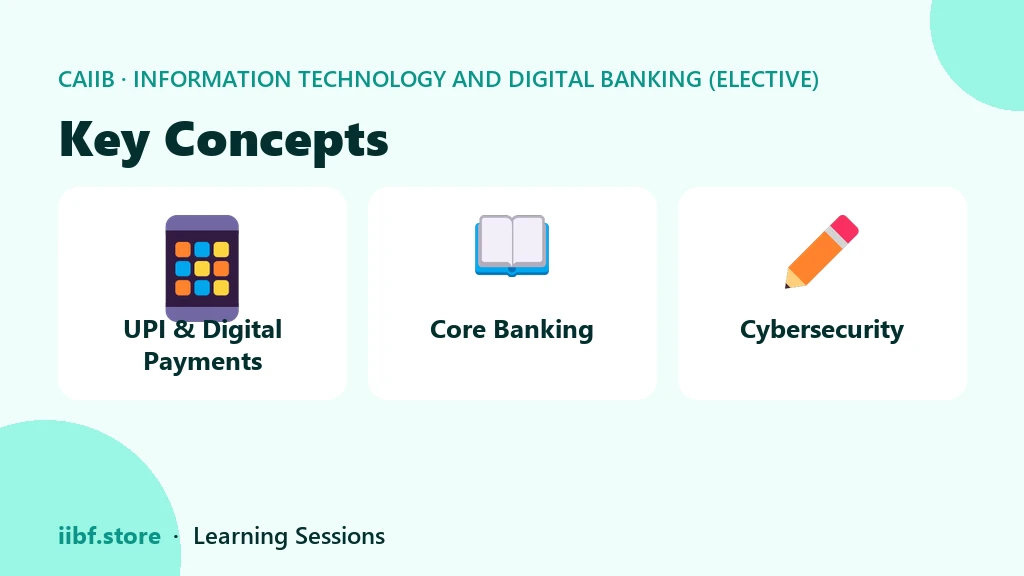
Every digital service a customer touches ultimately writes to a Core Banking System (CBS). A CBS is the centralised software that maintains customer accounts, processes deposits and withdrawals, calculates interest, and posts transactions to a single ledger in real time. CBS stands for Centralised Online Real-time Environment, which is why a customer of a bank can transact at any branch or channel, not just the home branch where the account was opened. Popular platforms in India include Finacle, Flexcube, and BaNCS, and public-sector banks completed near-universal CBS coverage more than a decade ago.
For the ITDB exam, remember that CBS is the system of record around which everything else is built. Channels such as internet banking, mobile apps, ATMs, and UPI are all front-ends that send instructions to the CBS. Middleware and API gateways translate those instructions. When you deploy AI in banking, the models are trained on data extracted from the CBS and its data warehouse, and their outputs (a fraud alert, a credit decision, a next-best-offer) feed back into the same channels. A strong CBS with clean, well-governed data is therefore a precondition for reliable AI. Candidates should also know the difference between the transaction-processing side of CBS and the analytical data lake or warehouse that feeds machine learning, because banks deliberately separate the two to protect live systems from heavy analytical workloads.
UPI and API Banking: Rails for Real-Time Payments
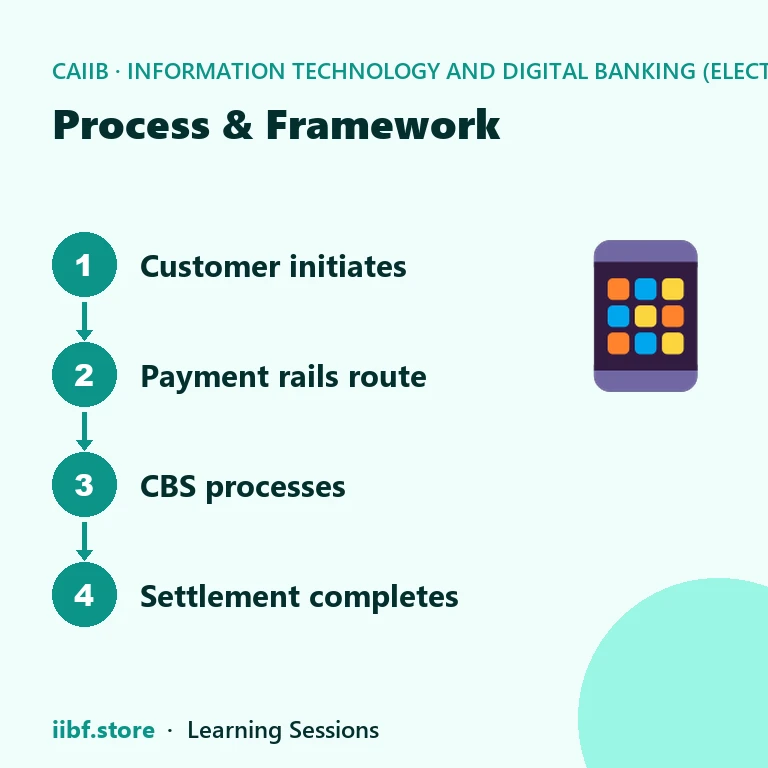
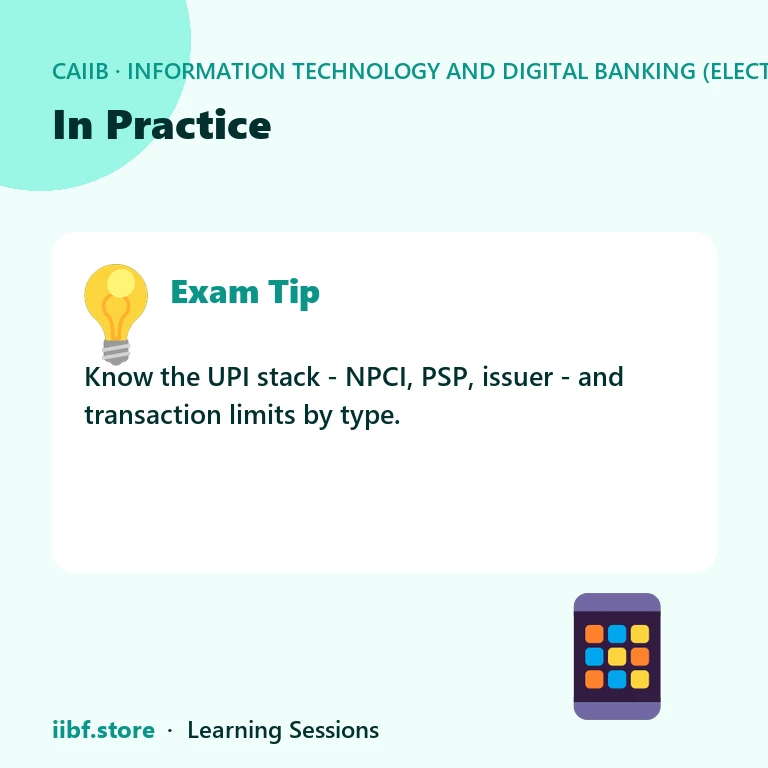
The Unified Payments Interface (UPI), built and operated by the National Payments Corporation of India (NPCI), is the world's largest real-time retail payment system and a favourite ITDB topic. UPI lets a customer link multiple bank accounts to a single mobile app, send money instantly using a Virtual Payment Address (VPA) or QR code, and authorise the transaction with a UPI PIN, all without sharing account numbers. It runs on an Immediate Payment Service (IMPS) backbone and settles round the clock. Features candidates must know include UPI AutoPay for recurring mandates, UPI Lite for small-value offline-style payments, UPI 123Pay for feature phones, and the interoperability that lets any app talk to any bank.
UPI is possible only because of API banking. An Application Programming Interface is a standard contract that lets two software systems exchange data securely. Banks expose APIs so that third-party apps, fintechs, and NPCI can initiate payments, check balances, and verify accounts without direct database access. This model, often called open banking, is governed by RBI guidelines on outsourcing, customer consent, and security. The Account Aggregator framework is a good example: with explicit consent, a customer's financial data flows through consent-driven APIs to a lender who can then use AI in banking to assess creditworthiness in minutes. For the exam, connect the dots: UPI rides on APIs, APIs demand strong authentication and consent, and AI/ML models consume the resulting transaction streams to detect fraud in real time. You can revise these payment concepts alongside our CAIIB material and test yourself on practice tests.
AI and Machine Learning Use Cases in Banking
Artificial Intelligence is the ability of machines to perform tasks that normally need human intelligence, while Machine Learning is the subset that learns patterns from data without being explicitly programmed. In Indian banking, AI in banking has moved from pilots to production across several use cases the ITDB syllabus expects you to list and explain:
- Fraud detection: ML models score every transaction in milliseconds, flagging anomalies such as unusual location, device, or amount, and are central to curbing UPI and card fraud.
- Credit underwriting: alternative-data models assess thin-file borrowers using cash-flow and bureau data, speeding up small-ticket and MSME lending.
- Chatbots and virtual assistants: natural-language systems handle balance queries, card blocking, and FAQs, reducing call-centre load.
- Anti-money-laundering (AML): models reduce false positives in transaction monitoring and help meet KYC/AML obligations.
- Personalisation: recommendation engines suggest products, while robo-advisory guides investments.
The RBI has taken this seriously enough to constitute a committee to develop a Framework for Responsible and Ethical Enablement of Artificial Intelligence (FREE-AI) in the financial sector, signalling that supervisors want innovation balanced with fairness, transparency, and accountability. For exam answers, always pair a use case with its risks: model bias, explainability (why a loan was refused), data quality, and the need for human oversight in high-stakes decisions. Understanding both the upside and the guardrails is exactly what examiners reward. Reinforce these concepts with our match game for quick recall.
DPDP Act 2023 and Cloud: Data, Privacy and Compliance
AI is only as trustworthy as the data governance behind it, which is why the Digital Personal Data Protection (DPDP) Act, 2023 is a must-know for ITDB. The Act is India's first comprehensive personal-data-protection law. It applies to the processing of digital personal data, requires consent as a primary lawful basis, and introduces key roles: the Data Principal (the individual whose data it is), the Data Fiduciary (the entity deciding how and why data is processed, such as a bank), and the Data Processor. It mandates purpose limitation, data minimisation, breach notification, and grants individuals rights to access, correction, and erasure, with a Data Protection Board to enforce compliance. Banks building AI models must ensure training data is collected with valid consent and used only for stated purposes.
Cloud computing is the delivery of computing services (servers, storage, databases, and AI platforms) over the internet on a pay-as-you-use basis, across public, private, and hybrid models. Indian banks increasingly run analytics and AI workloads on cloud because it offers elastic scale for training large models. However, RBI expects banks to retain accountability under its outsourcing and IT governance guidelines, ensure data localisation where required, and manage concentration and exit risks. For the exam, tie the threads together: cloud gives the horsepower for AI in banking, DPDP governs the personal data those models use, and RBI supervision keeps the whole stack safe and resilient. Keep current with rules using our IIBF news and RBI rates resources, and read more explainers on the blog.
Frequently Asked Questions
What is AI in banking in simple terms?
AI in banking means using artificial intelligence and machine learning to perform tasks like detecting fraud, scoring credit, answering customer queries via chatbots, and personalising products. The models learn from transaction and customer data drawn from the core banking system and act in real time across digital channels.
How does UPI relate to API banking for the ITDB exam?
UPI is a real-time payment system operated by NPCI that runs entirely on APIs. Banks expose secure APIs so apps and NPCI can initiate payments and verify accounts with customer consent. So UPI is essentially API banking in action, and both generate the data streams that AI models monitor for fraud.
What is the DPDP Act 2023 and why does it matter for AI?
The Digital Personal Data Protection Act, 2023 is India's data-protection law. It defines roles like Data Principal and Data Fiduciary, requires consent, purpose limitation, and breach notification, and grants individuals data rights. AI models must be trained on data collected with valid consent and used only for stated purposes.
Is ITDB a compulsory CAIIB paper?
Information Technology and Digital Banking is one of the CAIIB elective papers, not compulsory. Candidates choose it alongside the core papers. Always confirm the current paper structure on the official IIBF website, as the syllabus and elective options are updated periodically.
To sum up, mastering AI in banking for the CAIIB ITDB paper means connecting core banking, UPI, API banking, AI/ML use cases, the DPDP Act 2023, and cloud into one coherent story of modern digital banking governed by RBI. Study each layer, understand both its benefits and its risks, and practise applying the concepts to scenario questions. Ready to test your readiness? Attempt a full set of exam-style questions on our CAIIB practice tests and structure your revision with the complete CAIIB course. Verify every framework detail against the official IIBF syllabus before your exam day.
Quick quiz on this topic
5 exam-style questions from our free test bank — check yourself before you move on.
Practice this topic
Take a free mock test, download chapter PDFs, or watch a video class — all included on iibf.store.
Keep reading