Agricultural Credit Delivery System: CAIIB Rural Banking 2026
India's agricultural credit delivery system is the backbone that connects institutional finance to the farm gate, and CAIIB Rural Banking candidates must know how it works end to end. From cooperative banks and regional rural banks to commercial banks and NABARD's refinance window, the system exists to make timely, adequate and affordable credit reach farmers and allied activities. This article maps the institutional architecture, the flow of funds, and the exam-relevant policy touchpoints you need for the CAIIB 2026 exam.
🌾 What Is the Agricultural Credit Delivery System?
The agricultural credit delivery system in India is a multi-agency structure designed after decades of policy evolution, starting with the nationalisation of banks and the Lead Bank Scheme. Its objective is simple: ensure short-term crop loans and long-term investment credit reach farmers without excessive delay or collateral burden. The system rests on three pillars — cooperative credit institutions, regional rural banks (RRBs), and commercial banks — with NABARD acting as the apex refinancing and supervisory body. Each pillar serves a distinct geography and client profile, which is why the exam frequently tests candidates on which institution handles which segment. Understanding the rural economic base that this system serves is equally important; the agriculture economy chapter explains the production and income patterns that shape credit demand. Without a clear institutional map, it is easy to confuse the roles of cooperatives versus RRBs in exam scenarios, so treat this section as your foundation before moving to policy detail.
🏦 Institutional Structure: Cooperatives, RRBs and Commercial Banks
Short-term cooperative credit flows through a three-tier structure — State Cooperative Banks, District Central Cooperative Banks, and Primary Agricultural Credit Societies (PACS) — while long-term investment credit runs through State Cooperative Agriculture and Rural Development Banks. RRBs, sponsored by commercial banks and owned jointly with state governments, focus on small and marginal farmers in their notified districts. Commercial banks, including public sector and private banks, dominate volume-wise disbursement and are bound by priority sector lending sub-targets for agriculture. The table below is a quick exam-ready comparison of these channels.
| Institution | Primary Focus | Refinance Source | Rural-Only Mandate |
|---|---|---|---|
| PACS / Cooperative Banks | Short-term crop loans | NABARD via State Co-op Bank | ✅ Yes |
| Regional Rural Banks | Small & marginal farmers | NABARD / Sponsor Bank | ✅ Yes |
| Commercial Banks | Volume-led agri & agri-allied credit | Own resources / NABARD refinance | ❌ No |
| Small Finance Banks | Underserved & unbanked segments | Own resources | ❌ No |
💡 Exam Tip: PACS handle short-term credit, while SCARDBs handle long-term investment credit — the exam often swaps these two to test attentiveness.
📈 NABARD's Role in Refinance and Rural Development Policies
NABARD was set up to consolidate refinance and developmental functions that were earlier scattered across the RBI and other institutions. It refinances cooperative banks, RRBs and commercial banks for both short-term and long-term agricultural lending, and it also runs the Rural Infrastructure Development Fund (RIDF) that finances irrigation, rural roads and warehousing. Beyond refinance, NABARD frames the annual Potential Linked Credit Plans that district-level bankers use to fix agriculture credit targets, and it supervises cooperative banks and RRBs jointly with the RBI. This developmental mandate connects directly with government-led rural development policies, which candidates should study alongside the credit delivery mechanism — see the rural development policies chapter for the full policy landscape. For the latest refinance and priority sector lending master directions, always cross-check the primary source at rbi.org.in notifications rather than relying on last year's figures.
🔄 Credit Flow: From KCC to SHG-Bank Linkage
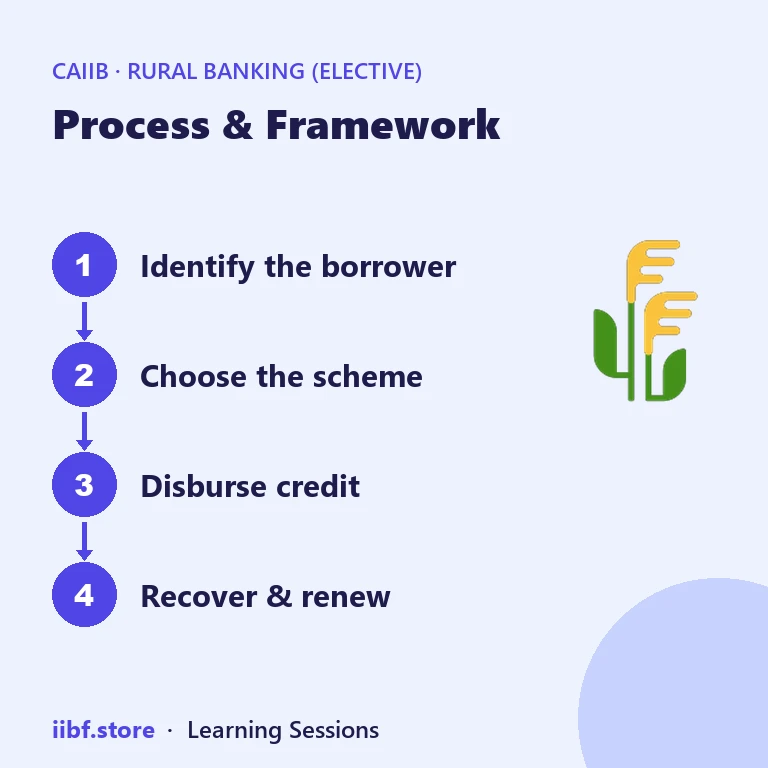
Two delivery mechanisms make the agricultural credit delivery system operationally efficient at the ground level. The first is the Kisan Credit Card scheme, a single-window product that bundles crop loan, working capital for allied activities, and consumption needs into one revolving limit. The second is the SHG-Bank Linkage model, where informal self-help groups build a savings and credit history before graduating to direct bank credit, dramatically cutting transaction costs for both farmers and lenders. Both mechanisms depend on ground realities described in the characteristics of rural society chapter, since social structure and group cohesion directly affect repayment discipline. Candidates should also connect this to broader PSL norms in India, since agriculture credit disbursed through KCC and SHG linkage counts towards priority sector targets.
⚠️ Common Mistake: Candidates often assume SHG-Bank Linkage is only a microfinance tool — in the CAIIB syllabus it is explicitly part of the agricultural and rural credit delivery framework, not a standalone topic.
🚧 Challenges Facing Agricultural Credit Delivery
Despite institutional depth, the system faces recurring friction points that examiners like to probe. Rural infrastructure gaps — poor connectivity, inadequate storage and weak market linkages — raise the cost of last-mile delivery, a theme covered in the infrastructure chapter. Overlapping jurisdiction between cooperatives, RRBs and commercial banks sometimes causes multiple financing of the same borrower, while seasonal repayment cycles and climate risk make agricultural NPAs more volatile than other loan books. Financial literacy and documentation gaps among small and marginal farmers also slow disbursement, an issue tied closely to broader issues concerning rural areas. On the digital side, the shift toward e-KCC renewals and account aggregator-based credit assessment is gradually easing some of these frictions, echoing the broader push covered under digital banking products rural banking and the wider API banking in India infrastructure that increasingly underpins rural loan origination.
📌 Remember: Agricultural NPAs are cyclical and weather-linked — restructuring and moratorium provisions differ from standard commercial loan norms.
🧠 Practice MCQs: Agricultural Credit Delivery System
Q1. Which institution provides short-term crop loans at the village level in the cooperative structure? (a) State Cooperative Bank (b) District Central Cooperative Bank (c) Primary Agricultural Credit Society (d) NABARD
Answer: (c) — PACS is the village-level unit of the short-term cooperative credit structure that lends directly to farmers.
Q2. Regional Rural Banks are primarily meant to serve which borrower segment? (a) Large corporate farmers only (b) Small and marginal farmers and rural artisans (c) Urban retail customers (d) Export-oriented agri businesses
Answer: (b) — RRBs were created specifically to extend credit to small and marginal farmers, agricultural labourers and rural artisans.
Q3. NABARD's Rural Infrastructure Development Fund (RIDF) is primarily used to finance which of the following? (a) Urban housing loans (b) Irrigation, rural roads and warehousing projects (c) Stock market investments (d) Corporate bond purchases
Answer: (b) — RIDF finances rural infrastructure such as irrigation, rural connectivity and storage/warehousing.
Q4. In the SHG-Bank Linkage model, what typically happens before a group receives direct bank credit? (a) Immediate large-ticket loan disbursement (b) A track record of regular internal savings and rotation of funds (c) Mandatory collateral of immovable property (d) A minimum turnover certificate from a chartered accountant
Answer: (b) — SHGs build a savings and internal lending history first, which banks use as a proxy credit assessment before linkage.
Q5. Long-term investment credit for agriculture in the cooperative structure is primarily channelled through which institution? (a) Primary Agricultural Credit Society (b) State Cooperative Agriculture and Rural Development Bank (c) Regional Rural Bank (d) Small Finance Bank
Answer: (b) — SCARDBs (and their primary-level units) are structured specifically for long-term investment credit like land development and farm mechanisation.
Want chapter-wise mock tests with 100+ MCQs? Start practising free →
Frequently Asked Questions
What is the agricultural credit delivery system in Indian banking?
It is the institutional network — cooperative banks, RRBs, commercial banks and NABARD refinance — through which short-term and long-term credit is delivered to farmers and allied rural activities.
What is the difference between PACS and RRBs?
PACS are village-level cooperative societies focused on short-term crop loans, while RRBs are commercial-cooperative hybrid banks sponsored by scheduled banks, focused on small and marginal farmers across notified districts.
How does NABARD support the agricultural credit delivery system?
NABARD refinances cooperative banks, RRBs and commercial banks for agricultural lending, funds rural infrastructure through RIDF, and prepares district-level Potential Linked Credit Plans used to set annual credit targets.
Why is SHG-Bank Linkage considered part of agricultural credit delivery?
Because it reduces transaction costs and improves repayment discipline for small farm and allied-activity borrowers, making it a formal channel banks use alongside KCC to extend rural credit.
Ready to test your understanding of the agricultural credit delivery system and the rest of the CAIIB Rural Banking elective? Browse more Rural Banking study articles, attempt chapter-wise mock tests on the CAIIB course page, and track your readiness before exam day.
Quick quiz on this topic
5 exam-style questions from our free test bank — check yourself before you move on.
Practice this topic
Take a free mock test, download chapter PDFs, or watch a video class — all included on iibf.store.
Keep reading