CKYC ID Explained: Why Your Bank Still Asks for KYC Again
Open a bank account: PAN card, two photographs, address proof. Buy a mutual fund: same documents. Take an insurance policy: KYC again. Open an account with a second bank: the same story from scratch. If your identity has already been verified once by a regulated institution, why does every new institution start over? That question is exactly what a CKYC ID was designed to answer — and why, in practice, you sometimes still get asked for documents anyway.
CKYC ID — why the bank still asks for KYC again · Watch on YouTube
What a CKYC ID actually is
CKYCR stands for Central KYC Records Registry. Think of it as the financial sector's shared KYC filing cabinet. Instead of your verified identity sitting locked inside one bank's core banking system, the KYC record is stored centrally so that any authorised financial institution can retrieve it when you approach them.
The Government of India authorised CERSAI — the Central Registry of Securitisation Asset Reconstruction and Security Interest of India — to act as and perform the functions of the CKYCR through Gazette Notification S.O. 3183(E) dated November 26, 2015. The registry's live run began on July 15, 2016, in a phased manner, starting with new individual accounts.
The registry is not a banking-only facility. It covers regulated entities across the financial sector — entities regulated by the Reserve Bank of India, SEBI, IRDAI and PFRDA. That is the whole point: your KYC is meant to be interoperable across banking, securities, insurance and pensions rather than being re-collected in each silo.
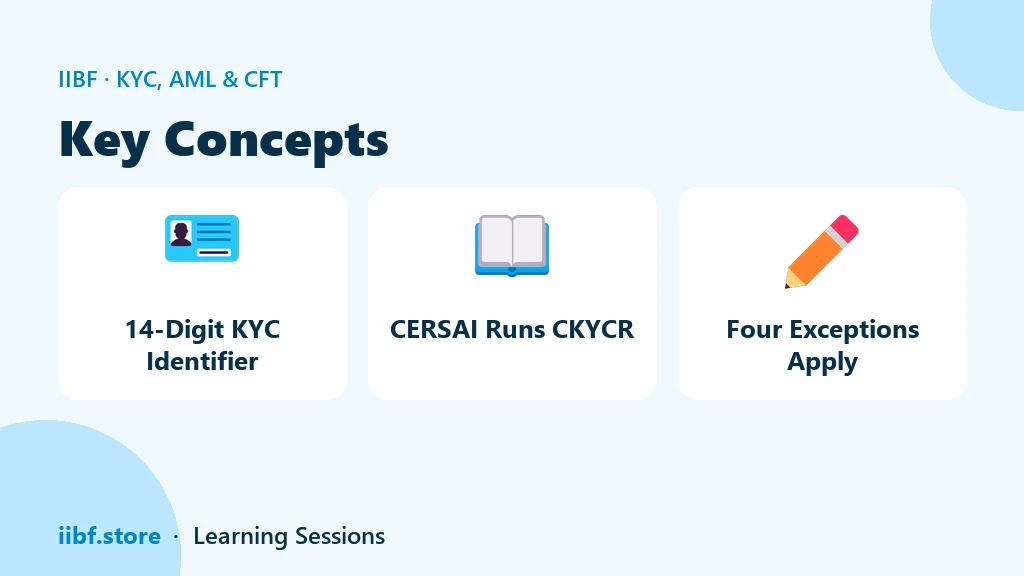
When your KYC record is uploaded, the registry deduplicates it and assigns a unique KYC Identifier. For individual customers this identifier is the familiar 14-digit number people call a CKYC ID. The RBI's FAQs are explicit that once the identifier is generated by CKYCR and provided to the regulated entity, that entity must share it with the concerned customer. You can also look it up yourself on the CKYCR portal at ckycindia.in. It is not a secret held inside the bank's system.
How your identifier gets created
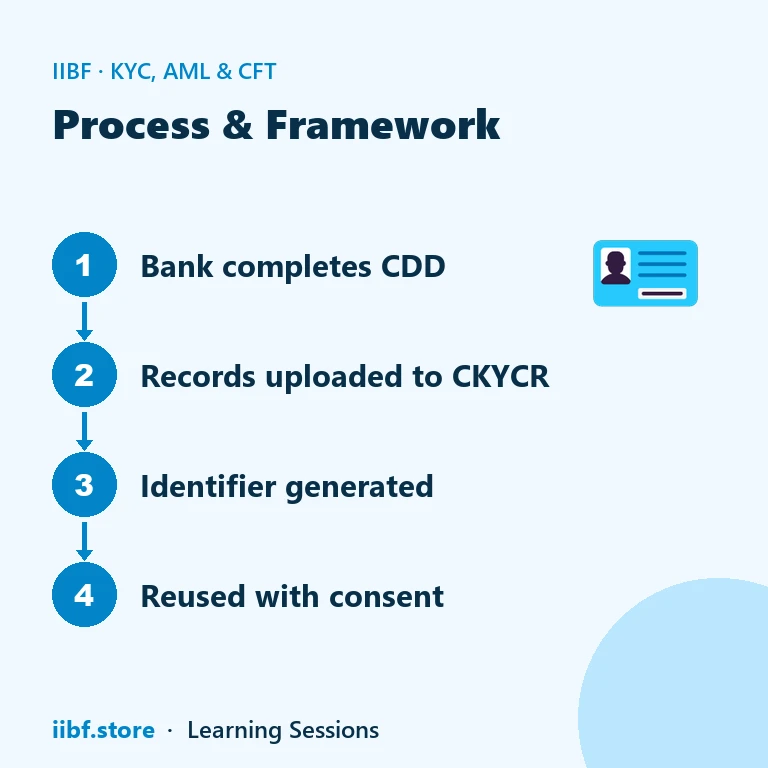
Suppose you walk into Bank A and open a new savings account. The bank completes the applicable customer due diligence — verifies your identity, verifies your address, and collects whatever else the risk category demands. The bank's job does not end when the account number is issued.
Under the Prevention of Money-Laundering (Maintenance of Records) Rules and the RBI's KYC Direction, the reporting entity must capture the KYC information in the prescribed template and upload it to CKYCR. Scheduled commercial banks were required to upload data for all new individual accounts opened on or after January 1, 2017; other regulated entities from April 1, 2017. CKYCR processes the submission, removes duplicates, generates the identifier, and returns it to the entity, which passes it on to you.
The next time you approach Bank B, you hand over that number instead of a fresh document set. Bank B seeks the identifier from you — or retrieves it from CKYCR if it is already available — and downloads the KYC records. One condition is non-negotiable: the RBI requires your explicit consent before an entity can use your identifier to pull records from the registry.
The four exceptions everyone forgets
Here is where the confident customer gets it wrong. "I have CKYC, you cannot ask me for anything" is an incomplete statement. The RBI's FAQs on the Master Direction on KYC say that when an account is opened using the identifier, the customer is not required to submit the same KYC records, information or additional identification documents — unless one of four situations applies.
| # | Exception | What it means in the branch |
|---|---|---|
| 1 | There is a change in the information of the customer as existing in the records of CKYCR | You shifted house, changed your name, updated a phone number — the registry copy is stale |
| 2 | The record or information retrieved is incomplete, or is not as per current applicable KYC norms | An old-format record that predates the norms now in force |
| 3 | The validity period of the downloaded documents has lapsed | The passport or driving licence used as the OVD has expired |
| 4 | The entity considers it necessary to verify identity or address (including current address), to perform enhanced due diligence, or to build an appropriate risk profile | Higher-risk profile, or the bank simply cannot satisfy itself on current address |
So the accurate statement is narrower: if a valid record exists, the documents are complete and current, nothing has changed, and none of the four exceptions is triggered, then your CKYC ID is sufficient and fresh paperwork should not be demanded. That is a meaningful right — it is just not an unconditional one.
A CKYC ID is not lifetime KYC
The single biggest misconception is that once the number exists, KYC is done forever. It is not. The identifier gives your documents reusability; it does not switch off the periodic updation requirement, which is risk based.
Periodic updation of KYC must be carried out at least once in every two years for high-risk customers, once in eight years for medium-risk customers, and once in ten years for low-risk customers. Two customers can hold identical identifiers and still face completely different re-KYC calendars, purely because of risk categorisation.
The process side has also become friendlier. Where there is no change in KYC information, or a change only in address, a self-declaration can be obtained through an authorised Business Correspondent of the bank, with the BC forwarding it to the branch and giving you an acknowledgement. Banks must also give at least three advance intimations before the due date — including at least one by letter — and at least three reminders afterwards if you still have not complied. If you have never received such an intimation, that is a service failure worth raising.
What this means for you at the counter
Carry the number. Ask for it if your bank has never shared it. Give consent knowingly rather than signing a blank mandate. And when a bank does ask for something extra, ask which of the four exceptions it is invoking — a well-trained officer will be able to name it. For candidates preparing for IIBF papers, this topic sits at the intersection of KYC, AML and customer service, and the examiner's favourite trap is precisely the "lifetime KYC" myth. Knowing the exact wording of the exceptions is worth more than memorising the history of the registry.
If you are building this into your revision, pair it with the wider customer-protection syllabus in our JAIIB course material, then test recall on the mock test series. Keep the current policy numbers handy on the RBI rates and reference page, and browse related explainers on the iibf.store blog. The primary source for every rule quoted here is the RBI's own FAQs on the Master Direction on KYC.
Frequently asked questions
Where can I find my CKYC ID myself?
Your regulated entity is required to share the identifier with you once CKYCR generates it. You can also retrieve it directly from the CKYCR portal at ckycindia.in using your registered details.
Can a bank refuse to accept my identifier and demand full documents?
Not without reason. It may ask for fresh records only if the registry information has changed, the retrieved record is incomplete or outdated against current norms, the downloaded documents have expired, or it needs to verify identity or current address, perform enhanced due diligence, or build a risk profile.
Does having the number mean I never have to do KYC again?
No. Periodic updation continues on a risk basis — at least once every two years for high-risk, eight years for medium-risk and ten years for low-risk customers.
Is my consent needed before a bank downloads my records?
Yes. The RBI requires the regulated entity to obtain your explicit consent before using the identifier to download KYC records from CKYCR, whether for account opening, periodic updation or identity verification.
Quick quiz on this topic
5 exam-style questions from our free test bank — check yourself before you move on.
Practice this topic
Take a free mock test, download chapter PDFs, or watch a video class — all included on iibf.store.
Keep reading