Asset Allocation Strategies in Wealth Management: JAIIB RBWM Guide (2026)
For the JAIIB Retail Banking and Wealth Management paper, few topics reward candidates as reliably as asset allocation strategies. This is the practical heart of wealth management: deciding how a client's money is split across equity, debt, gold, cash and other assets so that returns match the client's goals without exposing them to more risk than they can stomach. Examiners love this area because it blends theory (risk-return trade-off, diversification) with client-facing judgement (age, income, time horizon). In this 2026 guide we break down what asset allocation strategies are, the main approaches you must know, how rebalancing works, and the exact facts and MCQs the RBWM syllabus tests.
🎯 What Asset Allocation Actually Means
Asset allocation is the process of dividing an investment portfolio among different asset classes — broadly equity, fixed income (debt), cash or liquid instruments, gold, and alternatives such as real estate. The logic rests on a simple but powerful idea: different asset classes behave differently under the same economic conditions. Equity may fall while debt holds steady; gold often rises when equity is nervous. Because these movements are imperfectly correlated, combining them smooths the overall ride. Studies famously attribute the majority of a portfolio's long-run return variability to the asset-allocation decision rather than to individual security selection.
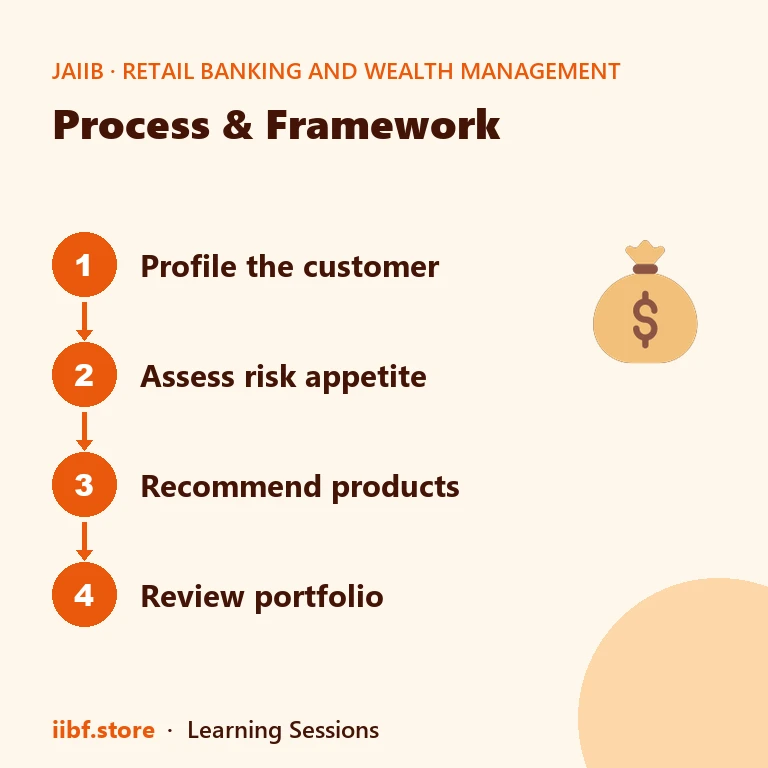
A wealth manager begins not with products but with the client. Before recommending any split, the advisor establishes the client's financial goals, time horizon, income stability, existing liabilities and — crucially — risk appetite. This discovery step is exactly why the RBWM syllabus pairs allocation with understanding client goals and constraints before a single rupee is invested. Only once the profile is clear does the manager translate it into a target allocation, for example 60% equity, 30% debt and 10% gold for a moderate-risk investor with a ten-year horizon. The allocation is then implemented through specific instruments and reviewed periodically.
💡 Exam Tip: Remember the hierarchy — asset allocation (which classes) comes first, then security selection (which fund or stock). Questions often test that allocation drives most of the return variability, not stock picking.
📊 The Main Asset Allocation Strategies
The syllabus expects you to distinguish several named approaches. Strategic asset allocation sets a long-term target mix based on the client's profile and largely sticks to it, rebalancing back to target periodically. Tactical asset allocation allows short-term deviations from the strategic mix to exploit market opportunities — for instance temporarily overweighting equity when valuations look cheap — before returning to the baseline. Dynamic asset allocation continuously adjusts the mix as market conditions and the portfolio value change, often reducing equity as markets rise or as goals near.
Two more approaches appear frequently. Life-cycle (age-based) allocation shifts the mix from growth to safety as the investor ages; the popular rule of thumb is that equity exposure should roughly equal "100 minus age", so a 30-year-old holds about 70% equity and a 60-year-old about 40%. Core-satellite allocation keeps a large, low-cost "core" (say index funds and high-grade debt) for stability, surrounded by smaller "satellite" positions in higher-conviction or thematic bets. Each strategy is really a rule for balancing the client's need for growth against their capacity and willingness to bear loss. Mapping these to a client's stated objectives connects directly to the discipline covered under the importance of wealth management, where suitability and fiduciary care are central.
⚠️ Common Mistake: Candidates confuse tactical and dynamic allocation. Tactical makes deliberate short-term bets around a fixed target; dynamic changes the target itself as conditions evolve.
⚖️ Comparing the Approaches Side by Side
The cleanest way to lock these strategies into memory is a comparison grid. The table below summarises how each approach treats the target mix, how actively it is managed, and the typical investor it suits. In the exam, a scenario will describe an investor — their age, goal and temperament — and ask which strategy fits best; matching rows from a table like this is the fastest route to the right option.
| Strategy | Target Mix | Rebalances to Baseline? | Activity Level | Best Suited For |
|---|---|---|---|---|
| Strategic | Fixed long-term | Yes ✓ | Low | Goal-focused, hands-off investors |
| Tactical | Fixed, with short deviations | Yes ✓ | Medium | Investors seeking modest extra return |
| Dynamic | Changes with conditions | No ✗ | High | Investors near goals or wanting downside control |
| Life-cycle | Shifts with age | Partly ✓ | Low–Medium | Retirement and long-horizon savers |
| Core-satellite | Stable core + flexible satellites | Core: Yes ✓ / Satellite: No ✗ | Medium | Investors wanting stability plus selective bets |
Notice that only dynamic allocation deliberately abandons a fixed baseline. Strategic and tactical both keep a defined target and rebalance back to it; the difference is only whether short-term deviations are allowed. This single distinction resolves a large share of the tricky MCQs. When you build a portfolio for a real retail client, the products you use — recurring deposits, debt funds, equity funds, gold — overlap with the bank's own shelf of retail asset and liability products, so the allocation decision and product selection are closely linked in practice.
🔁 Rebalancing, Diversification and Risk Profiling
Setting an allocation is only half the job; keeping it on target is the other half. Over time, a rising asset class grows to occupy a larger share of the portfolio than intended, quietly raising risk. Rebalancing restores the original weights by trimming what has grown and topping up what has lagged — effectively "selling high and buying low" as a mechanical discipline. Advisors rebalance either on a calendar (say annually) or by threshold (whenever a class drifts more than 5% from target). Both methods force emotion out of the decision.
Underpinning all of this is diversification — spreading money across assets whose returns do not move in lockstep, so that weak years in one class are cushioned by others. Diversification reduces unsystematic (asset-specific) risk but cannot remove systematic (market-wide) risk. The starting point for the whole exercise is risk profiling: classifying the client as conservative, moderate or aggressive using their risk capacity (financial ability to absorb loss) and risk tolerance (psychological willingness). A conservative retiree drawing income needs a debt-heavy mix; a young earner with a stable salary can accept an equity-heavy one. This customer-centric mindset is the same one that drives modern retail credit appraisal and product cross-sell, and it pairs naturally with insurance-linked planning covered in guides on bancassurance in India. Digital tools now automate much of the profiling and rebalancing, a theme explored in our note on digital lending in retail banking.
📌 Remember: Diversification lowers unsystematic risk only. No amount of asset spreading protects against a broad market crash — that is systematic risk, managed through allocation to defensive assets, not through diversification alone.
🧾 Where Allocation Fits in the RBWM Exam
In the RBWM paper, asset allocation sits inside the wealth management module and connects outward to several other topics. Payments and account infrastructure matter because implementing and rebalancing a portfolio relies on smooth fund movement, which is why understanding payment and settlement systems in India supports the practical side. For broader revision across the module, the Retail Banking and Wealth Management topic hub gathers related guides in one place. Expect questions that give a client scenario and ask for the most suitable strategy, questions on the "100 minus age" rule, and definition-matching between strategic, tactical and dynamic allocation. Keep the comparison table above at your fingertips, practise mapping investor profiles to mixes, and you will convert this topic into easy marks. Round out your preparation with full-length mock tests to see these concepts in exam form on the JAIIB course page.
🧠 Practice MCQs: Asset Allocation Strategies
Q1. Which decision is generally credited with explaining most of a portfolio's long-run return variability? (a) Individual stock selection (b) Market timing on single days (c) The asset allocation decision (d) Brokerage choice
Answer: (c) — Studies attribute the bulk of return variability to how money is split across asset classes, not to security picking.
Q2. A strategy that sets a long-term target mix and periodically rebalances back to it is called: (a) Tactical allocation (b) Strategic allocation (c) Dynamic allocation (d) Random allocation
Answer: (b) — Strategic asset allocation fixes a long-term target and rebalances to it, largely ignoring short-term market noise.
Q3. Under the "100 minus age" rule, what is the approximate equity allocation for a 35-year-old investor? (a) 35% (b) 50% (c) 65% (d) 100%
Answer: (c) — 100 minus 35 equals 65, so about 65% of the portfolio is suggested in equity.
Q4. Diversification across assets primarily reduces which type of risk? (a) Systematic (market) risk (b) Unsystematic (asset-specific) risk (c) Inflation risk entirely (d) Interest-rate risk entirely
Answer: (b) — Diversification lowers unsystematic risk; broad market (systematic) risk remains.
Q5. Which strategy deliberately does NOT return the portfolio to a fixed baseline mix? (a) Strategic (b) Tactical (c) Dynamic (d) Buy-and-hold to a fixed target
Answer: (c) — Dynamic allocation continuously changes the target itself as conditions evolve, rather than reverting to a set baseline.
Want chapter-wise mock tests with 100+ MCQs? Start practising free
❓ Frequently Asked Questions
Authoritative reference: see the latest guidelines on the Reserve Bank of India website and the IIBF syllabus portal.
Is asset allocation the same as diversification?
No. Asset allocation decides how much goes into each asset class based on the client's goals and risk profile. Diversification is spreading holdings within and across classes to reduce asset-specific risk. Allocation is the plan; diversification is one technique used to implement it.
How often should a portfolio be rebalanced?
Common practice is calendar-based rebalancing (for example once a year) or threshold-based rebalancing whenever any asset class drifts more than about 5% from its target weight. The aim is to restore the intended risk level without excessive transaction costs.
What is the difference between risk capacity and risk tolerance?
Risk capacity is the client's financial ability to absorb losses, driven by income stability, time horizon and net worth. Risk tolerance is their psychological willingness to accept volatility. A sound allocation respects the lower of the two.
Which allocation strategy suits an investor nearing retirement?
Life-cycle or dynamic allocation usually fits best, because both reduce equity exposure and increase safer debt and cash holdings as the goal approaches, protecting accumulated capital from late-stage market shocks.
Asset allocation strategies turn a client's goals into a disciplined, testable plan — and they are among the most predictable marks in the RBWM paper. Cement the strategy definitions, the "100 minus age" rule and the diversification–systematic-risk distinction, then pressure-test yourself with full mock exams on the IIBF practice tests and the wider JAIIB preparation course.
Prefer revising from a printed book?
Chapter-wise books with MCQs after every chapter — minimal pages, complete coverage, delivered anywhere in India. Every book has a free sample to read first.















Quick quiz on this topic
5 exam-style questions from our free test bank — check yourself before you move on.
Practice this topic
Take a free mock test, download chapter PDFs, or watch a video class — all included on iibf.store.