Risk Profiling in Wealth Management: JAIIB RBWM Guide (2026)
Risk profiling in wealth management is the structured process bankers and relationship managers use to match a client's investments to what that client can genuinely afford to lose — not merely what they hope to earn. For JAIIB candidates, understanding how retail and private banking teams assess risk capacity, risk tolerance and risk requirement is central to the RBWM syllabus on client goals, suitability and regulatory compliance. This article walks through the process step by step, the tools banks actually use, and the exam angles you must be ready for.
📊 What Is Risk Profiling in Wealth Management?
Risk profiling is the formal assessment a bank or wealth manager carries out before recommending any product to a customer — a fixed deposit, a mutual fund, a ULIP, or a structured product. It goes beyond asking "how much risk can you take" and instead measures three distinct dimensions: risk capacity (the client's financial ability to absorb loss, driven by income, net worth and liquidity needs), risk tolerance (the client's psychological comfort with volatility), and risk requirement (the return the client actually needs to meet stated goals). A sound risk profile combines all three rather than relying on any single input.
Relationship managers gather this information as part of the broader client discovery exercise covered in the client goals and constraints framework, where life stage, dependents, income stability, investment horizon and liquidity needs are all documented before any recommendation is made. Skipping this step, or treating it as a box-ticking exercise, is one of the most common causes of mis-selling complaints in Indian retail banking.
💡 Exam Tip: Remember the three-way split — capacity, tolerance, requirement — examiners frequently test which one should override the others when they conflict.
🎯 The Financial Planning Process and the Tools Used to Profile Risk
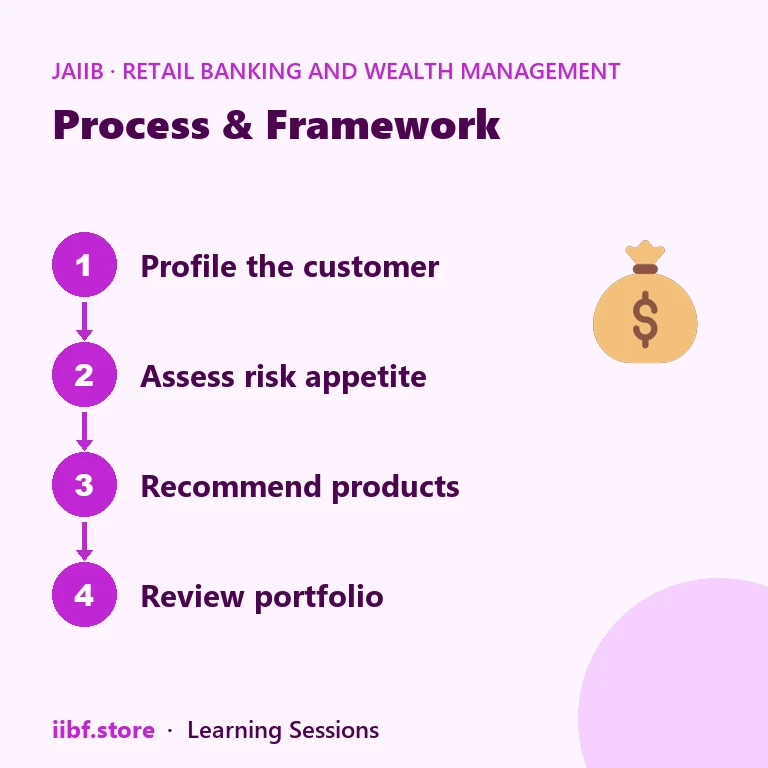
Risk profiling does not happen in isolation; it sits inside the standard financial planning process taught under wealth management: establishing the client relationship, gathering data, analysing the client's financial position, developing recommendations, implementing the plan, and periodically reviewing it. Risk profiling belongs squarely in the data-gathering and analysis stages, and it must be revisited at every review because a client's circumstances — a job change, a new dependent, an approaching retirement — can shift both capacity and tolerance even when stated goals stay the same. This is why the importance of wealth management as a discipline lies as much in ongoing monitoring as in the initial plan.
Banks and private banking desks use a mix of tools to capture this data: structured psychometric questionnaires that score tolerance on a numeric scale, face-to-face interviews for high-net-worth and elderly clients where nuance matters more than a score, and increasingly, algorithm-driven digital onboarding flows that generate a risk category instantly. Digital channels have made the questionnaire route far more common for mass-retail customers, a shift closely tied to broader technology in retail banking adoption, though banks are expected to flag inconsistent or contradictory answers for manual review rather than auto-approving every questionnaire output.
⚖️ Risk Capacity vs Risk Tolerance vs Risk Requirement
The most tested exam concept in this area is what happens when the three dimensions disagree. A client may have high risk tolerance — they say they are comfortable with volatility — but low risk capacity because they need the corpus for a child's education in eighteen months. In such cases, the prudent and regulator-expected practice is to let the lower of capacity and tolerance govern the recommendation, never the higher one, because capacity is an objective financial constraint while tolerance is a subjective, sometimes overconfident, self-assessment.
The table below summarises how each dimension is measured and whether it is treated as a hard constraint or a soft input during recommendation.
| Dimension | What It Measures | Can Override Client's Stated Preference? |
|---|---|---|
| Risk Capacity | Objective ability to bear loss (income, net worth, liquidity, time horizon) | ✅ Yes — hard constraint |
| Risk Tolerance | Psychological comfort with market volatility, self-reported | ❌ No — informative only |
| Risk Requirement | Return needed to reach a specific financial goal | ✅ Yes — flags if goal is unrealistic for the risk taken |
⚠️ Common Mistake: Candidates often assume the client's stated risk tolerance is the final word. In practice, capacity — not tolerance — is the binding constraint whenever the two conflict.
🏦 Regulatory Framework: KYC, Suitability and Mis-selling Safeguards
Risk profiling in India is not just good practice — it is a regulatory requirement. SEBI's Investment Adviser Regulations require that any person advising on securities first assess the client's risk profile and document it before recommending a product, and this suitability principle has been extended in spirit across bancassurance and wealth desks that sell mutual funds and insurance through the banking channel. On the deposit and lending side, the Reserve Bank of India's KYC Master Direction requires banks to build a customer risk category as part of customer due diligence, feeding into ongoing transaction monitoring rather than product suitability alone. Candidates preparing for JAIIB should also track guidance from the Securities and Exchange Board of India on suitability, since mis-selling enforcement actions in Indian retail banking have repeatedly cited absent or stale risk profiles as the root cause.
This regulatory backbone is why relationship management is treated as a compliance function as much as a sales one. The customer relationship management chapter ties directly into this — a documented, periodically refreshed risk profile is the audit trail that protects both the customer and the bank. It is worth contrasting this with how risk assessment works outside deposit-taking banks: non-banking financial companies in India follow parallel but distinct suitability norms under their own sectoral regulator, a comparison examiners occasionally draw on.
📌 Remember: A risk profile is not a one-time form. RBI and SEBI both expect periodic refresh, especially after major life events or market shocks.
Risk profiling also underpins related RBWM topics you should revise together. Once a client's risk category is fixed, the actual product mix — covered under asset allocation strategies — flows directly from it. Insurance-linked products such as those discussed in Unit Linked Insurance Plans require an especially careful profile because they combine market risk with a long lock-in, and distribution through bancassurance in India has been a recurring focus of suitability audits precisely because insurance is sold alongside banking relationships where trust can substitute for genuine profiling. For the full spread of RBWM topics, browse the retail banking and wealth management article archive.
🧠 Practice MCQs: Risk Profiling in Wealth Management
Q1. Which regulatory body's regulations require an investment adviser to assess a client's risk profile before recommending securities? (a) IRDAI (b) SEBI (c) PFRDA (d) IBBI
Answer: (b) — SEBI's Investment Adviser Regulations mandate documented risk profiling before advice is given.
Q2. A client states high risk tolerance but has low risk capacity due to an imminent large expense. Which dimension should govern the recommendation? (a) Risk tolerance (b) Risk requirement (c) Risk capacity (d) The client's stated preference, always
Answer: (c) — Risk capacity is the objective, hard constraint and should override subjective tolerance when the two conflict.
Q3. In the standard financial planning process, at which stage does risk profiling primarily take place? (a) Implementation (b) Data gathering and analysis (c) Plan review only (d) Client termination
Answer: (b) — Risk profiling is captured during data gathering and refined during analysis, before recommendations are developed.
Q4. Under RBI's KYC framework, the customer risk category built during onboarding primarily supports which function? (a) Product commission tracking (b) Ongoing transaction monitoring and due diligence (c) Branch profitability computation (d) Loan interest rate setting
Answer: (b) — The KYC-driven risk category feeds ongoing customer due diligence and transaction monitoring, not pricing or commissions.
Q5. Which risk profiling method is generally preferred for elderly or first-time investors over a purely algorithmic digital questionnaire? (a) Robo-advisory scoring alone (b) Structured face-to-face interview (c) No profiling, product-based recommendation (d) Peer group benchmarking
Answer: (b) — A structured interview captures nuance and reduces misinterpretation risk that a standalone algorithmic questionnaire can miss for vulnerable client segments.
Want chapter-wise mock tests with 100+ MCQs? Start practising free →
What is the difference between risk capacity and risk tolerance?
Risk capacity is the objective financial ability to absorb loss based on income, net worth and time horizon, while risk tolerance is the client's subjective psychological comfort with market volatility.
Is risk profiling legally mandatory for banks in India?
Yes for investment advice — SEBI's Investment Adviser Regulations require a documented risk profile before recommending securities, and RBI's KYC norms require a customer risk category for due diligence purposes.
How often should a client's risk profile be updated?
It should be refreshed periodically and after any major life event — a job change, marriage, retirement, or a significant market shock — since both capacity and tolerance can shift over time.
Why is risk profiling important for JAIIB RBWM candidates?
It links directly to client goals and constraints, suitability regulation, and mis-selling prevention, all of which are recurring themes across the RBWM syllabus and exam.

📝 Conclusion
Risk profiling in wealth management is the foundation every other RBWM topic builds on — get the client's capacity, tolerance and requirement right, and asset allocation, product selection and compliance all follow logically. Get it wrong, and even a well-designed product becomes a mis-selling risk. Strengthen your understanding with structured practice on the JAIIB course, which covers this topic alongside the full RBWM syllabus in exam-ready depth.
Prefer revising from a printed book?
Chapter-wise books with MCQs after every chapter — minimal pages, complete coverage, delivered anywhere in India. Every book has a free sample to read first.































Quick quiz on this topic
5 exam-style questions from our free test bank — check yourself before you move on.
Practice this topic
Take a free mock test, download chapter PDFs, or watch a video class — all included on iibf.store.