Bank Job Stress: How Bankers Actually Stay Happy
Every few months the same conversation goes around a branch. Someone says the job has changed, someone else says it was always like this, and the newest recruit quietly wonders whether they made a mistake. Bank job stress is not a soft topic and it is not solved by being told to think positive. It has specific causes, and most of them respond to specific fixes. Ashish sir returned to this question in part two of his short series, which is embedded below.
Bank mei khush kaise rahein? part 2 · Watch on YouTube
What follows is not a lecture about gratitude. It is an attempt to separate the parts of the job that genuinely cannot be changed from the parts that most bankers never try to change because they assume they cannot.
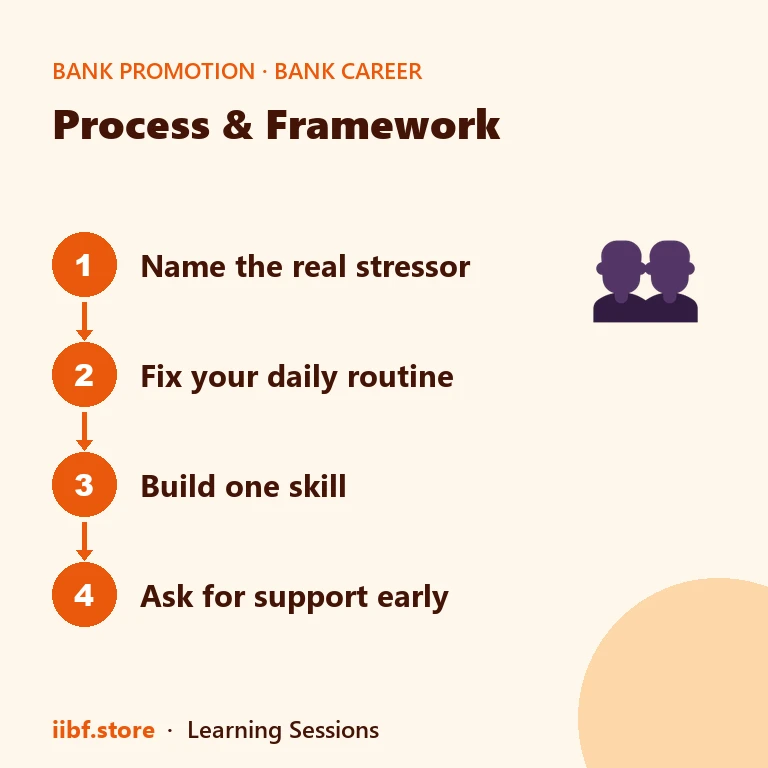
Name the actual stressor before trying to fix it
Most bankers describe their stress as one big undifferentiated weight. It almost never is. Broken into pieces, bank job stress usually comes from four separate sources, and each one has a different remedy.
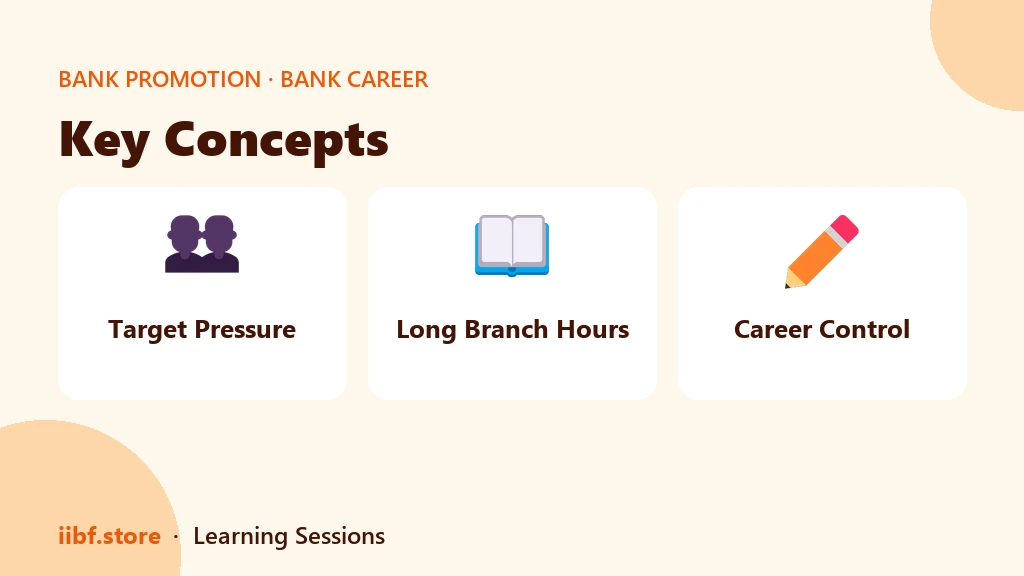
- Volume stress. Too many customers, too little time, an interrupted day. This is a systems problem, not a character problem.
- Target stress. Cross-selling numbers, deposit growth, recovery figures that are reviewed publicly. This is a comparison problem.
- Accountability stress. The fear of a decision going wrong later, of an audit note, of a signature you gave two years ago. This is a documentation problem.
- Life stress. Distance from family, transfers, no visible end date. This is a planning problem.
The reason this split matters is that people apply the wrong fix. An officer drowning in accountability stress takes a holiday, comes back, and feels exactly the same, because the unresolved file is still on the desk. Another officer with volume stress reads a book on positive thinking when what they needed was to move two routine activities out of peak counter hours.
What actually reduces it, and what only looks like it does
| Common response | Does it help? | What works better |
|---|---|---|
| Venting in the staff group all day | Short relief, then worse | One honest conversation with the person who can change something |
| Staying late every day to clear pending work | No, it resets the baseline | Fixed cut-off time with a written pending list for tomorrow |
| Comparing your posting with a batchmate's | No, it is pure comparison stress | Compare yourself to your own position one year ago |
| Waiting for a transfer to fix everything | Rarely, the pattern usually travels with you | Fix the routine first, so the next posting starts better |
| Studying for a certification at 1 am | No, it borrows from tomorrow | Forty focused minutes at a fixed hour, most days |
The pattern in that table is consistent. The things that help are small, boring and repeatable. The things that do not help are dramatic, emotionally satisfying in the moment, and leave the underlying cause untouched.
Documentation is an underrated cure
This sounds like the least emotional advice possible, and it is the one that changes the most. A very large share of the anxiety bankers carry home is the fear of a past decision being questioned without a record to explain it.
The fix is unglamorous. Note the reason for every non-routine decision at the time you take it, in the system where it belongs. Keep the approval trail in the file rather than in your memory or in a chat. When an audit query arrives eighteen months later, you spend twenty minutes on it instead of three weeks worrying about it. Officers who do this describe the change as sleeping better, which is exactly what it is.
Control is the thing you are actually missing
When bankers describe being unhappy, the word that keeps appearing is not workload. It is control. Somebody else decides the targets, the posting, the timing and the review. That feeling of having no lever to pull is the real source of the low mood, more than the hours are.
You cannot take back most of those levers. You can take back one, and it happens to be the one with the highest return: your qualifications. A certification is the only part of your career file that improves purely because you decided it should. It does not depend on your branch's business figures, your controller's opinion or this year's vacancy position.
That is why so many officers who felt stuck describe clearing JAIIB as the point where the mood changed, well before any promotion arrived. The exam did not reduce the workload. It restored the sense that the next step was partly theirs to decide. Going on to CAIIB, and then to a specialisation such as Advanced Bank Management, extends the same effect.
A realistic weekly routine for a working banker
The most common mistake is planning a study routine that assumes a quiet evening. Branch life does not supply quiet evenings. Plan for the days you actually have.
Pick a fixed forty-minute slot at the same hour on most days, ideally in the morning before the branch starts, because evenings get taken. Use a written plan so you are never deciding what to study while tired: a study planner removes that decision. End every session with a short set of questions rather than more reading, because recall is what fades under stress, not comprehension. Keep one longer slot on your weekly off for a full mock test, and treat the result as data rather than a verdict.
On the days the branch runs long and you get nothing done, do not add guilt on top of a hard day. A missed session is a missed session. The routine survives on the average, not on the perfect week. Handled this way, study becomes one of the few reliable cures for bank job stress rather than another source of it.
Frequently asked questions
Is bank job stress worse now than it used to be?
The mix has changed rather than simply increased. Manual work has reduced, while target intensity, digital complaint handling and audit scrutiny have grown. The result is less physical fatigue and more sustained mental pressure, which is why the old coping habits often no longer work.
Will a transfer to another branch solve it?
Sometimes, when a specific person or a specific branch culture is the cause. Often not, because volume, targets and accountability exist everywhere in the network. Fix the routine and the documentation habit first, so that whatever you carry into the next branch is a working system rather than a backlog.
How do I study for JAIIB or CAIIB while working full time?
Use a fixed short slot most days rather than long weekend sessions, study in the morning if your branch runs late, and finish every session with questions instead of reading. Forty focused minutes a day, sustained for a few months, beats an ambitious plan you abandon in week three.
Is it normal to think about leaving banking?
It is extremely common, particularly in the first three years and immediately after a difficult posting. Before deciding, separate the four stressors described above and check how many are tied to this branch rather than to banking itself. Many officers find that two of the four disappear with the next posting. You can browse more career and exam guidance on the Learning Sessions blog.
Prefer revising from a printed book?
Chapter-wise books with MCQs after every chapter — minimal pages, complete coverage, delivered anywhere in India. Every book has a free sample to read first.
131 pages · 672 MCQs
Learning Sessions · Ashish Sir
221 pages · 831 MCQs
Learning Sessions · Ashish Sir
128 pages · 524 MCQs
Learning Sessions · Ashish Sir
107 pages · 445 MCQs
Learning Sessions · Ashish Sir
148 pages · 478 MCQs
Learning Sessions · Ashish Sir
151 pages · 465 MCQs
Learning Sessions · Ashish Sir
148 pages · 375 MCQs
Learning Sessions · Ashish Sir
216 pages · 895 MCQs
Learning Sessions · Ashish Sir
109 pages · 300 MCQs
Learning Sessions · Ashish Sir
104 pages · 360 MCQs
Learning Sessions · Ashish Sir
82 pages · 297 MCQs
Learning Sessions · Ashish Sir
151 pages · 600 MCQs
Learning Sessions · Ashish Sir
98 pages · 282 MCQs
Learning Sessions · Ashish Sir
132 pages · 225 MCQs
Learning Sessions · Ashish Sir
188 pages · 435 MCQs
Learning Sessions · Ashish Sir
117 pages · 236 MCQs
Learning Sessions · Ashish Sir
Learning Sessions · Ashish Sir
118 pages · 299 MCQs
Learning Sessions · Ashish Sir
Learning Sessions · Ashish Sir
Learning Sessions · Ashish Sir
Learning Sessions · Ashish Sir
115 pages · 255 MCQs
Learning Sessions · Ashish Sir
Learning Sessions · Ashish Sir
334 pages · 936 MCQs
Learning Sessions · Ashish Sir
Learning Sessions · Ashish Sir
115 pages · 344 MCQs
Learning Sessions · Ashish Sir
107 pages · 240 MCQs
Learning Sessions · Ashish Sir
90 pages · 150 MCQs
Learning Sessions · Ashish Sir
Learning Sessions · Ashish Sir
Practice this topic
Take a free mock test, download chapter PDFs, or watch a video class — all included on iibf.store.