Bank Promotion Exam Study Material 2026: What You Get Free

If you are sitting for an internal promotion test this year, the honest problem is not a shortage of bank promotion exam study material — it is that most of what circulates in WhatsApp groups is three years stale, unsourced, and written for a syllabus that has since moved. The short video below was filmed in a cluttered two-monitor office, and the point it makes in seventy seconds is simple: the question PDFs, notes PDFs and one-liner PDFs used for JAIIB and CAIIB are the same material that works for bank promotions and IIBF certification courses, and they are available free.
Shortest blog · Watch on YouTube
That claim deserves unpacking, because “free material” is where most preparation quietly goes wrong. Downloading forty PDFs feels like progress. It is not. What follows is what each format is actually for, a routine that survives a working banker's day, and the specific traps that cost marks in a promotion paper.
Why promotion papers punish notes-only preparation
Internal promotion exams are set by your own bank, not by IIBF, so the syllabus varies from one institution to the next. What does not vary is the shape of the paper. Promotion tests lean heavily on applied banking — a branch scenario, a limit to be worked out, a classification to be decided — rather than on definitions you can recite. Two candidates can read the same chapter and only one of them can answer “the party has a sanctioned limit of ₹50 lakh and stock statements are two months late; what do you do?”
This is why a stack of notes on its own is a weak plan. Notes build recognition. Promotion papers test retrieval under a clock. The gap between the two is closed by questions, and by nothing else. Good bank promotion exam study material therefore comes in layers, not as one giant file, and the layers are meant to be used in a particular order.
The three PDF formats and what each one is actually for
Most candidates treat all PDFs as interchangeable reading. They are not. Each format answers a different question about your own preparation, and using the wrong one at the wrong stage is the commonest source of wasted evenings.
| Format | What it is for | Best used | Typical failure |
|---|---|---|---|
| Notes PDF | Building the concept the first time — why a rule exists, how the pieces connect | First pass on an unfamiliar chapter | Re-reading it four times and calling that revision |
| One-liner PDF | Holding facts, figures, limits and section numbers in short-term recall | Daily, 10–15 minutes, in the last three weeks | Starting one-liners before the concept exists — nothing sticks |
| Question PDF | Converting recognition into retrieval; exposing what you only think you know | Same day as the notes, then again after a week | Reading the answer key instead of attempting cold |
| Mock test | Rehearsing pace, negative-marking discipline and question selection | Weekly from the halfway point | Taking mocks but never reviewing the wrong answers |
The order matters more than the volume. Notes create the scaffold, questions test it the same day while the chapter is warm, and one-liners keep the numbers alive in the final weeks. A candidate who covers twelve chapters this way will out-score one who has skimmed forty.
A four-step routine that fits a working banker's day
Nobody clearing a promotion exam has four free hours. The routine below assumes ninety minutes on a working day and a longer block on one weekend day, which is roughly what a branch schedule actually permits.
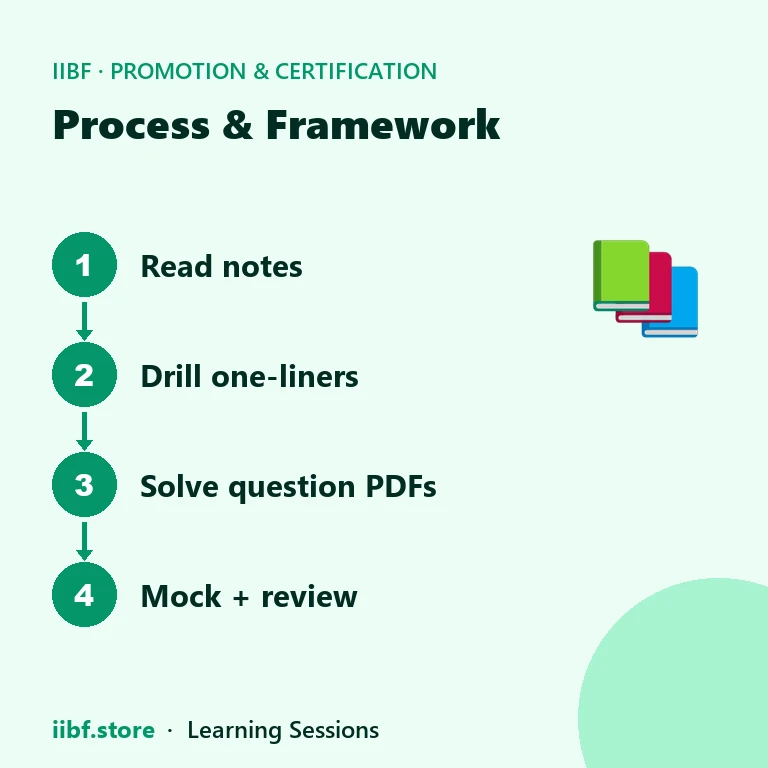
Step 1 — Read one chapter's notes (35 minutes). One chapter, not three. Close the file and write four lines from memory: what the rule is, who it applies to, the threshold or limit involved, and one branch situation where it bites. If you cannot write those four lines, you did not read the chapter, you looked at it.
Step 2 — Drill the one-liners for that chapter (10 minutes). One-liners are a memory tool, not a learning tool. Cover the right-hand side, recall, uncover, mark the misses. Only the misses come back tomorrow.
Step 3 — Attempt the question PDF cold (30 minutes). No notes open, no key visible. Attempt, then check in one pass and write a single line next to every wrong answer explaining why it was wrong — misread, didn't know, guessed, or calculation slip. That one line is the most valuable thing you will produce all week, because the four categories need four different fixes.
Step 4 — One timed mock per week, reviewed the same day (15 minutes of review minimum). An unreviewed mock is entertainment. Use the free practice test bank for this and keep the review shorter than the test itself, or you will stop doing it.
Run that loop and your bank promotion exam study material stops being a download folder and starts being a system. If planning the calendar is the part you keep postponing, the day-wise study planner will lay the chapters out against your exam date so you are not deciding what to study at 9 p.m. every night.
What promotion exams, JAIIB, CAIIB and IIBF certifications share
The overlap is larger than most candidates assume, which is exactly why the same free material serves all four. Credit appraisal, working-capital assessment, asset classification and provisioning, KYC and AML obligations, priority sector norms, forex basics for branch staff, and the current interest-rate framework appear in some form across nearly every one of these papers. A chapter you master for CAIIB is not a chapter you re-learn for your promotion test; it is the same content asked with a different accent.
Where they genuinely diverge is in emphasis. IIBF certification papers — the full current list and syllabus is published on iibf.org.in — go deep on one narrow domain. Promotion papers stay broad but expect operational judgement, and often add bank-specific circulars that no public PDF can cover. Budget time for your own bank's circular set separately; treat the shared bank promotion exam study material as the seventy per cent that is common, and your internal circulars as the thirty per cent only you can source.
Four mistakes that cost marks
Studying from material that predates the current rate framework. Lending-rate benchmarks, deposit rules and several regulatory thresholds have moved in recent years. If your PDF still explains a superseded structure as current, you will confidently write a wrong answer. Cross-check anything rate-linked against the current RBI rates page before you commit it to memory.
Collecting instead of finishing. Forty PDFs on a phone is not preparation. Ten worked properly beats forty skimmed, every time.
Skipping numericals because they are uncomfortable. Working-capital assessment, ratio interpretation and provisioning arithmetic are the highest-yield marks in most promotion papers precisely because so many candidates avoid them. Two numericals a day for a month is roughly sixty problems, which is enough.
Never simulating the clock. Knowing the answer and producing it in under sixty seconds are different skills. Test the second one before exam day, not on it.
Where to get it
The notes, one-liner and question PDFs referred to in the video are free and organised by paper, alongside daily classes on the channel. If you would rather start from written explanations than video, the article library covers the same ground chapter by chapter. Pick one chapter tonight, run the four-step loop on it, and judge the method by tomorrow's recall rather than by how many files you managed to download.
Is bank promotion exam study material really the same as JAIIB and CAIIB material?
Largely, yes. Credit, NPA classification, KYC and AML, priority sector and forex basics carry across all of them. The difference is that promotion papers add your own bank's circulars and policy, which no public PDF covers, so keep a separate slot for those.
How far ahead should I start preparing for a promotion exam?
Eight to ten weeks of consistent ninety-minute evenings is a realistic target for a working banker. Less than four weeks and you will be forced into one-liners only, which handles facts but not the applied questions that decide the result.
Are one-liner PDFs enough on their own?
No. One-liners hold figures, limits and section numbers in recall, but they cannot teach you to judge a branch scenario. Use them as the last layer over notes and solved questions, not as a substitute for either.
How many practice questions should I attempt per chapter?
Aim for thirty to forty per chapter, attempted cold and reviewed the same day. Quality of review matters more than volume — write one line on why each wrong answer was wrong, because a misread and a knowledge gap need completely different fixes.
Practice this topic
Take a free mock test, download chapter PDFs, or watch a video class — all included on iibf.store.