Basel III Updates for CAIIB BFM: Capital, LCR and 2026 Changes
Most candidates can recite that Basel III has three pillars and then freeze when the question asks for a number. The reel below is a quick nudge in that direction, and it is worth expanding, because the CAIIB Bank Financial Management paper almost never asks "what is a capital buffer" — it asks what the ratio is, who set it, and what changed.
BASEL 3 updates · Watch on YouTube
Two things make this topic slippery. First, the global minimums and the RBI's Indian minimums are different, and papers test the gap. Second, the framework keeps moving — there is a real change to the liquidity rules taking effect on 1 April 2026 that most study material has not caught up with yet.
The capital stack: global minimum versus RBI
The Reserve Bank has consistently run tighter than the Basel Committee floor. Learn both columns; the comparison itself is a favourite question.
| Requirement | Basel III minimum | RBI requirement for Indian banks |
|---|---|---|
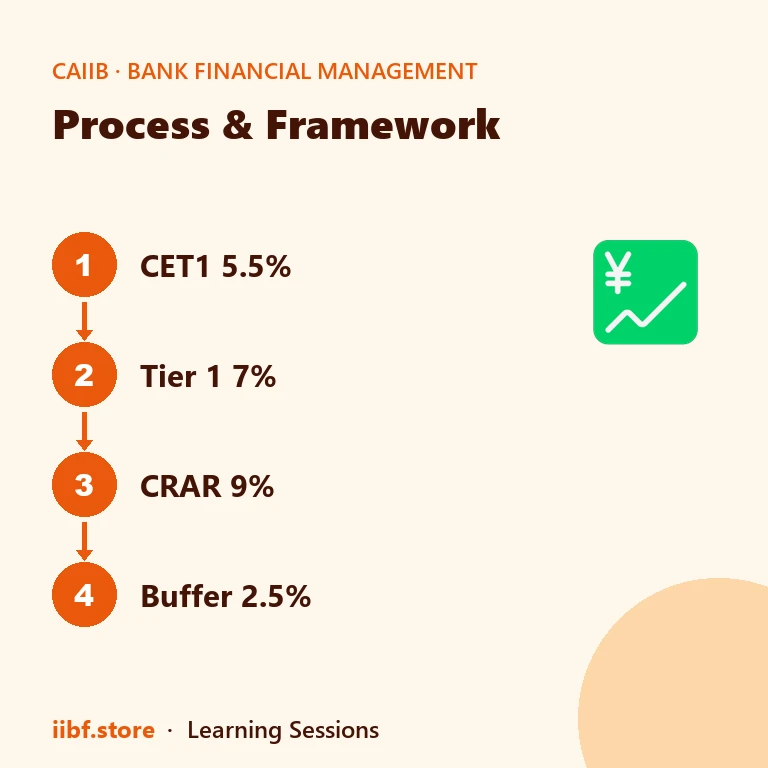
| Common Equity Tier 1 (CET1) | 4.5% | 5.5% |
| Tier 1 capital | 6.0% | 7.0% |
| Total capital (CRAR) | 8.0% | 9.0% |
| Capital Conservation Buffer (CET1) | 2.5% | 2.5% |
| Total capital including the buffer | 10.5% | 11.5% |
| Leverage ratio | 3.0% | 4.0% for D-SIBs, 3.5% for other banks |
Three notes the examiner likes. The Capital Conservation Buffer must be met with CET1 and is not a hard floor — breach it and you keep operating, but distributions such as dividends and discretionary bonuses get restricted. The Countercyclical Capital Buffer exists in the Indian framework but has not been activated. And domestic systemically important banks carry an additional CET1 surcharge on top of everything above, set by the bucket the RBI places them in and announced each year.
The liquidity side: LCR and NSFR
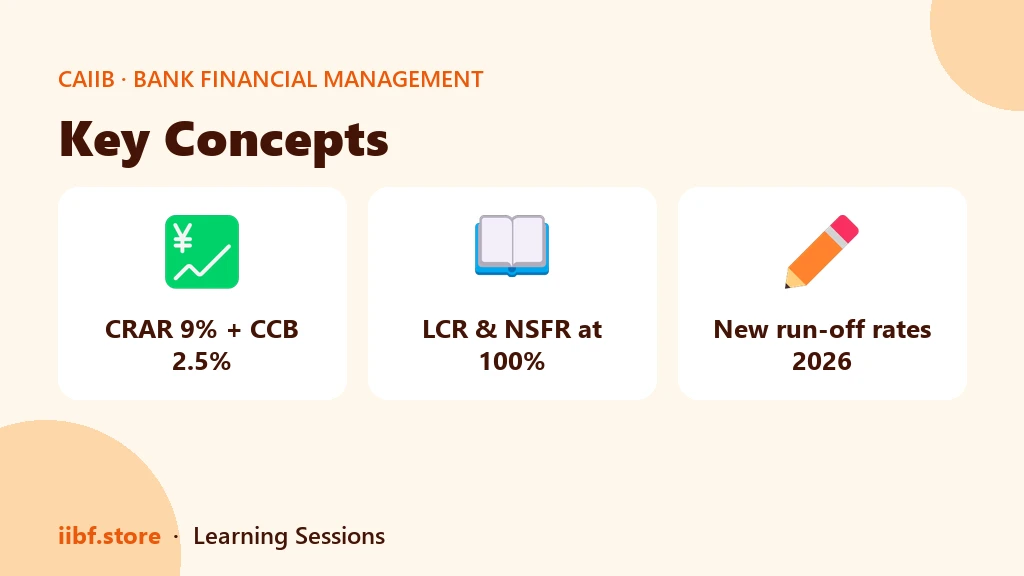
Capital answers the solvency question; the liquidity standards answer the survival question. The Liquidity Coverage Ratio requires a bank to hold enough High Quality Liquid Assets to cover net cash outflows over a 30-day acute stress scenario, at a minimum of 100%. The Net Stable Funding Ratio works over a one-year horizon, requiring available stable funding to be at least 100% of required stable funding. HQLA is split into Level 1 assets — cash, excess CRR, government securities — which carry no haircut in principle, and Level 2A and 2B assets, which are haircut and capped as a share of the stock.
A quick worked example, because the formula alone rarely sticks. If a bank holds ₹1,800 crore of HQLA after haircuts, expects ₹3,000 crore of stressed outflows over thirty days and ₹1,400 crore of inflows, inflows are capped at 75% of outflows, that is ₹2,250 crore — so the cap does not bite. Net outflow is ₹1,600 crore, and the ratio is 1,800 ÷ 1,600 = 112.5%. Compliant. Push outflows to ₹3,400 crore with the same inflows and net outflow becomes ₹2,000 crore, dropping the ratio to 90% — a shortfall the bank must report and remedy.
What actually changes on 1 April 2026
This is the genuine update, and it comes from the RBI circular revising the Basel III framework on liquidity standards. Four changes matter for the paper and for the branch.
- An extra run-off factor for digitally enabled retail deposits. Deposits with internet and mobile banking enabled attract an additional 2.5% run-off. Stable retail deposits move from 5% to 7.5%, and less stable retail deposits from 10% to 12.5%. The logic is simple: money that can be moved from a phone at 2 a.m. leaves faster in a stress event.
- Lower run-off on deposits from certain non-financial entities. Deposits from trusts, partnerships, association of persons and limited liability partnerships are treated as coming from non-financial corporates and attract a 40% run-off rate rather than 100%, unless they qualify as small business customers.
- A clearer haircut rule for Level 1 government securities. Government securities are valued at not more than current market value, adjusted for haircuts aligned with the margin requirements under the Liquidity Adjustment Facility and Marginal Standing Facility.
- Pledged deposits are treated as callable. Deposits contractually pledged as collateral must now be treated as callable for LCR purposes, even where they were earlier kept out of the computation.
These instructions apply to all commercial banks other than payments banks, regional rural banks and local area banks. If a question gives you a retail deposit book and asks for the outflow, check whether it is described as internet or mobile banking enabled before you reach for 5% or 10%.
How to revise this without drowning
Build one page: the capital table above, the two liquidity ratios with their horizons, the HQLA levels, and the four 2026 changes. Then attempt questions until the numbers come back without effort — a ratio you can recite but not apply is worth nothing in a two-hour objective paper. Work through the CAIIB course module on risk and capital, sit full-length mock tests, keep the current policy numbers handy on the RBI rates page, and read the source circulars on the Reserve Bank of India website whenever a figure looks stale.
Frequently asked questions
Why is India's CRAR 9% when the global minimum is 8%?
The Basel framework sets a floor, not a ceiling. The RBI has prescribed a higher minimum for Indian banks, with CET1 at 5.5% and Tier 1 at 7%, so total capital including the 2.5% conservation buffer works out to 11.5%.
What is the LCR minimum and over what horizon?
The Liquidity Coverage Ratio must be at least 100%, measured as stock of HQLA divided by total net cash outflows over the next 30 calendar days under a stress scenario. Inflows are capped at 75% of outflows in the denominator.
What changes for deposits from trusts and LLPs from April 2026?
They are classified as deposits from non-financial corporates and attract a 40% run-off rate instead of 100%, unless the depositor is treated as a small business customer under the framework.
Does breaching the Capital Conservation Buffer make a bank non-compliant?
The buffer is not a minimum in the same sense as the 9% CRAR. Operating inside the buffer triggers progressive restrictions on discretionary distributions such as dividends, share buybacks and bonus payments rather than an outright breach of the capital requirement.
Prefer revising from a printed book?
Chapter-wise books with MCQs after every chapter — minimal pages, complete coverage, delivered anywhere in India. Every book has a free sample to read first.
151 pages · 465 MCQs
Learning Sessions · Ashish Sir
148 pages · 478 MCQs
Learning Sessions · Ashish Sir
148 pages · 375 MCQs
Learning Sessions · Ashish Sir
216 pages · 895 MCQs
Learning Sessions · Ashish Sir
109 pages · 300 MCQs
Learning Sessions · Ashish Sir
104 pages · 360 MCQs
Learning Sessions · Ashish Sir
82 pages · 297 MCQs
Learning Sessions · Ashish Sir
151 pages · 600 MCQs
Learning Sessions · Ashish Sir
98 pages · 282 MCQs
Learning Sessions · Ashish Sir
131 pages · 672 MCQs
Learning Sessions · Ashish Sir
221 pages · 831 MCQs
Learning Sessions · Ashish Sir
128 pages · 524 MCQs
Learning Sessions · Ashish Sir
107 pages · 445 MCQs
Learning Sessions · Ashish Sir
132 pages · 225 MCQs
Learning Sessions · Ashish Sir
188 pages · 435 MCQs
Learning Sessions · Ashish Sir
117 pages · 236 MCQs
Learning Sessions · Ashish Sir
Learning Sessions · Ashish Sir
118 pages · 299 MCQs
Learning Sessions · Ashish Sir
Learning Sessions · Ashish Sir
Learning Sessions · Ashish Sir
Learning Sessions · Ashish Sir
115 pages · 255 MCQs
Learning Sessions · Ashish Sir
Learning Sessions · Ashish Sir
334 pages · 936 MCQs
Learning Sessions · Ashish Sir
Learning Sessions · Ashish Sir
115 pages · 344 MCQs
Learning Sessions · Ashish Sir
107 pages · 240 MCQs
Learning Sessions · Ashish Sir
90 pages · 150 MCQs
Learning Sessions · Ashish Sir
Learning Sessions · Ashish Sir
Quick quiz on this topic
5 exam-style questions from our free test bank — check yourself before you move on.
Practice this topic
Take a free mock test, download chapter PDFs, or watch a video class — all included on iibf.store.