Net Stable Funding Ratio (NSFR): CAIIB BFM Guide 2026
The Net Stable Funding Ratio is the second pillar of the Basel III liquidity framework, and CAIIB Bank Financial Management candidates routinely lose marks confusing it with its short-horizon cousin. Where the 30-day liquidity metric asks "can the bank survive a sudden run this month," the Net Stable Funding Ratio asks a slower, structural question: is the bank's balance sheet funded with sources stable enough to last a full year without forced asset sales? For CAIIB BFM aspirants, getting the mechanics of Available Stable Funding and Required Stable Funding right is non-negotiable exam territory, and this guide walks through the calculation, the RBI's local calibration, and the numbers you must memorise before test day.
📊 What Is the Net Stable Funding Ratio?
The Net Stable Funding Ratio (NSFR) is defined as Available Stable Funding (ASF) divided by Required Stable Funding (RSF), and Basel III mandates that this figure stay at or above 100% on an ongoing basis. ASF represents the portion of a bank's capital and liabilities expected to remain reliable over a one-year horizon — think equity capital, long-term wholesale debt, and stable retail deposits. RSF represents the amount of stable funding a bank's assets and off-balance-sheet exposures require, based on their liquidity characteristics and residual maturity. A mortgage loan needs far more stable funding backing it than an overnight interbank placement, because it cannot be liquidated quickly if depositors withdraw en masse.
The metric exists precisely because the 2008 crisis exposed banks that looked liquid on a 30-day view but were quietly running long-term assets on short-term wholesale funding — a structural mismatch the shorter ratio was never designed to catch. The Basel Committee finalised the NSFR standard in October 2014, and Indian banks have reported it to the RBI since 2018 under a phased implementation.
💡 Exam Tip: Remember the direction of the fraction — ASF is the numerator (funding a bank has), RSF is the denominator (funding a bank needs). Examiners love flipping this in MCQ options.
🧮 How ASF and RSF Are Calculated
Both sides of the NSFR formula work on a weighted-factor system, not a simple sum. Every liability is assigned an ASF factor between 0% and 100% depending on how "sticky" that funding source is, and every asset is assigned an RSF factor reflecting how encumbered or illiquid it is. Regulatory capital (Tier 1 and Tier 2) and liabilities with residual maturity beyond one year receive a 100% ASF factor — the bank can rely on this money fully. Stable retail and small business deposits typically receive 90-95%, while less stable retail deposits sit near 90% and wholesale funding from non-financial corporates gets 50%. Funding from other banks and financial institutions with maturity under one year gets a 0% ASF factor, because interbank money is considered flighty.
On the asset side, cash and unencumbered high-quality sovereign securities need almost no stable funding (0-5% RSF), performing residential mortgages backed by high-quality collateral typically sit around 65%, and other performing loans to retail and corporates generally attract 85%. Non-performing assets, fixed assets, and other illiquid holdings are weighted at 100%, since they cannot be converted to cash even in normal conditions. A bank calculates its total ASF and total RSF across every bucket, and the ratio of the two must clear 100%.
⚠️ Common Mistake: Students often assume RSF factors mirror risk weights under capital adequacy norms. They do not — RSF measures funding stability needs, not credit or market risk, so a AAA-rated bond and a retail mortgage can carry very different RSF factors despite similar risk weights.

⚖️ Net Stable Funding Ratio vs Liquidity Coverage Ratio
The two Basel III liquidity standards are frequently paired in CAIIB BFM questions precisely because they measure different things over different windows. The short-horizon ratio is a stress-survival test for the next 30 calendar days; the Net Stable Funding Ratio is a structural funding test for the next 12 months. A bank can be compliant on one and briefly stressed on the other, which is exactly why regulators run both in parallel rather than picking just one.
| Feature | Net Stable Funding Ratio | 30-Day Liquidity Ratio |
|---|---|---|
| Time horizon | 1 year | 30 days |
| Core question | Is funding structurally stable? | Can the bank survive a short stress event? |
| Numerator | Available Stable Funding | Stock of high-quality liquid assets |
| Denominator | Required Stable Funding | Net cash outflows over 30 days |
| Minimum requirement | 100% | 100% |
| Focuses on balance-sheet structure | ✅ Yes | ❌ No |
| Focuses on stress-period cash flow | ❌ No | ✅ Yes |
Both ratios feed into a bank's overall liquidity risk management framework alongside internal stock-and-flow tools such as maturity gap analysis, and both are reported quarterly by scheduled commercial banks to the RBI. Treating them as interchangeable in an exam answer is one of the fastest ways to lose easy marks.
🏦 RBI Guidelines and Indian Bank Compliance
The Reserve Bank of India issued its final guidelines on the Net Stable Funding Ratio in May 2018, aligning closely with the Basel Committee's template while retaining discretion on a few local calibrations, such as treatment of deposits mobilised through correspondent banking arrangements and stable-funding factors for certain NRI and non-resident deposit categories. Indian banks began formal NSFR reporting from October 2018, and the ratio now sits alongside capital adequacy and the short-horizon liquidity ratio as one of the three pillars regulators track every quarter.
In practice, treasury and ALM desks at Indian banks monitor how funding raised through External Commercial Borrowings and Foreign Investments in India gets bucketed for ASF purposes, since ECB tenors and currency mix directly affect the stable-funding contribution of that liability. Similarly, deposits under schemes covered in Correspondent Banking and NRI Accounts carry specific ASF factors depending on tenor and account type, which is why BFM candidates should not silo liquidity topics away from the trade finance and forex chapters — they intersect constantly in real treasury decisions and in exam case studies.
📌 Remember: A bank breaching the 100% NSFR floor must submit a remediation plan to the RBI; it is treated as a supervisory concern, not merely an internal metric.
🎯 Why NSFR Matters for CAIIB BFM Candidates
The Net Stable Funding Ratio consistently features in CAIIB BFM papers as both a standalone numerical question and as part of scenario-based case studies where candidates must classify a given liability or asset into its correct ASF or RSF bucket. Examiners also test the conceptual distinction between NSFR and the shorter liquidity ratio, the historical origin of the standard post-2008, and the RBI's implementation timeline for Indian banks.
Beyond the exam hall, understanding structural funding stability is genuinely useful for anyone in a treasury, ALM, or credit sanctioning role — the ratio directly shapes how aggressively a bank can grow its loan book without straining its funding base. Even priority-sector and agri-lending decisions, where products like the PMFBY crop insurance scheme interact with a bank's rural credit exposure, ultimately draw on the same stable-funding pool that NSFR measures. A well-rounded BFM candidate connects the dots between liquidity regulation and the bank's broader lending strategy rather than memorising the formula in isolation.

🧠 Practice MCQs: Net Stable Funding Ratio
Q1. The Net Stable Funding Ratio is calculated as: (a) HQLA / Net cash outflows (b) Tier 1 capital / RWA (c) Available Stable Funding / Required Stable Funding (d) Core deposits / Total assets
Answer: (c) — NSFR = ASF ÷ RSF, and Basel III requires this to stay at or above 100%.
Q2. What is the minimum time horizon the Net Stable Funding Ratio is designed to cover? (a) 12 months (b) 30 days (c) 7 days (d) 90 days
Answer: (a) — Unlike the 30-day short-horizon liquidity ratio, NSFR measures structural funding stability over a full year.
Q3. Regulatory capital such as Tier 1 and Tier 2 instruments typically receive which ASF factor? (a) 0% (b) 50% (c) 85% (d) 100%
Answer: (d) — Capital and liabilities with maturity beyond one year are treated as fully stable funding at a 100% ASF factor.
Q4. Short-term interbank borrowing with maturity under one year generally attracts which ASF factor? (a) 100% (b) 0% (c) 65% (d) 95%
Answer: (b) — Funding from other financial institutions with sub-one-year maturity is considered flighty and gets a 0% ASF factor.
Q5. Since which year have Indian scheduled commercial banks formally reported the Net Stable Funding Ratio to the RBI? (a) 2015 (b) 2020 (c) 2018 (d) 2022
Answer: (c) — The RBI's final NSFR guidelines took effect for reporting from October 2018.
Want chapter-wise mock tests with 100+ MCQs? Start practising free →
❓ Frequently Asked Questions
What is the difference between NSFR and the Liquidity Coverage Ratio?
NSFR measures structural funding stability over a one-year horizon using Available Stable Funding and Required Stable Funding, while the Liquidity Coverage Ratio measures a bank's ability to survive a 30-day stress scenario using high-quality liquid assets against net cash outflows.
What is the minimum Net Stable Funding Ratio required under Basel III?
Banks must maintain an NSFR of at least 100%, meaning Available Stable Funding must equal or exceed Required Stable Funding on an ongoing basis.
When did Indian banks start reporting NSFR to the RBI?
The RBI issued final NSFR guidelines in May 2018 and Indian scheduled commercial banks began formal quarterly reporting from October 2018.
Why do mortgages require more stable funding than government securities?
Mortgages are illiquid and cannot be converted to cash quickly if a bank faces funding stress, so they attract a higher RSF factor, whereas unencumbered high-quality sovereign securities can be sold or repo'd almost instantly and need very little stable funding backing.
The Net Stable Funding Ratio rewards banks that fund long-term assets with long-term, sticky liabilities — a discipline that protects the system from the exact mismatch that triggered the 2008 crisis. For CAIIB BFM, master the ASF/RSF bucketing table, keep the ratio clearly separate from the 30-day liquidity metric, and revise the RBI's 2018 implementation timeline. For structured revision across the rest of the syllabus, browse more Bank Financial Management articles, work through Basel III updates for CAIIB BFM and Capital Adequacy and Risk Weighted Assets to see how all three pillars connect, and cross-check your understanding of balance-sheet mismatches with maturity gap analysis. Ready to test yourself under exam conditions? Explore the full CAIIB BFM course →
Prefer revising from a printed book?
Chapter-wise books with MCQs after every chapter — minimal pages, complete coverage, delivered anywhere in India. Every book has a free sample to read first.
151 pages · 465 MCQs
Learning Sessions · Ashish Sir
148 pages · 478 MCQs
Learning Sessions · Ashish Sir
148 pages · 375 MCQs
Learning Sessions · Ashish Sir
216 pages · 895 MCQs
Learning Sessions · Ashish Sir
109 pages · 300 MCQs
Learning Sessions · Ashish Sir
104 pages · 360 MCQs
Learning Sessions · Ashish Sir
82 pages · 297 MCQs
Learning Sessions · Ashish Sir
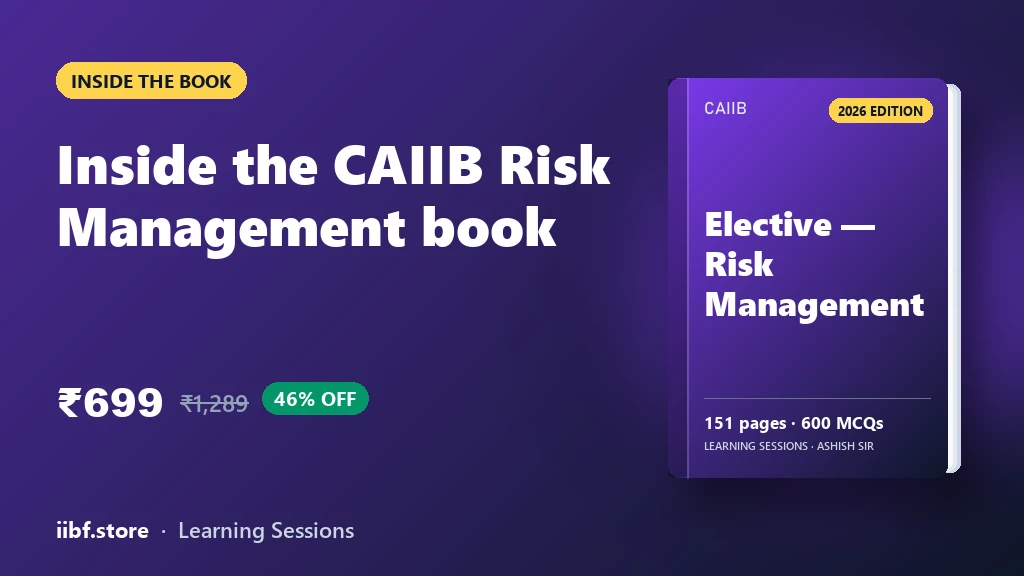
151 pages · 600 MCQs
Learning Sessions · Ashish Sir
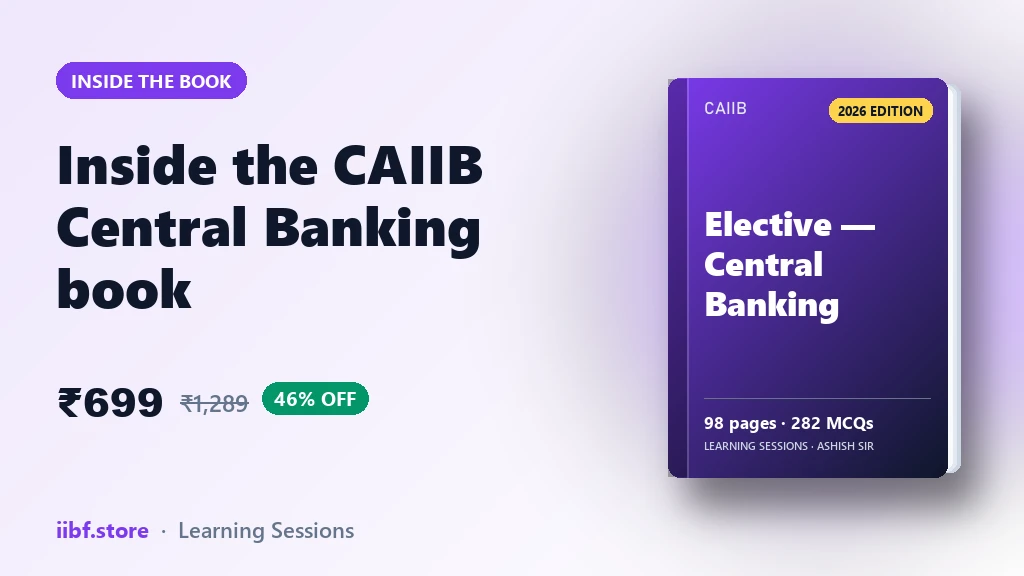
98 pages · 282 MCQs
Learning Sessions · Ashish Sir
131 pages · 672 MCQs
Learning Sessions · Ashish Sir
221 pages · 831 MCQs
Learning Sessions · Ashish Sir
128 pages · 524 MCQs
Learning Sessions · Ashish Sir
107 pages · 445 MCQs
Learning Sessions · Ashish Sir
132 pages · 225 MCQs
Learning Sessions · Ashish Sir
188 pages · 435 MCQs
Learning Sessions · Ashish Sir
117 pages · 236 MCQs
Learning Sessions · Ashish Sir
Learning Sessions · Ashish Sir
118 pages · 299 MCQs
Learning Sessions · Ashish Sir
Learning Sessions · Ashish Sir
Learning Sessions · Ashish Sir
Learning Sessions · Ashish Sir
115 pages · 255 MCQs
Learning Sessions · Ashish Sir
Learning Sessions · Ashish Sir
334 pages · 936 MCQs
Learning Sessions · Ashish Sir
Learning Sessions · Ashish Sir
115 pages · 344 MCQs
Learning Sessions · Ashish Sir
107 pages · 240 MCQs
Learning Sessions · Ashish Sir
90 pages · 150 MCQs
Learning Sessions · Ashish Sir
Learning Sessions · Ashish Sir
Quick quiz on this topic
5 exam-style questions from our free test bank — check yourself before you move on.
Practice this topic
Take a free mock test, download chapter PDFs, or watch a video class — all included on iibf.store.