Bill Discounting and Bills Purchase in Bank Credit (IIBF CCP)
Bill discounting and bills purchase is the one working-capital product where the source of repayment is written into the instrument itself. The bank is not lending against a projection or a stock statement; it is lending against a completed sale, evidenced by a bill of exchange that a named buyer must honour on a fixed date. For the IIBF Certified Credit Professional paper, this topic rewards precision. The examiner tests whether you know when a bank purchases a bill and when it discounts one, what the documentary routes do to your security, and whose credit standing actually carries the exposure.
🧾 Why Bill Finance Is Self-Liquidating Credit
Every short-term facility eventually faces the same question: where does the money to repay come from? With cash credit against inventory, the answer is a future sale that may or may not materialise. With bill finance, the sale has already happened. Goods have moved, an invoice exists, and a dated instrument now obliges the buyer to pay.
That is precisely why bill discounting and bills purchase is classified as self-liquidating credit. The very transaction that created the exposure also extinguishes it, on a date the bank knew at the time of sanction.
Three features do the heavy lifting. First, a definite due date replaces the open-ended rollover of a cash credit limit. Second, the bill is a negotiable instrument, so the bank holds statutory rights against the parties on it, not merely contractual ones. Third, in a documentary bill the bank controls the documents of title to goods until the buyer performs.
This is why the classical principles of lending — safety, liquidity and purpose are satisfied more comfortably here than in almost any other fund-based facility. When you study the range of borrower categories and credit facilities, note that bill limits are usually carved out of the assessed working capital requirement rather than added on top, so that the same receivable is not financed twice.
Bill limits are fund-based. They sit alongside, and are assessed together with, the non fund based credit limits such as letters of credit and guarantees that the same borrower enjoys.
⚖️ The Bill of Exchange Under the Negotiable Instruments Act, 1881
Section 5 of the Negotiable Instruments Act, 1881 defines a bill of exchange as an instrument in writing containing an unconditional order, signed by the maker, directing a certain person to pay a certain sum of money only to, or to the order of, a certain person or the bearer.
Three parties follow from that definition, and Section 7 names them. The drawer is the seller who makes the order. The drawee is the buyer directed to pay; once he signs across the bill he becomes the acceptor and takes on primary liability. The payee is the person entitled to receive payment — commonly the drawer himself, or the bank after endorsement.
For usance bills, Section 22 adds three days of grace to the stated tenor, so a bill drawn at 90 days after sight matures on the 93rd day. Candidates lose easy marks here every session.
Recourse is the other statutory pillar. Under Section 30, the drawer of a dishonoured bill is bound to compensate the holder, provided due notice of dishonour has been given. Noting and protest under Sections 99 and 100 preserve that evidence. So even after the bank has paid out cash, it retains a claim on its own borrower — the facility is with recourse unless the bank has expressly bought the receivable without recourse.
💡 Exam Tip: Memorise the pairing — a demand bill is purchased, a usance bill is discounted. Every other classification (clean or documentary, inland or foreign) sits on top of that base pair.
🔍 Demand or Usance, Clean or Documentary, Inland or Foreign
A demand bill (also called a sight bill) is payable on presentation. Because there is no waiting period, the bank simply purchases it and the facility is booked as bills purchased (BP). A usance bill carries a tenor — 30, 60, 90 or 120 days — so the bank discounts it and books bills discounted (BD).
A clean bill travels without documents of title; the goods have already been despatched directly to the buyer. A documentary bill is accompanied by the lorry receipt, railway receipt or bill of lading, which the bank releases only on the agreed trigger.
Within documentary bills, the trigger defines your security. Under documents against payment (D/P), the collecting bank parts with the documents only when the drawee pays — the bank retains control of the goods throughout. Under documents against acceptance (D/A), the documents go to the drawee the moment he accepts the bill, weeks before he pays. From that instant the exposure is a clean unsecured claim on the drawee's promise.
The table below is the fastest way to revise how the routes of bill discounting and bills purchase differ in risk. Learn to read it row-wise before the exam.
| Type of bill | When payable | Facility booked as | Bank holds documents of title? | Relative risk |
|---|---|---|---|---|
| Demand / sight, documentary | On presentation | Bills purchased (BP) | ✅ Yes, till payment | Lowest |
| Usance, D/P | On due date | Bills discounted (BD) | ✅ Yes, till payment | Low |
| Usance, D/A | On due date | Bills discounted (BD) | ❌ No, released on acceptance | Higher |
| Clean bill | Demand or usance | BP or BD | ❌ None exist | Highest (inland) |
| Foreign bill | Per contract | Export / import bill BP or BD | Depends on D/P or D/A | Adds country and currency risk |
Inland bills are drawn and payable in India on a resident. Foreign bills cross borders and therefore attract FEMA, FEDAI rules and exchange-rate risk on top of the ordinary credit risk. The credit delivery mechanism you choose — sole banking, multiple banking or consortium — decides which bank routes which set of bills.
🧮 Computing the Discount, the Yield and the Crystallisation Date
Discounting is front-ended interest. The bank credits the drawer the face value less the discount, and recovers the full face value on the due date. Nothing is billed monthly, which is why the effective yield always exceeds the nominal rate.
Take a bill of face value ₹10,00,000 drawn at 90 days, discounted at 10% per annum on a 365-day basis. The discount works out to ₹10,00,000 × 10% × 90/365 = ₹24,658. The drawer receives ₹9,75,342 today and the bank collects ₹10,00,000 after 90 days.
Now compute the true return. The bank has deployed ₹9,75,342, not ₹10,00,000. The 90-day return is 24,658 ÷ 9,75,342 = 2.528%, which annualises to roughly 10.25% per annum. Always check whether the question uses a 365-day or 360-day year, and whether the three days of grace are to be added.
The discount rate itself is anchored to the bank's benchmark under the external benchmark or MCLR framework, so it moves with policy rates — track them on the current RBI policy rates page.
If the drawee does not pay on the due date, the bank crystallises the bill: the outstanding is transferred out of the bills account into a demand loan or overdraft in the drawer's name, and normal interest, not discount, runs from then. For overdue foreign currency export bills, banks crystallise per a board-approved policy framed in line with FEDAI rules, converting the foreign currency liability into rupees on the crystallisation date. Under the IRAC norms, a bill purchased or discounted becomes an NPA when it remains overdue for more than 90 days — the same clock that governs the debt service coverage ratio discipline you apply to term loans.
🚩 Accommodation Bills, Co-acceptance and the Drawee Risk
The single biggest conceptual error candidates make is to treat the borrower as the risk. In bill discounting and bills purchase, the borrower is the drawer, but the money comes from the drawee. A prime-rated drawer selling to a weak buyer is a weak exposure. Appraise the drawee's payment record, the concentration of bills on a handful of drawees, and the history of returned bills.
⚠️ Common Mistake: Sanctioning a bill limit purely on the drawer's rating. Route-level discipline demands a drawee-wise sub-limit and a periodic bills-returned-unpaid statement, otherwise one weak buyer can sink the whole limit.
An accommodation bill has no genuine trade behind it. Two firms draw on each other, discount the paper and share the funds — pure financing dressed as trade. When bills keep being rotated to repay earlier bills, it is called kite-flying. Detection signals are practical: bills between associate or group concerns, round-sum amounts, identical drawer and drawee addresses, absence of transport documents, sales in the books that do not match the bills routed, and renewals or fresh bills timed to the maturity of earlier ones. The Reserve Bank's Master Directions on lending and guarantees are explicit that bill finance must be against genuine trade transactions.
Co-acceptance is the bank adding its own signature to the buyer's bill so that a third party will discount it. It creates a contingent liability that converts into a funded exposure the day the drawee fails, so it must be sanctioned as a limit, reckoned in total exposure, and reported. RBI has repeatedly restricted indiscriminate co-acceptance after past frauds; co-acceptance for parties enjoying limits elsewhere, or for group concerns, needs particular care.
💻 TReDS, Documentation and Limit Structuring
The electronic route has largely replaced paper for MSME receivables. The Trade Receivables Discounting System (TReDS) is an RBI-regulated platform where an MSME seller uploads an invoice, the corporate buyer accepts it, and financiers bid to discount it. The winning bid settles through the platform, and the transaction is without recourse to the MSME seller — the financier looks only to the buyer. RBI has widened the framework to allow insurance cover and a broader set of financiers, and the Ministry of MSME has progressively lowered the turnover threshold at which companies must onboard the platform, bringing far more buyers into scope.
Read TReDS alongside the MSMED Act, 2006, which requires buyers to pay micro and small enterprises within the agreed period, and in any case within 45 days, with penal compound interest for delay.
For a credit officer, the file for bill discounting and bills purchase must carry a sanction letter specifying BP and BD sub-limits and tenor caps, a general bills agreement, a letter of continuity or the drawer's undertaking to repay on dishonour, the drawee-wise list with sub-limits, and the trade documents themselves. Assess the limit from the sales pattern in the CMA data in credit appraisal — a bill limit larger than the credit sales that pass through it is a red flag by arithmetic alone.
Follow-up is monthly and data-driven: bills overdue ageing, drawee concentration, and the returned-bills ratio. The same discipline of classification and tabulation of banking data that CAIIB ABM teaches is exactly what turns a raw bills register into an early-warning report.
🧠 Practice MCQs: Bill Discounting and Bills Purchase
Q1. Under the Negotiable Instruments Act, 1881, the person who is directed to pay the amount of a bill of exchange is called the — (a) drawer (b) drawee (c) payee (d) endorser
Answer: (b) — The drawee is the party ordered to pay; on signing the bill he becomes the acceptor and assumes primary liability.
Q2. A bank sanctions a facility against bills payable on presentation, with no usance period. This facility is correctly described as — (a) bills discounted (b) bills sent for collection (c) bills purchased (d) co-acceptance of bills
Answer: (c) — Demand or sight bills are purchased; only usance bills carrying a tenor are discounted.
Q3. A usance bill of ₹10,00,000 for 90 days is discounted at 10% per annum on a 365-day basis. The discount amount is nearest to — (a) ₹22,500 (b) ₹27,397 (c) ₹25,000 (d) ₹24,658
Answer: (d) — 10,00,000 × 10% × 90/365 = ₹24,658, so the drawer is credited ₹9,75,342 upfront.
Q4. Under a documents against acceptance (D/A) bill, the documents of title to goods are released to the buyer — (a) against his acceptance of the bill, before payment (b) only against payment on the due date (c) only after the bill is crystallised (d) only after the bank obtains a co-acceptance
Answer: (a) — In D/A the buyer gets the goods on acceptance, so the bank's security from that point is only the acceptor's promise.
Q5. As per the IRAC norms, bills purchased and discounted are classified as non-performing when the bill remains overdue for a period of more than — (a) 30 days (b) 60 days (c) 90 days (d) 180 days
Answer: (c) — The 90-day overdue test applies to bills purchased and discounted, just as it does to term loan instalments.
Want chapter-wise mock tests with 100+ MCQs? Start practising free →
❓ Frequently Asked Questions
What exactly is the difference between bills purchased and bills discounted?
The tenor of the bill decides the label. Demand or sight bills, payable on presentation, are purchased and booked as bills purchased. Usance bills, payable after a stated period, are discounted and booked as bills discounted. The accounting entry, the interest treatment and the due-date follow-up all flow from this single distinction.
How does a bank detect accommodation or kite-flying bills?
Look for bills between associate or group concerns, identical or overlapping addresses for drawer and drawee, round-sum amounts, missing transport documents, bills value exceeding the credit sales recorded in the books, and fresh bills drawn exactly when earlier bills mature. Any two of these together justify a physical verification of the underlying trade.
Whose creditworthiness matters more — the drawer's or the drawee's?
The drawee's. He is the party who actually pays on the due date, so the primary credit risk sits with him. The drawer's standing matters for the bank's recourse if the bill is dishonoured, which is why banks maintain drawee-wise sub-limits within the overall bill limit sanctioned to the drawer.
Is discounting on TReDS with recourse to the MSME seller?
No. Financing on TReDS is structured without recourse to the MSME seller once the corporate buyer accepts the invoice on the platform. The financier's claim lies against the buyer, which is what makes the platform attractive to small suppliers who cannot offer conventional collateral.
🎯 Revise It, Then Test It
If you remember only one line from this topic, make it this: bill discounting and bills purchase is safe because the repayment is contractual and dated, and it turns risky the moment the underlying trade stops being real. Fix the demand-versus-usance pairing, the D/P versus D/A consequence, the front-ended discount arithmetic, and the crystallisation mechanic — those four carry most of the marks.
Work through the rest of the credit syllabus in sequence on the Certified Credit Professional article hub, and revise the sanction framework in the credit policy chapter. Then prove it under time pressure — take a free chapter-wise CCP mock test and see how many of these five you get right at speed.
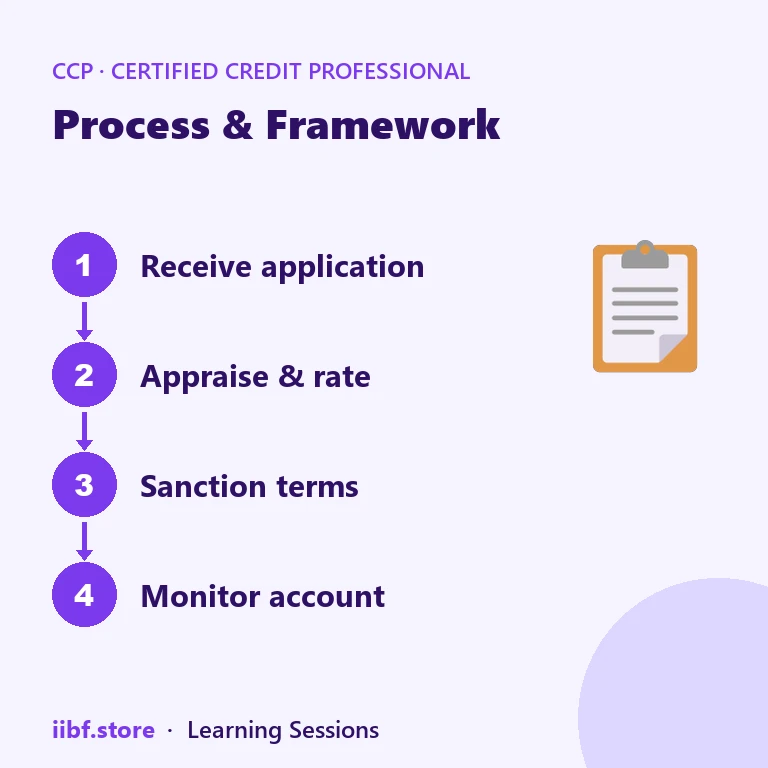
Quick quiz on this topic
5 exam-style questions from our free test bank — check yourself before you move on.
Practice this topic
Take a free mock test, download chapter PDFs, or watch a video class — all included on iibf.store.
Keep reading