Inside the CAIIB ABFM Book: 25 Chapters, 4 Modules, 375 MCQs
It is 10:40 pm. You have finished a full day at the branch, the tiffin is half eaten, and the Advanced Business and Financial Management syllabus feels like four different subjects glued together. Management theory, capital budgeting, company valuation, and then AI and SPACs. Where do you even begin? That is exactly the question this guided tour of the CAIIB ABFM book tries to answer, so that you can picture how the paper breaks down before you spend a single evening on it.
Even if you never buy anything from us, the structure below is useful. It shows you how to carve ABFM into 25 manageable pieces and how to study each piece without drowning.
Why ABFM feels harder than it is
Most working bankers do not struggle with ABFM because the ideas are impossibly difficult. They struggle because the paper jumps between very different styles of thinking. One evening you are reading about the functions of management, the next you are working out leverage and discounted cash flows, and soon after you are expected to talk about start-up finance or business analytics.
Three things make it feel heavier than it is:
- No single flow. Unlike a paper such as banking regulations, ABFM does not build one story from page one to the end. Each module is almost its own mini-subject.
- Numerical and theory mixed together. You need both the vocabulary of management and the comfort to handle capital investment and valuation problems.
- New topics keep entering. Artificial intelligence, green financing and SPACs are not the topics most of us studied during our graduation.
The fix is not more hours. It is a map. Once you see ABFM as four modules with 25 chapters in total, the paper stops being a wall and becomes a checklist you can tick off, one chapter per sitting.
How the CAIIB ABFM book is organised
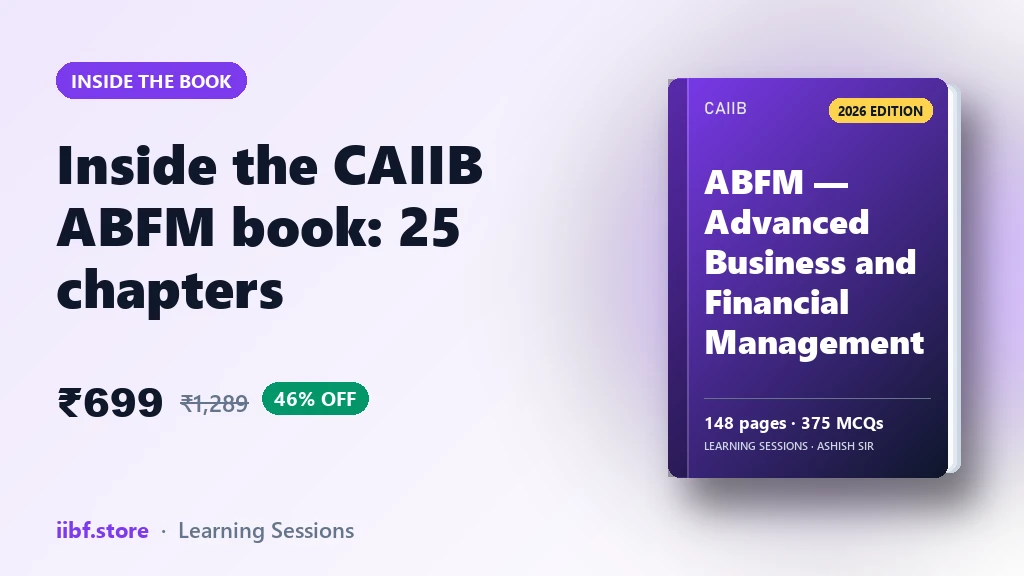
The CAIIB ABFM book from iibf.store is a printed, 2026-edition book of 148 pages. It follows the four-module structure of the paper, with 25 chapters in total and 375 MCQs. Here is what that looks like at a glance.
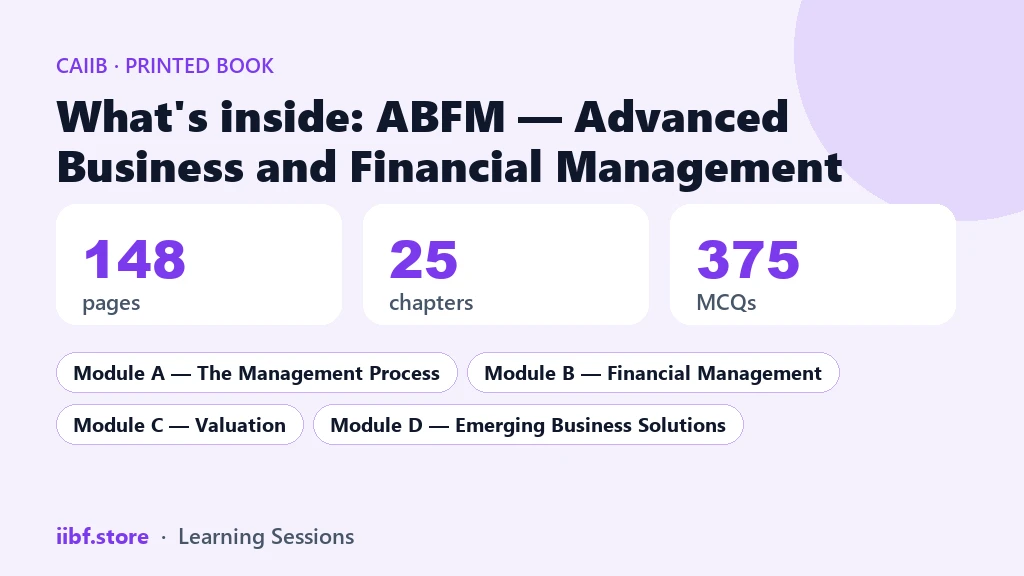
The table below lists the modules and how many chapters sit inside each. Use it as your own tracking sheet even if you are studying from another source.
| Module | Theme | Chapters |
|---|---|---|
| Module A | The Management Process | 6 |
| Module B | Financial Management | 6 |
| Module C | Valuation | 6 |
| Module D | Emerging Business Solutions | 7 |
6 + 6 + 6 + 7 gives the 25 chapters. If you are short of time, this is already a plan: roughly six sittings per module, with a little extra room for the last one.
Module A: The Management Process
This is the gentlest module and a good place to build momentum. It covers Basics of Management, Planning, Organizing, Staffing, Directing and Controlling. The six chapters follow the classic sequence of how a manager actually works, so they are easy to remember as a chain: plan, organise, staff, direct, control.
Module B: Financial Management
Here the paper gets quantitative. The chapters are Sources of Finance and Financial Strategies; Financial and Operating Leverages; Capital Investment Decisions; Capital Budgeting for International Project Investment Decisions; Adjustment of Risk and Uncertainty in Capital Budgeting Decision; and Decision Making. Many candidates find the leverage and capital budgeting chapters the most rewarding to practise, because the method is repeatable once you have seen it a few times.
Module C: Valuation
This module has six chapters: Corporate Valuations; Discounted Cash Flow Valuation; Other Non-DCF valuation models; Special cases of valuation; Mergers, Acquisitions and Restructuring; and Deal Structuring and Financial Strategies. Study the DCF chapter before the non-DCF one, so that you have a baseline to compare the alternatives against.
Module D: Emerging Business Solutions
The longest module has seven chapters: Hybrid Finance, Start-up Finance, Private Equity and Venture Capital, Artificial Intelligence, Business Analytics as Management Tool, Green and Sustainable Financing, and Special Purpose Acquisition Company. These are more descriptive, which makes them a good fit for tired weeknight reading.
What one chapter looks like
A book is only useful if you can predict what a sitting with it feels like. In the CAIIB ABFM book, each chapter follows the same rhythm, so you never waste energy working out how to read it:
- Concise notes. The chapter is condensed into the ideas an exam candidate actually needs, without the padding of a full textbook.
- Key points. The notes are pulled into points you can scan again on the day before the exam.
- MCQs. Questions at the end of the chapter let you test yourself immediately, while the material is fresh.
With 375 MCQs across 25 chapters, that works out to an average of 15 questions per chapter. That is enough to tell you honestly whether you understood the chapter, and short enough to finish in one sitting on a work night.
The same three-step habit works with any study material. Read, condense in your own words, then test. Do not skip the third step because you are tired. The test is the part that moves knowledge from short-term to long-term memory.
The extras: 100 case studies
Beyond the chapters, the book also lists 100 Case Studies (400 questions) as an extra. Case-based questions force you to apply a concept to a situation instead of simply recognising a definition. For ABFM, where capital budgeting, valuation and decision-making all lend themselves to scenarios, that practice is genuinely valuable. Treat the case studies as the second pass: first finish a module with the chapter MCQs, then come back and apply the ideas on cases.
A four-step plan to use the book
Whatever material you choose, here is a plan that fits around a full-time job. It is built on one chapter per sitting and one module at a time.
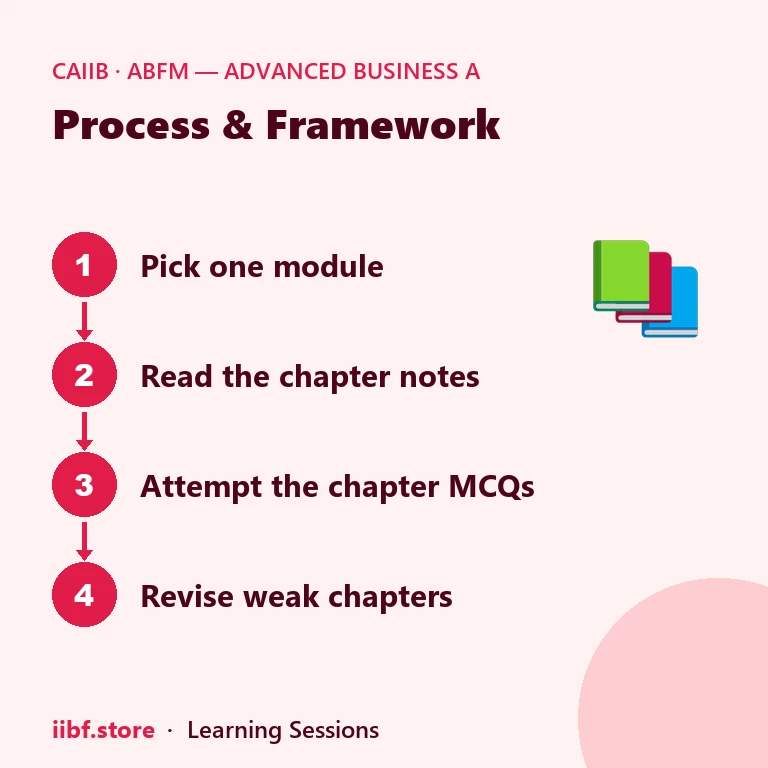
- Pick one module and commit to it. Do not hop between Module A and Module C. Finish one before starting the next so the vocabulary stays together in your head.
- Read one chapter's notes in a single sitting. Aim for 40 to 60 minutes. If a chapter feels too long for one evening, split it at a heading rather than at a random page.
- Attempt that chapter's MCQs the same day. Mark the ones you got wrong or guessed. Those are your real syllabus now.
- Revise only your marked questions on the weekend. A one-hour weekend revision of weak points beats re-reading everything.
If you want a rough pace, 25 chapters at one per weekday evening is five working weeks. At three evenings a week, it stretches to about eight to nine weeks. Choose the pace that you can keep for the whole stretch, not the one that sounds impressive on day one.
For free practice alongside this plan, you can use the free mock tests and the free study material on the site. They are a sensible way to check your progress without spending anything.
Reading the CAIIB ABFM book without burning out
Tired candidates fail by inconsistency, not by lack of intelligence. A few habits make a real difference when you are using the CAIIB ABFM book after a long day.
- Study the hardest module at your freshest time. If Module B numbers are tough for you, save them for Saturday morning, not Tuesday at 11 pm.
- Keep a one-page formula and definition sheet. Add to it after every chapter. By the exam it becomes your last-night revision.
- Do not memorise lists blindly. For Module D, understand why each emerging tool exists (for example, what problem start-up finance or green financing solves) and the lists become easy to recall.
- Protect one rest day. A paper like ABFM rewards steady effort. Burning out in week three helps nobody.
An honest word on what a book can and cannot do
A printed book gives you structure, brevity and something you can read on the metro or during a lunch break, without a screen. What it cannot give you is exam-hall speed. That comes only from timed practice, so pair any book with full-length mock tests in the weeks before the exam. Also check the official syllabus and the upcoming exam cycle on the IIBF website, because the syllabus and exam details are decided by IIBF, not by any study material.
If you want to compare options before deciding, browse the full range at iibf.store/books or read more preparation guides on the blog.
Who gets the most out of this book
Based purely on how it is built, this CAIIB ABFM book suits a few kinds of candidates in particular:
- Working bankers with limited evenings. A 148-page book with 25 short chapters is realistic to finish alongside a branch job.
- Candidates who have felt lost in thick textbooks. Concise notes and key points reduce the search for what matters.
- People who learn by testing themselves. The 375 MCQs and the 100 case studies give you plenty of practice material.
- Those who prefer paper. If you retain more when you can underline and flip pages, print still wins over a screen.
It is less ideal if you want a deep, textbook-level treatment of every topic, or if you plan to depend on a single resource with no mock tests at all. The CAIIB ABFM book works best as the spine of your preparation, supported by mocks and your own notes.
The current price is ₹699 against an MRP of ₹1,289, but prices can change, so always check the book page for the latest. A free sample is available there, so you can see the layout of a chapter yourself. For wider CAIIB preparation, the CAIIB course page lists the other papers as well.
Frequently asked questions
How many chapters and questions are in the CAIIB ABFM book?
The book has 148 pages, 25 chapters across four modules, and 375 MCQs. It also lists 100 case studies with 400 questions as an extra.
Is there a free sample I can look at first?
Yes. The book page has a free sample so you can check the layout and style of a chapter before ordering.
Can I finish ABFM with this book while working full time?
With 25 chapters, one chapter per evening is about five working weeks, and three evenings a week is roughly eight to nine weeks. Add timed mock tests towards the end, because a book alone will not build exam-hall speed.
Where do I check the official exam schedule and syllabus?
Always refer to the IIBF website at iibf.org.in for the upcoming exam cycle, syllabus and rules. Study material is only a preparation aid.
Prefer revising from a printed book?
Chapter-wise books with MCQs after every chapter — minimal pages, complete coverage, delivered anywhere in India. Every book has a free sample to read first.
148 pages · 375 MCQs
Learning Sessions · Ashish Sir
148 pages · 478 MCQs
Learning Sessions · Ashish Sir
151 pages · 465 MCQs
Learning Sessions · Ashish Sir
216 pages · 895 MCQs
Learning Sessions · Ashish Sir
109 pages · 300 MCQs
Learning Sessions · Ashish Sir
104 pages · 360 MCQs
Learning Sessions · Ashish Sir
82 pages · 297 MCQs
Learning Sessions · Ashish Sir
151 pages · 600 MCQs
Learning Sessions · Ashish Sir
98 pages · 282 MCQs
Learning Sessions · Ashish Sir
131 pages · 672 MCQs
Learning Sessions · Ashish Sir
221 pages · 831 MCQs
Learning Sessions · Ashish Sir
128 pages · 524 MCQs
Learning Sessions · Ashish Sir
107 pages · 445 MCQs
Learning Sessions · Ashish Sir
132 pages · 225 MCQs
Learning Sessions · Ashish Sir
188 pages · 435 MCQs
Learning Sessions · Ashish Sir
117 pages · 236 MCQs
Learning Sessions · Ashish Sir
Learning Sessions · Ashish Sir
118 pages · 299 MCQs
Learning Sessions · Ashish Sir
Learning Sessions · Ashish Sir
Learning Sessions · Ashish Sir
Learning Sessions · Ashish Sir
115 pages · 255 MCQs
Learning Sessions · Ashish Sir
Learning Sessions · Ashish Sir
334 pages · 936 MCQs
Learning Sessions · Ashish Sir
Learning Sessions · Ashish Sir
115 pages · 344 MCQs
Learning Sessions · Ashish Sir
107 pages · 240 MCQs
Learning Sessions · Ashish Sir
90 pages · 150 MCQs
Learning Sessions · Ashish Sir
Learning Sessions · Ashish Sir
Quick quiz on this topic
5 exam-style questions from our free test bank — check yourself before you move on.
Practice this topic
Take a free mock test, download chapter PDFs, or watch a video class — all included on iibf.store.
Keep reading