CAIIB ABM PYQ Practice: How to Use Previous Year Questions
There is a moment every CAIIB candidate hits somewhere around week three. You have read the Advanced Bank Management book once, the concepts feel familiar, and then you open a previous year paper and score 38. Nothing is technically new on that paper. You have seen every topic. You still cannot convert it into marks.
That gap is exactly what CAIIB ABM PYQ practice is meant to close, and it is why the mini marathon below runs through previous year questions rather than re-teaching the chapters. Watch it first, then come back for the method — because how you use these questions matters far more than how many of them you attempt.
ABM CAIIB 2026 PYQ Mini Marathon Part 1 · Watch on YouTube
What the ABM paper actually asks you to do
Start with the official shape of the exam, because a surprising number of candidates prepare for a paper that no longer exists. As per the IIBF Rules & Syllabus 2026, Advanced Bank Management is one of four compulsory CAIIB papers, alongside Bank Financial Management, Advanced Business & Financial Management, and Banking Regulations and Business Laws. You then pick one elective from five options.
The paper carries 100 objective multiple-choice questions for 100 marks in 2 hours, held online only, with no negative marking. IIBF also notes that some CAIIB subjects may carry numerical questions where no options are provided and the answer has to be keyed in directly. That single line changes how you should practise numericals — a guess between four options is worthless if there are no options.
Passing is 50 out of 100 in the subject. There is a second route many people miss: securing at least 45 marks in each subject with an aggregate of 50% across all subjects in a single attempt also counts as having completed the examination. You get 5 attempts within a maximum of three years from first registration, whichever comes earlier.
| Item | ABM 2026 position |
|---|---|
| Paper type | Compulsory (1 of 4) |
| Questions / marks | 100 MCQs for 100 marks |
| Duration | 2 hours, online only |
| Negative marking | None |
| Pass mark | 50/100, or 45 with 50% aggregate in one attempt |
| Attempts | 5 attempts within 3 years, whichever is earlier |
No negative marking has one practical consequence worth stating plainly: leave nothing blank. Every unanswered question is a guaranteed zero where a guess is free.
The four modules — and the one that trips people up
ABM under the current syllabus is built on four modules. Module A is Statistics. Module B is Human Resource Management. Module C is Credit Management. Module D is Compliance in Banks & Corporate Governance.
Read Module D again. It is Compliance and Corporate Governance — not Risk Management. Candidates working from older notes still prepare Risk Management as ABM Module D and walk in having studied the wrong material for a quarter of the paper. Risk Management now sits in Bank Financial Management as its Module B. If your study material predates the revision, this is the first thing to fix, and it is the single most expensive mistake in ABM preparation.
Module A covers definitions and limitations of statistics, sampling techniques and the Central Limit Theorem, measures of central tendency and dispersion, skewness and kurtosis, correlation and regression, time series, probability theory including binomial, Poisson and normal distributions, estimation, linear programming and simulation. It is the module where practice converts most directly into marks, because the question types repeat.
Module C is the heaviest in banking terms: principles of credit, analysis of financial statements, working capital finance including TReDS and non-fund-based limits, term loans and project appraisal, credit delivery and consortium lending, credit monitoring, credit rating, restructuring and stressed assets, and resolution under the Insolvency and Bankruptcy Code 2016.
How to actually run a PYQ session
Most candidates use previous year questions as a scoreboard. They attempt fifty, count the right answers, feel briefly good or briefly terrible, and move on. That produces a number, not learning. A CAIIB ABM PYQ set is a diagnostic instrument, not a mock scoreboard. The point of a question you have already seen the answer to is not the score — it is the diagnosis.
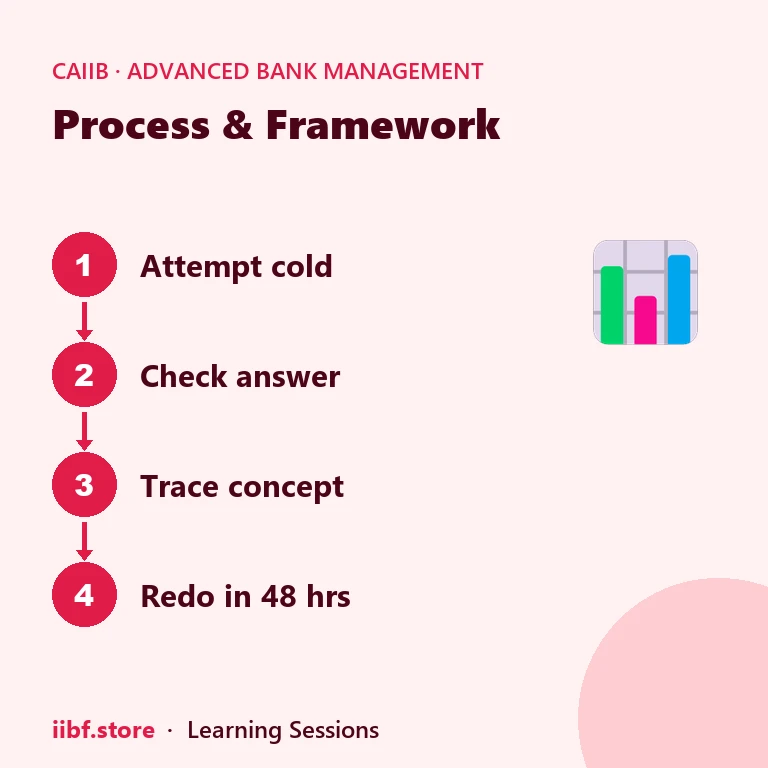
Attempt cold, with a timer and no book. Then check the answer. Then — the step everybody skips — trace the question back to the concept it came from and write that concept in one line. Then redo the same question 48 hours later without looking. If you can still do it two days on, it has moved into the memory that shows up in an exam hall. If you cannot, you had recognised the answer, not learned it.
A worked example makes this concrete. Suppose a question gives you a data set with mean 60 and standard deviation 12 and asks for the coefficient of variation. CV is standard deviation divided by mean, expressed as a percentage: 12 ÷ 60 = 0.20, so 20%. Getting that right is nice. The diagnosis is better: you now know whether you actually understand why CV exists — it lets you compare dispersion across two data sets measured in different units, which is precisely why a bank uses it to compare volatility across portfolios. Every solid CAIIB ABM PYQ attempt should end with a sentence like that, not just a tick mark.
Sequencing your remaining weeks
Order matters as much as effort, and a sensible CAIIB ABM PYQ plan follows the modules in order of payback rather than page number. Do not start at chapter one and grind forward. Start with Module A statistics, because it is self-contained and the fastest to convert into reliable marks. Move to Module C credit next, since it carries the most weight and overlaps directly with the work most bankers already do. Take Module D compliance third — it is largely factual, rewards recent RBI reading, and is where updated material pays off. Leave Module B human resource management for the final stretch; it is the most readable and least dependent on practice.
Through all of it, keep the ratio honest. Two hours of reading against thirty minutes of questions is how people end up at 38. Invert it once you have covered a module the first time. If you want structured question sets to run this loop against, the practice tests are organised paper-wise, and the Advanced Bank Management course page maps content to the current module structure. For pacing across the remaining weeks, the study planner will build the schedule for you.
Also make one habit permanent: check every rule against the source. IIBF publishes its rules and syllabus documents at iibf.org.in, and it is the only place worth trusting for exam dates, fees, and passing criteria. Consistent CAIIB ABM PYQ work plus a current syllabus beats volume every time — a hundred well-diagnosed questions will do more for you than five hundred ticked ones.
Frequently asked questions
How many questions and marks does CAIIB ABM carry?
The question paper contains 100 objective multiple-choice questions for 100 marks, to be completed in 2 hours. The exam is held in online mode only and there is no negative marking, though IIBF may vary the number of questions for a subject.
What are the passing marks for Advanced Bank Management?
The minimum for a pass in the subject is 50 out of 100. Alternatively, a candidate securing at least 45 marks in each subject with an aggregate of 50% across all subjects in a single attempt is also declared as having completed the examination.
Is Risk Management still a module in ABM?
No. The four ABM modules are Statistics, Human Resource Management, Credit Management, and Compliance in Banks & Corporate Governance. Risk Management is a module under Bank Financial Management. Older study material that lists Risk Management as ABM Module D is out of date.
How many attempts do I get to clear CAIIB?
Five attempts within a maximum period of three years from the date of registration for the first attempt, whichever comes earlier. Attempts are counted whenever you apply, whether or not you actually appear. Candidates who do not clear within that window must re-enrol afresh and lose credit for subjects passed earlier.
Prefer revising from a printed book?
Chapter-wise books with MCQs after every chapter — minimal pages, complete coverage, delivered anywhere in India. Every book has a free sample to read first.
148 pages · 478 MCQs
Learning Sessions · Ashish Sir
151 pages · 465 MCQs
Learning Sessions · Ashish Sir
148 pages · 375 MCQs
Learning Sessions · Ashish Sir
216 pages · 895 MCQs
Learning Sessions · Ashish Sir
109 pages · 300 MCQs
Learning Sessions · Ashish Sir
104 pages · 360 MCQs
Learning Sessions · Ashish Sir
82 pages · 297 MCQs
Learning Sessions · Ashish Sir
151 pages · 600 MCQs
Learning Sessions · Ashish Sir
98 pages · 282 MCQs
Learning Sessions · Ashish Sir
131 pages · 672 MCQs
Learning Sessions · Ashish Sir
221 pages · 831 MCQs
Learning Sessions · Ashish Sir
128 pages · 524 MCQs
Learning Sessions · Ashish Sir
107 pages · 445 MCQs
Learning Sessions · Ashish Sir
132 pages · 225 MCQs
Learning Sessions · Ashish Sir
188 pages · 435 MCQs
Learning Sessions · Ashish Sir
117 pages · 236 MCQs
Learning Sessions · Ashish Sir
Learning Sessions · Ashish Sir
118 pages · 299 MCQs
Learning Sessions · Ashish Sir
Learning Sessions · Ashish Sir
Learning Sessions · Ashish Sir
Learning Sessions · Ashish Sir
115 pages · 255 MCQs
Learning Sessions · Ashish Sir
Learning Sessions · Ashish Sir
334 pages · 936 MCQs
Learning Sessions · Ashish Sir
Learning Sessions · Ashish Sir
115 pages · 344 MCQs
Learning Sessions · Ashish Sir
107 pages · 240 MCQs
Learning Sessions · Ashish Sir
90 pages · 150 MCQs
Learning Sessions · Ashish Sir
Learning Sessions · Ashish Sir
Quick quiz on this topic
5 exam-style questions from our free test bank — check yourself before you move on.
Practice this topic
Take a free mock test, download chapter PDFs, or watch a video class — all included on iibf.store.