Credit Risk Management in Banks: CAIIB ABM Exam Guide
Credit risk management in banks is the discipline of pricing, limiting and monitoring the chance that a borrower does not repay — and in CAIIB Advanced Bank Management it is the single highest-scoring block of Module C. The examiner rarely asks for a definition. He asks whether you can classify an account, compute a provision, read a rating grade, or spot a stressed unit from one balance-sheet clue. This guide walks the full cycle — appraisal, sanction, documentation, monitoring, classification and recovery — with the numbers you must carry into the hall.
Everything below maps to the credit management module of the Advanced Bank Management study hub, so use it as a revision spine rather than a first reading.
🧭 The Credit Risk Cycle: Identify, Measure, Control
Credit risk is the risk of loss arising from a counterparty failing to meet its obligations on agreed terms. In an Indian bank it shows up in three forms: default risk (the borrower stops paying), concentration risk (too much exposure to one borrower, group, industry or geography) and settlement risk (value is delivered before the counter-value is received).
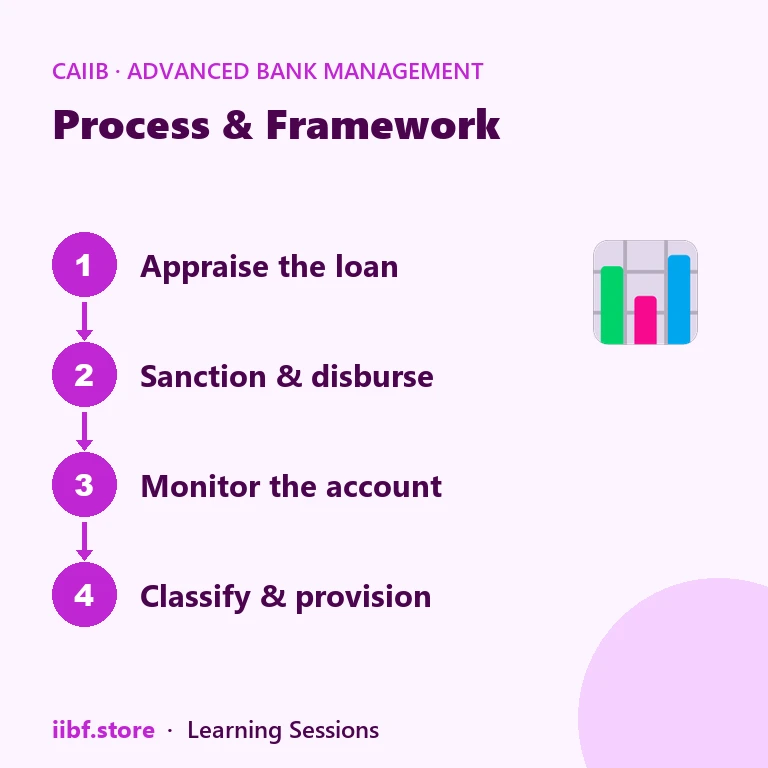
The management cycle has four stages, and CAIIB questions are usually pinned to one of them:
- Identification — credit policy, target market, entry-level rating, industry caps and prudential ceilings.
- Measurement — internal rating, probability of default, loss given default, exposure at default and expected loss.
- Control — sanction discretion, security and covenant structure, delegated powers, exposure limits.
- Monitoring and mitigation — stock statements, QIS returns, unit inspection, early warning signals, guarantees, restructuring and recovery.
The board-approved loan policy is the anchor document. It fixes the bank's risk appetite: which industries are open, which need higher rating grades, what the minimum margin is, what collateral coverage is expected, and which sanctions must travel to a higher committee. A bank that lends outside its own policy has already failed the first test of governance, irrespective of whether the account eventually turns bad.
Note the separation of duties the RBI expects: the officer who originates the proposal should not be the officer who rates it, and neither should be the officer who monitors it after disbursement. This three-line separation — business, risk and audit — is the structural answer to almost any "how should the bank prevent this" question.
💡 Exam Tip: When a question describes a control failure, first ask which of the four stages broke. Weak appraisal, weak documentation and weak monitoring produce very different correct answers even for the same NPA.
📊 Measuring Credit Risk: Rating, PD, LGD and EAD
Measurement converts judgement into a number. Every commercial exposure above the bank's threshold goes through an internal credit rating model scoring financial parameters (leverage, current ratio, interest coverage, DSCR), management quality, industry outlook and conduct of the account. The grade then drives pricing, sanctioning authority and review frequency.
Three parameters carry the quantitative load:
- Probability of default (PD) — the likelihood the borrower defaults over a one-year horizon, calibrated from the bank's own default history in each rating grade.
- Loss given default (LGD) — the fraction of exposure actually lost after recovery from security, guarantees and settlement.
- Exposure at default (EAD) — the amount outstanding when default occurs, which for a cash credit account includes expected further drawdown of the undrawn limit.
The product gives expected loss = PD × LGD × EAD. Expected loss is a cost of doing business and must be recovered through the risk premium in the interest rate. Unexpected loss — the volatility around that average — is what capital exists to absorb. That distinction is the reason a bank both provisions and holds capital: they cover different parts of the same loss distribution.
Statistical technique matters here, and CAIIB tests it directly. Rating models are validated by checking whether higher grades really do default less often, and dispersion within a grade shows whether the model discriminates. If that vocabulary feels shaky, revise measures of dispersion in statistics before attempting the credit-scoring questions, because the two modules share the same arithmetic.
Stress the assumptions too. A projection that survives a 10% fall in sales but collapses at 15% is a different credit from one that holds at both — which is exactly what sensitivity analysis in credit appraisal is designed to expose.
🏦 Appraisal Discipline: Working Capital Versus Term Loans
Appraisal is where credit risk is either created or avoided, and the two main products are appraised on completely different logic.
Working capital finances the operating cycle — the gap between paying for raw material and collecting from debtors. The assessment starts from projected sales, applies an acceptable holding period for inventory and receivables, deducts trade creditors, and arrives at the working capital gap. The borrower funds a margin from long-term sources; the bank funds the balance. Drawing power is then recomputed every month from stock and book-debt statements, net of creditors, so the limit breathes with the business. Work through the working capital finance chapter until the gap computation is automatic, because the numerical questions are formula-driven and fast marks.
Term loans finance a fixed asset and are repaid out of future cash accruals, so the appraisal is forward-looking. The key tests are debt service coverage ratio (cash accruals plus interest, divided by instalment plus interest), the debt-equity ratio, promoter contribution, moratorium against project gestation, and the sensitivity of the projections to price, volume and input-cost shocks. Repayment must be structured to the cash flow, not to a convenient equated instalment. Pair the theory with the term loan chapter and then with the credit delivery chapter, which covers consortium, multiple banking and loan syndication arrangements.
Two appraisal errors recur in case-study questions. The first is financing a long-term asset with a short-term limit, which guarantees a liquidity mismatch. The second is accepting projected sales that the unit's installed capacity cannot physically support.
⚠️ Common Mistake: Treating drawing power and sanctioned limit as the same thing. An account is irregular when the outstanding exceeds the lower of the two, and continuous irregularity for 90 days makes it out of order.
📉 IRAC Norms: When an Account Turns NPA
Asset classification is the most heavily tested topic in the whole module, because it is objective and easy to frame as a numerical. An asset becomes non-performing when it ceases to generate income for the bank. The operational triggers are: interest or instalment overdue for more than 90 days on a term loan; an out-of-order cash credit or overdraft; a bill overdue more than 90 days; and, for short-duration crops, two crop seasons.
Once an account is an NPA, income can no longer be recognised on accrual — interest already booked but not realised must be reversed. Classification then moves through sub-standard, doubtful and loss, and provisioning rises as the security cover becomes less reliable.
| Asset class | Trigger | Provision on secured portion | Provision on unsecured portion |
|---|---|---|---|
| Standard | Regular servicing | General provision as per RBI category (higher for commercial real estate) | |
| Sub-standard | NPA for up to 12 months | 15% | 25% |
| Doubtful 1 | Doubtful up to 1 year | 25% | 100% |
| Doubtful 2 | Doubtful 1 to 3 years | 40% | 100% |
| Doubtful 3 | Doubtful more than 3 years | 100% | 100% |
| Loss | Identified as unrecoverable | 100% of outstanding | |
Three rules decide most tricky questions. Classification is borrower-wise, not facility-wise, so one bad account taints every facility of that borrower with the same bank. Classification is done as part of the day-end process on the due date, so the count of overdue days is exact. And an NPA is upgraded to standard only when the entire arrears of interest and principal are paid, never on part payment. Because provisioning categories and general-provision rates are revised by circular, confirm the live figures against the RBI's own master directions and keep the current rates page open while you revise.
🛡️ Mitigation, Exposure Ceilings and Portfolio Control
Once risk is measured, it must be capped. At the transaction level the bank uses credit risk mitigation: primary security (the asset financed), collateral security, personal and corporate guarantees, credit guarantee cover for eligible micro and small enterprise loans, and covenants that restrict further borrowing, dividend payout or promoter stake dilution.
At the portfolio level, RBI's Large Exposures Framework caps a bank's exposure to a single counterparty at 20% of eligible Tier 1 capital and to a group of connected counterparties at 25%. Banks layer their own internal ceilings on top — industry caps, rating-grade caps, and sub-limits for unsecured exposure — so that a single sector downturn cannot impair the book.
Monitoring is the cheapest control available. Early warning signals include delayed submission of stock statements, frequent limit excesses, cheque returns, a sudden fall in credit summations, diversion of short-term funds into fixed assets, and disputes among promoters. Special Mention Account tagging — SMA-0, SMA-1 and SMA-2 as overdues cross 30 and 60 days — exists so the bank intervenes before the 90-day line, not after it.
Recovery follows a ladder: rephasement or restructuring where the unit is viable, compromise settlement where it is not, and enforcement through SARFAESI, the DRT or insolvency proceedings where recovery must be forced. Choosing the right rung is a viability judgement, not a legal one.
Do not forget the people dimension either — staff accountability examinations, transfers and disciplinary process interact with credit administration, and the HRM module tests that overlap through topics such as layoff and retrenchment in banks.
📌 Remember: Restructuring does not by itself upgrade an account. Viability, a signed agreement, and satisfactory performance through the specified period decide the classification.
🧠 Practice MCQs: Credit Risk Management in Banks
Q1. A term loan instalment fell due on 15 March 2026 and remained unpaid, with no other irregularity in the account. The account is classified as NPA on: (a) 15 April 2026 (b) 13 June 2026 (c) 30 June 2026 (d) 31 March 2027
Answer: (b) — The 90-day count runs from the due date, so the account becomes NPA on the 91st day, 13 June 2026.
Q2. The provision required on the secured portion of a sub-standard asset is: (a) 10% (b) 20% (c) 15% (d) 25%
Answer: (c) — Secured sub-standard advances attract 15%; the unsecured portion attracts 25%.
Q3. An advance has remained in the doubtful category for two years and is fully secured. Provision on the secured portion is: (a) 40% (b) 25% (c) 100% (d) 30%
Answer: (a) — Doubtful for one to three years (D2) requires 40% on the secured portion and 100% on the unsecured portion.
Q4. Under RBI's Large Exposures Framework, a bank's exposure to a group of connected counterparties is normally capped at: (a) 15% of Tier 1 capital (b) 20% of Tier 1 capital (c) 40% of Tier 1 capital (d) 25% of Tier 1 capital
Answer: (d) — The group ceiling is 25% of eligible Tier 1 capital; the single-counterparty ceiling is 20%.
Q5. A non-performing advance can be upgraded to the standard category only when: (a) the borrower pays the overdue interest alone (b) a fresh sanction is obtained (c) the entire arrears of interest and principal are repaid (d) the account has been an NPA for more than one year
Answer: (c) — Upgradation requires payment of the whole arrears of interest and principal, not a part payment.
Want chapter-wise mock tests with 100+ MCQs? Start practising free →
❓ Frequently Asked Questions
Is asset classification done borrower-wise or facility-wise?
Borrower-wise. If one facility of a borrower becomes non-performing, all facilities of that borrower with the same bank are classified as NPA, even if the others are being serviced regularly.
What is the difference between expected loss and unexpected loss?
Expected loss is the average loss the bank anticipates (PD multiplied by LGD and EAD) and is covered by provisions and the risk premium in pricing. Unexpected loss is the volatility around that average and is covered by regulatory capital.
When is a cash credit account treated as out of order?
When the outstanding balance remains continuously in excess of the sanctioned limit or drawing power for 90 days, or when there is no credit continuously for 90 days, or when credits are insufficient to cover the interest debited in that period.
How many marks does credit management carry in CAIIB ABM?
Credit management is one of the four modules and typically carries the largest share of case-study questions. Weightage moves between attempts, so the safest approach is to work through past papers — see our guide on using CAIIB ABM PYQ sets for the current pattern.
🚀 Revise It, Then Test It
Fix four things in memory and this topic stops costing you marks: the 90-day trigger, the provisioning ladder, the expected-loss formula, and the difference between drawing power and sanctioned limit. Everything else in the module is an application of those four. Then move straight to timed practice, because classification questions are won on speed, not on recall.
Ready to test yourself? Explore the full CAIIB preparation course →
Prefer revising from a printed book?
Chapter-wise books with MCQs after every chapter — minimal pages, complete coverage, delivered anywhere in India. Every book has a free sample to read first.
148 pages · 478 MCQs
Learning Sessions · Ashish Sir
151 pages · 465 MCQs
Learning Sessions · Ashish Sir
148 pages · 375 MCQs
Learning Sessions · Ashish Sir
216 pages · 895 MCQs
Learning Sessions · Ashish Sir
109 pages · 300 MCQs
Learning Sessions · Ashish Sir
104 pages · 360 MCQs
Learning Sessions · Ashish Sir
82 pages · 297 MCQs
Learning Sessions · Ashish Sir
151 pages · 600 MCQs
Learning Sessions · Ashish Sir
98 pages · 282 MCQs
Learning Sessions · Ashish Sir
131 pages · 672 MCQs
Learning Sessions · Ashish Sir
221 pages · 831 MCQs
Learning Sessions · Ashish Sir
128 pages · 524 MCQs
Learning Sessions · Ashish Sir
107 pages · 445 MCQs
Learning Sessions · Ashish Sir
132 pages · 225 MCQs
Learning Sessions · Ashish Sir
188 pages · 435 MCQs
Learning Sessions · Ashish Sir
117 pages · 236 MCQs
Learning Sessions · Ashish Sir
Learning Sessions · Ashish Sir
118 pages · 299 MCQs
Learning Sessions · Ashish Sir
Learning Sessions · Ashish Sir
Learning Sessions · Ashish Sir
Learning Sessions · Ashish Sir
115 pages · 255 MCQs
Learning Sessions · Ashish Sir
Learning Sessions · Ashish Sir
334 pages · 936 MCQs
Learning Sessions · Ashish Sir
Learning Sessions · Ashish Sir
115 pages · 344 MCQs
Learning Sessions · Ashish Sir
107 pages · 240 MCQs
Learning Sessions · Ashish Sir
90 pages · 150 MCQs
Learning Sessions · Ashish Sir
Learning Sessions · Ashish Sir
Quick quiz on this topic
5 exam-style questions from our free test bank — check yourself before you move on.
Practice this topic
Take a free mock test, download chapter PDFs, or watch a video class — all included on iibf.store.