CAIIB BFM Module C: Treasury Operations Made Simple
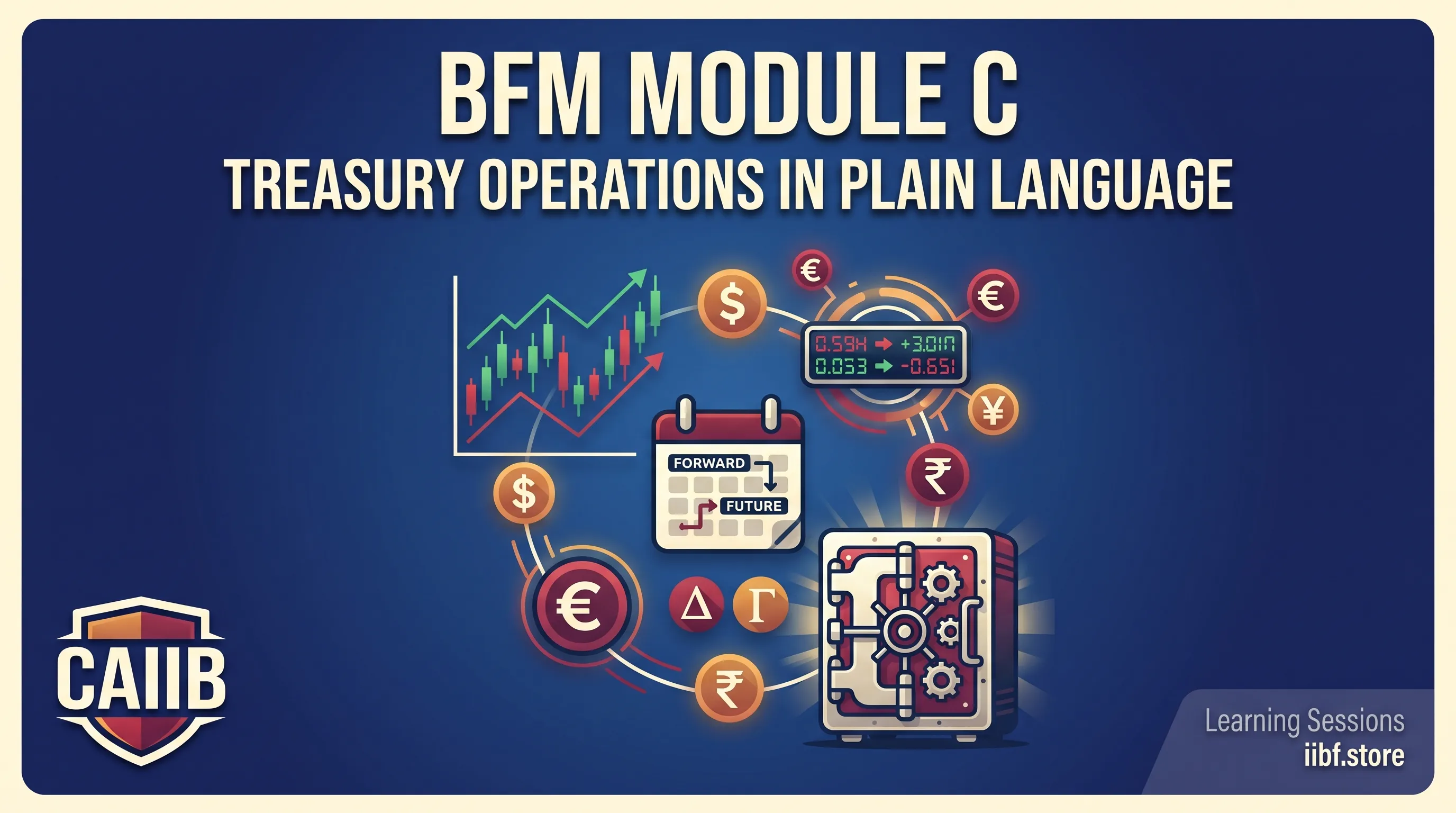
CAIIB BFM treasury operations is the part of Bank Financial Management that quietly decides how comfortable you feel walking into the exam hall. For a branch banker who has never sat at a dealing desk, Module C can read like a foreign language — spot, forward, swap, futures, options, FRA, OIS, repo, TREPS. This guide translates all of it into plain banking English, keeps every important fact intact, and hands you a formula-and-mental-model toolkit built specifically for the high-frequency questions in the CAIIB BFM paper.
Watch the full walkthrough above, then keep reading. By the end you will be able to read any textbook explanation of treasury without flinching, recognise which instrument fits which scenario, and apply the four core formulas under exam pressure.
Key takeaways
- Treasury has three jobs: manage the bank's own liquidity, trade for profit, and sell hedging products to customers.
- The money market handles instruments under one year; the capital market handles longer tenors — never mix the two.
- Forex revolves around two ideas: the spot rate and the forward rate, with the forward derived from interest-rate differentials.
- Derivatives compress into four families — forwards, futures, options and swaps.
- Memorise four formulas (T-Bill yield, forward rate, forward premium %, option payoffs) and most numerical questions become plug-and-chug.
What a bank treasury actually does
Before the jargon, fix the big picture. A bank's treasury department has three core responsibilities, and almost every Module C concept hangs off one of them.
- Balance-sheet liquidity management. Treasury makes sure the bank holds the right cash positions for daily settlement, meets SLR requirements, and borrows from the RBI window when short.
- Proprietary trading for profit. The desk takes positions in money markets, fixed income, foreign exchange and derivatives to earn spreads and capital gains.
- Customer treasury services. Treasury arranges forex remittances for importers and exporters, sells hedging products such as forwards and options, and parks corporate surpluses in money-market instruments.
These three jobs map roughly to three desks — asset-liability management (ALM), proprietary trading, and corporate treasury — though the exact structure varies from bank to bank. If you ever feel lost in Module C, ask which of these three buckets the topic belongs to. It almost always clicks back into place. For the wider balance-sheet view, our Advanced Bank Management module notes pair neatly with this chapter.
Money market: the short-term funding arena
The money market deals in instruments of less than one-year maturity. This is where banks plug overnight gaps and where the safest, most liquid paper lives. Commit the main instruments to memory.
- Call / Notice / Term Money — interbank lending. Call is overnight, Notice runs 2–14 days, and Term covers 15–365 days.
- Treasury Bills (T-Bills) — short-term Government of India borrowing in 91-day, 182-day and 364-day tenors. They are sold at a discount and redeemed at face value; the discount is the yield, and no separate interest is paid.
- Commercial Paper (CP) — unsecured short-term debt issued by highly rated corporates, maturing between 7 days and 1 year.
- Certificates of Deposit (CD) — short-term unsecured deposit certificates issued by banks, again 7 days to 1 year.
- Repo / Reverse Repo — collateralised borrowing and lending. A G-Sec is sold with an agreement to repurchase it later at a higher price; the difference is the interest cost.
- TREPS (Tri-Party Repo) — the modern, exchange-settled repo platform that replaced CBLO in 2018.
Worked example: A T-Bill of face value ₹100 and 91-day maturity is issued at ₹98.50. Discount yield = (Face − Price) / Price × (365 / Days) × 100 = (1.50 / 98.50) × (365 / 91) × 100 ≈ 6.10%. Memorise the structure; the arithmetic is mechanical.
Forex market in plain language
Two ideas carry the entire foreign-exchange portion of CAIIB BFM treasury operations, so internalise them before anything else.
Spot rate is the rate at which currency is exchanged for settlement on T+2 (two business days after the deal). It is quoted in pairs — for example, USD/INR = 84.50 means one US dollar buys 84.50 rupees.
Forward rate is the rate fixed today for settlement on a future date (1-month, 3-month, 6-month or 12-month forward). It is not a guess about the future; it is derived from the spot rate adjusted for the interest-rate differential between the two currencies:
Forward = Spot × (1 + Domestic Rate)^t / (1 + Foreign Rate)^t
If the forward rate is above spot, the foreign currency trades at a forward premium; if it is below spot, at a forward discount. The settlement conventions you must know are:
- Cash / Ready — same-day settlement.
- Tom — T+1 settlement.
- Spot — T+2 settlement.
- Forward — a specified future date.
- Swap — buying spot and selling forward (or vice versa) simultaneously.
The premium/discount calculation is an exam staple: Forward Premium or Discount % = (Forward Rate − Spot Rate) / Spot Rate × (12 / Months Forward) × 100.
Derivatives: the four-instrument toolkit
Four derivative families dominate Module C. Learn the logic of each and the terminology falls into place.
- Forward contracts — over-the-counter and fully customisable. Two parties agree a future price now and settle later.
- Futures — exchange-traded and standardised, with the same economic logic as forwards but daily mark-to-market and margins.
- Options — the buyer has the right, not the obligation, to buy (call) or sell (put) at a strike price. The seller carries the obligation if assigned.
- Swaps — two parties exchange cash flows. In an Interest Rate Swap (IRS) one pays fixed while the other pays floating; a Currency Swap does the same across two currencies.
For options, lock down the vocabulary: call, put, strike price, premium, and the moneyness trio — in-the-money, at-the-money and out-of-the-money — plus long versus short positions and European (exercisable only at expiry) versus American (exercisable any time). The four payoff diagrams — long call, short call, long put and short put — appear regularly. Draw all four once by hand, memorise the shapes, and payoff questions become recognition rather than recall. Because derivatives also sit at the heart of the wider syllabus, reinforce them with our Risk Management elective guide and the broader CAIIB ABFM guide.
Hedging: what corporates actually buy
The corporate treasury desk sells protection to importer and exporter clients. The same three tools come up again and again, and the exam loves testing which one fits a given scenario.
- Forward contract — an exporter sells dollars forward to lock in the rupee receivable. It removes downside FX risk but also caps the upside.
- Currency option — the buyer pays a premium upfront for the right to convert at a fixed rate. It protects the downside while letting the upside run, but it costs more.
- Currency swap — a borrower converts foreign-currency loan obligations into rupee cash flows across the loan tenor.
The mental shortcut: if the client wants certainty and zero upfront cost, think forward; if they want insurance with upside, think option; if they are managing a long-dated loan, think swap.
RBI's role in treasury markets
The Reserve Bank of India is both regulator and active participant in domestic treasury markets. These tools shape the rates every desk quotes.
- OMO (Open Market Operations) — the RBI buys or sells G-Secs to inject or absorb liquidity.
- LAF (Liquidity Adjustment Facility) — daily repo and reverse-repo operations that keep call-money rates inside the policy corridor.
- MSF (Marginal Standing Facility) — emergency overnight borrowing at a rate above the repo rate.
- SDF (Standing Deposit Facility) — the reverse-repo replacement that now forms the floor of the policy corridor.
- Forex intervention — the RBI buys or sells dollars in the spot market to manage rupee volatility.
Policy rates change with each Monetary Policy Committee meeting, so treat any specific number as time-sensitive and confirm the current values against the latest released RBI notification before exam day. The exam tests the mechanism far more often than the exact figure.
Instrument comparison at a glance
| Instrument | Market | Typical tenor | Key feature |
|---|---|---|---|
| Treasury Bill | Money market | 91 / 182 / 364 days | Sovereign, sold at discount |
| Commercial Paper | Money market | 7 days – 1 year | Unsecured, corporate issuer |
| Repo / TREPS | Money market | Overnight – short | Collateralised by G-Secs |
| Forward / Future | Derivatives | Custom / standardised | Lock in a future price |
| Option | Derivatives | Up to expiry | Right without obligation |
A focused study plan for Module C
Treasury looks intimidating because the language is alien, but the syllabus rewards pattern recognition over rote learning. Here is a sequence that works for busy bankers.
- Build the instrument map first. On one page, list money-market, capital-market and derivative instruments with their tenors. Most wrong answers come from mixing these buckets.
- Drill the four formulas. T-Bill yield, forward rate, forward premium %, and option payoffs. Once you know the structure, the maths is plug-and-chug.
- Draw the payoff diagrams by hand. Long call, short call, long put, short put. Spatial memory makes recall instant in the exam.
- Practise scenario questions. Pick the right hedge for a given importer or exporter, and the right RBI tool for a liquidity situation.
- Finish with timed mocks. Attempt a block of treasury questions under the clock on our CAIIB mock tests, and revise wrong answers the same day.
For quick, repeatable recall of terms and definitions, the CAIIB matching games are a fast way to lock in the vocabulary between study sessions. Once Module C feels solid, round out your ABM preparation with our guide to NPA management, classification and recovery.
If your exam is approaching, also revisit the date and readiness plan in our CAIIB Central Banking exam-date game plan so your treasury revision lands at the right time.
Common mistakes to avoid
- Mixing markets. Putting a T-Bill in the capital market or a bond in the money market is the single most common slip.
- Confusing forward premium with profit. A forward premium reflects interest-rate differentials, not a guaranteed gain.
- Swapping call and put payoffs. Always re-anchor on "call = right to buy, put = right to sell" before drawing.
- Memorising stale rates. Policy rates move with every MPC meeting; learn the mechanism and confirm current figures on the official IIBF notification and RBI releases.
- Skipping the diagrams. Students who never draw the four payoff shapes lose easy, recurring marks.
Frequently Asked Questions
Do I need Black-Scholes for CAIIB BFM treasury operations?
No. CAIIB tests conceptual understanding — what each derivative does, when it is used, and its payoff structure — along with basic pricing such as forward equals spot adjusted for cost of carry. Black-Scholes-level option pricing is outside the syllabus, so focus your energy on the four core formulas and the payoff diagrams instead.
Are forwards and futures the same thing?
Functionally they are very similar because both lock in a future price today. The differences matter for the exam: forwards are over-the-counter and customisable, while futures are exchange-traded and standardised. Futures carry daily mark-to-market and margin requirements and settle through an exchange, whereas forwards settle once at maturity and carry higher counterparty risk.
Which money-market instrument is the safest?
Treasury Bills are the safest because they are backed by the sovereign and carry effectively zero credit risk in rupee terms. Repo comes next, since it is collateralised by government securities. Commercial Paper and Certificates of Deposit carry issuer credit risk and rank below T-Bills on safety.
How current does my policy-rate knowledge need to be?
As current as the latest Monetary Policy Committee announcement. Rates such as repo, MSF and SDF can change at any MPC meeting, so always verify the prevailing numbers against the latest released RBI and IIBF notifications before exam week. In most questions, however, understanding the mechanism scores more marks than recalling the exact figure.
How much weight does treasury carry in BFM?
Module C is a substantial scoring area within Bank Financial Management, and its questions are largely formula-driven and predictable. Because the patterns repeat, a focused week on instruments, formulas and payoff diagrams can convert this module from a weakness into a reliable source of marks. Treat it as a high-return topic rather than an obstacle.
Where can I practise treasury questions for free?
You can attempt bilingual, exam-style treasury questions on the Learning Sessions CAIIB mock tests, complete with detailed explanations and a public leaderboard. Pair the mocks with the matching games for vocabulary and the video class above for concepts. Reviewing your wrong answers the same day is the fastest way to improve your Module C accuracy.
Final word
Module C feels hard only until you see its structure. Money-market instruments, forex rate calculations, derivative payoffs and the RBI's policy corridor are the four pillars, and each compresses into a small set of memorable patterns. Master those four, drill the formulas, draw the diagrams, and the bulk of the marks are yours. You are closer to clearing this paper than the jargon makes it feel — start a focused treasury session today, and let the patterns do the heavy lifting. For deeper preparation, explore every chapter PDF, video class and mock on the CAIIB course hub, browse all CAIIB guides, or confirm official details on the IIBF website.
Related Guides
📚 Free Learning Sessions resources — connect & crack your exam
- 📝 Free mock tests — chapter-wise, exam-pattern, with instant solutions
- 🎮 Matching games — gamified revision of key terms & concepts
- 📄 Study notes & PDFs — downloadable chapter material
- 🎥 Video classes on YouTube — subscribe to @learningsessions
💬 Want the full course? WhatsApp your course name to 8360944207 and our team will set you up.
📱 Study on the go — get our iOS & Android app at iibf.store/app.
Prefer revising from a printed book?
Chapter-wise books with MCQs after every chapter — minimal pages, complete coverage, delivered anywhere in India. Every book has a free sample to read first.
148 pages · 478 MCQs
Learning Sessions · Ashish Sir
151 pages · 465 MCQs
Learning Sessions · Ashish Sir
148 pages · 375 MCQs
Learning Sessions · Ashish Sir
216 pages · 895 MCQs
Learning Sessions · Ashish Sir
109 pages · 300 MCQs
Learning Sessions · Ashish Sir
104 pages · 360 MCQs
Learning Sessions · Ashish Sir
82 pages · 297 MCQs
Learning Sessions · Ashish Sir
151 pages · 600 MCQs
Learning Sessions · Ashish Sir
98 pages · 282 MCQs
Learning Sessions · Ashish Sir
131 pages · 672 MCQs
Learning Sessions · Ashish Sir
221 pages · 831 MCQs
Learning Sessions · Ashish Sir
128 pages · 524 MCQs
Learning Sessions · Ashish Sir
107 pages · 445 MCQs
Learning Sessions · Ashish Sir
132 pages · 225 MCQs
Learning Sessions · Ashish Sir
188 pages · 435 MCQs
Learning Sessions · Ashish Sir
117 pages · 236 MCQs
Learning Sessions · Ashish Sir
Learning Sessions · Ashish Sir
118 pages · 299 MCQs
Learning Sessions · Ashish Sir
Learning Sessions · Ashish Sir
Learning Sessions · Ashish Sir
Learning Sessions · Ashish Sir
115 pages · 255 MCQs
Learning Sessions · Ashish Sir
Learning Sessions · Ashish Sir
334 pages · 936 MCQs
Learning Sessions · Ashish Sir
Learning Sessions · Ashish Sir
115 pages · 344 MCQs
Learning Sessions · Ashish Sir
107 pages · 240 MCQs
Learning Sessions · Ashish Sir
90 pages · 150 MCQs
Learning Sessions · Ashish Sir
Learning Sessions · Ashish Sir
Quick quiz on this topic
5 exam-style questions from our free test bank — check yourself before you move on.
Practice this topic
Take a free mock test, download chapter PDFs, or watch a video class — all included on iibf.store.