CAIIB Central Banking Exam Date 2026: Your Game Plan
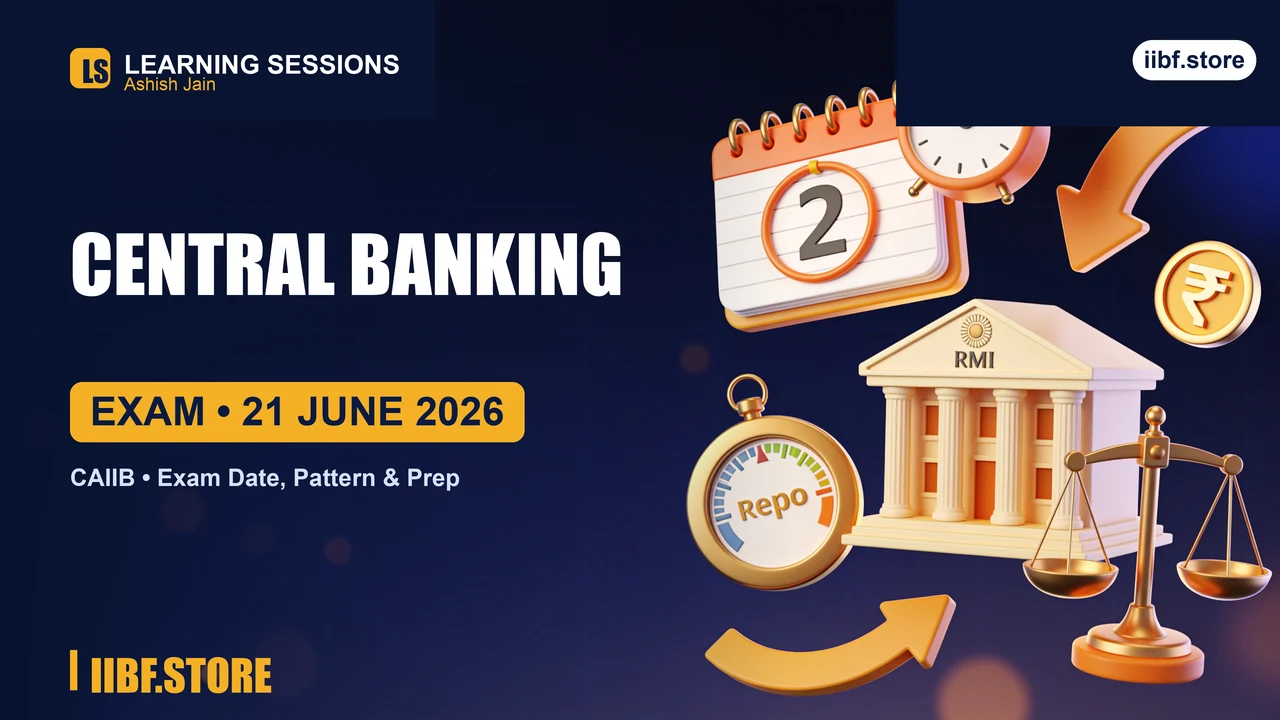
The CAIIB Central Banking exam date is the single most important number on your calendar this cycle, and as per the latest released IIBF schedule the paper sits on 21 June 2026 — always confirm it on the official IIBF notification before you firm up your plan. If you have chosen Central Banking as your CAIIB elective, this guide hands you everything that actually moves the needle: the dates that matter, what the paper genuinely tests, a week-by-week study plan, the mistakes that quietly cost marks, and a clear-eyed view of whether the June or December window suits you better.
Central Banking is one of the most rewarding electives in the CAIIB basket because the syllabus is finite and the core ideas — the role of a central bank, the Reserve Bank of India's mandate, and monetary policy — repeat with reassuring regularity. Get the foundations right once and you can answer a wide spread of questions with confidence.
Key takeaways
- The CAIIB Central Banking exam date for this cycle is 21 June 2026 as per the latest IIBF schedule — verify it on the official notification.
- IIBF conducts CAIIB twice a year, so the next opportunity is the December 2026 sitting if you miss June.
- Registration for the June cycle typically opens around March 2026; apply on day one to lock your preferred centre.
- Monetary policy and credit control is the highest-yield module — never go light here.
- The paper is objective and concept-driven; mock tests, not passive reading, are what build a pass.

When is the CAIIB Central Banking exam?
The CAIIB Central Banking exam date in this cycle is 21 June 2026, as per the latest released IIBF schedule. Because the Indian Institute of Banking & Finance (IIBF) runs CAIIB twice every year, this June sitting is one of two annual windows. If you cannot appear in June, your next chance arrives in the December 2026 cycle — but a six-month wait is a long time to keep momentum, so treat 21 June as your hard anchor and plan backwards from it.
Central Banking is an elective, which means you select it on top of the compulsory CAIIB papers. Choose it deliberately, register on time, and you give yourself a clean, focused subject to clear. Time-sensitive specifics like the exact reporting time, duration and centre allocation change cycle to cycle, so confirm them on your admit letter and the official IIBF notification.
Why Central Banking is a smart CAIIB elective
Many candidates underrate this paper because it sounds theory-heavy. In practice, Central Banking is one of the more predictable CAIIB electives. The syllabus is bounded — it revolves around the rationale for central banks, the functions of the Reserve Bank of India, the conduct of monetary policy, and the supervisory framework that keeps the financial system stable.
For working bankers, the content rarely feels abstract because it mirrors day-to-day regulatory reality. You already live with the repo rate, CRR and SLR; this elective simply explains the machinery behind them. Master the RBI's toolkit once and the same core ideas surface again and again across the question paper. If you are weighing your options across the full elective basket, the CAIIB exam hub lays out every paper side by side so you can choose the one that plays to your strengths.
What the Central Banking paper actually tests
The CAIIB Central Banking paper is an objective, multiple-choice exam that rewards understanding over rote learning. Expect application and scenario questions spread across the syllabus modules. Always confirm the current number of questions, exam duration and passing marks on the latest IIBF notification, but the smarter move is to know the syllabus cold. Here is how the marks are typically distributed across the four pillars of the paper.
| Syllabus module | What it covers | Relative weight |
|---|---|---|
| Rationale & functions of a central bank | Why central banks exist, their evolution and core objectives | Foundational |
| The Reserve Bank of India | Organisation, statutory framework and the many roles the RBI plays | High |
| Monetary policy & credit control | Policy rates, liquidity tools, transmission and the inflation-targeting framework | Highest yield |
| Supervision & financial stability | The regulatory architecture and the RBI's role in keeping the system stable | Moderate |
Notice where the weight sits. The monetary policy and credit control module is the heart of this paper, so the repo rate, CRR, SLR, open-market operations and the transmission mechanism deserve the lion's share of your study hours. To sharpen recall on the RBI's policy toolkit and supervisory terms, the CAIIB matching games turn dry definitions into quick, memorable drills.
Registration: don't miss the window
Registration for the June cycle typically opens around March 2026, but the exact dates can shift by a few days, so confirm them on the official IIBF notification. A few practical reminders before the window goes live:
- You must be a member of the Institute and have cleared JAIIB (or hold the relevant eligibility) to register for CAIIB.
- Apply early — preferred exam centres fill fast, especially in metro cities.
- Keep your photo, signature and a working payment method ready to avoid last-minute upload errors.
- Note that IIBF allows multiple attempts within a fixed time limit from your first CAIIB registration; aim to clear the elective as early as you can.
Your week-by-week plan to 21 June 2026
Counting back from the CAIIB Central Banking exam date, here is a realistic ten-week schedule that keeps the pressure low and the coverage complete. Anchor every week to 21 June and you will arrive calm, not crammed.
- Weeks 1–3 — Build the base. Cover the rationale, functions and evolution of central banks, then the RBI's structure and statutory role. Don't rush this foundation; everything else rests on it.
- Weeks 4–6 — Go deep on monetary policy. Master the repo rate, CRR, SLR, liquidity operations and the transmission mechanism. This is the highest-yield zone, so spend real time here.
- Weeks 7–8 — Supervision and stability. Work through the supervisory architecture and financial-stability role, and start one timed mock every weekend to build exam stamina.
- Weeks 9–10 — Revision and mocks. Alternate full-length tests with quick one-liner recaps, and fix weak chapters instead of chasing new ones.
- Final week — Taper. Light revision, good sleep, and a pass over high-yield definitions and policy concepts. No new topics.
If you only have six weeks, compress the foundation phase but protect at least two full weeks for mock tests — that practice block is non-negotiable. You can attempt CAIIB chapter-wise mock tests with instant explanations, and when you want a broader pool, the full Learning Sessions test library keeps you in exam rhythm right up to the day.
Common mistakes that cost marks
The candidates who slip on this paper rarely fail on knowledge — they fail on approach. Watch for these four traps:
1. Treating it as pure memorisation. The paper rewards concepts. Understand why the RBI changes a policy rate, not just the textbook definition of it.
2. Using stale figures. Policy rates and frameworks evolve. Keep your understanding of liquidity tools and the policy framework current rather than trusting old notes.
3. Skipping the monetary-policy module. It is the core of this paper, and going light here is the single most common reason candidates underperform.
4. Reading without attempting. Reading is not the same as solving under time pressure. Mocks expose weak chapters while you can still fix them.
Central Banking does not stand alone — it connects to the wider CAIIB syllabus. Recovery and regulatory topics in NPA classification, provisioning and recovery and the secured-creditor framework in the SARFAESI Act 2002 guide both deepen your grasp of how the RBI's supervisory mandate plays out in practice.
Exam-day checklist
- Carry your printed admit letter and a valid photo ID.
- Reach the centre early — aim for 45 minutes before reporting time.
- Read each question fully; Central Banking distractors are close, so don't skim.
- Attempt every question, and confirm the negative-marking rule on your admit letter before you start.
- Watch the clock — bank roughly a minute per question and flag the tough ones for review.
Frequently asked questions
What is the CAIIB Central Banking exam date in 2026?
As per the latest released IIBF schedule, the CAIIB Central Banking elective falls on 21 June 2026 in this cycle. Because IIBF runs CAIIB twice a year, the next sitting is in the December 2026 window. Always reconfirm the exact date on the official IIBF notification before finalising your plan.
When does registration for the June cycle open?
Registration for the June cycle generally opens around March 2026. Apply on the first day the window goes live to secure your preferred centre, since metro-city seats fill quickly. The precise opening and closing dates can shift slightly, so verify them on the official IIBF site.
Is there negative marking in the CAIIB Central Banking paper?
CAIIB objective papers generally do not carry negative marking, so the smart move is to attempt every question. That said, rules can change between cycles. Always reconfirm the current negative-marking rule printed on your admit letter before the exam begins.
What are the eligibility requirements for the elective?
To register for CAIIB and its electives, you must be a member of the Institute and have cleared JAIIB or hold the relevant eligibility. Central Banking is taken on top of the compulsory CAIIB papers. Confirm the current eligibility criteria on the official IIBF notification before you apply.
How many attempts do I get to clear Central Banking?
IIBF allows multiple attempts within a fixed time limit from your first CAIIB registration. The exact number of attempts and the time window are set out in the official rules. Check the current limit on the IIBF notification and aim to clear the paper as early as possible.
Should I pick the June or December cycle?
If you have a few months in hand, the June 2026 sitting is usually the practical choice, because registering in March gives you an unhurried study runway. The December cycle suits candidates already comfortable with the RBI and monetary-policy basics, or those who cannot free up time before June. Either way, commit early and protect your mock-test weeks.
June or December — making the call
The strategy is identical whichever window you pick: choose the cycle you can realistically prepare for, register on the first day the window opens, and protect your mock-test weeks. Switching cycles late only resets your momentum, so decide once and stick to it. For a sense of how the elective calendar sits alongside the compulsory papers, the CAIIB BRBL exam-date game plan is a useful companion read, and you can browse every guide for this exam in one place at the CAIIB blog hub.
Whatever you decide, treat the official source as the final word — cross-check every date, fee and rule on the IIBF official website before you act on it.
Final word
The CAIIB Central Banking exam date of 21 June 2026 is closer than it looks once March registration opens, so lock the date, register on time, and work a steady plan instead of a last-month sprint. Start with the syllabus, go deep on monetary policy, layer in mock tests and one-liners, and fix your weak modules through practice. Do that, and you will walk into the hall ready to clear the Central Banking elective on your first attempt.
Related Guides
📚 Free Learning Sessions resources — connect & crack your exam
- 📝 Free mock tests — chapter-wise, exam-pattern, with instant solutions
- 🎮 Matching games — gamified revision of key terms & concepts
- 📄 Study notes & PDFs — downloadable chapter material
- 🎥 Video classes on YouTube — subscribe to @learningsessions
💬 Want the full course? WhatsApp your course name to 8360944207 and our team will set you up.
📱 Study on the go — get our iOS & Android app at iibf.store/app.
Quick quiz on this topic
5 exam-style questions from our free test bank — check yourself before you move on.
Practice this topic
Take a free mock test, download chapter PDFs, or watch a video class — all included on iibf.store.
Keep reading