Compliance Testing and Monitoring in Banks: IIBF BCP Guide 2026
A compliance policy that nobody tests is just a document. In Indian banking, compliance testing and monitoring is the machinery that converts a written policy into demonstrable regulatory assurance — it is how a bank proves to the Reserve Bank of India, to its Audit Committee of the Board (ACB) and to itself that the rules it has adopted are actually being followed at the branch counter, in the loan sanction note and inside the core banking system. For candidates preparing for the IIBF Banking Compliance Professional (BCP) certification, this is one of the highest-yield areas in the syllabus, because it links the compliance function to almost every other module you study.
RBI's framework circular on the Compliance Function in banks (issued in September 2020) expects every bank to run a structured, risk-based compliance testing programme rather than ad hoc checks. This guide walks through how the programme is designed, how tests are executed, how results are monitored and escalated, and the mistakes that cost marks in the exam and credibility in the job.
🔍 What Compliance Testing and Monitoring Actually Means
Compliance testing is the independent verification that a specific regulatory requirement is being complied with in practice. Monitoring is the ongoing, largely continuous surveillance that detects deviations between two testing cycles. The two are complementary: testing gives depth at a point in time, monitoring gives breadth over time.
The distinction matters because the compliance function is a second line of defence. The first line — the business unit — owns the control and performs its own checks. Compliance does not re-do the business unit's work; it tests whether the control the business claims to operate genuinely exists, is designed correctly and is operating effectively. Internal audit, as the third line, then independently assures that compliance itself is doing its job.
A well-constructed test has four elements: the regulatory source (circular, Master Direction, statute), the control expected to deliver it, the population from which evidence is drawn, and the pass/fail criterion. Vague tests such as "check whether KYC is done" fail because they have no criterion. A usable test reads: "For 50 accounts opened in Q1, verify that customer due diligence was completed and risk categorisation assigned before the first credit transaction; any exception is a fail."
Testing must cover both prudential and conduct obligations. Prudential testing touches areas like exposure ceilings and asset classification — see our chapter on IRAC norms and wilful defaulters. Conduct testing covers customer service, fair practices, mis-selling and grievance handling.
💡 Exam Tip: If a question contrasts "compliance testing" with "internal audit", the differentiator is independence level and scope — compliance tests specific regulatory obligations continuously; audit assures the whole control environment periodically, including the compliance function itself.
🗂️ Building the Annual Compliance Testing Plan
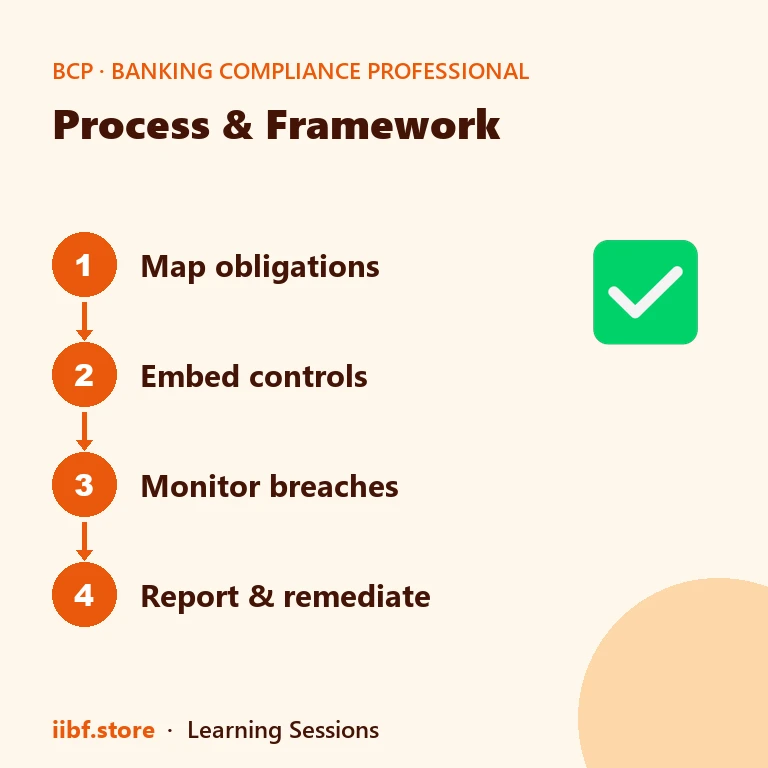
The starting point is the compliance risk assessment. Each regulatory obligation is scored on inherent risk (impact of breach, likelihood, regulatory attention, past incidents) and on control strength. High-residual-risk obligations get tested more frequently and with larger samples; low-risk obligations may be tested once a year or on a rotational basis over two to three years.
A defensible plan documents, for every line item: the obligation, the owning business unit, the risk rating, the testing frequency, the sample size logic, the tester, and the reporting month. The plan is approved by the ACB — not merely noted — and material changes mid-year require fresh approval with reasons. Because regulations change constantly, the plan must be a living document: every new RBI Master Direction or circular should trigger a gap assessment that either maps to an existing test or creates a new one.
Coverage should be mapped against the bank's own regulatory universe. Lending-side obligations such as those covered in loans and advances regulatory restrictions and the ceilings discussed under large exposures and exposure norms are natural high-risk candidates, because breaches there are visible directly in regulatory returns and attract supervisory action quickly.
Resourcing is the constraint that breaks most plans. A programme that promises 400 tests with a team of four will silently degrade into desk reviews. It is far better to test 120 obligations properly and disclose the uncovered residual to the ACB than to claim full coverage on paper. The risk assessment that drives the plan is the same exercise described in our guide to RCSA in banking compliance.
🧪 Testing Techniques and When to Use Each
Banks use several testing methods, and the BCP exam frequently asks which method suits a given scenario. Sample-based transaction testing draws a statistically or judgementally selected set of transactions and inspects evidence. Thematic reviews take a single theme — say, digital lending disclosures — across the whole bank. Automated or rule-based monitoring runs continuously in the system and flags every exception rather than a sample. Self-certification asks the business to attest compliance, and is the weakest form because it is unverified.
| Method | Best suited for | Evidence depth | Full population covered? |
|---|---|---|---|
| Sample transaction testing | Documented, manual controls (KYC files, sanction notes) | High | ❌ |
| Thematic review | New regulations, post-incident deep dives | High | ❌ |
| Automated rule monitoring | System-enforced limits, interest rates, exposure caps | Medium | ✅ |
| Concurrent / branch-level checks | High-volume day-to-day operations | Medium | ❌ |
| Business self-certification | Low-risk obligations only | Low | ✅ (unverified) |
The rule of thumb: wherever a control is embedded in the system, prefer automated monitoring, because it covers 100% of the population and costs almost nothing to repeat. Where the control depends on human judgement — a relationship manager's suitability assessment, a branch manager's override — sampling is unavoidable, and the sample must be skewed towards high-value, high-risk and exception cases rather than drawn purely at random.
⚠️ Common Mistake: Treating self-certification as a test. A signed attestation from the business is a management representation, not compliance evidence. If a test result rests only on what the business said, it cannot be reported as "tested and compliant".
📈 Monitoring, Reporting and Escalation to the ACB
Test results are worthless if they die in a spreadsheet. Every finding should carry a severity rating, a root cause, a named owner, an agreed remediation action and a due date — and the compliance function must track closure independently rather than accepting the owner's word. Findings that are overdue must age visibly in the report, because ageing is the single most persuasive metric in front of a board committee.
Reporting normally runs on three tracks. Operational findings go to the business unit head immediately. A consolidated monthly or quarterly compliance report goes to the MD & CEO and to the ACB, covering test coverage achieved versus plan, open findings by severity and ageing, regulatory changes absorbed, and any breaches reportable to RBI. Serious breaches — those with financial, customer or supervisory consequences — escalate immediately outside the reporting calendar, since delayed escalation is itself treated as a compliance failure.
The Chief Compliance Officer's independence is what makes this credible. RBI's framework prescribes a minimum fixed tenure for the CCO, a senior grade, board-approved appointment and removal, and reporting lines that do not run through the business. Read the RBI's own supervisory material on the Reserve Bank of India website for the underlying circulars before the exam.
Monitoring outputs also feed the supervisory process. Under RBI's risk-based supervision, the quality and honesty of a bank's own compliance monitoring influences its supervisory rating — a bank that finds and fixes its own breaches is treated far more favourably than one where the regulator finds them first. This links closely to the assurance perspective in risk based internal audit in banks.
🚧 Where Testing Programmes Break Down
The recurring failure patterns are worth memorising, because BCP questions are often framed as short case studies. First, stale coverage: the plan was built three years ago and never re-mapped to new regulations, so entire areas like digital lending or data handling go untested. Second, sample bias: testers pick clean, easily available files, so the pass rate looks excellent while the real exceptions sit untouched.
Third, root cause blindness. If the same finding recurs each cycle, the remediation was cosmetic — retraining a branch does not fix a system that permits the breach. Fourth, ownership drift, where compliance ends up owning the fix as well as the finding, which destroys the second-line boundary. Fifth, evidence gaps: a test with no retained working papers cannot be defended during a supervisory inspection, and effectively did not happen.
Data-related obligations deserve special mention, since they now cut across every product. Testing whether customer data is stored, transferred and retained lawfully overlaps with the areas covered in our guide to the data protection framework for banks and the storage rules explained under data localisation norms for banks.
📌 Remember: Coverage, evidence, severity, closure. If your answer to a descriptive BCP question on monitoring touches all four, you will secure most of the available marks.
For more study material across this certification, browse the Banking Compliance Professional article hub.
🧠 Practice MCQs: Compliance Testing and Monitoring
Q1. In the three lines of defence model, compliance testing is performed by which line? (a) First line (b) Second line (c) Third line (d) External auditors
Answer: (b) — Compliance is the second line; the business owns controls (first line) and internal audit assures independently (third line).
Q2. Which testing method covers the entire population of transactions? (a) Judgemental sampling (b) Thematic review (c) Automated rule-based monitoring (d) Concurrent branch check
Answer: (c) — System-embedded rule monitoring evaluates every transaction, unlike sample-based methods.
Q3. The annual compliance testing plan should primarily be approved by: (a) The branch manager (b) The Audit Committee of the Board (c) The RBI (d) The external auditor
Answer: (b) — The ACB approves the plan, and material mid-year changes need fresh approval with reasons.
Q4. Business self-certification is considered a weak form of assurance because it is: (a) Too expensive (b) Unverified by an independent party (c) Not permitted by RBI (d) Only usable for lending
Answer: (b) — It is a management representation, not independently corroborated compliance evidence.
Q5. Repeated recurrence of the same finding in successive testing cycles most likely indicates: (a) Sample size was too large (b) The root cause was never addressed (c) The obligation is low risk (d) Testing frequency is excessive
Answer: (b) — Recurrence signals cosmetic remediation rather than a genuine root-cause fix.
Want chapter-wise mock tests with 100+ MCQs? Start practising free →
❓ Frequently Asked Questions
How often should compliance testing be carried out?
Frequency is risk-driven. High-residual-risk obligations are typically tested quarterly or monthly, medium-risk half-yearly or annually, and low-risk items on a rotational cycle. The frequency and its rationale should be documented in the board-approved testing plan.
What is the difference between compliance monitoring and internal audit?
Compliance monitoring is continuous second-line surveillance of specific regulatory obligations. Internal audit is periodic third-line assurance over the whole control environment, including an assessment of whether the compliance function itself is effective.
Who is accountable for fixing a compliance testing finding?
The business unit that owns the control is accountable for remediation. The compliance function owns the finding, tracks the action to closure and validates the fix, but must not take over the remediation itself.
How important is this topic for the IIBF BCP exam?
Very. Testing and monitoring links to almost every module, and questions frequently appear as short scenarios asking you to identify the correct method, the right escalation route or the failure in a described programme.
🎯 Conclusion
A compliance testing and monitoring programme succeeds when it is risk-prioritised, evidence-backed, honestly reported and relentlessly followed up to closure. Everything else — sample sizes, templates, dashboards — is detail around those four pillars. Master this framework and a large slice of the BCP syllabus becomes intuitive rather than memorised.
Ready to test yourself under exam conditions? Take a free IIBF mock test now → and identify your weak modules before the real paper does.
Prefer revising from a printed book?
Chapter-wise books with MCQs after every chapter — minimal pages, complete coverage, delivered anywhere in India. Every book has a free sample to read first.
Learning Sessions · Ashish Sir
132 pages · 225 MCQs
Learning Sessions · Ashish Sir
188 pages · 435 MCQs
Learning Sessions · Ashish Sir
117 pages · 236 MCQs
Learning Sessions · Ashish Sir
Learning Sessions · Ashish Sir
118 pages · 299 MCQs
Learning Sessions · Ashish Sir
Learning Sessions · Ashish Sir
Learning Sessions · Ashish Sir
Learning Sessions · Ashish Sir
115 pages · 255 MCQs
Learning Sessions · Ashish Sir
Learning Sessions · Ashish Sir
334 pages · 936 MCQs
Learning Sessions · Ashish Sir
Learning Sessions · Ashish Sir
115 pages · 344 MCQs
Learning Sessions · Ashish Sir
107 pages · 240 MCQs
Learning Sessions · Ashish Sir
90 pages · 150 MCQs
Learning Sessions · Ashish Sir
131 pages · 672 MCQs
Learning Sessions · Ashish Sir
221 pages · 831 MCQs
Learning Sessions · Ashish Sir
128 pages · 524 MCQs
Learning Sessions · Ashish Sir
107 pages · 445 MCQs
Learning Sessions · Ashish Sir
148 pages · 478 MCQs
Learning Sessions · Ashish Sir
151 pages · 465 MCQs
Learning Sessions · Ashish Sir
148 pages · 375 MCQs
Learning Sessions · Ashish Sir
216 pages · 895 MCQs
Learning Sessions · Ashish Sir
109 pages · 300 MCQs
Learning Sessions · Ashish Sir
104 pages · 360 MCQs
Learning Sessions · Ashish Sir
82 pages · 297 MCQs
Learning Sessions · Ashish Sir
151 pages · 600 MCQs
Learning Sessions · Ashish Sir
98 pages · 282 MCQs
Learning Sessions · Ashish Sir
Practice this topic
Take a free mock test, download chapter PDFs, or watch a video class — all included on iibf.store.
Keep reading