Recruitment and Selection in Banks: CAIIB HRM Guide 2026
Recruitment and selection in banks is one of the most examinable areas of the CAIIB Human Resources Management elective, because it links directly to how Indian banks build capability, control cost and manage risk. Every branch you walk into is the end product of a hiring decision taken months or years earlier. Studying recruitment and selection in banks properly means understanding the full chain. This guide explains manpower planning, sources of recruitment, selection tools, induction and probation in the Indian banking context, and finishes with practice MCQs and FAQs shaped like the real CAIIB paper.
👥 Why Recruitment and Selection Matter in Banking
Banks are people-intensive service organisations. Unlike a manufacturing unit, a bank cannot store its output; the quality of a loan appraisal, a KYC check or a customer conversation is produced and consumed at the same moment by an employee. That makes the hiring decision a direct operational-risk decision, not merely an administrative one.
Three structural pressures make this topic important for the 2026 exam. First, large-scale retirements in public sector banks have created continuous replacement demand at officer and clerical grades. Second, digital banking has changed the skill mix required — banks now hire for analytics, cyber security, treasury and IT alongside traditional generalist roles, often on lateral or contractual terms. Third, competition from private banks, small finance banks, NBFCs and fintechs has raised attrition, so a bank that recruits poorly pays twice: once in training cost and again in replacement cost.
In HRM theory, recruitment is a positive process — it widens the pool by attracting applicants. Selection is a negative process — it narrows that pool by rejecting unsuitable candidates. Examiners test this distinction relentlessly, so fix it early. Recruitment creates options; selection makes choices.
The foundations are covered in the study chapter on Fundamentals of HRM, which frames staffing as one of the core managerial functions alongside training, appraisal and reward.
💡 Exam Tip: If a question asks which process is "positive" and which is "negative", the answer is recruitment (positive, attracting) and selection (negative, rejecting). This one-liner appears in some form almost every cycle.
🗂️ Manpower Planning, Job Analysis and Job Description
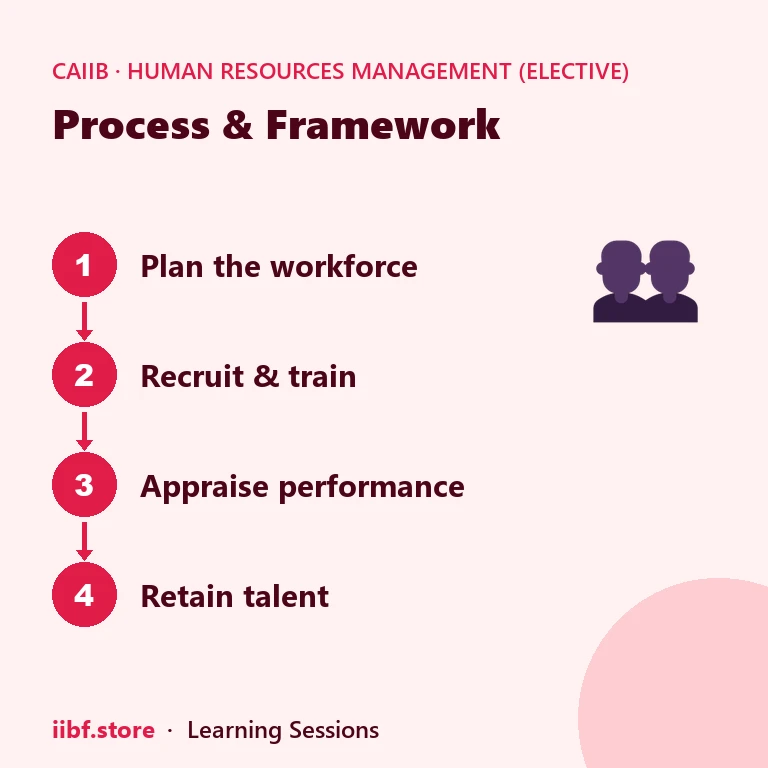
Recruitment does not begin with an advertisement. It begins with manpower planning (human resource planning) — estimating how many people, with what skills, will be needed at which locations and by when. The classic sequence is: analyse business plan → forecast demand → assess internal supply → identify the gap → decide the action (recruit, redeploy, train or outsource).
Demand forecasting in banks commonly uses workload analysis (business per employee, accounts per branch), ratio-trend analysis, and managerial judgement. Supply-side assessment relies on skills inventories, age profiles and attrition data. A bank with a heavy retirement bulge in the next three years must start recruiting today, because a probationary officer takes roughly two to three years to become fully productive.
The gap then feeds job analysis, which produces two documents students must never confuse:
- Job description — describes the job: title, duties, reporting relationships, authority limits, working conditions.
- Job specification — describes the person: qualifications, experience, competencies, aptitude and behavioural attributes needed to do that job.
Modern banks increasingly write job specifications as competency profiles rather than degree lists — for example, "credit appraisal, negotiation, digital literacy, regulatory awareness". That approach connects this chapter to talent management in banks, where the same competency framework drives development and succession. It also links downstream: a clean job description is the basis of an objective appraisal and of fair compensation management in banks.
📌 Remember: Job analysis is the parent process. Job description (the job) and job specification (the person) are its two outputs. Manpower planning tells you how many; job analysis tells you who.
🧭 Sources and Methods of Recruitment in Indian Banks
Sources are classified as internal and external. Internal sources include promotion, transfer, internal job posting, redeployment and re-employment of retired staff on contract. They are cheaper, faster, lower-risk (the candidate is a known quantity) and motivate existing staff — but they risk inbreeding, offer no fresh perspective and simply move the vacancy elsewhere in the organisation.
External sources include common written examinations, campus recruitment, employment exchanges, professional and executive search firms, job portals, employee referrals and unsolicited applications. External hiring brings new skills and demographic renewal, but costs more, takes longer and carries higher settlement risk.
In Indian public sector banks, the dominant external channel is the common recruitment process conducted by the Institute of Banking Personnel Selection (IBPS) for clerical and probationary officer cadres, with the State Bank of India running its own examinations. The typical architecture is a preliminary objective test, a main examination, and then an interview or group exercise, followed by a merit list and document verification. Specialist officer posts — IT, risk, law, agriculture, chartered accountants — are recruited through separate notifications, and senior lateral hires are increasingly made by direct advertisement.
Private and small finance banks rely far more on referrals, job portals, campus hiring and search firms, which gives them speed but exposes them to higher early attrition. Whichever channel is used, the bank must comply with reservation policy where applicable, with fair-employment norms, and with fit-and-proper standards. Official recruitment notifications and certification pathways are published by the Indian Institute of Banking & Finance, and supervisory expectations on governance and staffing of key functions come from the Reserve Bank of India.
For the Indian institutional detail, work through the chapter on HRM in Indian Banks.
✅ Selection Tools Compared
Selection is a series of successive hurdles: application screening → written/online test → group discussion or case exercise → interview → reference and background check → medical fitness → offer and document verification. Each stage removes candidates, so the order matters — cheap, high-volume filters go first; expensive, high-information tools go last.
Two technical terms are frequently examined. Reliability means a selection tool gives consistent results on repetition. Validity means it actually predicts job performance. A test can be reliable but invalid (consistently measuring the wrong thing); it cannot be valid without being reliable.
| Selection tool | What it measures | Cost per candidate | Predictive validity | Suitable for mass recruitment? |
|---|---|---|---|---|
| Online objective test | Reasoning, quantitative, English, banking awareness | Low | Moderate–high | ✅ |
| Structured interview | Motivation, communication, judgement | Medium | Moderate–high | ❌ |
| Unstructured interview | General impression | Medium | Low | ❌ |
| Group discussion | Team behaviour, articulation | Low–medium | Moderate | ✅ |
| Psychometric / personality test | Traits, integrity, work style | Medium | Moderate | ✅ |
| Assessment centre | Multiple competencies via simulations | High | High | ❌ |
| Reference & background check | Antecedents, integrity | Low | Screening only | ✅ |
Note the pattern the examiner wants: assessment centres have the highest validity but the highest cost, so banks reserve them for senior and specialist roles; structured interviews beat unstructured ones because the same questions and scoring rubric are applied to every candidate, reducing interviewer bias.
⚠️ Common Mistake: Candidates write that "an interview has high validity". A structured interview does; an unstructured, free-flowing interview is one of the weaker predictors of job performance because of halo effect, first-impression bias and stereotyping.
🌱 Induction, Probation and Making the Hire Stick
A selection decision is only half the investment. Induction (orientation) introduces the new entrant to the bank's values, code of conduct, products, systems, compliance obligations and reporting lines. Good induction shortens time-to-productivity and sharply reduces first-year attrition; poor induction produces "reality shock", where the job the recruit imagined does not match the job that exists.
Placement follows induction — matching the person to a specific role and branch. Probation then serves as the final selection filter: performance is observed on the job, and confirmation is granted only if the recruit meets the standard. Many banks pair probation with a mentor or buddy, on-the-job rotation across counters, and a structured learning plan tied to internal certification.
Retention completes the cycle. Recruitment cost is wasted if the recruit leaves within eighteen months, which is why hiring policy must be read together with employee engagement practices in banks and with career-path design. The chapter on Human Resource Development Strategies and Systems ties staffing to the wider HRD architecture.
Finally, remember that HR decisions have balance-sheet consequences: understaffed credit departments weaken appraisal quality, a point developed in the ABM guide to the credit management lifecycle. Browse more revision notes on the Human Resources Management (Elective) tag hub.
🧠 Practice MCQs: Recruitment and Selection in Banks
Q1. Recruitment is described as a positive process and selection as a negative process because — (a) recruitment is cheaper (b) recruitment attracts applicants while selection rejects them (c) selection is done by outsiders (d) recruitment is optional
Answer: (b) — Recruitment widens the applicant pool; selection narrows it by eliminating unsuitable candidates.
Q2. A document that lists the qualifications, experience and competencies required in a candidate is called — (a) job description (b) job evaluation (c) job specification (d) job enrichment
Answer: (c) — Job specification describes the person; job description describes the job.
Q3. Which of the following is an internal source of recruitment? (a) Campus recruitment (b) Employee referral of an outsider (c) Internal job posting and promotion (d) Executive search firm
Answer: (c) — Promotion, transfer and internal job posting draw on existing employees.
Q4. A selection test that gives consistent results on repeated administration but fails to predict job performance is — (a) valid but unreliable (b) reliable but not valid (c) both valid and reliable (d) neither
Answer: (b) — Consistency is reliability; predicting performance is validity.
Q5. The selection method generally regarded as having the highest predictive validity but the highest cost per candidate is — (a) unstructured interview (b) online objective test (c) assessment centre (d) reference check
Answer: (c) — Assessment centres use multiple simulations and assessors, giving high validity at high cost, so banks use them mainly for senior and specialist roles.
Want chapter-wise mock tests with 100+ MCQs? Start practising free →
❓ Frequently Asked Questions
What is the difference between recruitment and selection?
Recruitment is the process of searching for and attracting a pool of applicants for a vacancy. Selection is the process of screening that pool and choosing the most suitable candidate. Recruitment is positive and expansive; selection is negative and eliminative.
Which body conducts common recruitment for public sector banks in India?
The Institute of Banking Personnel Selection (IBPS) conducts the common recruitment process for clerical, probationary officer and specialist officer cadres in participating public sector banks. The State Bank of India conducts its own separate recruitment examinations.
Why do banks use structured rather than unstructured interviews?
A structured interview asks every candidate the same predetermined questions and scores answers against a rubric. This improves reliability, reduces halo effect and interviewer bias, and makes the decision defensible if challenged — all of which raise predictive validity.
How much of the CAIIB HRM paper does this topic carry?
IIBF does not publish a fixed mark-wise break-up, but staffing topics — manpower planning, job analysis, recruitment sources, selection methods and induction — recur regularly as objective and case-based questions, so treat the chapter as high-yield rather than optional.
🎯 Conclusion
Master this topic as a chain, not a list: manpower planning identifies the gap, job analysis defines the role and the person, recruitment attracts a pool, selection filters it through successively costlier hurdles, and induction plus probation converts a hire into a productive banker. If you can explain that chain in five sentences and defend the reliability–validity distinction, you can answer almost any question the examiner frames on it.
Ready to lock it in? Work the full elective syllabus with structured notes and mock tests on the CAIIB course page.
Prefer revising from a printed book?
Chapter-wise books with MCQs after every chapter — minimal pages, complete coverage, delivered anywhere in India. Every book has a free sample to read first.
104 pages · 360 MCQs
Learning Sessions · Ashish Sir
148 pages · 478 MCQs
Learning Sessions · Ashish Sir
151 pages · 465 MCQs
Learning Sessions · Ashish Sir
148 pages · 375 MCQs
Learning Sessions · Ashish Sir
216 pages · 895 MCQs
Learning Sessions · Ashish Sir
109 pages · 300 MCQs
Learning Sessions · Ashish Sir
82 pages · 297 MCQs
Learning Sessions · Ashish Sir
151 pages · 600 MCQs
Learning Sessions · Ashish Sir
98 pages · 282 MCQs
Learning Sessions · Ashish Sir
131 pages · 672 MCQs
Learning Sessions · Ashish Sir
221 pages · 831 MCQs
Learning Sessions · Ashish Sir
128 pages · 524 MCQs
Learning Sessions · Ashish Sir
107 pages · 445 MCQs
Learning Sessions · Ashish Sir
132 pages · 225 MCQs
Learning Sessions · Ashish Sir
188 pages · 435 MCQs
Learning Sessions · Ashish Sir
117 pages · 236 MCQs
Learning Sessions · Ashish Sir
Learning Sessions · Ashish Sir
118 pages · 299 MCQs
Learning Sessions · Ashish Sir
Learning Sessions · Ashish Sir
Learning Sessions · Ashish Sir
Learning Sessions · Ashish Sir
115 pages · 255 MCQs
Learning Sessions · Ashish Sir
Learning Sessions · Ashish Sir
334 pages · 936 MCQs
Learning Sessions · Ashish Sir
Learning Sessions · Ashish Sir
115 pages · 344 MCQs
Learning Sessions · Ashish Sir
107 pages · 240 MCQs
Learning Sessions · Ashish Sir
90 pages · 150 MCQs
Learning Sessions · Ashish Sir
Learning Sessions · Ashish Sir
Quick quiz on this topic
5 exam-style questions from our free test bank — check yourself before you move on.
Practice this topic
Take a free mock test, download chapter PDFs, or watch a video class — all included on iibf.store.