Information Systems Audit in Banks: CAAP Exam Guide 2026
An information systems audit in banks is the independent examination of a bank's IT environment — its core banking system, applications, databases, networks, access controls and change-management processes — to confirm that the data flowing into the financial statements is complete, accurate and authorised. For CAAP candidates this topic sits at the junction of accounting and audit: almost every balance in a modern bank's books is machine-generated, so the reliability of the numbers depends on the reliability of the systems that produce them. This guide explains the scope, the control framework, the testing techniques and the reporting expectations you need for the exam and for real assignments.
Because Indian banks run fully automated Core Banking Solutions (CBS), the traditional idea of "vouching every entry" collapsed long ago. Instead, auditors test the controls inside the system and then use the system's own data to test transactions. That shift is exactly what the CAAP syllabus wants you to understand.
🖥️ What an Information Systems Audit Actually Covers
An IS audit is broader than a "computer check". It examines the entire technology stack that supports financial reporting and customer service. The typical scope in an Indian bank includes:
- General IT controls (ITGC) — access management, change management, IT operations (batch jobs, backups, job scheduling) and physical/environmental security of data centres.
- Application controls — validation checks, calculation logic (interest, charges, depreciation), authorisation matrices and maker-checker enforcement inside CBS and satellite systems.
- Data integrity and interfaces — the correctness of data moving between CBS, treasury systems, loan origination systems, the general ledger and regulatory reporting engines.
- Business continuity and disaster recovery — recovery point objective (RPO), recovery time objective (RTO), DR drills and the adequacy of the near-site/far-site arrangement.
- Cyber security and incident response — perimeter controls, patching discipline, log retention and escalation to the board-level IT Strategy Committee.
- Outsourced/third-party IT — vendor governance, right-to-audit clauses and control over cloud or managed-service providers.
Foundational accounting knowledge still matters. Before you can judge whether an application control is working, you must know what the entry should have looked like — which is why the CAAP syllabus pairs this with core material such as Banking Operations and Accounting Functions.
💡 Exam Tip: IS audit does not replace financial audit — it supports it. If ITGCs are weak, the auditor must increase substantive testing rather than rely on system-generated reports.
📜 The Regulatory Backbone in India
The regulatory expectations for technology risk in Indian banks are set by the Reserve Bank of India. The RBI's Master Direction on Information Technology Governance, Risk, Controls and Assurance Practices requires every regulated entity to have a board-approved IT governance framework, an IT Strategy Committee, an IT Steering Committee, and — critically — an independent information systems audit function whose head reports into the internal audit structure rather than into IT.
Three structural points are worth memorising because they are exactly the kind of thing examiners test:
- Independence. IS audit must be independent of the IT function it audits. Personnel who design or operate a system cannot audit it.
- Coverage and periodicity. IS audit is planned on a risk-based basis, with critical systems audited more frequently. The plan and the findings go to the Audit Committee of the Board.
- Competence. The team must have adequate technical skills; certifications such as CISA/DISA are the norm, and external specialists may be engaged for niche areas.
Alongside this, the RBI's cyber security framework requires a baseline set of controls and prompt incident reporting. Candidates should read the primary text on the RBI website at least once, because the language used in the Master Direction is often reproduced verbatim in exam options. For the reporting-timeline angle, see our companion piece on cyber incident reporting timelines.
📌 Remember: The Audit Committee of the Board — not the CIO — owns oversight of IS audit findings and their closure.
🔍 How IS Audit Differs from Other Bank Audits
Bank audit in India is a layered system, and the CAAP paper expects you to place each layer correctly. The chapter on Bank Audit and Various Types of Audits in Banks is the anchor reading; the table below summarises the distinctions.
| Feature | Information Systems Audit | Concurrent Audit | Statutory Audit |
|---|---|---|---|
| Primary object | IT controls, data integrity, system logic | Day-to-day transactions at a branch/unit | True and fair view of financial statements |
| Timing | Risk-based cycle through the year | Continuous / near-real time | Annual, after year-end |
| Who appoints | Bank management / Audit Committee | Bank management | Shareholders, with RBI approval process |
| Report goes to | Audit Committee of the Board | Branch and internal audit head | Shareholders, RBI |
| Opinion on financial statements? | ❌ | ❌ | ✅ |
| Tests system access rights? | ✅ | ❌ (limited) | ❌ (relies on IS audit) |
| Can raise a Memorandum of Changes? | ❌ | ❌ | ✅ |
Note how the layers feed each other. A statutory auditor relying on CBS-generated NPA reports is implicitly relying on IS audit assurance; if that assurance is missing, the statutory auditor must test the underlying data directly. Related reading: statutory auditor appointment in banks and risk based internal audit in banks.
🧰 Techniques: CAATs, Audit Trails and Access Testing
The practical heart of the subject is Computer Assisted Audit Techniques (CAATs) — using software to interrogate the bank's own data rather than sampling paper. Typical CAAT procedures in a bank include re-computing interest on the entire loan book, identifying accounts where the NPA flag was manually overridden, listing dormant accounts that suddenly transacted, spotting duplicate customer IDs, and testing whether any account crossed the 90-day overdue threshold without being downgraded.
Three technique families recur in exam questions:
- Auditing around the computer — comparing inputs with outputs, ignoring the processing logic. Cheap, but useless when logic is complex.
- Auditing through the computer — testing the processing itself using test data, integrated test facilities or parallel simulation.
- Auditing with the computer — using generalised audit software to analyse 100% of the population.
Two evidence sources deserve special attention. Audit trails must be enabled, tamper-resistant and retained for the prescribed period; an audit trail that can be switched off by an application administrator is not evidence at all. Access rights must be reviewed for segregation of duties — the classic red flag is a user who can both create a customer and authorise a payment to that customer. Reconciliation controls matter equally, which is why the Bank Reconciliation Statement chapter is examinable alongside this one.
⚠️ Common Mistake: Candidates assume a system-generated report is automatically reliable. It is reliable only if the report logic and the underlying data have themselves been tested — otherwise it is management's assertion in a nicer font.
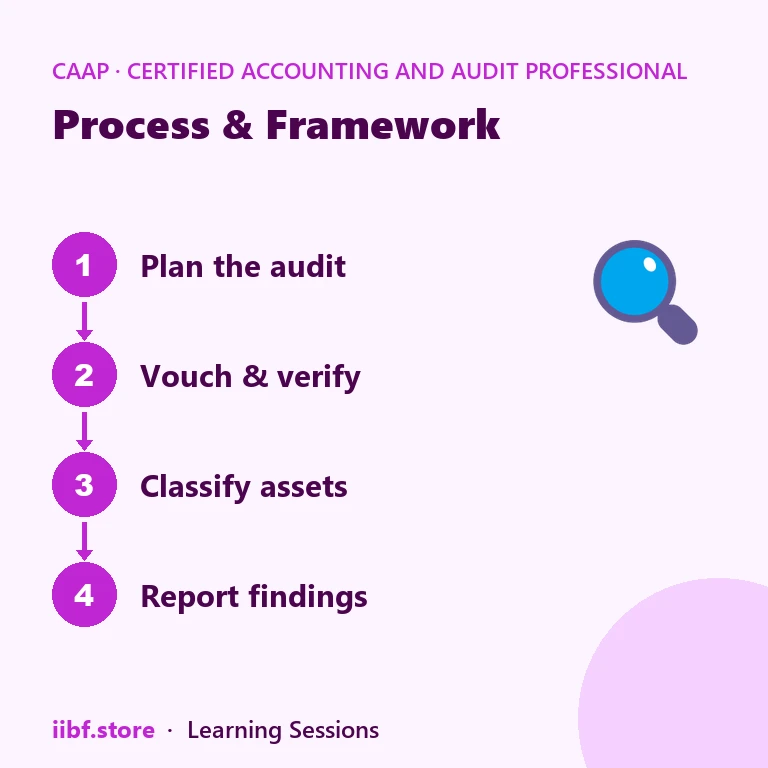
📝 Reporting, Follow-Up and Exam Strategy
An IS audit report should rate each finding by risk, name the control that failed, quantify exposure where possible, record management's response with an owner and a target date, and track closure. Repeat findings across cycles are themselves a governance failure and should be escalated. Unlike statutory audit, an IS audit report carries no opinion on the financial statements — but a severe unremediated finding (say, shared administrator credentials on the CBS) will directly affect the statutory auditor's risk assessment and may drive a qualification elsewhere.
For the exam, drill four things: the RBI governance structures and who reports to whom; the ITGC-versus-application-control distinction; the three "around / through / with the computer" approaches; and BCP metrics (RPO and RTO, and which one is about data loss — it is RPO). Browse more material on the Certified Accounting and Audit Professional tag hub, and pair theory with timed practice.
🧠 Practice MCQs: Information Systems Audit in Banks
Q1. Under RBI's IT governance expectations, the head of the information systems audit function should report to: (a) the Chief Information Officer (b) the internal audit function / Audit Committee (c) the branch manager (d) the statutory auditor
Answer: (b) — Independence requires IS audit to sit outside IT and report through internal audit to the Audit Committee.
Q2. Which of these is an application control rather than a general IT control? (a) Data centre access badges (b) Quarterly user access review (c) A validation rule rejecting a loan EMI below the computed minimum (d) Backup scheduling
Answer: (c) — Validation and calculation logic inside an application is an application control; the others are ITGCs.
Q3. "Auditing through the computer" is best illustrated by: (a) Comparing input vouchers with printed output (b) Using test data and an integrated test facility to check processing logic (c) Reading the vendor's brochure (d) Interviewing the IT head
Answer: (b) — It tests the processing logic itself, not just inputs and outputs.
Q4. Recovery Point Objective (RPO) in a bank's business continuity plan measures: (a) Time taken to restore service (b) Maximum acceptable data loss measured in time (c) Cost of the DR site (d) Number of DR drills per year
Answer: (b) — RPO is about tolerable data loss; RTO is about restoration time.
Q5. An IS auditor finds that application administrators can disable audit logging. The most appropriate conclusion is: (a) Acceptable, since administrators are trusted (b) A minor observation (c) A significant control weakness undermining the reliability of system evidence (d) Outside IS audit scope
Answer: (c) — Logs that can be switched off by the audited party cease to be reliable audit evidence.
Want chapter-wise mock tests with 100+ MCQs? Start practising free →
❓ Frequently Asked Questions
Is an information systems audit mandatory for Indian banks?
Yes. RBI's Master Direction on IT Governance, Risk, Controls and Assurance Practices requires regulated entities to maintain an independent IS audit function with a risk-based audit plan approved and monitored by the Audit Committee of the Board.
What qualifications does an IS auditor in a bank usually hold?
Typically CISA or DISA in addition to a professional accounting or IT background. Banks may also engage external specialists for areas such as penetration testing, cloud configuration review or application source-code review.
How does IS audit help the statutory auditor?
Statutory auditors rely heavily on system-generated data such as NPA classification reports and interest computations. Strong IS audit assurance over ITGCs and application controls lets them place reliance on that data; weak assurance forces expanded substantive testing.
What is the difference between ITGC and application controls?
ITGCs are pervasive controls over the environment — access, change management, operations and security. Application controls are embedded within a specific application and govern the completeness, accuracy and authorisation of individual transactions.
🎯 Conclusion
In a fully automated banking environment, the audit question has shifted from "was this voucher signed?" to "can this system be trusted to produce a signed voucher every time?" Mastering IS audit means understanding governance structure, the ITGC/application-control split, CAAT techniques, audit trails and continuity metrics — and being able to say precisely how each of those affects the financial statements. Build that map in your head, then test it under time pressure. Explore the full syllabus on the CAIIB and certification course hub or jump straight into chapter-wise mock tests and start scoring.
Prefer revising from a printed book?
Chapter-wise books with MCQs after every chapter — minimal pages, complete coverage, delivered anywhere in India. Every book has a free sample to read first.
334 pages · 936 MCQs
Learning Sessions · Ashish Sir
132 pages · 225 MCQs
Learning Sessions · Ashish Sir
188 pages · 435 MCQs
Learning Sessions · Ashish Sir
117 pages · 236 MCQs
Learning Sessions · Ashish Sir
Learning Sessions · Ashish Sir
118 pages · 299 MCQs
Learning Sessions · Ashish Sir
Learning Sessions · Ashish Sir
Learning Sessions · Ashish Sir
Learning Sessions · Ashish Sir
115 pages · 255 MCQs
Learning Sessions · Ashish Sir
Learning Sessions · Ashish Sir
Learning Sessions · Ashish Sir
115 pages · 344 MCQs
Learning Sessions · Ashish Sir
107 pages · 240 MCQs
Learning Sessions · Ashish Sir
90 pages · 150 MCQs
Learning Sessions · Ashish Sir
Learning Sessions · Ashish Sir
131 pages · 672 MCQs
Learning Sessions · Ashish Sir
221 pages · 831 MCQs
Learning Sessions · Ashish Sir
128 pages · 524 MCQs
Learning Sessions · Ashish Sir
107 pages · 445 MCQs
Learning Sessions · Ashish Sir
148 pages · 478 MCQs
Learning Sessions · Ashish Sir
151 pages · 465 MCQs
Learning Sessions · Ashish Sir
148 pages · 375 MCQs
Learning Sessions · Ashish Sir
216 pages · 895 MCQs
Learning Sessions · Ashish Sir
109 pages · 300 MCQs
Learning Sessions · Ashish Sir
104 pages · 360 MCQs
Learning Sessions · Ashish Sir
82 pages · 297 MCQs
Learning Sessions · Ashish Sir
151 pages · 600 MCQs
Learning Sessions · Ashish Sir
98 pages · 282 MCQs
Learning Sessions · Ashish Sir
Practice this topic
Take a free mock test, download chapter PDFs, or watch a video class — all included on iibf.store.