IIBF ITF Guide: export documentation and EDPMS (2026)
Every consignment that leaves an Indian port carries two parallel journeys: the physical shipment and the paperwork trail that proves it. For IIBF candidates, export documentation and EDPMS sit at the heart of that second journey — the declaration forms an exporter files, the shipping bill data Customs transmits, and the RBI-run database that keeps score until the money actually lands in India. This guide walks through the full lifecycle, from the Export Declaration Form to caution-listing, so you can answer both the theory questions and the tricky application-based ones in the International Trade Finance paper.
The reason this chapter carries weight is simple. India's exchange control framework does not merely encourage repatriation of export proceeds — it mandates it under the Foreign Exchange Management Act. Documentation is the enforcement mechanism, and the Export Data Processing and Monitoring System is the audit trail. An AD Category-I bank that mishandles either one is exposed to regulatory action, which is exactly why examiners keep returning to this area.
📄 The Core Export Documents You Must Know
Export documentation splits into three broad families, and mixing them up is the most common source of lost marks.
Regulatory declarations are filed with or through Customs to satisfy FEMA. The Export Declaration Form (EDF) replaced the older GR and PP forms and is used for shipments through non-EDI ports and for exports by post. At EDI ports the declaration is embedded in the electronic shipping bill itself, so no separate physical form travels with the goods. Software exports are declared on the SOFTEX form, routed through STPI or the relevant designated authority before reaching the AD bank.
Commercial documents are what the buyer and the bank actually examine: the commercial invoice, packing list, certificate of origin, inspection or quality certificate, and the insurance policy where the contract terms place cover on the seller. These are the documents that get scrutinised for discrepancies when a letter of credit is involved.
Transport documents — the bill of lading, airway bill, or multimodal transport document — evidence dispatch and, in the case of a negotiable bill of lading, control over the goods themselves. The distinction matters because only a document of title can be used to withhold delivery until payment.
A fourth item sits slightly outside these families: the electronic Bank Realisation Certificate (eBRC), generated by the AD bank on the DGFT platform once proceeds are received. Exporters need it to claim export incentives, which makes timely bank action a commercial issue and not just a compliance one. For the underlying framework, revise the regulatory framework chapter alongside this section.
💡 Exam Tip: Remember the pairing — EDF for goods through non-EDI ports and post, shipping bill declaration at EDI ports, SOFTEX for software and IT-enabled services. Questions often swap SOFTEX and EDF to test whether you actually read the chapter.
🖥️ How EDPMS Actually Works End to End
EDPMS was introduced by the Reserve Bank to replace a fragmented, manual follow-up process in which each AD bank tracked its own outstanding shipping bills with no central visibility. Under the system, Customs transmits shipping bill and EDF data directly to RBI, which pushes each entry to the AD bank named in the document. That entry sits open in the bank's EDPMS dashboard until it is closed.
Closure happens when the AD bank matches the shipment against an Inward Remittance Message (IRM) — the record of foreign currency actually received — and marks the transaction realised. Where a single remittance covers several shipping bills, or one shipment is paid in tranches, the bank performs a partial or many-to-one match. The design is deliberately mechanical: no export entry disappears simply because the exporter says it was paid.
Three consequences follow, and each is examinable. First, an exporter can no longer route the shipment through one bank and the proceeds through another without reconciliation, because the entry stays open at the bank named in the shipping bill until formally transferred. Second, delays become visible to the regulator in aggregate rather than case by case. Third, the burden of chasing overdue bills sits squarely with the AD bank, which must follow up with the exporter and escalate where realisation does not occur.
The import side mirrors this. The Import Data Processing and Monitoring System (IDPMS) tracks Bills of Entry against Outward Remittance Messages, closing the loop on whether goods paid for were actually brought into India. Together, EDPMS and IDPMS give RBI a two-sided view of trade flows and are a primary input into trade-based money laundering surveillance. The trade transactions chapter connects these systems to the underlying settlement mechanics.
⏱️ Realisation Timelines, Extensions and Write-Offs
The compliance clock starts on the date of export. Under FEMA rules, export proceeds must generally be realised and repatriated within nine months from the date of export, and the exporter must sell the foreign exchange to an authorised dealer or hold it in an EEFC account within the permitted window. Longer periods apply to specific categories such as goods exported to a warehouse abroad, where the arrangement inherently defers payment.
When proceeds do not arrive on time, the framework offers graded relief rather than an immediate breach. AD banks may extend the realisation period in genuine cases where the exporter has made reasonable efforts, has a valid commercial reason, and the delay is not attributable to a wilful default. Beyond the bank's delegated powers, the exporter must approach the Reserve Bank.
Where recovery is genuinely impossible — the buyer is insolvent, the goods were auctioned by foreign customs, or legal recovery costs exceed the amount involved — the outstanding bill can be written off. The framework distributes this power across three levels: the exporter's own self write-off, a higher limit for status holder exporters, and an AD bank limit, each expressed as a percentage of the total export proceeds realised in the previous calendar year. Anything beyond those limits requires RBI approval, and write-off is not available where the matter is under investigation by an enforcement agency.
A related concession is reduction in invoice value, used when the buyer negotiates a discount after shipment because of quality disputes or market movement. AD banks may permit a reduction within a prescribed percentage of the invoice value, provided the exporter is not on the caution list and the balance is realised within the normal period. Read the risk management chapter for how these outcomes tie back to credit and country risk assessment.
⚠️ Common Mistake: Candidates treat write-off and reduction in invoice value as the same relief. They are not. Write-off closes an unrealisable bill; reduction in invoice value adjusts the amount expected before realisation, and the reduced balance must still be repatriated.
🚫 Caution Listing and the AD Bank's Duties
Caution listing is the enforcement teeth behind EDPMS. Exporters with shipping bills remaining open in the system well past the permitted realisation period, or who do not respond meaningfully to bank follow-up, can be placed on the caution list. Since RBI decentralised the process, AD banks themselves initiate caution-listing based on EDPMS data rather than waiting for a central directive.
The consequence for a caution-listed exporter is commercially severe. Further shipments are permitted only against an irrevocable letter of credit or full advance payment, and the AD bank must satisfy itself on each transaction. De-caution listing follows once outstanding bills are realised or regularised and the bank is satisfied that the exporter is compliant.
For the bank, the operating obligations are continuous rather than periodic. They include reconciling EDPMS entries regularly, issuing follow-up letters on overdue bills, reporting outstanding positions accurately, generating eBRCs promptly on realisation, and ensuring that any transfer of documents to another AD bank is reflected in the system so no entry is orphaned.
| Aspect | EDPMS (Exports) | IDPMS (Imports) |
|---|---|---|
| Primary source document | Shipping Bill / EDF / SOFTEX | Bill of Entry |
| Matched against | Inward Remittance Message (IRM) | Outward Remittance Message (ORM) |
| Entry closed by AD bank on | Realisation of proceeds | Evidence of import |
| Adverse listing for default | ✅ Caution list | ❌ No equivalent caution list |
| Certificate generated | ✅ eBRC via DGFT | ❌ Not applicable |
📌 Remember: EDPMS closes on money coming in; IDPMS closes on goods coming in. If you can hold that one line, half the comparison questions answer themselves.
🎯 How This Chapter Is Examined
Questions in this area cluster into four recognisable shapes. The first is straight recall — which form applies to which channel of export, what each system stands for, which message type closes an entry. These are free marks if you have memorised the pairings in the table above.
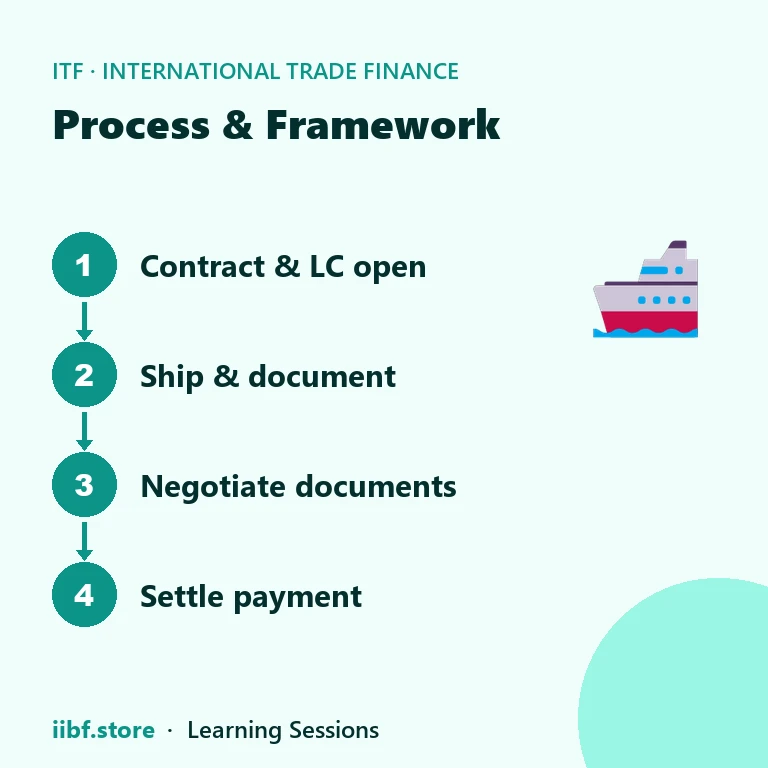
The second shape is procedural sequencing: given a shipment, arrange the steps from filing the shipping bill through Customs transmission, EDPMS entry creation, receipt of proceeds, IRM matching, closure, and eBRC generation. Practise saying that chain out loud; examiners like to insert one step out of order.
The third shape tests the exception framework — extensions, write-offs, reduction in invoice value, and who may approve what. Focus on the hierarchy (exporter, status holder, AD bank, RBI) rather than memorising every percentage in isolation, because the structure is stable even as limits are revised.
The fourth shape is scenario-based: an exporter has bills outstanding beyond the permitted period and wants to ship again. The expected answer weaves together caution listing, the LC-or-advance-payment restriction, and the bank's follow-up duty. To build fluency, pair this article with our guides on the documentary collection process and on packing credit, since pre-shipment finance and collection mechanics feed directly into realisation outcomes. Our note on ECGC cover for exporters covers what happens when non-payment is a credit event rather than a compliance lapse, and candidates preparing across papers will find the piece on Forex Facilities for Individuals useful for the wider FEMA context. You can browse the full International Trade Finance topic hub for the rest of the syllabus, and the authoritative source remains the Reserve Bank of India master directions on export of goods and services.
🧠 Practice MCQs: Export Documentation and EDPMS
Q1. Which form is used to declare software exports? (a) EDF (b) SOFTEX (c) Bill of Entry (d) Shipping Bill
Answer: (b) — SOFTEX is the prescribed declaration for software and IT-enabled service exports, routed through the designated authority before reaching the AD bank.
Q2. In EDPMS, an export entry is closed when it is matched against which message? (a) ORM (b) SWIFT MT700 (c) IRM (d) MT103 only
Answer: (c) — The Inward Remittance Message evidences receipt of foreign currency and is matched to the shipping bill to close the entry.
Q3. Which system tracks Bills of Entry against outward remittances? (a) EDPMS (b) IDPMS (c) EDF portal (d) DGFT eBRC
Answer: (b) — IDPMS is the import-side mirror of EDPMS, confirming that goods paid for were actually imported.
Q4. A caution-listed exporter may ship goods only against which arrangement? (a) Open account (b) Documents against acceptance (c) Irrevocable LC or full advance payment (d) Consignment sale
Answer: (c) — Caution listing restricts further exports to an irrevocable letter of credit or receipt of full advance payment.
Q5. The eBRC required for claiming export incentives is generated by whom? (a) Customs (b) The AD bank on the DGFT platform (c) The exporter directly (d) RBI
Answer: (b) — The AD Category-I bank generates the electronic Bank Realisation Certificate on the DGFT platform once proceeds are realised.
Want chapter-wise mock tests with 100+ MCQs? Start practising free →
❓ Frequently Asked Questions
Is the EDF still required at EDI ports?
No. At EDI ports the declaration is built into the electronic shipping bill itself, so a separate physical EDF is not filed. The EDF applies to non-EDI ports and to exports by post.
What is the general period for realising export proceeds?
Export proceeds must generally be realised and repatriated within nine months from the date of export, with longer periods for specified categories such as goods exported to a warehouse abroad.
Who can approve a write-off of unrealised export bills?
The framework allows a self write-off by the exporter, a higher limit for status holder exporters, and a limit for the AD bank, each as a percentage of the previous year's realised proceeds. Anything beyond requires RBI approval.
Can an exporter be removed from the caution list?
Yes. Once the outstanding bills are realised or otherwise regularised and the AD bank is satisfied about compliance, the exporter can be de-caution listed in EDPMS.
✅ Conclusion
Treat this chapter as one continuous chain rather than a list of forms: declaration is filed, Customs transmits, EDPMS opens the entry, proceeds arrive, the bank matches and closes, and the eBRC follows. Every relief mechanism — extension, write-off, reduction in invoice value — is just a controlled exception to that chain, and caution listing is what happens when the chain breaks repeatedly. Learn the sequence first and the details attach themselves naturally. Ready to test it under exam conditions? Take a free ITF mock test on iibf.store and find your weak links before the paper does.
Prefer revising from a printed book?
Chapter-wise books with MCQs after every chapter — minimal pages, complete coverage, delivered anywhere in India. Every book has a free sample to read first.
Learning Sessions · Ashish Sir
132 pages · 225 MCQs
Learning Sessions · Ashish Sir
188 pages · 435 MCQs
Learning Sessions · Ashish Sir
117 pages · 236 MCQs
Learning Sessions · Ashish Sir
Learning Sessions · Ashish Sir
118 pages · 299 MCQs
Learning Sessions · Ashish Sir
Learning Sessions · Ashish Sir
Learning Sessions · Ashish Sir
Learning Sessions · Ashish Sir
115 pages · 255 MCQs
Learning Sessions · Ashish Sir
334 pages · 936 MCQs
Learning Sessions · Ashish Sir
Learning Sessions · Ashish Sir
115 pages · 344 MCQs
Learning Sessions · Ashish Sir
107 pages · 240 MCQs
Learning Sessions · Ashish Sir
90 pages · 150 MCQs
Learning Sessions · Ashish Sir
Learning Sessions · Ashish Sir
131 pages · 672 MCQs
Learning Sessions · Ashish Sir
221 pages · 831 MCQs
Learning Sessions · Ashish Sir
128 pages · 524 MCQs
Learning Sessions · Ashish Sir
107 pages · 445 MCQs
Learning Sessions · Ashish Sir
148 pages · 478 MCQs
Learning Sessions · Ashish Sir
151 pages · 465 MCQs
Learning Sessions · Ashish Sir
148 pages · 375 MCQs
Learning Sessions · Ashish Sir
216 pages · 895 MCQs
Learning Sessions · Ashish Sir
109 pages · 300 MCQs
Learning Sessions · Ashish Sir
104 pages · 360 MCQs
Learning Sessions · Ashish Sir
82 pages · 297 MCQs
Learning Sessions · Ashish Sir
151 pages · 600 MCQs
Learning Sessions · Ashish Sir
98 pages · 282 MCQs
Learning Sessions · Ashish Sir
Practice this topic
Take a free mock test, download chapter PDFs, or watch a video class — all included on iibf.store.